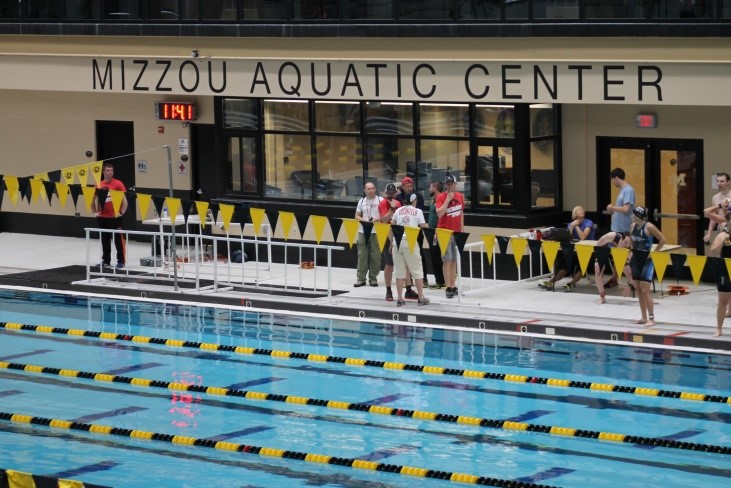
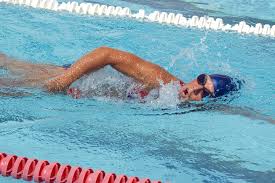
Want to prevent fellow triathletes from becoming annoyed with you during a race? Avoid these mistakes commonly made during a pool swim.
From my experience with sprint triathlon, here are the top five mistakes, in no particular order, that occur doing a pool swim:
Reporting too aggressive or conservative pace/time
This mistake most often occurs during registration when you are asked to provide an estimate of the time that it will take to complete the swim. You definitely do not want to be swimming with triathletes who are significantly faster or slower than you.
If you are worried about the registration filling before you can time your swim, give your best estimate. Then, after later measuring the time, contact the race organizer to make any correction.
In many cases, you will also have opportunity on race day to make any correction. You will likely be asked to line up with those of similar pace (if the start is one at a time) or to join a group with those of similar speed (if swimmers start in a group, typically of five or six) .
Just don’t make the mistake on race day.
Starting too fast
With adrenaline rushing and the crowd roaring (even a small crowd can be deafening in an indoor pool), it is tempting to start swimming too fast too soon causing your heart rate to spike or breathing to become difficult. The next thing you know, you are swimming much slower than planned or even stopping to catch your breath. Better to start out at what you consider to be a bit slower that you think you should until you are in a rhythm. Once your breathing is at a normal race pace and you are ‘warmed up, give it your all.
Not drafting, if it is possible
Drafting is considered by many to be one of the keys to conserving energy during the swim while at the same time turning in a respectable (for you) time. The problem with drafting is that it can be difficult to practice unless you swim with a group.
To take advantage of drafting, swim with your hands just behind the feet of the person in front of you. (Avoid touching their feet which sends the message that you want to pass them.)
Not staying in your space
This is especially important when swimming in the same lane as one or more athletes and remaining in the same lane during the entire swim. Stay on your side (usually the right side) of the lane. You do not want to be the cause of a head-on crash.
Even if the swim involves a single length of each of several lanes in a Z-pattern, stay to the right as a matter of courtesy to faster swimmers. You will appreciate this if you are the faster swimmer.
Staying within your space during a pool swim will allow faster racers to pass.
Not allowing faster swimmers to pass when they let you know that they want to
Another courtesy to fellow racers is to allow faster swimmers to pass. Let them pass as soon as possible once they have signaled that they want to do so. Typically, faster swimmers will tap one of the feet of the swimmer that they wish to pass. If you can, move to the right side of the lane to allow them to pass. In races in which the entire length of swim involves multiple laps within a given lane, it is typical for the racer who is being passed to pause at the end of a length. Allow the faster swimmer or swimmers to pass you, and then resume your swim.
What is your experience?
Have you identified other mistakes or have experience with those I have listed? Leave your comments below.
Youngsville, Louisiana; October 1, 2017—Sugarman Triathlon, Sugar Mill Pond.
I had not originally planned to compete in a triathlon in Louisiana during 2017. However, a race in a western state that was part of my original plan did not take place. Then there was Hurricane Harvey.
The October 1st date of the Sugarman Triathlon fit nicely into our plans to visit Florida for our wedding anniversary. Besides, its location in western Louisiana provided us the opportunity to meet a friend who had been through a horrific time with Hurricane Harvey and its aftermath.
While our friend lived in Katy (Houston), Texas, she had been commuting to Baton Rouge, Louisiana for work for over a year. Youngsville provided a perfect meeting point for a face-to-face visit to get caught up.
Joy and I left our Minnesota home at a little before 6 am on Friday morning. With a new audiobook playing on the radio, we headed toward Little Rock, Arkansas, where we would spend our first night. The overnight stop in Little Rock meant we were roughly two-thirds of the way to the race venue in Youngsville (Lafayette), Louisiana.
We finished the trip to Youngsville the next day, arriving in plenty of time for packet pickup. Following this, we made a quick tour of the race venue around Sugar Mill Pond. We finished the evening with our friend from Texas around some authentic Cajun cuisine at Poor Boy’s Riverside Inn.
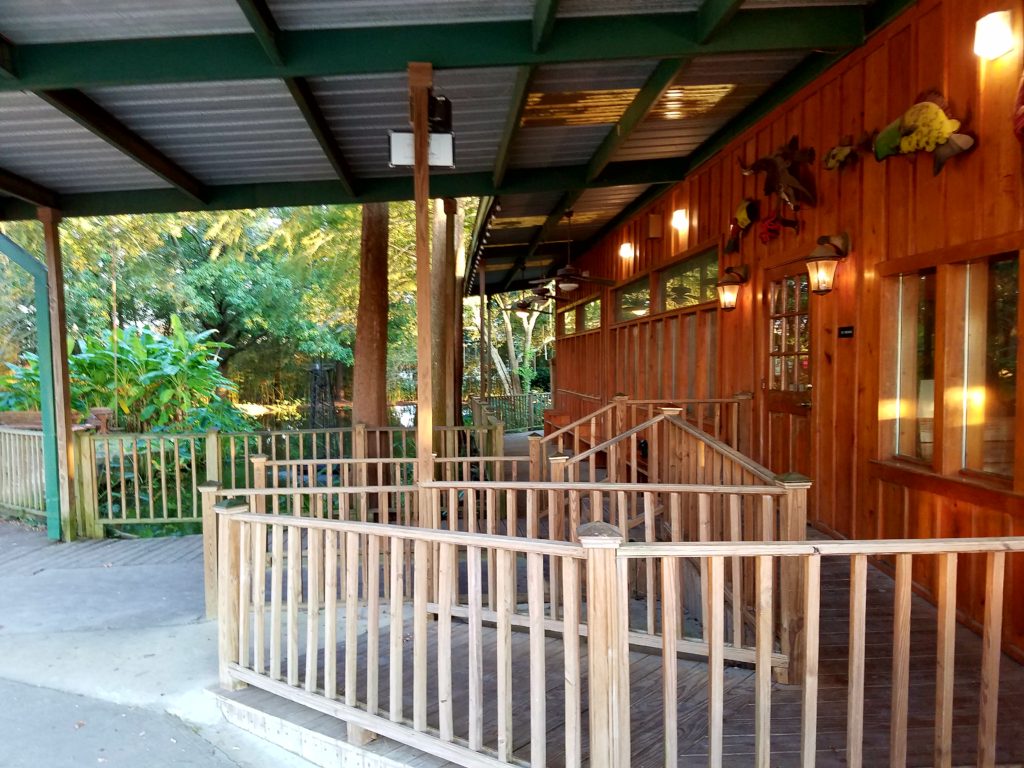
Poor Boy’s Riverside Inn. If you happen to visit, be on the lookout for the ‘pet’ raccoons looking for hand-outs near the entrance.
8th Annual Sugarman Triathlon
2017 was the 8th annual running of Sugarman Triathlon. Like many triathlons, Sugarman doubled as a fundraiser.
For this race, the proceeds benefited two causes important to the area – the Jacob Crouch Foundation for suicide prevention and TRAIL (Transportation Recreation Alternatives In Louisiana), an organization aimed at “building and maintaining opportunities for outdoor recreation”.
Distances for the individual legs of this USAT-sanctioned sprint triathlon were:
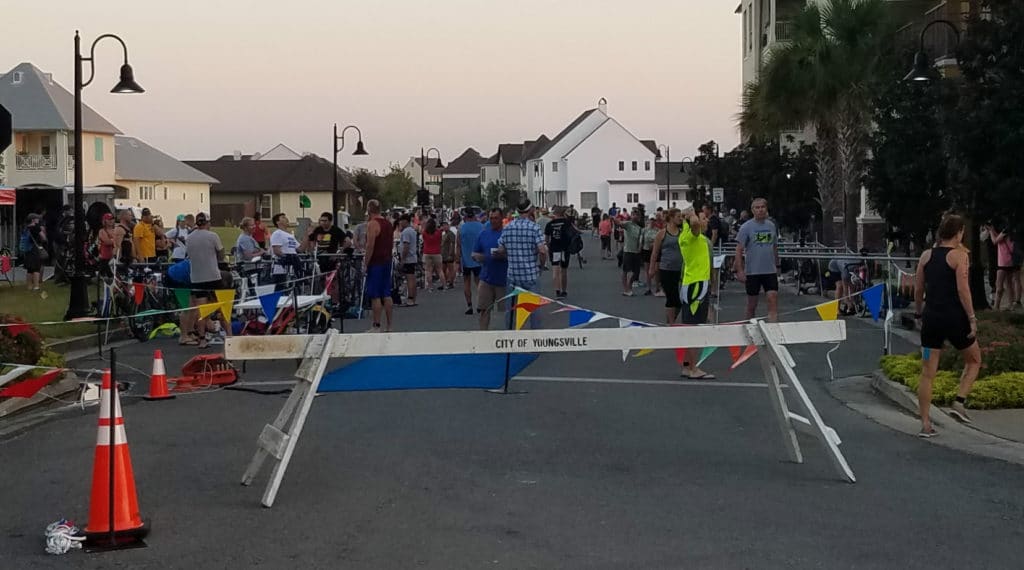
The transition area for the nearly 200 participants occupied the space on Waterview Street between Shore Drive and Prescott Boulevard, in front of the Sugar Mill Athletic Club.
Racers were assigned a rack based on our race number. As is customary, we racked our bikes alternately facing one of the two transition area exits. For example, if the bike occupying the end position faced toward the ‘Bike Out’ end, the next bike would be racked to face opposite this, or toward the ‘Run Out’ location.
Transition area for Sugarman Triathlon on race morning from the ‘Run Out’ end.
How Do You Setup Your Transition Space?
You may have heard the saying, “you cannot win a triathlon in transition, but you can lose it.” Any time spent in transition is just as important as time taken in the individual legs of the race.
Shaving a minute from your transition time is just as good as reducing your swim or bike or run time by a minute.
One key to faster transition times in a sprint distance triathlon is keeping the setup of the transition area simple. The video below shows how I setup my transition area for this and most other sprint distance races. Simpler is faster.
Video describing setup of my transition area at Sugarman Triathlon.
Before the Start
Race organizers set a pleasant tone for the event, especially during the final moments before the first racers hit the course. Participants, volunteers, and spectators all came together at dockside alongside Sugar Mill Pond. Here, everyone joined in reciting the pledge of allegiance, singing of the National Anthem, and prayer.
Congratulations to the young lady to lead us in the National Anthem. What a beautiful voice!
Swim
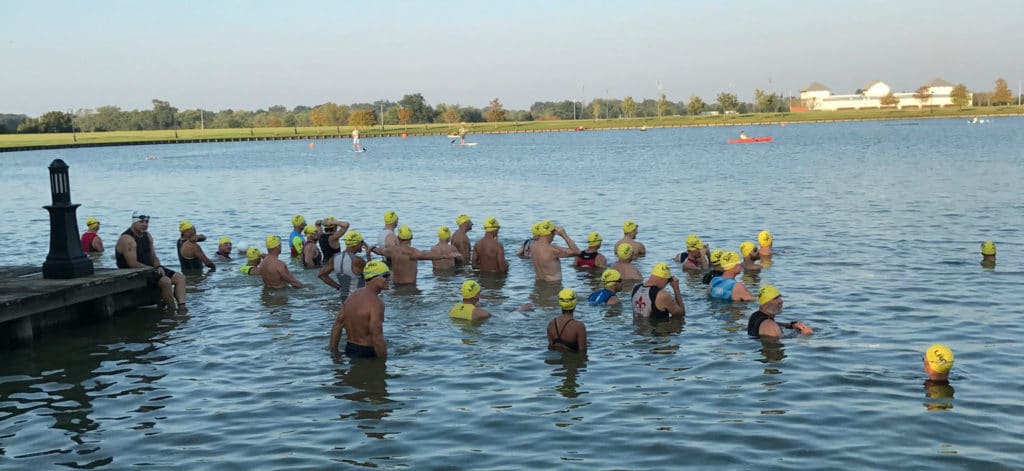
The swim was an in-water start with participants beginning in groups based on gender and age group. The first group (also referred to as the ‘first wave’) included all males aged 50 and over and all Relay participants.
50 and over male Age Groupers and Clydesdales and swim participants of Relay Teams awaiting the swim start at Sugarman Triathlon.
Swimmers followed a counterclockwise course around a series of buoys that led us to the exit a few hundred yards south of our starting location.
Bike
The 15-mile bike course was well marked and staffed with many volunteers and members of the local police department. There was no question about the course or the safety of the participants. The out-and-back course was nice and flat.
However, the less than ideal road conditions, with many asphalt repairs, kept us “on our toes”. These repairs meant lots of rough patches for those of us who obeyed the call to stay to right.
Fortunately, my fellow racers were forgiving. This was especially true for the guy who I pulled in front of to avoid an exceptionally rough area.
Thank you, sir. You are a gentleman.
Run
The temperature just before the start of the race was in the low 70s °F. However, it shot up quickly. By the time I finished the run, the temperature was somewhere in the upper 80s and very humid.
Such conditions are not unusual, or even considered hot, for those who live in the South. However, for me, a Minnesotan, the upper 80s with high humidity represents a condition in which I usually say “Maybe later” to running.
My run was slow, with stops at each of the many aid stations. Despite taking a glass of Powerade at each of these, I experienced a cramp in my hamstring with about a half mile to go.
Thankfully, an answer to my quick prayer came as relief from the cramp. I finished the final 1/2-mile of the run around the pond with a respectable sprint through the dockside finish line.
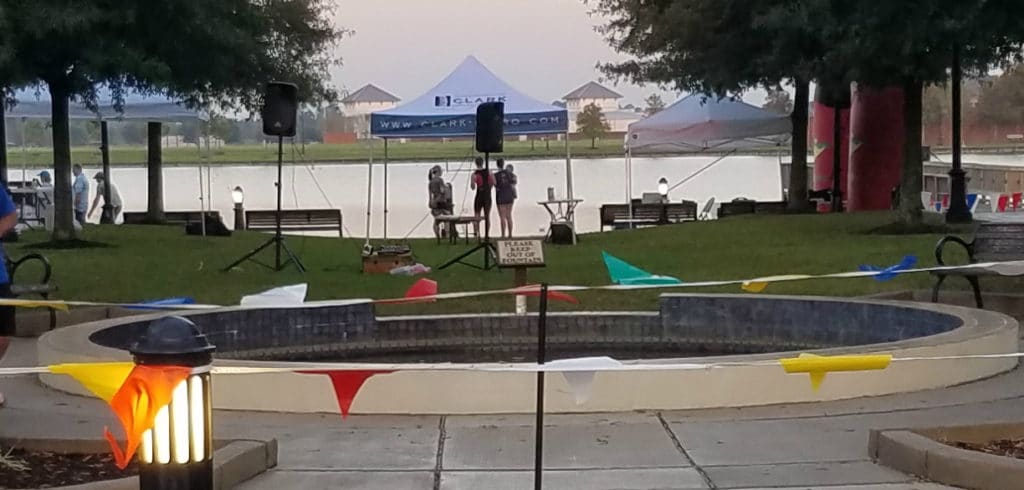
The finish area for the Sugarman Triathlon was in the park next to Sugar Mill Pond (in the background). The red inflatable at the upper right (seen beneath the tree branches) marks the finish line.
After the Race
With the race finished, Joy and I attended the 11am service at the Bayou Church. Not only did we enjoy the worship and fellowship with other believers, but helped to celebrate the pastor’s 33rd anniversary as pastor. This was another opportunity to experience Acadiana (French Louisiana).
From here, we continued our journey to The Villages, Florida, where we would spend the next two weeks.
Race Firsts
First race within a planned residential neighborhood.
First race involving swim in a man-made pond.
Roundabouts on the bike and run courses was another first.
A Journey Beyond This Race
“Uplifting, real, and full of heart—I couldn’t put it down.”
Where in Louisiana have you done a triathlon? What did you learn from this race?
Please share your comments below.
Comments: We’d love to hear about your experience. Join the conversation below. All comments are reviewed before they appear.
Reply notifications: Click the bell icon above Post Comment to be notified when someone replies to your comment.
Follow the discussion: Click Subscribe above the comment box and enter your email address to receive notifications whenever a new comment is added—even if you don’t leave a comment. After subscribing, check your email and click Confirm to activate notifications.
Rye, New Hampshire; September 23, 2012 – Wallis Sands Triathlon, Rye Beach at Wallis Sands State Beach.
I started this triathlon, the second in as many days, differently than previous ones. I had fresh scrapes on my right arm and right knee. My right shoulder was also injured. After this race, I would not swim for four months while my shoulder healed.
The injuries resulted from a bike crash a day earlier in the Newport 19.7 Triathlon in Newport, Rhode Island. On a positive note, I had a new front tire and tube, thanks to the previous ones being destroyed by a knife-like object I had apparently run over early in the bike leg of that race.
I was glad that my injuries weren’t so severe that they were going to stop me from competing,
Joy and I left Newport, Rhode Island, late Saturday morning of the day before the Wallis Sands Triathlon. We drove the 140 miles north to the Trek Bicycle Store in Portsmouth, New Hampshire, the triathlon’s main sponsor and location for packet pickup.
Since I was at the shop, I asked a technician to look at my Trek SpeedConcept bike for any damage from the crash. He showed me a large cut in the front tire. My only option was to have the tire replaced.
Following packet pickup, replacement of the front tire, and a lunch of fresh seafood, we drove the bike course checking out the road conditions. One thing that struck us was the number of cyclists, literally hundreds. To this day, I have never seen an area with so many cyclists sharing the road with cars and trucks.
Before heading to the hotel, we stopped at a local pharmacy to purchase a tube of liquid bandage. Joy applied it to the main cuts and scrapes once we had settled in our room.
3rd Annual Wallis Sands Triathlon
Just under 400 men and women competed in the third running of the Wallis Sands Triathlon sponsored by Trek Portsmouth.
Distances for the individual legs of this USAT-sanctioned sprint triathlon were:
Swim: 0.33 mile (530 m)
Bike: 14.5 mile (23.3 km)
Run: 3.1 mile (5 km)
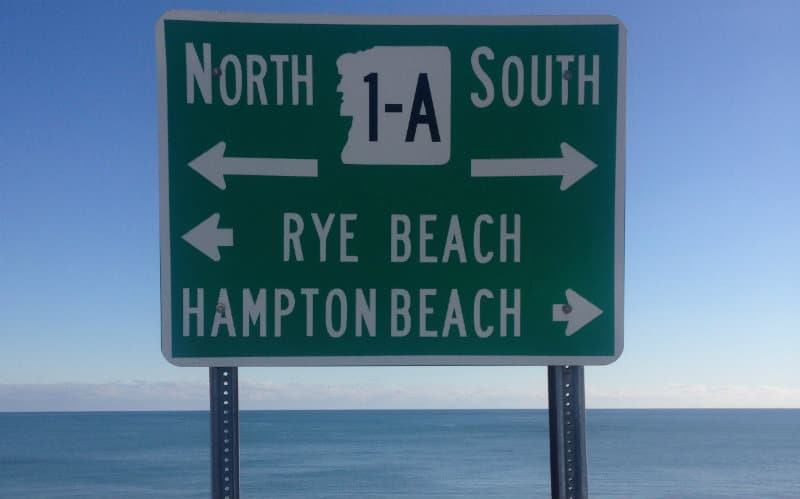
Rye Beach, site for the Wallis Sands Triathlon, is on US1-A
Swim
One of the distinguishing features of this race was the swim. The water was “freezing” cold, in the mid-60s °F, making the race definitely ‘wetsuit legal’. Despite this, there were still some hardy souls swimming in only triathlon shorts, without a shirt!
The waves of the surf on race morning were 7 to 8 feet (2.2 to 2.4 meter) high. Just so you don’t think I am a sissy, the race organizers announced that the waves on this day were the highest they had seen all summer.
During the warm-up swim, I learned that getting past the cresting waves was nearly impossible through a frontal attack. Thankfully, the race director gave those of us not experienced with swimming in such conditions some simple advice for getting past the waves and beyond the surf. “Swim under the waves”.
Following this advice made all the difference. Swimming under a wave before it crashed made it straightforward to get into open water where most of the swim occurred. Of course, coming back to shore was much easier, much like body surfing.
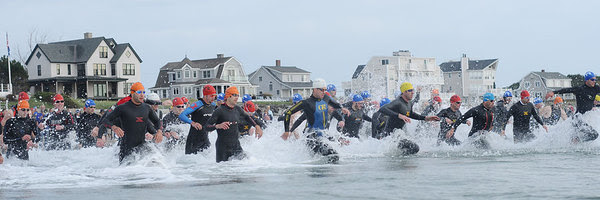
Swim start at Rye Beach. (Photo courtesy of TriME.)
Bike
The ‘flat and fast’ bike leg began and ended on US1-A, where we road between the Atlantic Ocean (on our right side) and houses as shown in the background of the above picture (on the left side).
Leaving Rye Beach, the course consisted of a two-mile ride north on US1-A before turning inland toward the town of Rye and its adjacent neighborhoods. At about mile 10, the course rejoined US1-A south of Rye Beach for the final four and a half miles back to the transition area.
Run
The out-and-back run course also left Rye Beach north on US1-A, with a turnaround at Odiorne Point State Park. From here, it was back to the finish line at Rye Beach.
I made one short stop during the first mile to remove a small rock from my shoe. However, after this, I was able to finish the run with a respectable (for me) time and average speed.
One lesson that I took from this race is that I should wear socks during the run when the air temperature is cold (as it was in this case). My bike shoes are porous to allow air to flow through them. Under normal circumstances when the air temperature is higher, this is good. However, today, my feet were cold after the bike leg. While I normally run without socks (see How to Achieve Faster Transition Times) in sprint triathlons, doing so with cold feet is uncomfortable.
Results
I am not sure what is ‘in the water’ in Rye, New Hampshire. This race will likely go down as one of the fastest in which I have taken part. Despite respectable times for me, times which led to top three finishes in my age group in several other races, I ended up 13th of 16 in my age group.
Race Firsts
First time completing sprint triathlons on consecutive days.
This race was the first with a swim in the surf of the Atlantic Ocean.
First race with bike and run portions on scenic US Highway 1-A.
A Journey Beyond This Race
“Uplifting, real, and full of heart—I couldn’t put it down.”
Have you raced in New Hampshire? Did an open water swim in the Atlantic Ocean? Tell us about your experience in the Comments below.
Comments: We’d love to hear about your experience. Join the conversation below. All comments are reviewed before they appear.
Reply notifications: Click the bell icon above Post Comment to be notified when someone replies to your comment.
Follow the discussion: Click Subscribe above the comment box and enter your email address to receive notifications whenever a new comment is added—even if you don’t leave a comment. After subscribing, check your email and click Confirm to activate notifications.
Middletown, Rhode Island; September 22, 2012 – Amica 19.7 Newport Triathlon, Second Beach and Third Beach.
The goal for 2012, the second year in the ‘Triathlon Across the USA‘ journey, was to complete triathlons in the remaining New England states. In January, registration opened for triathlons in two of these states, Rhode Island and New Hampshire, on back-to-back days in September. I registered for both in January.
Joy and I left our house in Chicopee, Massachusetts around 3 pm on Friday, taking a southern route through Hartford, Connecticut to Newport, Rhode Island. We arrived at the race venue for packet pickup on time, albeit with some difficulty. Since we had left our GPS in Minnesota, we navigated the ‘old fashioned’ way using printed maps. We were reminded that some skills, like navigating with maps, follow the ‘use it or lose it’ principle.
After picking up the race packet, we made our way to the hotel for the evening in Swansea, Massachusetts. In order to save money, I used points to book a free night at the nearest Holiday Inn. The drive to the hotel from Newport should have taken 25 minutes. Instead, it took us 45 minutes.
We finally made it to the hotel, frustrated by the difficulty in first getting to the race site and then to the hotel. However, the payoff was a wonderful dinner at Kent’s—Joy had steak and lobster and I had fish and chips. Both were excellent.
The next morning, we rose early and made our way to the race venue. This time, we used a more efficient route and arrived with time to spare.
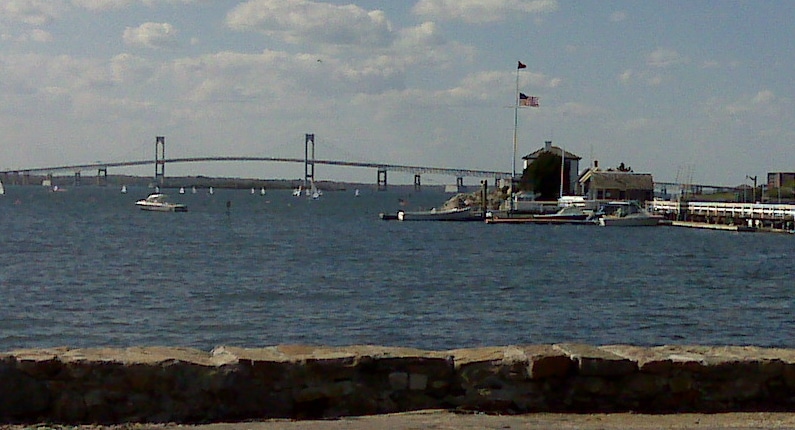
Salve Regina University’s campus in Newport, Rhode Island is one of the most unique in the United States. Typical of Newport and its rich architectural history, the University has been described by the National Trust for Historic Preservation as a “tour of the great architectural works of the Gilded Age.”
3rd Amica 19.7 Newport
2012 was the 3rd running of the Amica-sponsored Newport 19.7 sprint triathlon. Distances for the individual legs of this USAT-sanctioned sprint triathlon were:
Swim: 0.5 mile (800 m)
Bike: 16.1 mile (25.8 km)
Run: 3.1 mile (5 km)
Like the recently completed No Label Triathlon in Katy (Houston), Texas, the Newport 19.7 had two distinct transition areas. The first transition area, that for the swim to bike, was in a park at Third Beach. A second area, near Second Beach, contained the bike to run transition area and finish line.
Following the pre-race meeting, we walked our bikes the half mile from the second transition area to the swim to bike transition area.
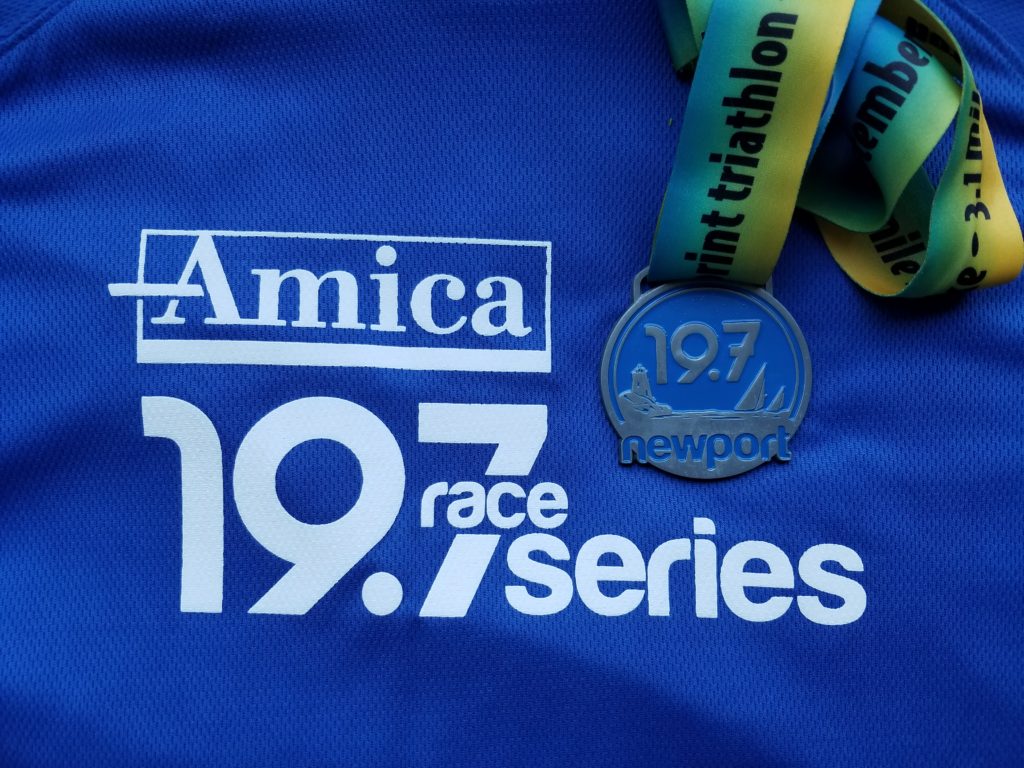
T-shirt and finisher medal for 2012 Amica Newport, Rhode Island triathlon. The number 19.7 is the sum of the distances, in miles, of the swim, bike, and run legs of the triathlon.
Swim
As I waited for the start of the swim, I noticed a light mist in the air, enough to cover my goggles.
The half-mile swim took place in the bay off Third Beach. The water was calm and comfortable, thanks to the wetsuit. However, beneath the water were sharp rocks that cut my feet in at least two locations while entering the water.
As it turned out, I soon forgot about these small cuts.
Bike
The mist continued as we started the bike leg. Within a short time, my glasses were covered with water making them useless. Since I could no longer see through the lenses, I pushed the glasses down on my nose, peering over the top.
At somewhere around five miles into the bike course, I started to notice a periodic hissing sound from the front tire. I later learned that this sound was made by air leaking from the tube with each revolution of the wheel.
I did not see that the front tire was gradually becoming flat. However, it finally became apparent that the tire was completely flat and I was riding on the rim of the front wheel. There was no choice but to stop and replace the tube.
I decided to make the upcoming turn and pull off the road to replace the tire. I soon learned how little control one has with a flat front tire.
My First Crash During a Triathlon
Upon making the turn, I fell hard on my right side, in front of a crowd of spectators, no less. I landed partly on asphalt and partly on a grassy shoulder of the road. In the fall, my knee was cut, my right arm was scraped from its wrist to the elbow (there is a scar to this day), and other parts of my right side were scratched, After the race, my shoulder would be sore, having been jammed into the grassy area next to the road.
As I began removing the front tire to replace the tube, a member of the volunteer bike maintenance crew came around the corner in his truck. He stopped and asked if I needed help.
Casting any remaining pride and ego aside, I told him I would very much appreciate his help. He became my Good Samaritan, quickly replacing the tube. He also replaced the chain that had come off in the fall so I could continue the race. My best estimate is that the repairs took about four and a half minutes.
I have often thought about the perfect timing of my Good Samaritan’s arrival. A coincidence? I don’t believe in them. The Lord’s timing is always perfect.
I got back on the bike and rode as if I could make up for the lost time. Surprising myself, I rode as if nothing had happened, racing down several steep hills to finish the course.
I saw Joy as I came into the transition area, giving her a summary of the crash as I ran my bike to the rack.
Run
Unlike the bike course, the run was flat. After the excitement during the bike leg, this out-and-back run was uneventful.
However, I apparently looked pretty battered. As we met, one runner commented about my injuries and his similar experience a week earlier.
After Crossing the Finish Line
Joy was waiting for me at the finish line. We made our way to the first aid vehicle, where paramedics cleaned my cuts and scrapes and covered those on my arm and knee with gauze.
We then walked over to check the results. Despite having lost 4-5 minutes with the flat tire and crash, I finished 9th of 16 in my age group.
While putting the bike into the van, I noticed a hole in the tire roughly a half inch in diameter, large enough that the new tube was protruding through it. Fortunately, the new tube had not worn through and lost its air.
On the way to the hotel in New Hampshire for the triathlon the next day, we stopped at a bike shop to have the damaged tire replaced.
As near as I could determine from inspecting the tire, the puncture had come from a large piece of glass or an unusually sharp rock.
Lessons Learned During the Rhode Island Triathlon
Through the Rhode Island triathlon, I learned two important lessons which I have applied in other races.
The most important lesson was to stop riding at the earliest sign of a leaking or damaged tire. Following this experience, I am extra cautious whenever the road is wet and I hear water spraying from the tire. On at least one occasion, I stopped and dismounted the bike to inspect the tire and verify that it is still solid.
A second lesson from the Rhode Island triathlon was that whenever race organizers provide a transition area bag, use it. It helps to avoid losing gear in the chaos of a race.
At packet pickup, race organizers provided a plastic bag with our race number on it. During the race, volunteers used the bags to transport racer’s wetsuits and goggles from the individual swim/bike transition spaces to the second transition area.
I made the mistake of not bringing the plastic bag to the swim/bike transition area. As a result, I spent several moments after the race frantically digging through a pile of unbagged swim gear, searching for my wetsuit and goggles.
Fortunately, I found both. I would definitely need them the next day during the Atlantic Ocean swim at the New Hampshire triathlon.
Race Firsts
First race with the swim portion in the Atlantic Ocean.
This was the first race in which I had a flat tire.
First race in which I was injured in a bike crash.
What Could Your Journey Be?
“It made me think, ‘Wow, wouldn’t it be fun to try to do this too?’”
Have you been in a bike crash during a triathlon? Let us know about it and what you learned.
Comments: We’d love to hear about your experience. Join the conversation below. All comments are reviewed before they appear.
Reply notifications: Click the bell icon above Post Comment to be notified when someone replies to your comment.
Follow the discussion: Click Subscribe above the comment box and enter your email address to receive notifications whenever a new comment is added—even if you don’t leave a comment. After subscribing, check your email and click Confirm to activate notifications.








Comments: We’d love to hear about your experience. Join the conversation below. All comments are reviewed before they appear.
Reply notifications: Click the bell icon above Post Comment to be notified when someone replies to your comment.
Follow the discussion: Click Subscribe above the comment box and enter your email address to receive notifications whenever a new comment is added—even if you don’t leave a comment. After subscribing, check your email and click Confirm to activate notifications.