Quickest Way To Your Faster Triathlon Swim

This post had its genesis while reading Why I Quit Masters Swimming. In this article in Triathlete magazine, the author, Marshall Ellis, colorfully described his frustration with swimming drills. He felt like he never just swam because of the time spent on drills.

Still, many books and blog posts on training for the triathlon swim encourage various types of drills. These are one reason I have a backpack dedicated to swim training aids: fins, paddles, kickboard, and more.

What Is Your Goal?

Most of us training for triathlon or aquabike are not aiming to be elite swimmers. Our goal is to swim the race course for the distance in which we have chosen to compete. We want to finish with a competitive time, especially within the cut-off time, if the race has one, so we can continue with the bike leg. And, we also want to have enough energy after the swim to continue to finish the race.

Considerations For Training For A Faster Triathlon Swim

Within this context, our swim training needs to consider the following:

  • Triathletes need to become comfortable swimming in open water. This means consistent swimming, some in open water mimicking race conditions, or those you may encounter. In other words, don’t just swim in calm water, but practice in choppy water as well. And, if your race is at a higher elevation than you are accustomed to, try to swim some in these conditions before race day. Through a practice swim, you will learn how your body reacts to the altitude.

Related Post: Planning For A Triathlon At Higher Altitude

  • Completing a triathlon swim, no matter the distance, requires aerobic fitness. Building a strong aerobic base is as important for swimming as it is for running and cycling. The good news is that aerobic capacity built through biking and running will benefit the same cardiovascular system called upon in swimming.
  • Swimming relies on additional muscles, many not as important for biking and running. Specific training to strengthen our core, shoulders, back, and arms leads to faster swimming.
  • Of particular importance to older triathletes is swimming efficiency. As we age, our fight to maintain strength becomes more difficult. For many, it’s a losing battle. However, we can overcome reduced strength by developing greater efficiency, following the “work smarter, not harder” aphorism.

In summary, training for a faster triathlon swim requires a mix of strength training, swim technique development, and yards (or meters) of swimming.

But, where should we focus?

To answer this question, I prepared a pros and cons assessment for drills-focused and distance-focused swim training. To me, there should be no debate about the merits of strength training as part of a comprehensive triathlon training program.

Drills-Focused Training Pros and Cons

Pros

  • Drills can be an effective tool for improving swimming efficiency by isolating movements within the swim stroke. This allows one to focus on improving stroke mechanics, body position, and the “catch.”
  • Through drills, we can learn what the components of an efficient stroke feel like. We begin to feel when we are and are not using an efficient stroke.
  • Avoiding improper movements helps prevent injury, especially when these movements are repeated hundreds or thousands of times.
  • Reduces the monotony of swimming back and forth tens of times.

Cons

  • Drills can neglect the need to put all the pieces together for an efficient stroke.
  • Poorly explained drills can be confusing, demoralizing, and a waste of precious training time.
  • Many drills do little to build aerobic fitness.

My perception, based on my experience trying to apply drills only read about, is that drills require a dedicated coach. A coach will make sure each drill is performed correctly and developing the intended skills.

Distance-Focused Pros and Cons

Pros

  • Builds swim fitness, both in terms of aerobic fitness and strength of the specific muscles for swimming.
  • Prepares for the distance required on race day and, if done right, various conditions to become a more confident swimmer. Don’t underestimate the value of confidence to face both the knowns and unknowns of race day. You are not swimming fast if you pause to catch your breath after being slapped in the face by a big wave.

Cons

  • Repeating poor stroke mechanics, body position, and the like, during thousands of strokes reinforces these bad habits.
  • Repetition of poor mechanics is more likely to produce overuse injuries.
  • Swimming performance will often plateau without a coach observing your stroke and offering skilled advice. Emphasis is on “skilled.”
  • Long, continuous swims can be boring. With boredom comes excuses to cut the training short or avoid it all together. At least that’s the way I roll.

The “Quickest Way” for Triathletes Over 50

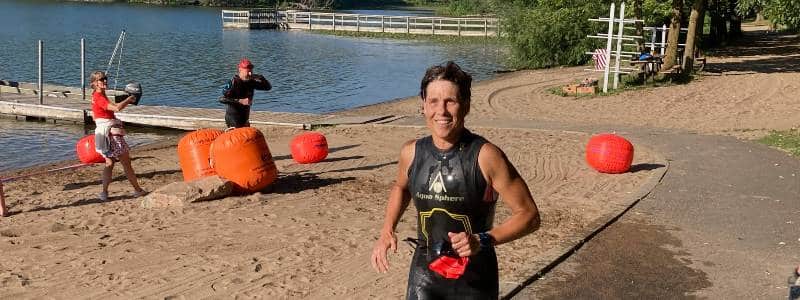
Our performance in swimming is arguably more technical, that is more dependent on technique, than it is for cycling and running. Because of this, the quickest way to a faster triathlon swim is to prioritize a more efficient swim stroke. Strength and aerobic fitness training, including swimming in race conditions, top off the swim portion of training.

This is precisely the approach of the TriDot Pool School. According to Brandy Ramirez, Director of TriDot Pool School, “the only way to improve an athlete’s swim technique is to solve the root cause of the inefficiency. This correction can only be done by stripping away the athletes’ preconceived swim techniques (the flawed technique) and building from the ground up. While I know this sounds like a heavy lift and one might think this would take months to complete, I can attest that this is exactly what we do at TriDot Pool School.

“In the course of 2 days (4 hours on Saturday and 4 hours on Sunday) our skilled Instructors walk athletes through our program and improve their efficiency in only 8 hours time. We see an average 13% improvement of swimmer’s times and 100% improvement on stroke.”

The TriDot Pool School website describes the approach, including preparation before the two days and continued stroke development exercises afterward. The website also includes a near-term schedule of classes.

Here’s To A Faster Triathlon Swim

Each of us is unique in our habits, capabilities, and needs. Some will benefit from a new stroke technique more than others. Still, from the testimonies on the TriDot Pool School website, even professional triathletes will benefit from a periodic review of their technique.

For our fastest triathlon swim, we need an efficient stroke along with aerobic fitness and strong swimming muscles.

What Works For You?

This post is based on my reading and comments of TriDot coaches who help with some of this site’s content.

I would like to hear from you. What has worked for you as you trained for a faster triathlon swim?

Comments: We’d love to hear about your experience. Join the conversation below. All comments are reviewed before they appear.

Reply notifications: Click the bell icon above Post Comment to be notified when someone replies to your comment.

Follow the discussion: Click Subscribe above the comment box and enter your email address to receive notifications whenever a new comment is added—even if you don’t leave a comment. After subscribing, check your email and click Confirm to activate notifications.

How 75 Became My Best Ironman Year Yet – Rick Burgess’ Story

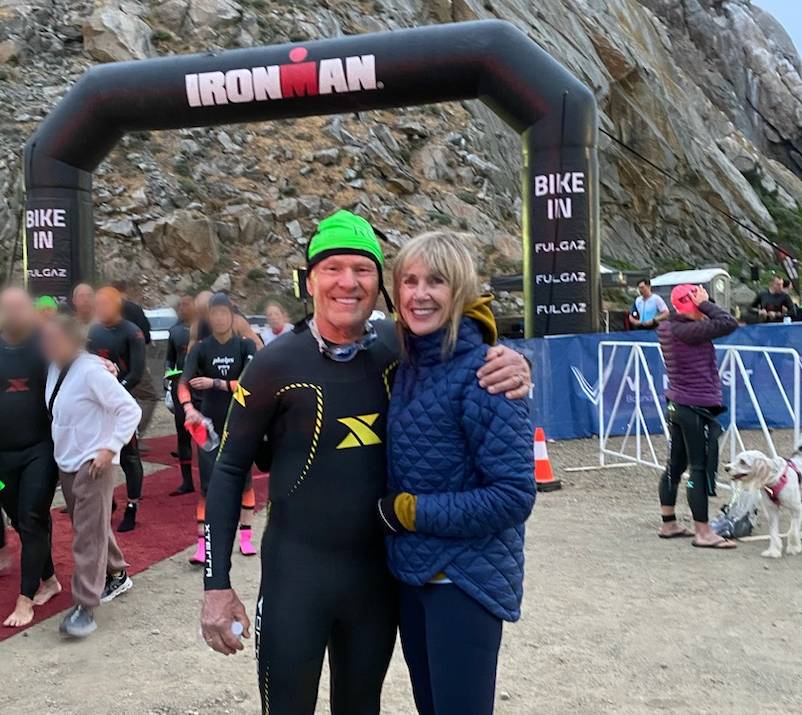
Caption: Rick and Elaine Burgess at the 2024 Morro Bay 70.3 swim start.

Stamina, Strength, and Wild Goals

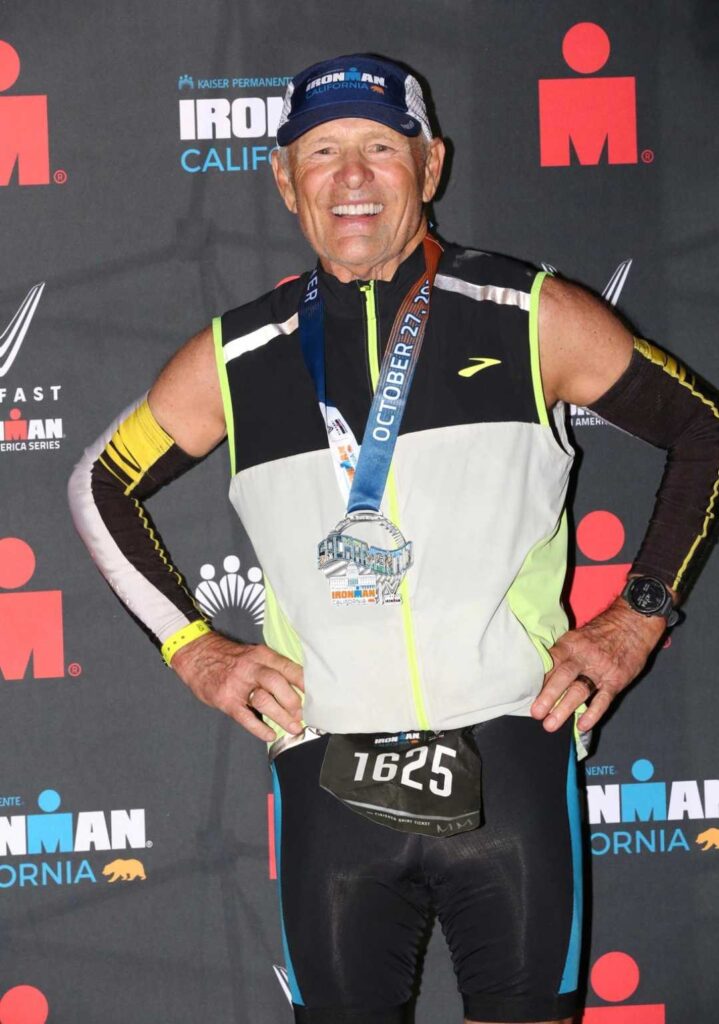
When does getting older mean getting better? That’s the question I asked myself after completing Ironman California in late 2022. It was my fifth full-distance Ironman, and while my time of 15:45 wasn’t remarkable, crossing the finish line is always a win. Later, I realized I was the oldest finisher among the 2,600 participants. At 73, that achievement sparked a thought: If I could do this at 73, what could I accomplish at 75?

Inspired, my wife Elaine and I decided to celebrate my upcoming 75th birthday by taking on all five California Ironman races in 2024—Oceanside 70.3, Morro Bay 70.3, Santa Cruz 70.3, Ironman California 140.6, and Indian Wells 70.3. The word celebrate felt deliberate since there are no guarantees at this stage of life. Each race would honor the health and strength I’d been given while aiming to see what was possible.

Building on a Lifetime of Triathlons

I’ve been competing in triathlons for 25 years, with my first full Ironman at Panama City in 2004. I was a runner in my late 40s. When I tweaked my back one summer, my physical therapist encouraged me to swim while recovering. Over the next few months, I worked up to swimming over a mile. I thought, I can run, I have a bike, and now I can manage the swim. I should do a triathlon.

The first year (2001), I signed up for three tri’s – a Sprint (Uvas) and two Olympic (San Jose and Santa Cruz) distances – and an aquathlon, all in the Bay Area. I still remember coming out of the water in the sprint. My bike, a mountain bike, was the only one left in T1. The next year I did the same Sprint and an Olympic tri, but added two 70.3’s: Vineman-Santa Rosa and Big Kahuna-Santa Cruz. I was off!

During that time, I was a good runner and an average swimmer and cyclist, solidly middle-of-the-pack. Over time, as the field in my age group thinned, my rankings improved.

Achieving All-World Athlete Ranking

IRONMAN® ranks all athletes worldwide that complete an Ironman race, called the All World Athlete program. The top 2% in each age group earn Gold, the next 5% Silver and the next 10% Bronze. My first Bronze award came while competing in the 65-69 age group. I earned a second Bronze while competing in the 70-74 age group.

I really enjoyed the challenge of triathlons. Having finished the Boston Marathon six times, I was a comfortable and competitive runner. I found the swim/bike cross training a challenge and an important part of balancing the wear and tear of running. Plus, tri’s are fun races and I enjoy the excitement and camaraderie.

The base I had built was about to be challenged, though, as the 2024 races were sure to be an adventure. I hadn’t competed in a triathlon in 16 months and had never raced Oceanside. Morro Bay was equally unfamiliar territory. Yet, I was optimistic and ready to embrace the challenge.

Oceanside: A Strong Start

The Oceanside race was exciting and nerve-wracking. It’s known as the unofficial California Ironman championship, so I expected strong representation, even in the 75-79 age group. Eight of us started, and I ended up finishing third out of five. The harbor swim took me 48 minutes, complicated by swimming into the sun. The bike course, winding through Camp Pendleton, was challenging, with many athletes dismounting and walking up steep hills – a rarity in triathlons. Despite the hilly course, I completed the bike leg in 3:45 and finished the run in 2:25 for an overall time of 7:16. I felt pleased and confident heading into the next event.

Morro Bay: The Challenge of the Tide

Morro Bay seemed like it would be easier than Oceanside, with fewer hills and a “saltwater lake” swim. The venue was picturesque, though the water was cold at 58°F. The swim quickly turned into a battle.

A strong opposing tide made progress painfully slow and the water temperature dropped to the low 50’s. At one point, I clung to a buoy with others, unsure if I’d make it to the finish. My swim took 1:18, far exceeding my 45 minute goal. I finished, shivering and tired, failing to meet the 1:10 cutoff.

Soon afterwards, I realized many others also struggled, and race officials hadn’t strictly enforced the cutoff. I could have continued. While I regretted not finishing, safety felt like the better choice. Ironman appropriately offered free entry to another event to the 100s of entrants who DNF’d on the swim. I used it to register for Oceanside 2025 after Ironman announced that Morro Bay would no longer be held.

Finishing Strong

The remaining three races brought redemption. At Santa Cruz, I clocked a 41 minute swim and finished in 7:15, securing second place in my age group. IRONMAN California was a standout, winning my age group with a finish time of 14:45—nearly an hour better than my time two years earlier. At Indian Wells, I was the only competitor in my age group and won in a time of 7:24.

At year’s end, I achieved an unexpected accolade: Ranked #1 globally (Gold) in my age group in the Ironman All-World Athlete program (out of 90 athletes). The recognition capped an amazing year, and my wife Elaine and I decided to tackle the Nice (140.6) and Marbella (70.3) World Championship races in 2025 along with Oceanside and St George.

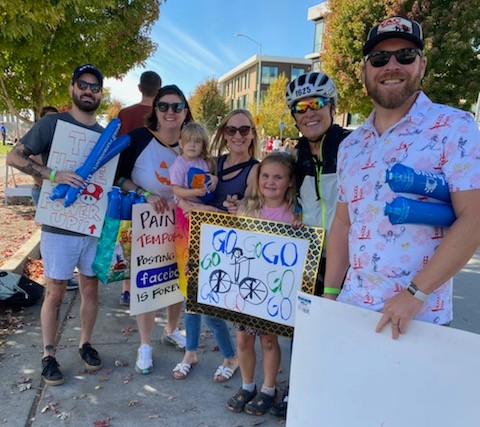
Rick Burgess and his cheering squad for IRONMAN California 2024.

Lessons Learned

The year taught me three key lessons.

Consistency Over Intensity

My training over the years has evolved. I’ve used books (Joel Friel), on-line coaching, and tri club training programs and just evolved to my own cadence and distances. Three workouts/discipline/week, each one with a long, tempo and speed/power session and 1 rest day. And training consistently, even if not at high intensity, proved more effective than epic workouts. My longest runs were 2.5 hours, longest swims 1 hour and this year I focused heavily on the bike with a longest ride of 6 hours.

In 2024 I swam 86 miles, biked 4,339 miles, and ran 726 miles and remarkably stayed healthy. Joel Friel has a great post titled How to Have a Personal Best Ironman. This became a foundation of my training plan.

Healthy Nutrition

Maintaining a 90% vegetarian diet, prioritizing protein intake, and reducing alcohol made a big difference. We basically cut out red meat and eat fish once or twice weekly. I weigh 165 pounds, and target 100 grams of protein daily. Cutting alcohol improved my sleep, recovery, and overall fitness metrics. Protein bars, fruit, and smoothies became dietary staples.

The Power of Balance

Integrating training into my life with Elaine kept the journey enjoyable. Long rides together with Elaine on her e-bike and shared spin and strength sessions created memories while keeping training sustainable. The mental shift to viewing races as celebrations, not obligations, helped me stay grounded.

Gratitude for the Journey

Looking ahead to 2025, I’m embracing new adventures and challenges with excitement and gratitude. The grace of God, the love of my wife, and the enduring joy of triathlon continue to fuel me. Here’s to striving for the extraordinary and proving that growing older can also mean growing better.

I aim to continue celebrating the journey, not just the results. Wishing us all another year of swimming, biking, running—and living—with purpose.

Rick Burgess, senior Ironman triathlete
Rick Burgess at IRONMAN California 2024.

Share Your Questions and Comments With Rick Below

Editor’s Note: I know that many of you have questions about triathlon training. Here is your opportunity to ask an experienced and successful triathlete for his advice.

Click here for more inspiring stories from Senior Triathletes.

Comments: We’d love to hear about your experience. Join the conversation below. All comments are reviewed before they appear.

Reply notifications: Click the bell icon above Post Comment to be notified when someone replies to your comment.

Follow the discussion: Click Subscribe above the comment box and enter your email address to receive notifications whenever a new comment is added—even if you don’t leave a comment. After subscribing, check your email and click Confirm to activate notifications.

Best Pre-Run Warmup Approach For Senior Triathletes

A pre-run warmup becomes more important with each birthday. A combination of dynamic stretching and foam rolling provides what you need for safer and better quality run training.

Background

During a recent conversation with Dr. George Eversaul, developer of AquaStretch™ therapy, I mentioned my tight hips. I told him that I was looking for a way to loosen them. In response, he told me that the first thing I should try is stretching and foam rolling before running.

It surprised me to hear him say this. I needed no convincing to stretch after running. I am also a proponent of foam rolling, having solved an IT band problem by foam rolling many years ago.

However, I had convinced myself that stretching before running needed to be gentle, especially when the running muscles were “cold”. For most runs, I have migrated to skipping the warmup. Still, George’s comment caused me to do some research on the best way to warmup before a run, especially if it would improve my running performance, prevent injury, or both.

This post is what I learned through this research.

What Is The Purpose Of Pre-Run Warmup?

As with many so-called “givens”, conventional wisdom about pre-run warmup has changed dramatically over time. According to a post on the Marathon Handbook website titled How To Warm Up For Runners + A Complete Warm-Up Routine, pre-run advice has gone from static stretching to no stretching, then no warmup to, more recently, pre-run warmup as a must-do. Sports medicine research, such as that summarized in “Warm-up or stretch as preparation for sprint performance?” published in the Journal of Science and Medicine in Sport (JSMS), supports this advice.

Static stretching is no longer advised. Why? As the JSMS article referenced in the previous paragraph showed, there appears to be no benefit. In fact, holding stretches for 30 or more seconds before the muscles are warmed up may reduce performance by decreasing muscle strength and stability. Static stretches of “cold” muscles may also increase the risk of injury, including strains, during the run.

Before heading out on a training run, sports medicine professionals and physical therapists, recommend a 10-15 minute warmup routine. The challenge is to find a routine that does not compromise muscle strength or performance.

Warmups that are now recommended have the following main goals:

  • activate, elongate, and reduce tightness of the muscles involved in running,
  • prepare joints for moving,
  • increase blood flow to increase core temperature and the temperature of the muscles required for running,
  • stimulate the nervous system.

Because of the natural decline in flexibility and muscle elasticity that occurs with age, warming up before a run is even more important for older athletes.

Best Practices for Older Athletes

Searching Google for best pre-run warmup for “older athletes” will get you a generous number of sites to peruse. However, these generally miss an important practice for older athletes, especially those with limited mobility or flexibility in parts of the body engaged in running.

The following approach is especially important for older runners.

Get Your Heart Rate Up, Gradually

Whether through a brisk walk, doing a few jumping jacks, jogging in place, or pedaling a stationary bike, start with 5 to 10 minutes of light aerobic activity. This will raise your heart rate and core temperature gradually and, in doing so, increase blood flow to your muscles. This makes the muscles more pliable and ready for the next steps. I have also found that this is a good way to produce a little moisture on my skin so my heart rate monitor is more accurate and consistent.

Foam Roll Tight Areas

For many older athletes, foam rolling tight muscles can further improve pre-run mobility.

A major cause of tight muscles is myofascial adhesions, connections that form between the fascia, or outer wrapping, of adjacent muscles and other tissue. As explained to me by a physical therapist, tightness is like trying to slide two similar materials across each other while the two materials stick together at points along their surfaces.

By releasing myofascial adhesions, foam rolling after light aerobic activity offers the following benefits:

  • Improves range of motion: According to the author of “A PT’s Guide to Foam Rolling for Runners“, studies have documented improved hip extension and knee flexion when foam rolling is combined with dynamic stretching.
  • Increases blood flow: Along with the aerobic warmup, foam rolling further prepares muscles for physical activity. Increased blood flow aids in muscle relaxation, which can reduce the risk of injury.
  • Reduces tightness: Tight muscles caused by myofascial adhesions may force our body to compensate during the run. These unnatural patterns can overuse other muscles. By providing myofascial release, foam rolling can help reduce the risk of injury caused by compensation.
  • Activates the nervous system: The pressure from foam rolling activates neural receptors, which can relax muscles and optimize their response to dynamic movements

Foam rolling is simple. Place the foam roller against a hard surface, such as floor or wall, and place the tight area of your body against the foam roller. Lean into it and slowly roll across the tight area in both directions. If you are able, hold the position directly over the tight area for a few seconds, then repeat the process until the tightness has reduced.

For more information on foam rolling, checkout Become a More Flexible Senior Triathlete By Foam Rolling.

Dynamic Stretches Round Out a Warmup

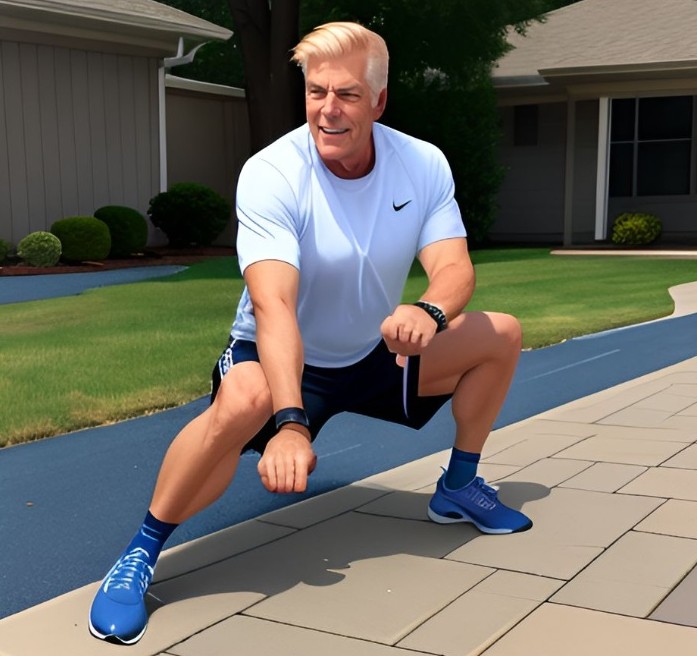
The warmup concludes with one or more dynamic stretches. These are controlled, movement-based stretches that mimic the motions of running.

Examples include:

  • Leg swings: Swing your legs front-to-back and side-to-side to open up the hip flexors and hamstrings.
  • Forward lunges with a twist to engage the core.
  • Side lunges to activate inner and outer thighs.
  • Inchworms: A full-body stretch that also targets hamstrings and core.
  • Butt kicks and high knees: These help activate your quads and glutes, promoting good form and balance during running.
  • Leg kicks: Stand with feet apart with knees straight and stretch the right hand to the left foot, holding the position for two seconds, then repeat this with the opposite hand and foot.

Resources for Dynamic Stretching:

After completing dynamic stretches, consider easing into your run, running at an easy pace for the first five minutes. Gradually increase the intensity throughout this period. This primes your body for sustained effort while minimizing injury risk.

Conclusion

Older runners and triathletes will benefit from a pre-run warmup that includes light aerobic activity, foam rolling, and dynamic stretching. After increasing our heart rate and beginning to warm our running muscles, foam rolling relieves excess tension to improve flexibility. Dynamic stretches round out the warmup by activating the running muscles.

Skipping a pre-run warmup is a “no-no” if you want to avoid injury.

How Do You Warmup Before A Run?

Please let us know how you warmup for your run? What have you learned along the way?

Comments: We’d love to hear about your experience. Join the conversation below. All comments are reviewed before they appear.

Reply notifications: Click the bell icon above Post Comment to be notified when someone replies to your comment.

Follow the discussion: Click Subscribe above the comment box and enter your email address to receive notifications whenever a new comment is added—even if you don’t leave a comment. After subscribing, check your email and click Confirm to activate notifications.

What Does The Bible Say About Triathlon?

The Bible does not include the word “triathlon”. However, it mentions many aspects of the sport as a metaphor for life.

Introduction

Over the past decade and a half, I have trained for and competed in triathlons across the United States. I have also heard and read the stories of many senior triathletes and multisport athletes. From these, I have come to appreciate the benefits of multisport endurance training and racing, particularly in developing physical endurance and mental toughness.

In an earlier post, Four Symptoms of Impatience In Triathlon Training, I highlighted the benefits of patience in triathlon training. Not surprising, the wisdom of patience is prominent in the Bible. I highlighted some of the Bible’s statements in that post.

I have also seen the Bible’s many references to training, racing, and endurance sports. To me, the Bible continues to provide the best explanation of humanity and of life and its purpose.

Millions of people apparently agree. According to Guinness World Records, more Bibles have been sold worldwide than any other book, an estimated five billion copies. And, that doesn’t count the many downloaded electronic versions, like the free YouVersion Bible App.

While finishing this post, I received an email with a link to a Wall Street Journal article titled “Sales of Bibles Are Booming, Fueled by First-Time Buyers and New Versions“. The December 1, 2024 article cites a 22% increase in Bible sales during the past year.

In this post, I share some of the Bible’s references to endurance sports training and racing. Hopefully, you will be inspired to look into these more on your own or with family and friends.

For reference, all Bible verses are from the New Living Translation (NLT).

Running

“So I run with purpose in every step. I am not just shadowboxing. I discipline my body like an athlete, training it to do what it should. Otherwise, I fear that after preaching to others I myself might be disqualified.” 1 Corinthians 9:26-27 (NLT)

The Apostle Paul, author of this passage, told his readers about his focus on telling others about God’s plan through Jesus, describing it as training with a purpose. Whether training for a race or competing in that race, most of us swim, bike, and run with a plan, a purpose. Otherwise, why bother? There are other ways to spend our time and money. The same is true in life. Be serious about what you commit yourself to.

Swimming, But Not Cycling

“as a swimmer pushes down water with his hands.” Isaiah 25:11 (NLT)

In this verse, the author, the prophet Isaiah, uses the analogy of a swim stroke to describe God stretching forth His arms to provide justice for His people.

Endurance Training

“If racing against mere men makes you tired, how will you race against horses? If you stumble and fall on open ground, what will you do in the thickets near the Jordan?” Jeremiah 12:5 (NLT)

This passage speaks of being prepared for difficulty. Life comes with difficulty, even if only seldom. Racing may also come with difficulty in the form of inclement weather, high or low temperature, or poor water or road conditions. It’s best to be prepared for these if you aspire to be a serious competitor.

“Dear brothers and sisters, when troubles of any kind come your way, consider it an opportunity for great joy. For you know that when your faith is tested, your endurance has a chance to grow. So let it grow, for when your endurance is fully developed, you will be perfect and complete, needing nothing.” James 1:2-4 (NLT)

In these verses, James, the half-brother of Jesus, describes the value of difficulties in making us stronger. Isn’t this the idea behind progressive overload in triathlon training?

“We can rejoice, too, when we run into problems and trials, for we know that they help us develop endurance.” Romans 5:3 (NLT)

Here, the apostle Paul tells those in the Church to look at problems and trials as opportunities to develop endurance. Sound familiar? That’s the reason coaches advise us to not just train in pleasant weather, but also in conditions we might experience on race day.

Racing and Competing

“All athletes are disciplined in their training. They do it to win a prize that will fade away, but we do it for an eternal prize.” 1 Corinthians 9:25 (NLT)

It is within our nature to compete. While there is such a thing as unhealthy competition, healthy competition in sports reminds us of the value of setting a goal for our life, then remaining committed to it. My counsel is that you choose the right goal(s).

“Don’t you realize that in a race everyone runs, but only one person gets the prize? So run to win!” 1 Corinthians 9:24 (NLT)

The apostle Paul, author of this letter to the church in Corinth, Greece, used an analogy of endurance racing for the Christian life. He knew that those who read his letter, or heard it read, would relate to this picture because of the popularity of the Isthmian Games in Corinth. He encouraged hearers to train for and compete to win in their spiritual life, with the same focus as athletes competing in the Games did.

“And athletes cannot win the prize unless they follow the rules.” 2 Timothy 2:5 (NLT)

Anyone racing in triathlon for a while has read accounts of or witnessed athletes attempting to cut corners or violate rules. One of the most common is drafting on the bike in non-drafting competitions. As in triathlon, we will never rightfully earn a reward in life while trying to cut corners or make up our own rules.

“Therefore, since we are surrounded by such a huge crowd of witnesses to the life of faith, let us strip off every weight that slows us down, especially the sin that so easily trips us up. And let us run with endurance the race God has set before us.” Hebrews 12:1 (NLT)

Seldom, if ever, does one enter a triathlon or other endurance race wearing extra weights. So too, the Bible teaches us to shed the unnecessary weights or burdens that slow us down or hinder us from producing our best in the race called life.

Here’s What The Bible Says About Triathlon

The Bible uses many metaphors for life based on endurance sports training and competition. It also seems to add credence to the adage that “life is a marathon, not a sprint.” Make yours a negative-split, stronger in the second half than your first half.

I hope you will consider the Bible’s portrayal of life and the world around us. I also hope you consider the teachings of Jesus and what the Bible has to say about Him. He is far more than an outstanding teacher.

“I press on to reach the end of the race and receive the heavenly prize for which God, through Christ Jesus, is calling us.” Philippians 3:14 (NLT)

Screenshot of 1 Corinthians 9:24-27 from the YouVersion Bible app

Share Your Thoughts

Please leave your comments and questions in the Comments below.

Comments: We’d love to hear about your experience. Join the conversation below. All comments are reviewed before they appear.

Reply notifications: Click the bell icon above Post Comment to be notified when someone replies to your comment.

Follow the discussion: Click Subscribe above the comment box and enter your email address to receive notifications whenever a new comment is added—even if you don’t leave a comment. After subscribing, check your email and click Confirm to activate notifications.

error

Enjoy this post? Please spread the word :)