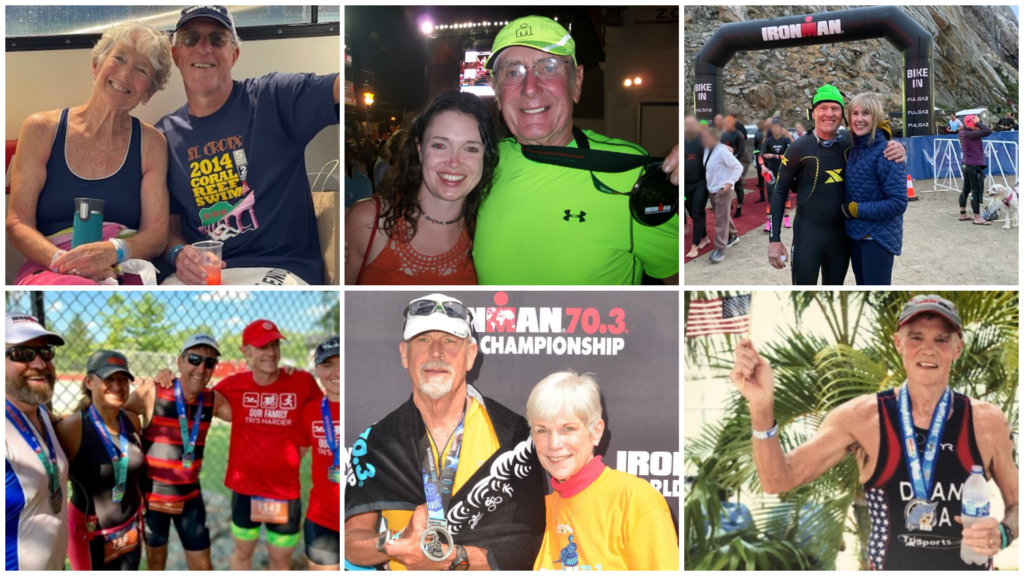
A 76-Year Old’s Perspective on Running Performance After 70

Caption: Jim Riley with Julie Moss after the 2017 Oceanside IM70.3.

A 76-year-old triathlete shares his perspective and experience on advice given in another Senior Triathletes post for reducing a decline in running performance after 70.

Introduction: Setting the Stage

by Terry VanderWert, Editor, SeniorTriathletes.com

Last month, I published a post titled How To Slow Age-Related Drop in Running Performance. After reading that post, Jim Riley wrote me a long, personal email with his comments. His email ended with, “I felt I needed to respond for all those trying to be the very best for their age.”

I thought his perspective and detailed comments worthy of a dedicated post rather than a comment at the bottom of the post. Jim agreed to share his thoughts on age-related performance decline with our community.

In the post which prompted Jim’s comments, Coach Kurt Madden referred to an article in Triathlete magazine about the documented increased times with age. The May 14, 2024 article titled How Much Slower Will You Get As You “Age Up” in Triathlon? graphically presents Ironman 140.6 and Ironman 70.3 finish times and swim, bike, and run splits. Specific to running, this article documents slower Ironman times that begin in our late 20s or early 30s and progress with age.

What is less obvious but still represented in the data is that for some legs, including the run for both the IM140.6 and IM70.3, the rate of decline (slope of the graph) increases with age, especially for those in the 70s age groups.

With that introduction and background, here are Jim Riley’s remarks.

The 70s Are Different Than the Late-60s

by Jim Riley

I am in the same competitive mode as Kurt but seven years older. He is correct in everything he says [in How To Slow Age-Related Drop in Running Performance]. However, he is not 76, so cannot yet feel what happens from 69 to 76 even if you are doing everything he advocates.

Please tell your over-70 set to be very careful with running training. Trying to do what he suggests in getting uncomfortable with more Zone 3 and 4 training can result in a greater chance of injury and frustration.

My times for 70.3 distance events have declined every year since my comeback as a 69-year-old. Yet, I have never missed a podium finish.

I am still so frustrated to see my times slow even if I have gone to more strength, mobility, and core training, more Zone 2 on the bike, harder swim sessions, and even more zone 3 and 4 running, including running in the pool. Also, I am getting at least 100 grams of protein in a day — it’s very hard to get to 150,

The irony is that even with all this, performance declines occur more rapidly after 70, no matter what you do with nutrition or training.

The key in my humble opinion is to check winning times for those 65 to 69 (Kurt’s age group). Then, compare these to the 70 to 75 and the 75 to 79 age groups and see the decline. When Kurt was 65, he blew away all his competiton. Now, like I did as a 69 year old, he still makes the podium. But, he is no longer always first. That tells you something. The critical challenge is to tailor a plan for your age group and go from there.

Keys To Enjoying Fitness With Age After 70

Lower your expectations each and every year after 70, If you don’t, you may never be able to enjoy fitness into your 80s and 90s.

Also race more sparingly over 70 as recovery from racing takes more time. If you are determined to do a full Ironman, just try and enjoy it rather than checking your watch. If you focus on your time, you will be destined for disappointment.

Here are some specific steps I recommend:

  • Start slowly with each aspect of all areas of training, especially running.
  • Go to the gym more. Besides weights, get on the stair climber and elliptical to build strength without the pounding outside.
  • Do pull-ups and hang from a bar in a door jamb at home. These will help with swimming, biking, and running.
  • Incorporate mobility every day and more stretching and foam rolling. There are many great programs if you have a peleton
  • Add more protein every day. It is easy to get to 60 grams per day. But, you will need to take protein pills to get close to your body weight. Warning: with the pills comes farting issues, which can be annoying. Find a balance that works for you.

Then you can set a training program tailored to expectations, rather than one from coaches that are not your age. This is a problem for everyone over 70 as the decline is so much more significant.

Share Comments and Questions About Running Performance After 70

Several years ago, I cited an article about running for masters athletes. Once readers realized the article was written by a 40-year-old man, I quickly learned of the frustration, even anger, of older athletes, especially those over age 70, a group in which I now reside, being lumped together with athletes age 40 and above.

What has been your experience with running decline after 70? What are your thoughts on Jim’s comments? Or, maybe you have questions for Jim.

Post them in the Comments section below.

Comments: Join the conversation below — Click on “Subscribe” (located above the Comment box) if you’d like to be alerted to replies to your Comment. Even if you do not submit a comment, you may subscribe to be notified when a new comment is published. Please note that I review all comments before they are posted.

How To Slow Age-Related Drop in Running Performance

We often expect some drop in running speed as we age. Still, how can we minimize it? This post is based on TriDot coach Kurt Madden’s response to a request from a senior triathlete in his late 60s who hopes to reverse a dramatic drop in his running performance.

How Can I Reverse a Drop in Running Performance?

David, one of our community of senior triathletes, sent me the following request.

“I’m looking for some articles and guidance on nutrition for senior triathletes. I’m going to be 69 in July and my endurance has dropped dramatically in the past 4 years. The run has been the most affected. I expect age related drops but have gone from an 8:45 [minute per mile] pace to an 11:45 [minute per mile] pace on the run after bike.”

I sent David’s request to Our Coaches, and asked them to share the most common causes for drops in performance they see among older athletes. Kurt Madden, a TriDot Certified Coach and Head of Coach Development for TriDot, offered to speak with me about what he sees. Kurt’s comments are the basis for the rest of this post.

Protein-Based Diet

According to Coach Madden, David is correct in asking about nutrition when wanting to recover his earlier running performance.

To begin with, any person in training should be “building their nutritional regimen around protein”. This can include lean protein and any combination of protein-containing foods that provide all essential amino acids. Such a diet can slow aging somewhat. How?

Kurt said, “Fifty percent of the cellular membrane is protein. Generally speaking, for males and for females, as we look at current data, any person who is active, including seniors, should strive for close to one gram of protein per pound of body weight.” This is equivalent to 2.2 grams of protein per kilogram of body weight, higher than general recommendations for older active adults.

A common mistake of athletes in training is, according to Kurt, “protein fasting”. Protein fasting occurs when the athlete does not consume the recommended amount of protein. It also occurs when protein is not consumed throughout the day. We can’t starve ourselves of protein for sixteen hours, then cram it in at the end of the day. This is because it takes time for our bodies to absorb the protein we consume.

According to an article titled The Science Behind Intermittent Fasting For Athletes, “Your protein absorption rate may be as low as 8-10 grams per hour. Intermittent fasting limits one’s ability to spread protein intake throughout the day. This may not be a problem if your protein needs fit effectively within an 8-hour eating window. But if you have extremely high protein needs (say, you’re training for a triathlon and spend 3+ hours/day training) you may need to supplement with protein even during a fasting period.”

What About Intermittent Fasting?

I asked Kurt about intermittent fasting, considering this advice. From his response, I learned that while intermittent fasting may help with weight loss, the athlete in training who employs this approach may give up the quality of cellular development and quality of their metabolism. “If we can build in protein throughout the day, our waking hours, we are going to help build the cell membranes and help with recovery. To me, that is a huge win right there.”

Not absorbing enough protein while in training is, according to Coach Madden, “like a battery pack on a flashlight. You’ve got four batteries in there, but only two are working.”

Kurt continued, “The power house of the cell, that is the mitochondria. When everything within the cell is fed, it is going to produce at a much higher level. They can get larger, they can increase in size and number at any age. That’s the importance when you look at protein.”

Athletes who do not absorb enough protein will “struggle with recovery and doing powerful things, like trying to maintain your running speed at any age, versus people that are not [protein fasting] who recover quicker, generally speaking, and not going to see that rapid decline [in running speed]. So, just that tweak there is going to be incredible.”

Twenty Different Vegetables and Fruits Each Week

In addition, Kurt said, “It’s really important to try to get twenty different fruits and vegetables every single week with a shift toward more vegetables than fruits.” While fruits provide antioxidants, they also contain more sugar than vegetables.

Kurt emphasizes the need to “be strategic in your carbohydrate intake. Ideally you are getting complex carbohydrates versus simple sugars. And you are doing it strategically so every day in your training you know that if you are training less than an hour, you don’t need a surplus of carbohydrates. Conversely, if you are in a longer session any day of the week, if it’s a two hour bike ride and a thirty-minute run, you definitely need to shift those carbohydrates over.”

How Clean Are You Eating?

“And then the thing that I find with people who struggle a little with their weight, when I see a ratio of protein to carbohydrates, it’s not one to one or it’s not one to two. It’s like one for protein and four for carbohydrates. And many times what goes into that mix, when you really peel the onion back, is that their percentage of processed foods is much larger. Processed food will slow down your recovery.”

Following these guidelines will slow age-related performance decline for everyone, including seniors.

Related post: What Masters Athletes Need To Know About Nutrition

Building Strength and Endurance Reverses a Drop in Running Performance

Another area in which we can affect age-related performance is training. Kurt began this part of our discussion by referring to a May 14, 2024 article in Triathlete magazine titled How Much Slower Will You Get As You “Age Up” in Triathlon?. This article documents slower Ironman 70.3 run times that begin in our late 20s or early 30s and progress with age.

While the article mentions five main reasons for age-related performance declines, Kurt identified two of these for seniors to target in their training: (1) strength and (2) oxygen uptake.

“When you look at your oxygen uptake, the amount of oxygen that you can deliver to the working muscles . . . you are going to see that decline [with age]. That’s unavoidable because you are losing your strength.”

For this reason, seniors must include strength training, being careful to avoid injury. “Accept that by doing strength training, you are putting some stress on your ligaments, your tendons, your long bones, your connective tissue.” Still, he reminds seniors to remember that they are no longer in your 20s. Start slow.

Getting Uncomfortable to Get Faster

Still, beyond reduced strength, another cause for reduced oxygen uptake is our approach to training. “Typically, what we see, when you look at research, is that when people get older, they are more comfortable staying in a Zone 2, aerobic type training program. They are exercising. Hallelujah. I think that is beyond awesome. However, most people who are seniors, they are not willing to get uncomfortable. They are not doing the high intensity training.”

“It’s kind of like investing. How can I get bigger gains in my investments, and still be ethical and honest? Zone 2 is like investing in bonds. You’re not going to lose a thing. That’s awesome. If you want to be a little more ambitious, you’ve got to raise that bar again and, as we say, get into anerobic or you get things at your anerobic threshold. That is a true separation. And we see that.

“I can look at article after article about people in their sixties and seventies. It’s scary. People are running under three hour marathons. I was looking at results just last weekend for an Ironman 70.3 over on the east coast. A person that did a 70.3, they did a 1.2 mile swim, they did a 56 mile bike ride, and they ran a half marathon. They ran eight minute miles at age 65 to 69.

Add Some Good Stress

“I have to believe it could be two things. Number one, genetically, they are just flat out superior. But, secondly, I have to believe that person is doing some high intensity training because you have to stimulate your cardiovascular system. You have to put a little bit of stress on it and know you also need to back off.

“And that’s the beauty of TriDot. I work with 80 year olds, 70 year olds, 60 year olds, 50 year olds. I’m 68. I know later today, I have a session on a bike for an hour and I have got to get twenty-one minutes at Zone 4. And I know that I am going to get bigger gains or be able to maintain my oxygen uptake when I do that.

“Same thing on the run and the swim. But when we go to David’s question about the run, that’s very typical. We ask, well why does that happen? Well, I think to be very candid, running is the most stressful of all three disciplines. Because, you’ve got gravity. You’ve got force. You’ve got this person pounding on their ligaments, tendons, musculature, and connective tissue. And we see most injuries happening through running. And many times, it’s the volume of running, it’s overuse of running.

Balancing and Optimizing Stress

“And, again, when you see that decline, mostly speaking, I have to look at this person’s training program. They need to run at Zone 4 and Zone 3, not excessively, but have something that is optimizing them. Why? Because again, your body is going to get used to performing at that level. That prevents the decline they are going to see.

Kurt continued, “In swimming . . as long as your range of motion is good, you have the buoyancy factor. On the bike, you’re not pounding. If you’re disciplined, have good strength, good balance, mental toughness, you can hang on.”

“I just know, I did a max VO2 on the bike two weeks ago. It was close to what I did thirty years ago.”

Rest & Recovery For Better Running Performance

“Every person is a little different in the rest and recovery they need.

“Many times when we see [an athlete’s] performance declining, we get right to sleep factor. Shut things off so they are no longer getting blue light coming off screens fifteen hours a day. They shut things off and get the quality of sleep and recovery.”

Related post: Rest and Recovery: Why It’s Important for Senior Triathletes

Running Performance: A Three-Legged Stool

Just as a three-legged stool or tripod is the most stable platform, so is a training approach that considers the three principal contributors to running performance. Whether training for running or the triathlon run, a comprehensive plan will address these three legs:

  • Nutrition
  • Training
  • Rest

Of the three sports of triathlon, running is the one most sensitive to proper balance of these.

Need Your Own Plan?

Do you want a review of your current training plan or a plan tailored to you? Contact Kurt or one of Our Coaches.

Comments: Join the conversation below — Click on “Subscribe” (located above the Comment box) if you’d like to be alerted to replies to your Comment. Even if you do not submit a comment, you may subscribe to be notified when a new comment is published. Please note that I review all comments before they are posted.

Other Contributions By Coach Madden

Since our affiliation with TriDot began nearly a year and a half ago, Kurt Madden has helped on several Senior Triathletes posts. He is the exclusive contributor to these two:

Leveraging TriDot to Optimize Your Training at Any Age

How To Make Triathlon Training Senior-Specific

Kurt has also regularly responded to questions raised by readers in the Ask Our Coaches series.

Product Review: Bob and Brad Air 2 Mini Massage Gun

This post contains a review of the compact Air 2 Mini Massage Gun sent to me by Bob and Brad. In addition to my feedback, I have included thoughts provided by a licensed massage therapist.

Introduction

As older athletes, we know that recovery can be slower than when we were younger. Yet we want to train consistently. Tools and techniques that help us prevent injury and recover faster are especially important as we age.

Even though the days of ‘No Pain, No Gain’ are behind us, we may still occasionally experience pain, stiffness, or sore muscles after a workout. Massage guns have become a popular and effective tool for relieving pain and tight muscles.

About Bob and Brad

Bob and Brad is a brand built around two “physical therapists trusted by millions of followers.”

Almost one year ago, I reviewed the C2 Massage Gun from Bob and Brad. Both my wife, Joy, and I found the C2 to be effective in treating a painful area we were dealing with during that time.

In the earlier review, I wrote, “I am confident in their products because I trust these guys.” I trust them even more today, having since watched more videos on the Bob and Brad website.

picture comparing the shape and size of the Air 2 Mini and C2 massage guns.
Air 2 Mini (left) and C2 (right) massage guns from Bob and Brad.

What You Get With the Air 2 Mini Massage Gun

Here is what you will find inside the Air 2 Mini massage gun box:

  • Zippered carrying case with an insert for organizing the massager and its five heads.
  • Air 2 Mini massage gun.
  • Five quick change heads for different applications.
  • USB-C to USB charging cable
  • Extra grommets for quick change heads (2)
  • Manual in English, German, French, Italian, and Spanish languages.

Specifications

The table below shows the main specifications for the Air 2 Mini Massage Gun.

SpecificationWhy It’s ImportantValue for Bob and Brad Air 2 Mini Massage Gun
SpeedAlong with amplitude, speed determines the power of the massage gun. Lower speed is for a lighter duty massage, while higher speed is for a faster or more aggressive one.1750 – 2050 – 2400 rpm (3 speeds)
AmplitudeDetermines the depth of the penetration of the head. The higher this value, the deeper the massaging tool can press into the muscle.12 mm
Stall ForceThis measures the amount of force at which the gun stops vibrating. Stalling is a way the unit protects itself.28 pounds
WeightThe weight of the gun affects how easy it is to hold during use.1.25 pounds with air cushion head
Noise levelThe sound produced by the gun during operation determines if you can use it while talking or listening to others or while listening to TV or other audio or video recordings. The value for this gun is within the normal range of human conversation.not specified, though listed as their quietest massage gun

Why Five Different Heads?

The User Manual included with the Air 2 Mini Massage Gun pictures the five heads and their typical uses. These range from activating muscles before a workout to recovering after exercise and managing chronic pain from injury.

uses of different heads for the Bob and Brad Air 2 Mini massage gun
Page from the Air 2 Mini massage gun User Manual showing uses for different heads.

Our Experience

After opening the Air 2 Mini box earlier in the day, Joy and I took it to a dance where we met friends. One friend, Sheri C., a licensed massage therapist, had not heard of this massage gun. While talking at our table on the dance floor, Sheri started to use it. She seemed to like it. The next day after Joy and I finished golfing with Sheri and her husband, I left the Air 2 Mini with her for more testing.

Following is Sheri’s and my comments on the Air 2 Mini.

A Licensed Massage Therapist’s Review

As a Licensed Massage Therapist, I had the opportunity to try out the Bob & Brad Air 2 Mini Massage Gun, and I must say, it exceeded my expectations. From the moment I picked it up, I found it incredibly easy to hold and maneuver, allowing me to target specific muscle groups with precision.

The pulsing percussive movements offer three levels of strength, but what stood out to me was the versatility. Despite having the option of higher intensities, I personally found the lowest setting to be perfect for my needs. It provided just the right amount of pressure without causing any discomfort.

I primarily used the massage gun on my upper traps and hips, areas that tend to hold a lot of tension, especially after long days of giving massages. As I do not always find time to get a professional massage for myself, I found this to be a great utensil to help with those nagging areas of tight muscles that develop from my work as a Licensed Massage Therapist. The results were truly impressive. My muscles felt relaxed, rejuvenated, and most importantly, not overworked or sore. It’s clear that the device effectively alleviated tension and helped promote recovery.

One of the standout features of the Bob & Brad Air 2 Mini Massage Gun is the inclusion of several adapters, which allows for the targeting of even more specific areas with ease. This level of customization is invaluable in my line of work, as everyone has unique needs.

Additionally, I appreciate the thoughtful design of the device itself. It’s evident that a lot of consideration went into its construction, from the ergonomic design, to the compact carrying case it comes in. The case makes it convenient to transport between clients or while traveling, ensuring that I always have access to relief whenever I need it.

Overall, I believe the Bob & Brad Air 2 Mini Massage Gun is a well-thought-out device that delivers exceptional results. This will definitely become an essential tool for me, to keep me moving when I am not able to obtain a professional massage. I would whole-heartedly recommend it to fellow massage therapists or anyone looking for effective quick relief of tight muscles.

My Thoughts

From its specifications for amplitude and stall force, the Air 2 Mini Massage Gun is a light to medium duty gun. I was able to stall it easily using the air cushion head. Still, I found it to have plenty of power to release tension in stiff muscles.

The Air 2 Mini is compact yet powerful enough to treat stiffness on the go. Since I suffer with stiff upper back muscles while golfing, I took the Air 2 Mini on the golf course. I appreciated the way it relaxed tight muscles while waiting to tee off.

For some cases, like self massaging the upper back muscles, I find the C2 Massage gun easier to hold. But the Air 2 Mini is ideal for carrying in a computer bag, backpack, gym bag, and golf bag.

Want to Order the Air 2 Mini Massage Gun?

If you want to buy the Bob and Brad C2 Massage Gun on Amazon, please use this link: https://amzn.to/3QR6qSn.

If you purchase the Air 2 Mini using this link, I earn a small commission which helps to cover the cost of maintaining this website.

Affiliate Disclosure

How Do You Use a Massage Gun?

What do you use a massage gun for?

What massage gun do you use? How did you choose it? What is the most important specification for you?

Comments: Join the conversation below — Click on “Subscribe” (located above the Comment box) if you’d like to be alerted to replies to your Comment. Even if you do not submit a comment, you may subscribe to be notified when a new comment is published. Please note that I review all comments before they are posted.

A Triathlon Bike’s Tale

Editor’s Note: Ever wonder what your triathlon bike thinks about travel? Dave Conover has. He has teamed up with his triathlon bike to share the good, bad, and the ugly parts of traveling for triathlon.

By Dave’s Quintana Roo PRFive

A Little About Me

I’m a matte red and black, four-plus year old 56 centimeter Quintana Roo (QR) PRfive with numerous triathlon training and racing on my frame and wheelset. I was purchased in Virginia by my rider and good friend, Dave Conover.

Dave takes good care of me. Aside from racing in some rain in Puerto Rico in 2022, I have never been out in stormy or wet weather. We have logged close to 10,000 miles together outside and on a basement trainer with oldies from the 60’s playing. This is my story.

After qualifying for the 2020 World Triathlon Championship at the 2019 Cleveland Olympic Distance USA Triathlon (USAT) Nationals, Dave got the go ahead from his wife of 50 years, Louise, to team up with a new bike. He ordered me through a local triathlon-focused shop after a session with a professional bike fitter.

After arriving at Dave’s house, we quickly became good partners. I also got to literally hang out on the wall with his well-aged and cared-for FUJI Airfoil Pro. We got in some late fall rides, then transitioned to the indoor trainer.

My First Time Traveling

We made plans – truthfully, Dave made most of them – to travel to Edmonton, Canada for Worlds in 2020. These plans included me being transported by Tri Bike Transport (TBT) from Virginia to Edmonton and back. We were ready to start our racing season in 2020, then COVID came along. Long story short, we spent a lot of time on the indoor trainer and on solitary rides outside on less traveled two-lane roads in 2020. We also did a virtual triathlon together.

The Edmonton trip was postponed until 2021, then canceled in 2021. Still, we started racing in 2021 and drove to all our races, where I got to ride inside the SUV. Thankfully, I didn’t need to wear a face mask, though had to keep my distance according to USAT Competitive Rules.

Anxious for a challenge, we used a credit from TBT for our pre-paid trip to Edmonton to travel to Puerto Rico for a 70.3 race. I’ll simply say it was a wonderful experience, although a little warm and muggy.

From drop off to pick up in Virginia and at the race site, TBT was wonderful. I had a great time traveling and hanging out with so many other bikes, including a number of QRs from my time at the QR factory. Oh, how great to sit supported from a rack with that wonderful late-March sun on my aerobars.

My First Time in Europe Was Great

Then, in 2022, we raced well in Milwaukee, where we qualified to go to Spain for World’s in September 2023. It excited me to think about another trip arranged by TBT, again traveling with other bikes from the U.S.

I was ready to go in August, and was picked up and shipped to Spain with no incident. During this trip, I got to visit with some old bike buddies and make some new friends.
All 186 of us were stored in a nice warehouse near the race site. We were treated very well.

I was reunited with Dave a few days before the race for a few rides. I also got to stay with him and his wife at their rented apartment. You should have seen the view of the river. Still, it reminded me why I am glad to do the biking. I cannot swim or run.

What fun going up, then down, and up and down again, a big long hill during the race. My new rear cassette made my easy gear just a little easier for the hill. I was also glad to not be going down the hill at over 50 miles per hour like some of the other bikes.

But, The Way Home Was Long

After the race, I was dropped off at the warehouse for my trip back home. I got to compare notes about the race with all the other bikes. Then, when they turned out the lights, we had a great party using some remaining race hydration and CO2 cartridges.

I was packed up and made it back to the U.S. We were happy to be back in the states and almost home. However, we began a bonus tour of the U.S., one which we soon learned was no bonus. Some would say we were stolen.

Right after being offloaded from the trip across the Atlantic, we heard discussion, some heated, about shipping fees and unpaid invoices. Some bikes ridden by lawyers understood there were even threats about legal action.

From what these bikes heard, TBT had contracted with another company to transport us to and from the U.S. and Spain and had not paid this company. It was not just for the 186 of us who went to Spain, but other bikes that had gone on different trips organized by TBT.

Someone went to court to secure our release and got an order for the shipping company to do just that. Unfortunately, we were moved to another state and then another before settling in California.

California? From Spain to Virginia?

Days turned into weeks, then months. It was getting pretty bad. The fluids and goos dropped on us in Spain were getting smelly. Our tires where deflating. Rust was showing up in places. On top of this, we were getting restless from not being able to get out to ride.

We also did not get much sleep because of all the noise associated with the places we were shipped and stored. Some of the bikes snored, while a few released some bad air from their tires.
It also got really cold at times. We knew we had been moved to California when it warmed up. I wish I could have smelled the salt air; by now, the odor inside our containers was really stale and smelly.

After being in California for a while, one of the Cervellos heard the word “auction”. As we discussed what this could mean, we realized the shipping company was going to sell each of us in an attempt to recoup the money they were owed.

We were awestruck. How could TBT allow this to happen? Where would we end up and with whom? Would we ever race again? A few bikes feared the worst, being sold for parts and never riding again. This exerted a significant amount of mental stress on each of us.

A Glimmer of Hope

Then there was a ray of hope. Someone heard that if our owners would each pay $2,000, they could come to California and pick us up. A few bikes left because their owners paid what we considered a ransom. Of course, I hoped Dave would come rescue me.

At the same time, I realized this was not reasonable. He had already paid for my safe return to Virginia. Now, he was looking at the cost and time associated with a trip from Virginia to California on top of the $2,000.

Those of us not rescued by our owners waited as our tires deflated some more. Many of us lost our desire to ride again.

Finally Rescued

Then someone came along to save us and get us back home. Travelers Insurance Company, who had underwritten policies to cover damage and loss, agreed to pay the outstanding fees to the shipping company to secure our release. Even better, they had arranged with a company to pack and ship us to our homes.

We were all thrilled, so much so that we threw another party with what we could scrounge together.

I was packed in a box and found my way back to Dave’s house. This ride was a little rougher than the first one; a plastic box on my seat post, like that on all QR PR bikes, was knocked off and damaged in shipment. But, after this ordeal, a little broken plastic was not a big deal.

It thrilled me to be reunited with Dave. He cleaned me, and put fresh air in my tires. He even took me to the triathlon shop for a check and tune up. Then, we got to go out for rides again in Virginia.

I’m Looking Forward

Later, I thought about what could have happened. While the additional four or so months it took to get home were very trying, it all worked out in the end. I have some good and not so good memories of my ordeal.

I also learned that TBT is no longer in the business of shipping bikes. Maybe someone will put them in a box and ship them around a while to see how they like it.

I’m still in contact with a few of my hostage mates. We are looking forward to the 2024 racing season. Even better, I have some trips coming up this season, though none outside the U.S. I will very much enjoy being pampered by Dave, driven in the back of his Honda SUV while I lay on my side, being properly cleaned up after each ride, and getting to visit with many friends in transition.

Have You or Your Bike Had An Experience Like Dave’s Bike?

We’d love to hear your or your bike’s story in the Comments below.

Comments: Join the conversation below — Click on “Subscribe” (located above the Comment box) if you’d like to be alerted to replies to your Comment. Even if you do not submit a comment, you may subscribe to be notified when a new comment is published. Please note that I review all comments before they are posted.

error

Enjoy this post? Please spread the word :)