Triathlon Across the USA: State #42 – Arkansas
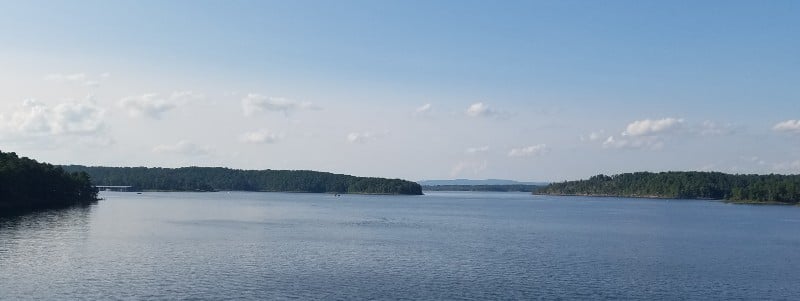
Arkadelphia-Caddo Valley, Arkansas; September 13, 2020—DeGray Lake Sprint Triathlon.

The DeGray Lake Triathlon was the only race I would take part in during 2020. The government’s response to the COVID-19 pandemic resulted in others in Kansas and Oklahoma I had registered for being canceled.

I had originally registered for a spring race, the Ozark Valley Triathlon in Fayetteville, Arkansas. Organizers delayed this triathlon until the fall and eventually made it a virtual-only race.

I had – and still have – no interest in a virtual race. One of my reasons for doing a triathlon in every state is to visit each one. I want to experience each state from the perspective of triathlon by swimming, biking, and running in it.

Meanwhile, the DeGray Lake Triathlon had always been scheduled for later in the year. Thanks to a relaxing of restrictions by the State of Arkansas, organizers could hold a live event.

This race is one chapter in a 50-state journey—now told in full in Triathlon Adventures Across America .

Traveling to the DeGray Lake Triathlon in Arkansas

Our ultimate destination for this trip was a little south of Little Rock, Arkansas. Through a couple of slight detours, we visited our son and his family and our son’s in laws.

Our initial route took us through central Iowa. Here, we saw hundreds of acres of flattened corn stalks. These were reminders of the hurricane level winds which had passed through the area in mid-August. Three hours later and we were at our son’s home near Omaha, Nebraska.

That evening, Joy and I prepared for the six of us Alaskan halibut that I had caught about a month earlier. We finished the evening watching “Frozen” for the umpteenth time with our granddaughters.

The destination for the second day was our son’s in laws in a pastoral area of central Missouri. This was the second visit to their home, as we had stayed with them before the Missouri triathlon. They are the greatest hosts.

Before departing for Arkansas the next morning, Joan loaded us up with canned goods. The box she sent us off with included jars of salsa, relish, tomato sauce, and elderberry juice, all from the produce of her garden.

Last Minute Preparations for the Arkansas Triathlon

By mid-afternoon, we had arrived in Arkadelphia. After checking into our hotel, we drove the few miles to the race venue for packet pickup. Here, I had my first experience with a triathlon being run under COVID-19 restrictions.
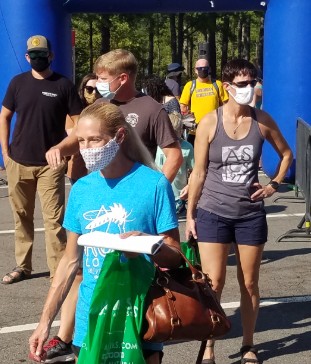
masked triathletes waiting for packet pickup during the COVID-19 pandemic
Masked triathletes awaiting packet pickup for the 2020 DeGray Lake Triathlon.

Part of the protocol for complying with state requirements was to allow triathletes to set up their transition area during packet pickup and leave their bike overnight.

A group from Teen Challenge, a faith-based nonprofit organization, secured the area. Others from this group provided support throughout the race the next day.

Next, we completed our pre-race ritual of driving the course, or most of it. Joy drove while I observed the road conditions and took a few pictures. It was then time to sample the local cuisine at the Fish Net Family Restaurant.

22nd Annual DeGray Lake Triathlon

The weather on race morning was as near perfect for a triathlon as one can imagine. A light breeze created a satiny feeling to the humid, 73°F air.

While the sun was shining, it did so through a thick haze. We attributed this to smoke from forest fires still burning in California and the Pacific Northwest.

The advertised distances for the individual legs of this USAT-sanctioned sprint triathlon were:

  • Swim: 820 yards (0.75 km) – Actual: 645 yards or 0.59 km
  • Bike: 12.4 miles (20 km) – Actual: 14.1 miles or 22,7 km
  • Run: 3.1 miles (5 km) – Actual: 3.8 miles or 6.1 km

(The actual distances shown above are from my Garmin Forerunner 920XT.)

Before the start, race director Bruce Dunn of All Sports Productions led with a prayer that was both thoughtful and relevant to the time. After the playing of a recorded version of the National Anthem, the triathlon began.

Swim

The temperature of the Lake DeGray water was over 78°F. To comply with USAT rules, anyone competing for an award could not wear a wetsuit.

The swim leg began using a ‘time-trial start’. This was another part of the COVID-19 protocol for this race. About every 5 seconds, a swimmer crossed the first timing mat, starting the timer for their race, and entered the water.

One benefit of the hazy sky was a muted sun. Had the sun been shining through an unfiltered sky, we would have looked nearly directly into it when sighting during the last part of the swim. Today, however, the haze made it much easier to locate the exit and swim on course.
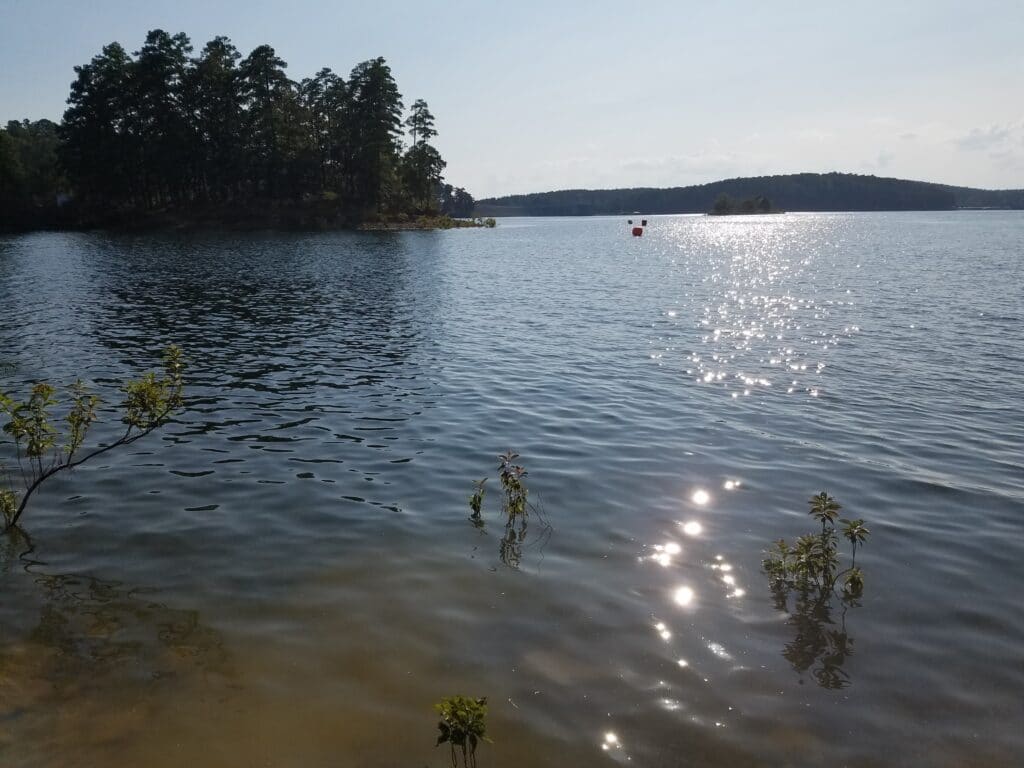
The swim course for the DeGray Lake triathlon started from the boat launch at the DeGray Lake Spillway Area.
The swim course for the DeGray Lake triathlon started from the boat launch at the Spillway Area.

Bike

Lake DeGray was the only flat part of this course. Both the bike and run courses involved a continuous series of rolling hills.

After a short ride from the ‘Bike Mount’ location outside the transition area, we turned onto the road within the park. The bike course stayed on this road during both the out and back portions.

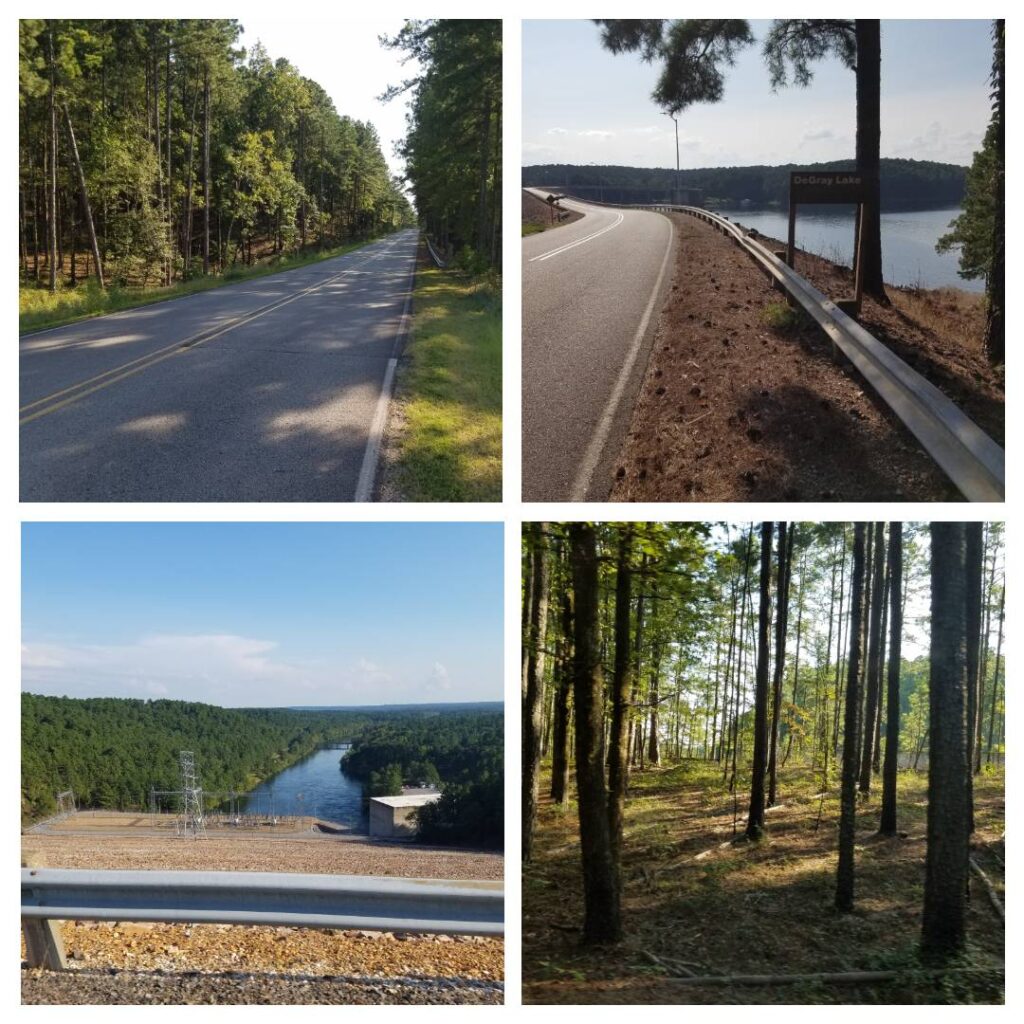
The initial ride involved a climb that felt much steeper than the picture below shows.

I made it through the first hill, though my heart was pounding. I caught my breath while on the flatter section across the dam.

As I started to climb the second hill a little past the dam, I downshifted and the chain came off. It became jammed between the frame and sprocket. The bike stopped almost instantly.

Unable to unclip my shoes from the pedals, I promptly fell over to my left. I scuffed my left knee and jammed my left ring finger.

Another casualty was my pride. Typical of the camaraderie with triathlon, several racers paused as they passed to ask if I needed help. I didn’t, but was grateful for the support.

Limping through the bike leg

I got the chain back on. However, being on a modest hill, I could not mount my bike and clip my shoes into the pedals. I have never practiced this.

I walked the bike up the hill until reaching a flat enough section on which I could get on the bike and clip my shoes into the pedals.

Immediately, I noticed the chain would jump back or ahead one gear every one to two revolutions of the pedal. I was at a loss for what to do. Finding no solution, I kept riding, though slower than I should have. The clicking sound distracted me. I was also concerned the chain would come off again.

On the other hand, I was grateful for being able to finish the race.
pictures from along the bike course of the DeGray Lake Arkansas triathlon
Scenes from along the bike course of the DeGray Lake Triathlon in Arkansas. Clockwise from the upper left: (1) The first part of the course was a modest hill that got our hearts pumping, (2) followed by a short flat stretch before crossing the DeGray Lake Dam. (3) Woods provided the scenery for much of the rest of the course. (4) However, in the last mile, we again crossed over the dam, this time looking down at the hydroelectric power plant.

After the race, I learned that both the chain and derailleur were damaged, presumably in the crash. A few days after returning home, a technician at Maple Grove Cycling repaired the derailleur and installed a new chain.

Run

By the time I got to the run leg, the temperature had risen ten degrees to 81°F. It was still humid, though not different from conditions I had been training in over the summer.
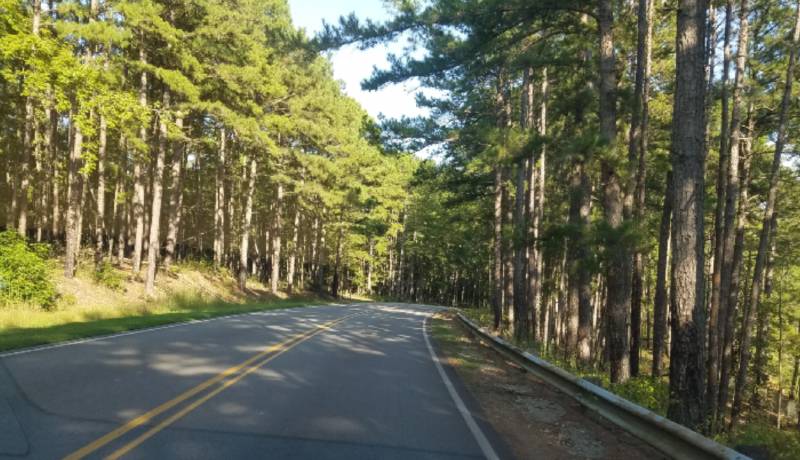
Scene from the run course on the road from AR-7 to the Lake DeGray Spillway Dam Area
The T-shaped out and-back run course for the DeGray Lake Triathlon was on the road between the DeGray Lake Spillway Area and AR-7, the highway that travels along the eastern edge of DeGray Lake.

The T-shaped out-and-back course took place on roads within the DeGray Lake Recreation Area. With the time trial start, maintaining distance between racers was easy.

Or was it because I was near the rear of the pack?

A Variation on a Basic Triathlon Axiom

Most beginner triathletes know you should never put into practice anything for the first time on race day.

I learned an important corollary to this truth in the Arkansas triathlon: “Do nothing on race day that you have not done during the final weeks of training for the race.”

I had not ridden my triathlon bike on hills similar to those of the race course during the last several months before this race. Even though the bike had been recently tuned and ridden on the trainer, it was not race-ready.

After the DeGray Lake Triathlon

After the race, Joy and I visited historic Hot Springs. From there, we headed north through the Ozark Mountains. We continued through Kansas City and Des Moines back to Minneapolis.

Race Firsts

  • First triathlon race during the COVID-19 pandemic.
  • This was the first triathlon with a new Trek SpeedConcept frame.
  • First triathlon for which I body marked myself using tattoos provided by the race organizer and a felt-tip marker. This was yet another part of the COVID protocol for this race.
  • Because of government restrictions, this was the first of my triathlons that Joy did not attend as a spectator. She did, however, visit the race venue with me during packet pickup the day before the race. (Truthfully, I think she enjoyed sleeping in.)
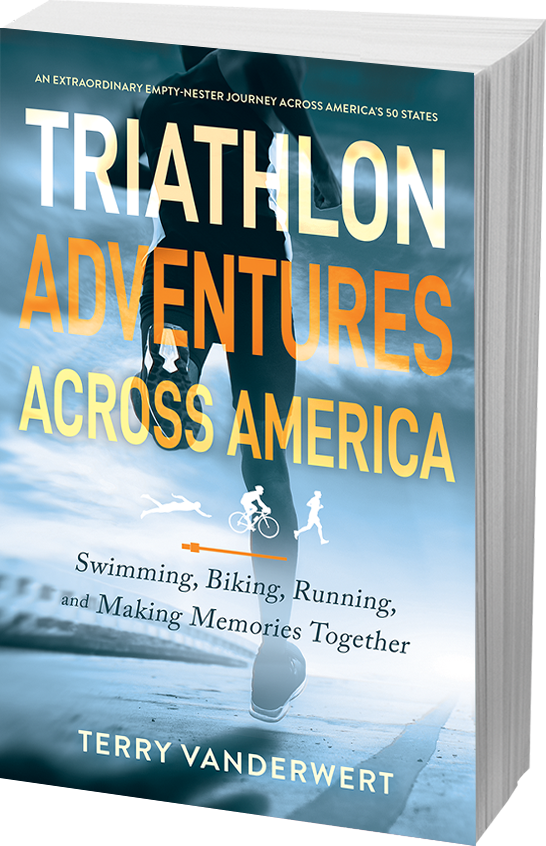
Triathlon Adventures Across America book cover

What Could Your Journey Be?

“It made me think, ‘Wow, wouldn’t it be fun to try to do this too?’”

Explore the journey across all 50 states

Have You Had a Bike Malfunction During a Triathlon?

Has your bike malfunctioned during a triathlon?

Have you done any triathlons in Arkansas? Which? What was your experience?

Share your comments below.
Comments: We’d love to hear about your experience. Join the conversation below. All comments are reviewed before they appear.

Reply notifications: Click the bell icon above Post Comment to be notified when someone replies to your comment.

Follow the discussion: Click Subscribe above the comment box and enter your email address to receive notifications whenever a new comment is added—even if you don’t leave a comment. After subscribing, check your email and click Confirm to activate notifications.

Better Balance Makes A Stronger Triathlete

Does better balance make for a stronger triathlete? I believe it does.

In the post titled “Triathlon Bike Training When You Can’t Ride Outside” published last month, I wrote about my upcoming skate skiing lesson. Why skate skiing? Because it is great cross-training for the bike leg of triathlon.

I completed the lesson, finishing with a game plan from the instructor for further developing my skate skiing technique. Before the second, solo outing with the skate skis, I watched a few videos with drills for beginners.

The videos reinforced what I had learned during the lesson, that skate skiing requires much better balance than classic cross country skiing. Before moving from the practice area to the course, I must learn to balance while gliding on one ski longer than I am currently able.

How do I improve my balance? That is the question I have been trying to answer and the subject of this post.

If you’re new to triathlon after 50, this guide on how to start triathlon after 50 will help you take the first step.

What is Balance?

According to the non-profit VeDA, “Balance is achieved and maintained by a complex set of sensorimotor control systems that include sensory input from vision (sight), proprioception (touch), and the vestibular system (motion, equilibrium, spatial orientation); integration of that sensory input; and motor output to the eye and body muscles.”

Essentially, balance involves the following three processes:

  1. Signals from inputs (eyes, ears, touch, etc.) travel to and are processed by the brain.
  2. Signals from the brain travel to the muscles required to maintain balance.
  3. These muscles contract as needed to stabilize the body.

For good balance, these processes must occur quickly and efficiently.

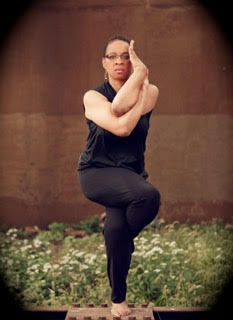
Yoga is one way to develop better balance and become a stronger triathlete.
Yoga is one way to develop better balance. Practicing poses like the one shown produces better balance and makes for a stronger triathlete. Picture from Jessica Perkins.

How Does Age Affect Balance?

Balance tends to decline with age, beginning as early as age 40. According to the USA’s National Institutes of Health, a problem with balance is among the most common reasons older adults seek help from a doctor. 

Poor balance can have many causes. These include disease, loss of eyesight, reaction to medications, changes in the skeletal system, and loss of muscle strength and joint flexibility.

Muscle strength is key to balance for a healthy, active adult. Strong muscles allow the signals from the brain to produce quick response. Conversely, if muscles are weak, they may not be able to provide adequate or fast enough response to maintain balance.

The foot, which can also change with age, is critical to balance. Even a relatively minor change, such as growth of a bunion, has been shown to affect balance.

Posture, which affects one’s center of gravity, often becomes poorer with age through loss of core muscle strength. If our body’s center of gravity is not directly over the support position, we are not balanced. With poor posture, we are less stable and more likely to fall.

How Can Balance Be Improved?

Assuming no other medical conditions, balance is primarily related to the neuromuscular system. Therefore, the current training program can be modified to (1) strengthen any overlooked muscles that affect balance and (2) train the nervous system.

Sensory systems

According to an article on the NESTA (National Exercise & Sports Trainers Association) website, adaptation of the nervous system occurs more quickly than does building of muscle mass. Early in a strength training program, the ability to lift greater weight is due more to adaptation of the nervous system than to increase in muscle mass.

The Law of Facilitation is in play when a signal from the brain to a muscle or set of muscles passes through a given pathway, excluding other paths. As the movement is repeated, the resistance in the ideal path becomes progressively smaller with the number of repetitions. The body continues to adapt and respond more efficiently until the movement becomes automatic.

Through this process of adaptation, we are creating what is often called ‘muscle memory‘. Through practice, even complex movements are made with little or no conscious effort.

Muscle strength

Several posts, including Six Principles of Triathlon Training for Seniors, document that the rate of muscle loss increases with age. Our goal is to reduce the rate of muscle loss. As noted earlier, one component of a program to improve balance is to strengthen the muscles affecting balance.

While the focus of most strength training for triathlon is the larger muscles (gluteus maximus, hamstring, quadriceps), smaller muscles (gluteus medius, soleus) are often ignored and lose strength without us realizing it.

Since these smaller muscles are important for stabilizing the hip and knee when standing on one leg, they are important for balance and, therefore, skate skiing and ice skating as well as biking and running.

Posture

My wife is a stickler for good posture. After many years of ignoring her comments about my posture, I now encourage her to point out when I am slouching or not sitting tall. She relishes the assignment and is quite good at it.

If you’re already training, this guide on how to improve triathlon performance after 50 will help you take the next step.

Exercises To Develop Better Balance and Become a Stronger Triathlete

Through a ski instructor, physical therapist, and several websites, I have developed a routine that I expect will lead to better balance for skate skiing.

The following series of exercises is performed three days per week. They are add-ons to regular strength training, which includes a series of five core strengthening exercises and a new exercise targeting the gluteus medius.

Single leg balance

Skitrax has produced a video demonstrating three ‘dry land’ drills for improving balance. The video shows these drills; I have added the duration for each set.

  • Single leg stand – stand on one leg with the knee bent slightly and the other leg off the ground and stationary. Hold for one minute on each leg. Once this becomes too easy with your eyes fixed on a point in the distance, try it with your eyes open but looking to your right or left. Then try it with your eyes closed.
  • Single leg swing – stand on one leg with the knee bent slightly and the other leg swinging forward and backward. Move your arms in combination with your leg. Repeat one minute on each leg.
  • Single leg dip – stand on one leg with the other out to the side, then bend the knee of the leg on which you are balancing to dip down and return to standing upright with your knee bent slightly. Repeat for one minute on each leg for 10-15 repetitions.
  • Single leg hop scotch – hop on one leg, landing inside an array of five real or imaginary rings and return backward to the start. Switch legs and repeat. Maintain standing balance at the end of each repetition.

Expect these to become easier as your body adapts to the position and the stabilizing muscles become stronger.

Single leg forward jump and hold

To even more closely mimic the movements in skate skiing than those of the single leg hop scotch, Peter from McBike & Sport suggests hopping forward and out onto one foot and holding this position for one to two seconds to simulate maintaining balance during the glide. Repeat the sequence on the other foot for one repetition. I am working up to repeating this 50 times for each foot.

Check-out the video demonstration of this drill.

Better Balance Makes A Stronger, Less Injury Prone Runner

This project started out as an effort to find a better, more enjoyable way of training for the bike leg during the winter without sitting on a trainer or moving to a warmer climate or buying a fat tire bike.

What I have learned is that better balance will also help in the run leg. Running is effectively a matter of jumping onto one leg and balancing on it for a short time then repeating this on the other leg. Good balance of each leg minimizes fatigue and injury from running.

Essentially, running is a series of single leg squat jumps, occurring quickly and repetitively. 

The Importance of Single Leg Balance

Want to take the next step? Choose your path below.

Whether you’re just getting started or looking to improve, here are your next steps:

New to Triathlon?

Start with a step-by-step guide to triathlon after 50 designed specifically for older athletes.

Start Here →

Already Training?

Learn how to train smarter, recover better, and improve performance after 50.

Improve Performance →

Developing Better Balance

Over the next several weeks, I will be working to improve balance so that I can get back out on the snow with better skate skiing form. I will keep you posted on what I learn.

Meanwhile, please share your thoughts on the exercises I have added to my routine.

Also, I would love to hear what you have done or are currently doing to maintain or improve your balance.

Share your comments below.

Comments: We’d love to hear about your experience. Join the conversation below. All comments are reviewed before they appear.

Reply notifications: Click the bell icon above Post Comment to be notified when someone replies to your comment.

Follow the discussion: Click Subscribe above the comment box and enter your email address to receive notifications whenever a new comment is added—even if you don’t leave a comment. After subscribing, check your email and click Confirm to activate notifications.

Triathlon Bike Training When You Can’t Ride Outside

How does training for the bike leg of triathlon occur when you can’t ride outside? There are more opportunities than you might imagine.

It’s Getting Cold Outside

I woke this morning to an outside temperature of 11°F (-12°C) and new snow. On top of this, the fitness centers are closed because of COVID-19 restrictions.

I don’t have, nor do I intend to purchase, a fat tire bike for riding in the snow.

Fat tire bikes with studded tires are preferred for a winter triathlon.

So, how can I maintain fitness for the bike leg of triathlons in which I hope to compete next spring?

There are plenty of options. While these may not be as good as going to a warm climate where I can ride outside, they still take away any excuses.

In this post, I will highlight the training I intend to use over the next several months to prepare for my next races.

Bike Trainer

The most common way of developing bike fitness without riding outside is to use a trainer. In most cases, you connect your road bike or triathlon bike to one of many styles of trainer.

One benefit of using a trainer is that you develop and maintain a familiarity with the bike you will use for your next triathlon.

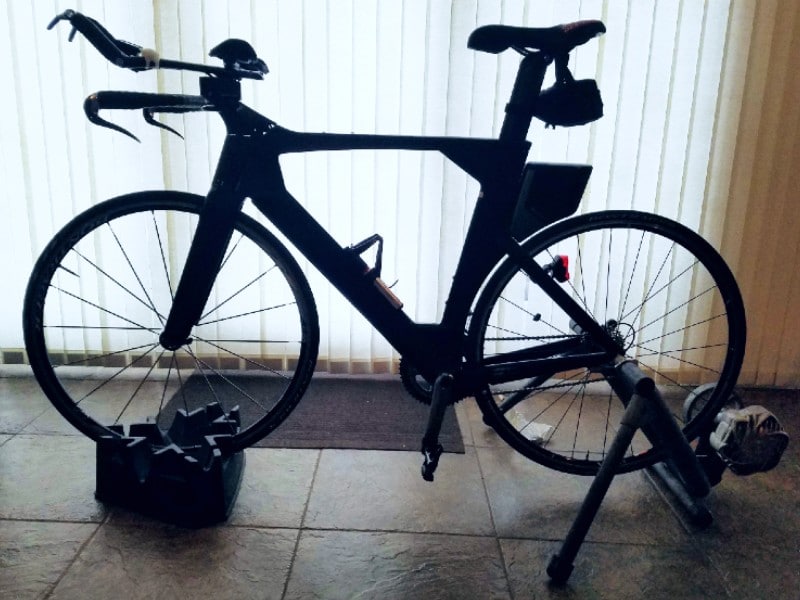
Trek SpeedConcept triathlon bike connected to a Saris CycleOps Fluid2 trainer for bike training when I can't ride on roads or trails.
Trek SpeedConcept on a Saris CycleOps Fluid2 trainer.

When the fitness centers re-open, I will also use their stationary bikes both for individual sessions and classes. I prefer the latter.

My trainer session, usually one hour, is divided into a few periods. Each segment is designed to work on a different goal. Breaking up the session also helps to prevent boredom. (Trainer sessions are also a great time to catchup on one of my favorite podcasts.)

A common one hour trainer session involves:

  • Warm up – 10 minutes at a moderate pace, 80-90 rpm cadence.
  • Single leg drill – 5 repetitions of 1 minute per leg at 80-90 rpm cadence – 10 minutes total. (NOTE: This may not be advisable for some trainers, but is for the Saris CycleOps Fluid2.)
  • Intervals – 5 repetitions of 4 minutes in the highest gear in which I can maintain 60 rpm cadence followed by 2 minutes easy at 80-90 rpm cadence – 30 minutes total.
  • Cool down – 10 minutes at moderate pace, 80-90 rpm cadence.

You can find many workouts to match your current fitness level and specific goals on-line or in books like “The Big Book of Bicycling” by Emily Furia and the Editors of Bicycling.

Advantages

  • Safer than riding in traffic or in the aero position on winding trails shared with pedestrians, especially in the winter but really any time of the year.
  • Efficient – A rule of thumb is that one hour on a trainer represents two hours riding on the road because you aren’t (or shouldn’t be) coasting on the trainer.
  • Some training, such as single leg drills, are best done on a trainer.
  • Accessible within your house or apartment.

Disadvantages

  • Static trainers don’t help to develop stability and coordination or bike handling skills.
  • Can be terribly boring. Some call these sessions the ‘purgatory’ of bike training.

Strength and Endurance Exercises

Strength training throughout the year should be a regular part of a triathlete’s training. I recommend Mark Allen’s program, especially if your fitness center is open.

However, if it isn’t or you want to give extra attention to strength training for the bike leg, look at the TrainingPeaks routine.

Except for the row, the exercises that involve weights can be done with homemade alternatives such as a weighted backpack (kettlebell) and plastic jugs filled with water (8 pounds per gallon/1 kilogram per liter) or other materials (beans, sand, coins) depending on the desired weight.

Advantages

  • Allows you to focus on strengthening the weakest areas for the greatest improvement.
  • Can be done from the convenience of home or at a fitness center.

Disadvantages

  • The only disadvantage of which I am aware is that doing exercises without the benefit of a coach or training partner can lead to less than optimal results because of poor form.

Cross-Country Skiing

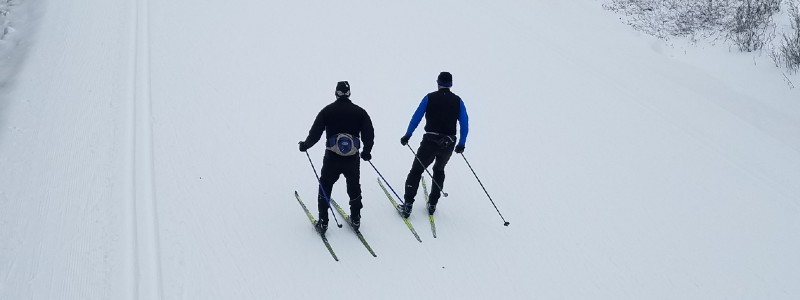
cross-country skiing is effective cross training for cycling
Cross-country skiing is a great way to cross train for cycling while enjoying fresh air and sun. It also helps prepare for a winter triathlon involving running, biking, and skiing.

In the northern USA state where I live, Nordic skiing, or cross-country skiing, and ice skating are popular winter sports. I enjoy both skiing and skating, though have not skied for over 20 years.

Nearly every county park in our area has groomed cross-country ski trails. Larger parks also rent ski equipment (skis, boots, and poles) and offer group and personalized instruction.

Cross-country skiing produces endurance and strength for both the large muscles and the smaller muscles that support the larger muscles. Brett Sutton, coach of world champion triathletes, calls cross-country skiing “the hardest overall body workout out there”.

Downhill skiing is also good for building lower body and core muscle strength and for improving balance and coordination. However, downhill skiing does not yield the endurance benefits of cross-country skiing. Also, it much less accessible and more expensive than cross-country skiing.

“Nordic skiing, or cross-country skiing, is also great cross training for cycling. While downhill skiing brings more strength gains than endurance, Nordic skiing brings more endurance gains along with the added development of supporting muscles.”

ILoveBicycling.com

Classical vs. Skate Skiing

Today, there are two types of cross-country skiing – classical and skate-skiing.

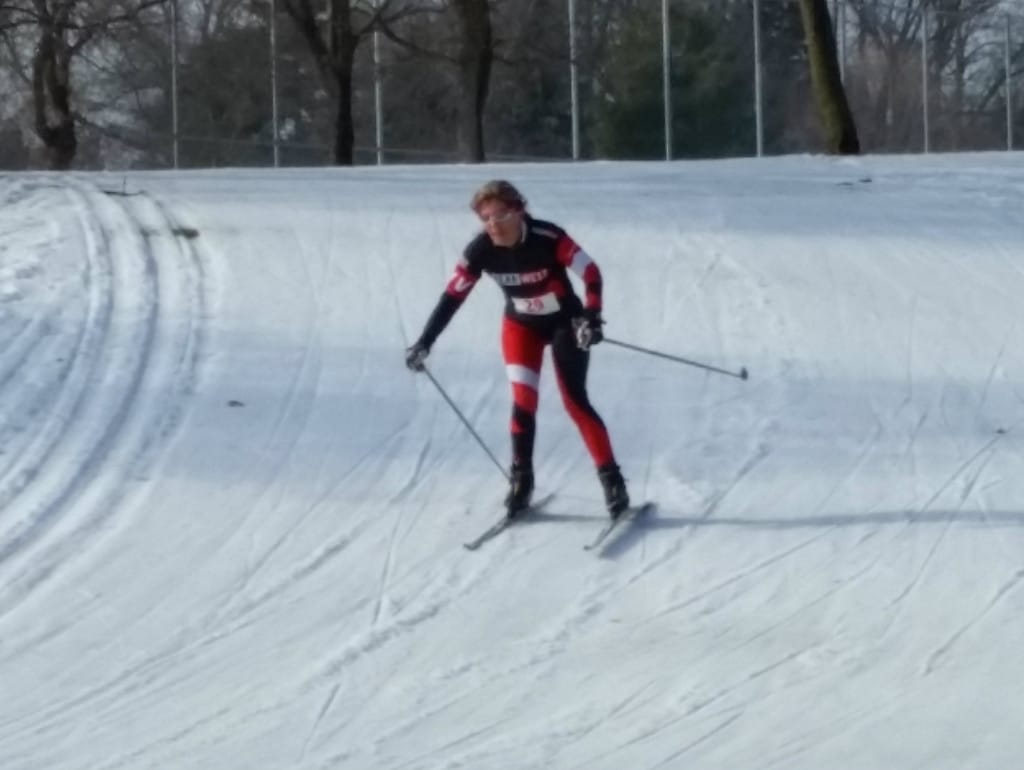
Classical cross-country skiing involves a kick and glide motion. Skis remain parallel to each other, unless ‘snow plowing’. The classical cross-country ski courses are characterized by the parallel ruts in which the skis glide.

Cross-country skiing can also be done on fresh snow, that is, without a groomed trail. Most snow covered walking or bike paths are a candidate for classical skiing.

In contrast, the side-to-side motion in skate-skiing is like that of ice skating. Therefore, it uses muscles even more similar to those for pedaling.

One disadvantage of skate-skiing is that it requires a groomed trail. This makes it less flexible in where it can be done. Skate-skiing is also more difficult because it requires greater balance and coordination. However, it is faster than classical skiing.

Advantages

  • Provides both endurance and strength benefits.
  • Accessible – classical cross-country skiing can be done at your nearest park, golf course, or snow-covered lake. (Be sure the golf course is open for skiing and the ice on the lake is thick enough.)
  • Relatively inexpensive, especially compared to downhill skiing.
  • Gets you outside, into the fresh air and, hopefully, the sun. Think Vitamin D.

Disadvantages

  • While cross-country skiing uses many of the same muscle groups as cycling, you may put more strain on certain muscles and tendons than when biking. To avoid injury, start slow and increase distance gradually.
  • A beginning skier is likely to fall. Expect it and try to relax as you fall to avoid significant injury.

Note

From the reading I did in preparing this post, I have taken the first steps in scheduling cross-country ski lessons at a nearby county park. I am hoping to learn to skate-ski.

Ice Skating

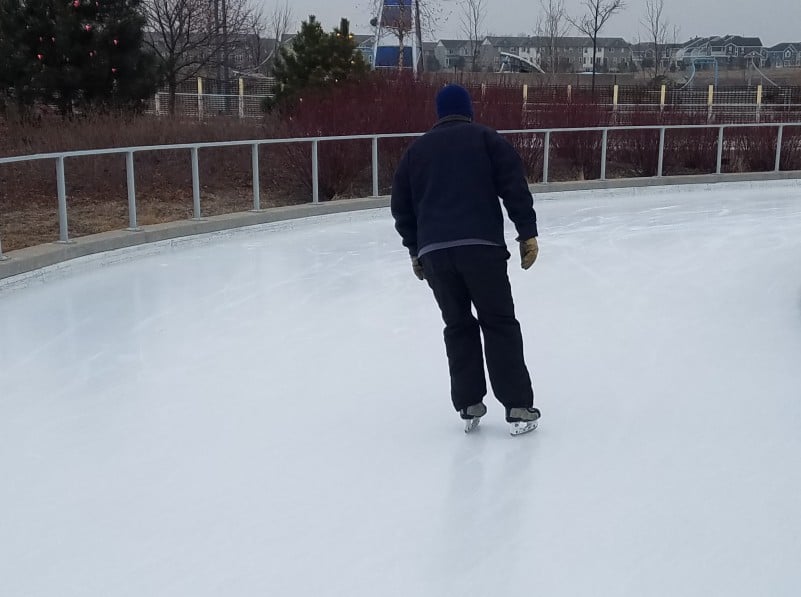
Most cities in the northern climates, large or small, have an outdoor ice skating rink. Elsewhere, given the popularity of ice hockey, many of the more populated areas in the USA and Canada have indoor ice arenas.

Ice skating, like skate-skiing, is great for working smaller muscles that are often overlooked but valuable for biking performance. It is also great for improving balance, flexibility, and coordination.

Ice skating is an effective way to strengthen small muscles often overlooked in strength training yet important for cycling performance.

Advantages

  • Great for strengthening leg and abdominal muscles. Skating is also reported to increase the flexibility of more joints than cycling and running by strengthening ligaments and connective tissue around these.
  • Low impact, unless you jump or spin (or fall often).
  • Relatively inexpensive, often free (after purchasing or renting skates) if you live in a climate where outside temperatures are consistently below freezing. Even small towns typically have an outdoor ice skating rink open to the public.
  • Gets you outside, into the fresh air.

Disadvantages

  • Ice skating requires good ankle strength (which you probably have as a runner). However, you may put more strain on some muscles and tendons of the feet and ankles than when biking. As with any new sport, start slowly and increase gradually.
  • Expect to fall, especially as you begin. At least that’s my experience. However, since I am usually bundled up for the cold, I have seldom been injured and then only with a bump or bruise to my ego.

No Excuses!

None of us has an excuse related to weather for not continuing to train for the bike leg of a triathlon throughout the winter. Even if I stay in the north part of the USA, there are plenty of opportunities inside and outside my house.

Some may actually be better than riding outside.

How Do You Train for Triathlon Biking When You Can’t Ride Outside?

How do you continue training for the bike when you cannot ride outside? Share your comments below.

Too Stubborn to Quit – Marty Hunter’s Story

Have you thought about doing your first triathlon in your 60s? Marty Hunter did and is now on her way to completing an Ironman 140.6 in her 70s.

Introducing Marty Hunter

Maureen ‘Marty’ Hunter lives in eastern Washington, in a region often referred to as the inland Pacific Northwest. She is “currently experiencing the joys of being 70 years old – or young or whatever 70 means.”

Marty discovered triathlon several years ago through a sprint distance race called The Valley Girl. T-shirts given to the racers were so small she put hers on a teddy bear. After that experience, Marty forgot about triathlon. For a while, that is.

As you read her inspiring story of perseverance, think of ways we can better connect with other Senior Triathletes, share specific needs and experiences, and encourage those in our community along their triathlon journey. Please share your thoughts at the end of this post.

Rediscovering Triathlon

After a not-so-inspiring start in triathlon, Marty was reintroduced to triathlon in June 2016. Two friends entered and completed the Coeur d’Alene (CDA) Ironman 70.3 triathlon. Marty and her husband watched both young women finish “along with many other athletes of all sizes, shapes and ages”. 

Marty told me, “l wondered aloud if I could do a race like this, turning to my husband for confirmation and encouragement.  Understanding what I was asking and what undertaking such a goal would mean, he turned a little green and muttered ‘Sure you can’. While there was not an ounce of sincerity in his voice, there was lots of love. We then went to get a beer.”

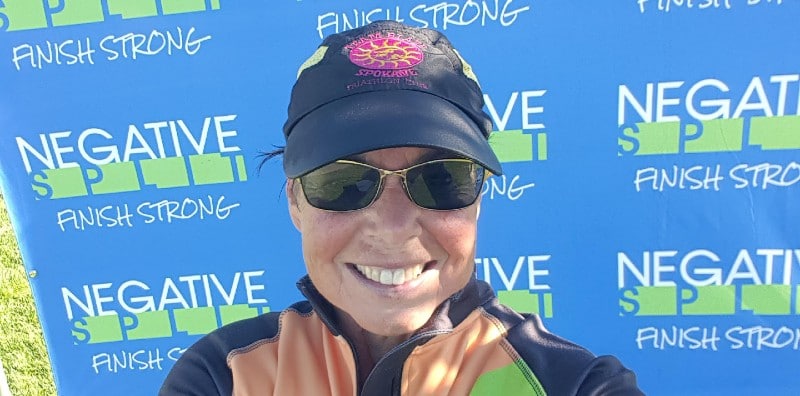
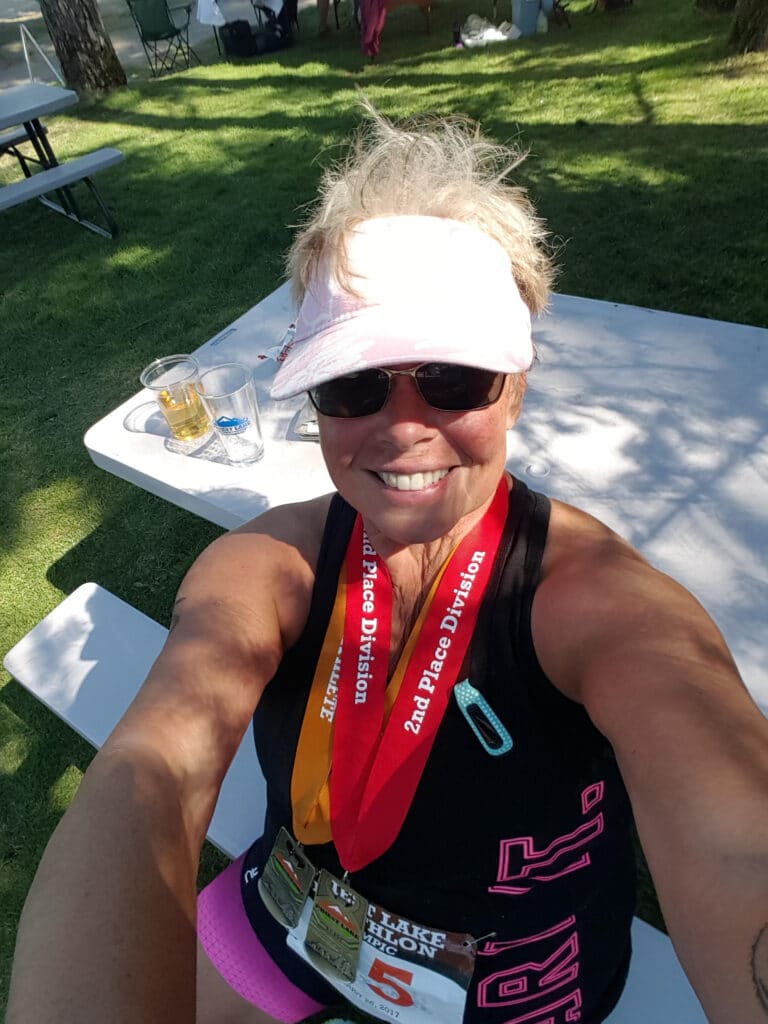
Doing your first triathlon in your 60s.  Marty Hunter started to compete in triathlon while in her 60s.
Marty Hunter after an Age Group podium finish at an Olympic distance triathlon.

Even though neither Marty nor her husband realized it, a fire had been lit inside her that day. “I was unable to silence the powerful internal dragon who had awakened inside me.”

Marty Hunter’s Triathlon Journey – A Rough Start . . .

Marty said, “I finally drummed up the courage to sign up for the 2017 Coeur d’Alene 70.3 race. I committed the money and, I thought, the effort to achieve this amazing goal. 

“Mind you, I have never been athletic. I have fought my weight all my life. I was scared to death, with zero confidence and certain that I would fail”, she said.

Marty joined a couple of triathlon clubs, invested in triathlon gear, took swim lessons, and ran and biked. She also entered an Olympic distance triathlon scheduled for a couple of months before the Coeur d’ Alene race.

In this triathlon, meant to be a ‘warm-up’ for the 70.3 Ironman, she ‘DNF’d’ (Did Not Finish).

. . . Though Never Giving Up

Marty says, “I sobbed as I exited the water and accepted a most needed hug from the goddess who is now my coach. I then went home to sulk.  The next day, I finished that tri by completing the bike and run alone.”

In hindsight, she learned much from the DNF experience, lots which she claims to be still harvesting. 

“I pulled out of the Ironman event acknowledging I was not ready. Instead, I volunteered at this race, which relit the triathlon flame as I watched the many athletes finishing this distance.

“I got to work building my base, trying to quiet the demon voices, listening to my coach and discovering strength that truly surprised me.  Then, at the peak of my most confident month, December 2017, I fell on a treadmill while running, breaking my jaw and hand.

“I got through the surgeries and lost weight and did all the required swim strokes, pedal revolutions, and miles of running to finish the race I had failed to complete a year earlier. I never quit, probably because I was really, really mad to have tripped.”

The Payoff For Not Quitting

The focus and perseverance paid off. In June 2018, Marty completed Ironman 70.3 Coeur d’Alene.

“2018 ended up being a wonderful year for my body, heart and soul.” It was also a turning point on her triathlon journey.

Doing your first triathlon in your 60s.  Marty completed her first half Ironman while in her 60s.
In 2018, Marty completed the Coeur d’Alene Half Ironman after having stubbornly pursued this goal.

Despite a shaky start, Marty never gave up. As of today, she has completed an impressive list of endurance sport events including:

  • Triathlon, various distances
    • Super sprint (2)
    • Sprint (2)
    • Olympic (2)
    • Half Ironman 70.3 (1)
  • Rainier Ragnar trail events (2)
  • Several half marathons
  • Full marathons (3)
  • Endurance swims of 1.76 and 2.2 miles, one each

Sights Set on a Full Ironman

Marty has continued persistent and patient training in the distances of each of the legs of the Ironman 140.6. She has also raced in progressively longer distances with an eye to her next challenge, a full Ironman race.

Her ‘Big Dream’ is to compete in the full distance Ironman Arizona in November 2021 “assuming I can snag a slot with so many deferrals from the 2020 races”.  Since first beginning our conversation, Marty officially became registered for the race.

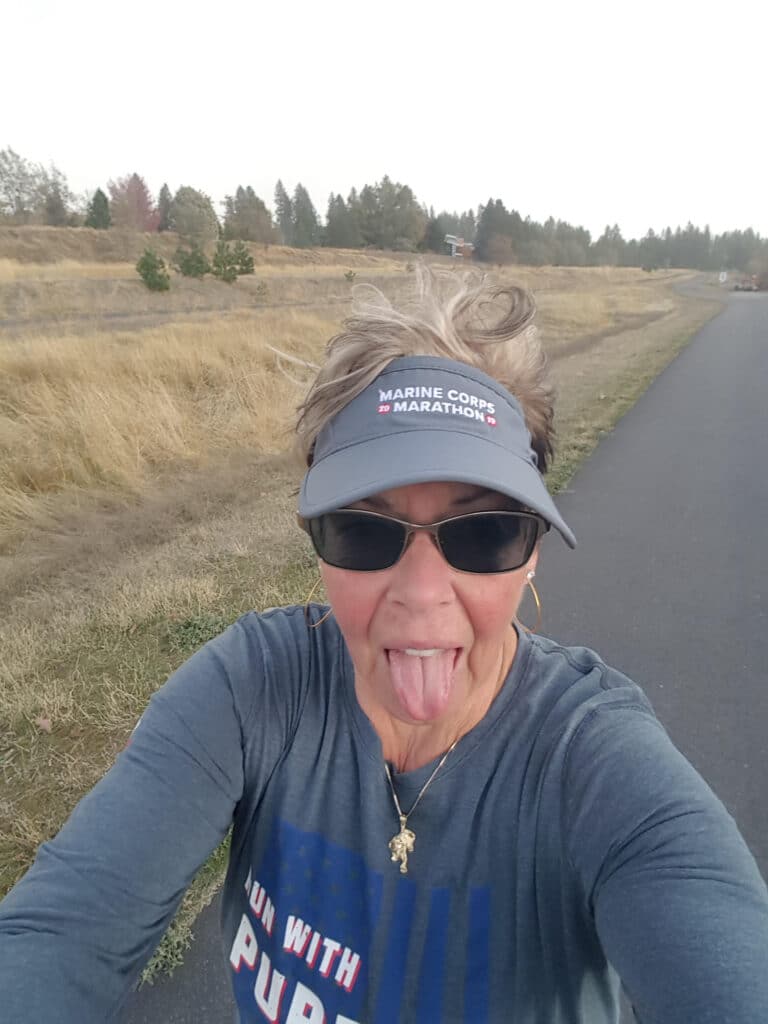
After doing your first triathlon in your 60s, Marty is training for her first Ironman.  This includes running 
full marathons
Marty Hunter after the virtual Marine Corps Marathon completed with friends in Coeur d’Alene, Idaho. Marty trains and races in the individual legs of Ironman triathlon in preparation for her ‘Big Dream’.

Training Approach

I asked Marty the same question I ask everyone who races long course triathlons – how they train. Do they train with a coach, use a purchased training plan, or train based on their own research and planning?

Marty has done a lot of her own research, searching for information and tips about training. However, the key to her success – Marty will never admit that she is successful but I recognize it – has been her “red head, fierce and terrifying” coach who has pushed her to higher levels of performance and provides the right amount of encouragement.

“I need guidance and love having a week-by-week plan.  I also need the encouragement her experience gives me to expect setbacks and issues.  But she also is quite effective at getting me to work harder than I think I can, so that the event itself will be easier.  Coaching fees are something I just consider necessary for my success.”

Training focus

Marty claims that her weakest leg is the bike.

“With our long winters and my concern for riding in traffic during other parts of the year, most of my rides are on the trainer. I don’t build confidence for screaming down hills or dodging potholes without time on the road.”

“The run is the toughest mentally, probably since it’s the last part. That’s why I am working on strategies to cope with the run and to finish strong.”

However, Marty’s greatest struggle is with nutrition. In the context of triathlon, nutrition refers to consuming liquid and solid calories during the race to stay hydrated and fuel the racer’s muscles. “I must get this dialed in to have any chance of finishing 140.6 miles in the time available.”

Marty’s comments about nutrition are more common that you might expect if you have not done a long course triathlon. Here are links to two Senior Triathletes’ posts about Ironman triathletes who also described their struggles with race nutrition.

Lessons in Ironman Triathlon Racing – Another Senior Triathlete’s Experience

A Special Birthday Present – Juha Makitalo’s Story

Advice for Those Over 50

What advice does Marty have for those of us over age 50 who are thinking about competing in a triathlon, short or long?

“Anyone, truly anyone, can compete in a triathlon.  Proper training in all the legs is, of course, crucial as is rest and care of the body.

“Early on, I experienced severe knee pain which ended up in a meniscus repair. During conversations with the surgeon, I learned that pain is a language. 

“While I’m pretty bad at ‘listening to my body’, I am getting better. My ‘Big Dream’ is making me a better listener to my body.”

An Inspiration For Never Quitting and More

A favorite Bible verse of mine is Hebrews 12:1. It contains the phrase “let’s run with endurance the race that is set before us”. Marty’s story reminded me of it.

Marty says, “I have a truly Big Dream and believe I have the desire to make it come true.  I will scan the finisher stats for race information on athletes my age and older.  It is pretty cool to see the stats and to even consider being part of this very, very special group. 

“I’m frequently told I’m an ‘Inspiration’ which cracks me up. Inspiration! Ha Ha! I’m just too stubborn to quit!”

Best wishes, Marty, for achieving your ‘Big Dream’. I am looking forward to the day I can read your finisher stats.

Let’s Encourage One Another

When I first met Marty, she had already been “looking for this tribe [the Senior Triathletes community] for quite a while”. She wrote, “I feel I have found in this group just exactly what I need to proceed on a journey I started in 2016. Thank you all in advance for your help and guidance.”

As you have just read, Marty has a ‘Big Dream’. Please share your words of encouragement and other advice with her in the Comments section below.

Meanwhile, what are ways all of us can better support one another through the Senior Triathletes community? What is it you need for your ‘triathlon journey’, no matter if you are thinking about the sport or are an experienced Ironman athlete?

Please share your questions and thoughts in the Comments below.

error

Enjoy this post? Please spread the word :)