Triathlon Across the USA: State #14 – New Jersey
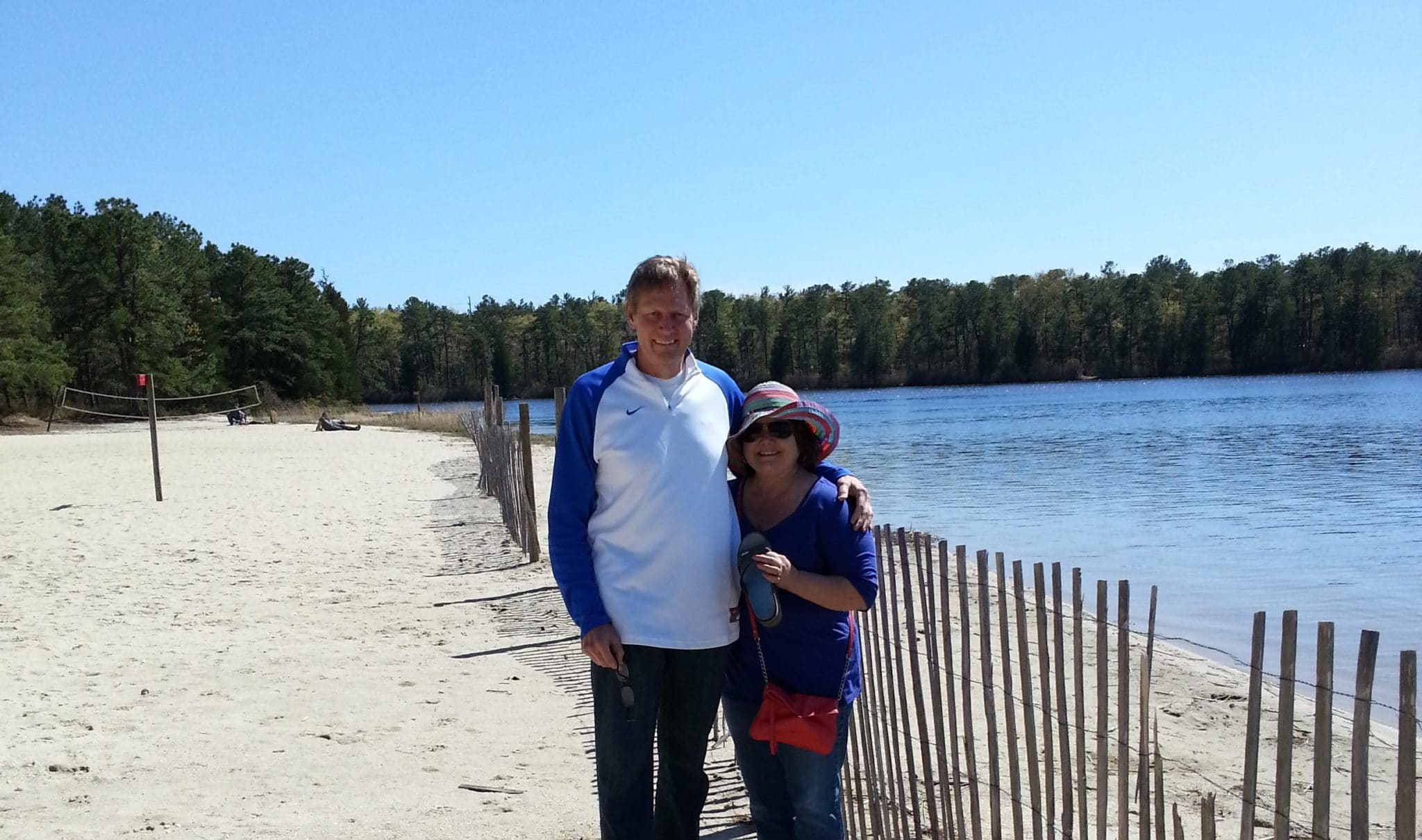
Tuckerton, New Jersey; May 5, 2013–Bassman Sprint Triathlon

Swimming, biking and running in the Garden State (New Jersey) tested my recent triathlon training plan. This triathlon was also the motivation for visiting a part of the Atlantic coast we had not seen before.

This race is one chapter in a 50-state journey—now told in full in Triathlon Adventures Across America .

Planning the New Jersey Triathlon

One goal for the 2013 season was to complete triathlons in New Jersey, Pennsylvania, and Maryland. With these under our belt, we would check off the northern portion of the Mid-Atlantic states in my quest to complete a triathlon in all fifty of the USA states.

This weekend, it was New Jersey. Joy and I would travel to Maryland and Pennsylvania about one month later for triathlons in these two states. This left Delaware, North Carolina, and Virginia, the remaining Mid-Atlantic states, for later.

Travel to New Jersey for a Triathlon

We left our house in Chicopee, Massachusetts early Saturday morning to make the roughly 250-mile trek to Bass River State Forest just west of Tuckerton, New Jersey.

Bass River State Forest, the location of the Bassman Triathlon, is about 100 miles south of New York City and about 30 miles north of Atlantic City, New Jersey, which sits directly on the Atlantic Coast.

On Saturday afternoon, we picked up the race packet at the Bass River State Forest.  While at the park, we took a brief walk to check out Lake Absegami where we would swim the next morning.  We then headed out on the 45-minute drive south to Atlantic City.

A Quick Visit to Atlantic City

While neither of us is a fan of casinos nor gambling, we were curious to see the draw that this city had on Pat and T, two of Joy’s friends from our Chicopee neighborhood.  Twice each year, these two ladies would drive to Atlantic City for gambling and an overnight stay in Pat’s timeshare.
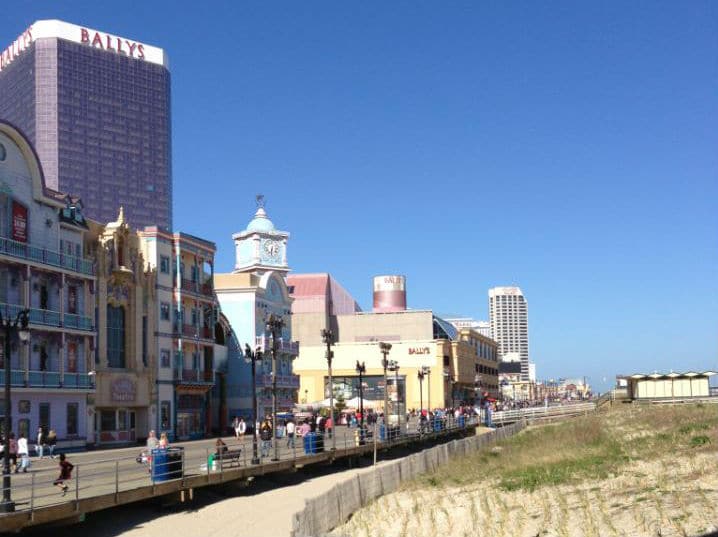
Atlantic City boardwalk.

We drove along the strip, which was lined with a mix of casinos – small and large, simple and opulent.  With the gusty winds and air temperature in the mid-50s °F, not to mention expensive parking, Joy and I took turns walking from a nearby hotel loading dock for a quick look at the famous Atlantic City Boardwalk.

We then headed a couple of miles further up the strip to Brigantine Beach where we stopped for lunch at the Pirates Den.

About six months earlier, Hurricane Sandy had passed through the area. While there was still some debris from Sandy, the beach was in good shape. I can certainly understand the attraction of these sandy beaches, especially in warmer weather.

After a short tour of Brigantine, we headed to our hotel, the Holiday Inn Manahawkin/Long Beach Island, for last-minute preparations for the triathlon and for an early dinner.  Remember my motto: “The early triathlete gets the best spots in transition.”

6th Annual Bassman Sprint Triathlon

It was a busy day for the people of City Tri who managed the race.

The Bassman event included three triathlon distances (half Ironman, Olympic, and sprint) as well as half Ironman and Olympic distances of a duathlon (run-bike-run) and aquabike (swim-bike).

Distances for the individual legs of this USAT-sanctioned sprint triathlon were:

  • Swim: 0.35 mile (620 yds or 560 m)
  • Bike: 12.5 miles (20.1 km)
  • Run: 3.1 miles (5 km)
Lake Absegami Day Use Area of the Bass River Forest, venue for the New Jersey triathlon
The Bassman Triathlon transition area and swim were in the Lake Absegami Day Use Area of the Bass River Forest.

Swim

The air temperature on race morning was still in the 50s °F. With the temperature of the Lake Absegami water reported to be around 65ºF, the race was ‘wetsuit-legal’.  In fact, the race director encouraged triathletes to wear a wetsuit during the swim.

I started out too fast in the swim, which led to a moment of panic as I became light-headed. The congestion I had been battling during the previous week probably didn’t help.

After slowing my stroke rate, which allowed my heart rate to drop a bit, I was able to resume the swim without any further difficulty.

Triathlon Tip: One reason I now take a short swim just before the start of a race is to get my heart rate up.  When the gun goes off, I can start swimming already partially warmed up.
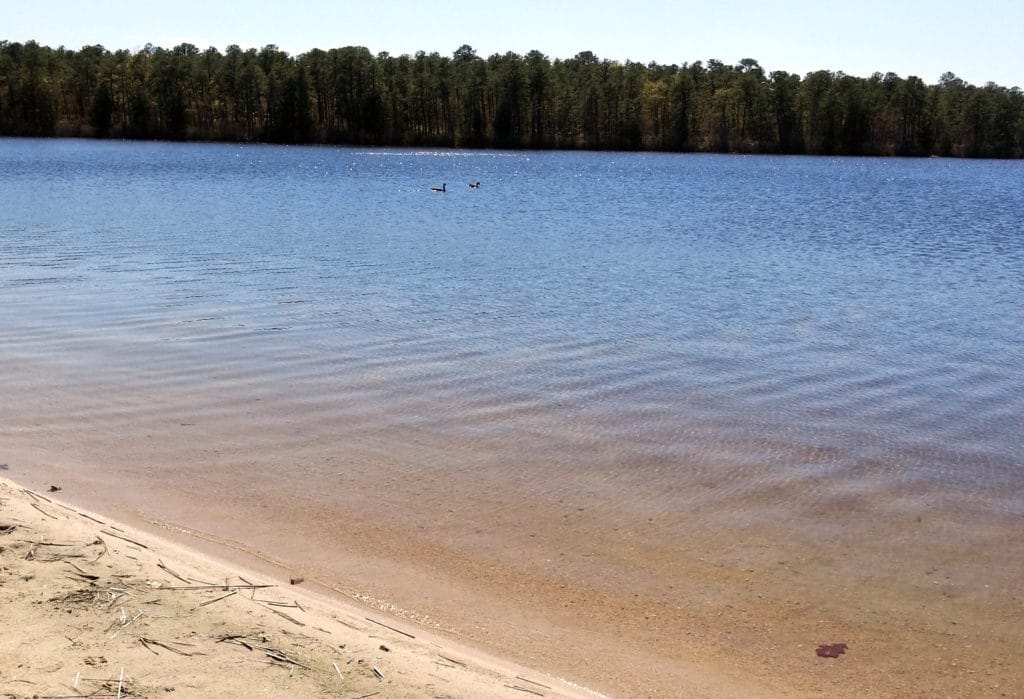
The swim for the Bassman triathlon was in Lake Absegami.
The open water swim for the Bassman triathlon was in Lake Absegami.

A Slightly Different Approach to Timing

If you are not familiar with the transition part of a triathlon, you can feel free to skip this section.  Or, you can learn about triathlon transition in How to Achieve Faster Transition Times.

Anyway, back to the race.

It was a short run from the exit of Lake Absegami to the transition area.

For this race, there was only one timing mat for the transition area.  Normally, there are two timing mats, one at each end of the transition area.

The swim time officially ended upon crossing the timing mat and entering the transition area.  Bikes exited the opposite end of the transition area where there was no timing mat.  Upon completing the bike leg, athletes entered the transition area where they had previously entered after the swim.    Crossing the timing mat officially ended the bike leg and started the run leg.

As a result, the T1 (transition from swim to bike) and T2 (transition from bike to run) times were included in the bike and run times, respectively.

Bike

The bike portion of the race included a loop out of the park onto local roads.  The loop rejoined the original portion with about two miles back to the transition area.
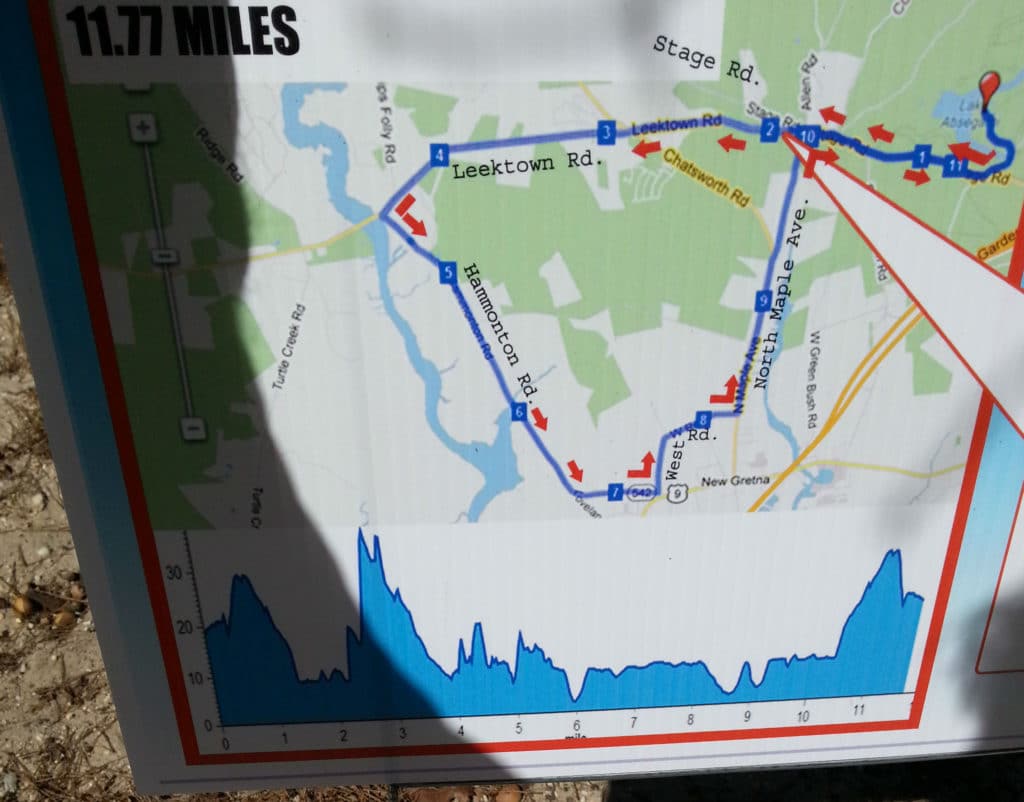
Map of Bassman sprint triathlon bike course
The bike course for the Bassman Triathlon was a loop on roads outside Bass River State Forest

As suggested by the map, the view from the bike was mostly forest, with the occasional body of water. Picturesque. The course was relatively flat, with the maximum difference in elevation of just over 30 ft (9 m).

The most unique ‘scenery’ was near the end of the course. We passed two large turkey vultures cleaning up a deer carcass. The animal had probably been hit by a car and was now lying on the shoulder of the road. The vultures seemed unfazed by the many bikers who passed within a few feet of them.

Run

The 3.1 mile (5 km) run in the Bass River Forest was on a combination of dirt, hiking trails, and park road.

In no way bragging, I sweat during typical races as much as anyone. With that wonderful word picture in mind, the fact that I did not break a sweat until the very end of the run tells you a lot about the temperature during the race.

In fact, my feet were almost numb during the run.  The good news is that the cool temperatures helped me to achieve the run pace that I had set for races this season.

After the New Jersey Triathlon

Much to my surprise, I was the first finisher age 60 and over (my age group was 60-64).

As a result of the finish, this was the first time that I qualified for the USA Triathlon National Championships.  Finishers in the top 10% of their age group automatically qualify for Nationals.

About New Jersey, the ‘Garden State’

When those of us from the Midwestern USA think of New Jersey, we most often picture the sprawling metropolitan areas like Newark from which you can see New York City across the Hudson River.

While driving back to Massachusetts from Bass River Forest, we were struck by the contrast between the massive green areas found throughout most of New Jersey and the asphalt and concrete covered areas of the more well known metropolitan areas.

New Jersey is called the ‘Garden State’ for good reason.  Get away from the major cities and you see the importance of fruit and vegetable farming.

Race Firsts

  • First race in which I finished first in my 60-64 age group and qualified for USAT Nationals
  • Vultures picking at a dead deer lying alongside the bike course was a first.
  • First race in which I did not break a sweat until the very end of the run.
Triathlon Adventures Across America book cover

A Story That Resonates

“A must-read for every athlete and retiring business executive committed to living healthy.”

Discover the complete story

Have You Done a Triathlon in New Jersey?

Tell us about your favorite or most memorable triathlon in the Garden State. Leave your Comments below.

Comments: We’d love to hear about your experience. Join the conversation below. All comments are reviewed before they appear.

Reply notifications: Click the bell icon above Post Comment to be notified when someone replies to your comment.

Follow the discussion: Click Subscribe above the comment box and enter your email address to receive notifications whenever a new comment is added—even if you don’t leave a comment. After subscribing, check your email and click Confirm to activate notifications.

Triathlon Across the USA: State #19 – Wyoming

Gillette, Wyoming, May 3, 2014 – Razor City Splash & Dash Triathlon

The Razor City Splash & Dash Triathlon in Gillette, Wyoming was the opportunity to visit family, explore eastern Wyoming, and enjoy our 15 minutes of fame.

This race is one chapter in a 50-state journey—now told in full in Triathlon Adventures Across America .

Why a Triathlon in Gillette, Wyoming?

Joy’s and my plans to compete in the Razor City Splash & Dash Triathlon, my first of the 2014 season, were cemented with mailing a check to the Campbell County Parks & Recreation on January 10, 2014.

Why this triathlon?

If you have read “How to Choose Your Next Triathlon”, you may have already guessed that there was a connection to family or friends weaved somewhere into the story.

If you have not read the earlier post, please do so later.  For now, I’ll give you the short version of the answer to the above question.

First, Wyoming was one of the states in which I had not completed a triathlon.

More importantly, Gillette was a short drive past Rapid City, South Dakota. Rapid City was the summer home of Joy’s dear Aunt Evelyn.  Evelyn learned that she enjoyed being a triathlon spectator during the Catching Cupid Triathlon in Mesa, Arizona (State #12).  She was more than ready to watch another race.

Travel to the Wyoming Triathlon

Joy and I left our Minnesota home on Thursday evening, spending the night in Mitchell, South Dakota, home of the world famous Corn Palace.   We rose early the next morning, reaching Rapid City in time for lunch with Aunt Evelyn.

While we had planned to pick up Evelyn on the way to Gillette – and she was looking forward to the trip – health problems prevented her from joining us.  Nevertheless, we were able to visit with her both on the way to and from Gillette.

After lunch and some ‘catching up’, we made the roughly two hour trip to Gillette.  Arriving mid-afternoon allowed us to prepare for the race, pick up the race packet, and explore the area a bit before having an early dinner at the Prime Rib restaurant.

Learning About Gillette

Gillette is named after Edward Gillette, an engineer and surveyor for the Chicago, Burlington and Quincy Railroad who in 1891 recommended the eventual route of the railroad.

But, what about the ‘Razor City’ nickname that is the basis for the triathlon’s name?

Legend has it that the ‘Razor City’ nickname came from association of the Gillette family name with that of the company that manufactures razor blades.

The more popular nickname for Gillette today is ‘Energy Capital of the Nation’.  This name recognizes the city’s central location within an area from which large quantities of coal, oil, and coal bed methane gas have been obtained.

One fact about Gillette relevant to the triathlon is its altitude.  Like many western USA cities, Gillette is located at an elevation significantly higher than that of my home state of Minnesota.  For this race, the average altitude was 4,550 to just over 4,600 feet.

11th Annual Razor City Splash & Dash Sprint Triathlon

The race is one of several run by Campbell County Parks & Recreation (CCPR).  You can find information about the next triathlon and other races sponsored by CCPR here. I challenge you to find a lower cost triathlon.

Distances for the individual legs of this sprint triathlon were:

  • Swim: 0.51 mile (900 yds or 823 m)
  • Bike: 11.3 miles (18.2 km) as measured from my bike computer (officially listed as ‘approximately 12 miles’)
  • Run: 3.1 miles (5 km)

Race Day

We rose early to reach the Recreation Center for the opening of the transition area.  In fact, we arrived before the race staff.

After setting up my transition area, I chatted with the race director.  During the conversation, I shared with him that this race was the Wyoming triathlon in our 50-states quest.

As more racers began to arrive, the conversation turned to other topics.   Before I knew it, we were in the aquatic center for the pre-race meeting.

Swim

Gillette is blessed with an incredible pool, the location for the triathlon’s swim leg.  For the triathlon, the Olympic size pool (50-yard length) was configured as a 25-yard pool with 20 lanes.

Triathletes-awaiting-the-swim-start
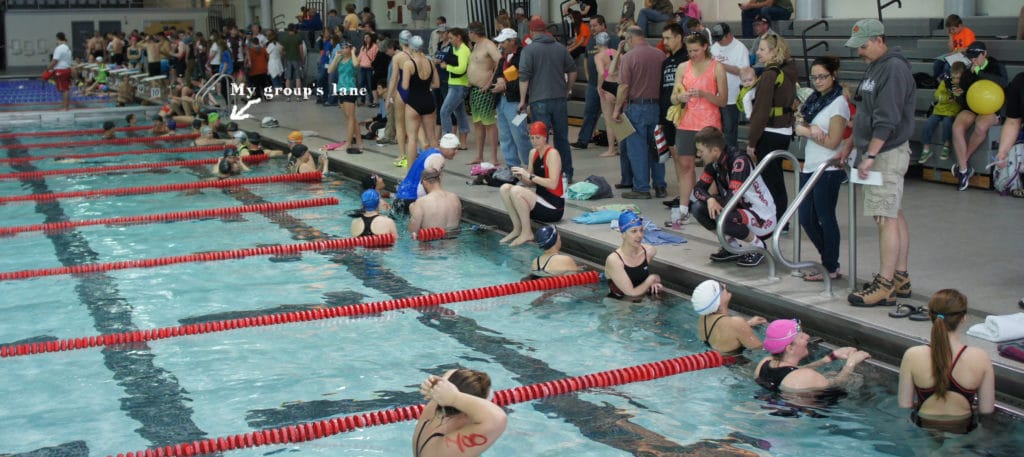
Razor City Splash & Dash triathletes awaiting the start of the swim leg. I added text (in white font) showing my lane. (Photo courtesy of Razor City Splash & Dash Triathlon.)

The swim for this race involved five triathletes in each lane, all who had estimated similar times for their swim.  The entire 900 yards of the swim occurred within the same lane with the same five swimmers, in this case, four young ladies and me. 

Each swimmer was responsible for providing a person to count their laps.  Filling this need for me, Joy ticked off one more volunteer performance.

My swim time was actually almost three minutes faster than I had estimated at registration.  I am not sure how this happened but it was a pleasant surprise.   On several occasions, I had to slow down because of congestion in the lane.

Bike

For the bike leg, we left the transition area outside the aquatic center and headed onto a city street.  From the course map, the route looked more or less like a capital letter ‘T’ with the starting point near the bottom of the vertical section.

The course involved an out and back route with two turnarounds, one corresponding to each of the two ends of the top, horizontal section of the ‘T’.

What is missing from the simple description of the course as a flat letter ‘T’ are the four steep climbs (and descents) and rolling hills. These made this short course a bit more challenging though still quite fast.

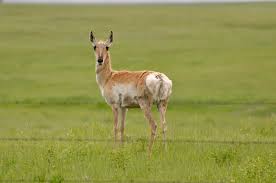
One of the unique memories of this race was the pronghorn deer in the field alongside the course.  With the deer separated from the road by a fence, there was little danger of them running onto the course.  It’s just that you don’t see deer, nonetheless pronghorn deer, during every triathlon.

Pronghorn-deer-at-Razor-City-Splash-and-Dash-Triathlon
Pronghorn Deer were among the spectators of the Razor City Splash & Dash Triathlon

Run

The 3.1 mile (5k) flat run course took us through a quiet neighborhood of Gillette.  The course left from the eastern side of the Recreation Center parking lot, looped around streets south and eventually southwest of the Center, returning to the Center parking lot and finish line.

15 Minutes of Fame

Since I was the only participant over 60 years of age, I was able to claim a first place age group prize.  When announcing my ‘win’, the race director also announced Joy’s and my mission to cover the USA through triathlon.

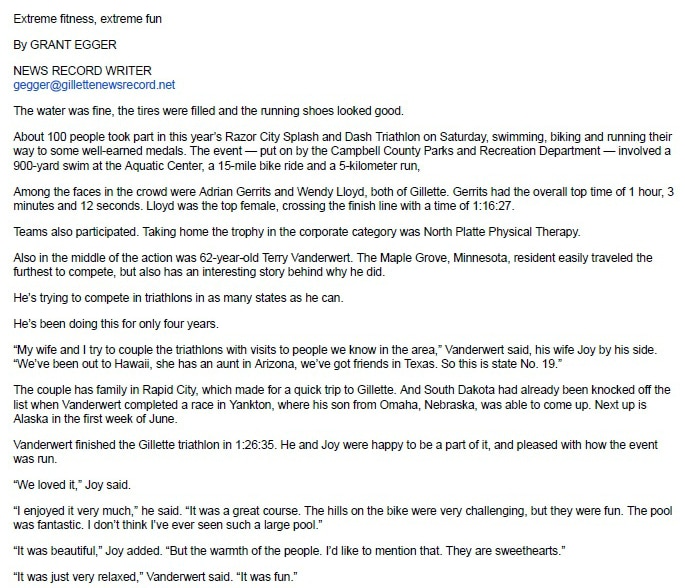
Following the awards ceremony, Grant Egger, a reporter for the Gillette News Record, informed us that he was writing a story about the Splash & Dash.  Of course, we agreed to his request for an interview.

A few days later, I received a copy of the newspaper article in my e-mail. 

Gillette-News-Record-article-about-Razor-City-Splash-and-Dash-Triathlon
Gillette News Record article about the Razor City Splash & Dash Triathlon

A Final Stop in Rapid City

We left Gillette at 12:15 pm Mountain Time for our first stop, Rapid City.  Our mission was to pay Aunt Evelyn another visit, this time with an update on the triathlon.

Being an experienced triathlon spectator, she asked all the right questions.  After getting her caught up and enjoying some snacks, we said our farewells and headed toward Minnesota.

Three months later, Evelyn had passed away.   We were blessed to have been allowed time with her during this trip.

Race Firsts

  • First timing biking past Pronghorn Deer.
  • I was the oldest participant for this race, another first.
  • First race in which Joy and I were interviewed by a local newspaper reporter after the race.
Triathlon Adventures Across America book cover

A Journey Beyond This Race

“Uplifting, real, and full of heart—I couldn’t put it down.”

Read the full journey in Triathlon Adventures Across America

Have You Done a Triathlon in Wyoming?

Wyoming is such a beautiful state. I have loved it since visiting Jackson Hole, the Grand Tetons, and Yellowstone Park as a child.

Have you done any triathlons in Wyoming? If so tell us which one and what you learned from it in the Comments section below.

Comments: We’d love to hear about your experience. Join the conversation below. All comments are reviewed before they appear.

Reply notifications: Click the bell icon above Post Comment to be notified when someone replies to your comment.

Follow the discussion: Click Subscribe above the comment box and enter your email address to receive notifications whenever a new comment is added—even if you don’t leave a comment. After subscribing, check your email and click Confirm to activate notifications.

Triathlon Across the USA: State #34 – Louisiana

Youngsville, Louisiana; October 1, 2017—Sugarman Triathlon, Sugar Mill Pond.

I had not originally planned to compete in a triathlon in Louisiana during 2017. However, a race in a western state that was part of my original plan did not take place. Then there was Hurricane Harvey.

The October 1st date of the Sugarman Triathlon fit nicely into our plans to visit Florida for our wedding anniversary. Besides, its location in western Louisiana provided us the opportunity to meet a friend who had been through a horrific time with Hurricane Harvey and its aftermath.

While our friend lived in Katy (Houston), Texas, she had been commuting to Baton Rouge, Louisiana for work for over a year. Youngsville provided a perfect meeting point for a face-to-face visit to get caught up.

This race is one chapter in a 50-state journey—now told in full in Triathlon Adventures Across America .

Getting to the Louisiana Triathlon

Joy and I left our Minnesota home at a little before 6 am on Friday morning. With a new audiobook playing on the radio, we headed toward Little Rock, Arkansas, where we would spend our first night. The overnight stop in Little Rock meant we were roughly two-thirds of the way to the race venue in Youngsville (Lafayette), Louisiana.

We finished the trip to Youngsville the next day, arriving in plenty of time for packet pickup. Following this, we made a quick tour of the race venue around Sugar Mill Pond. We finished the evening with our friend from Texas around some authentic Cajun cuisine at Poor Boy’s Riverside Inn.

Poor Boy’s Riverside Inn in Broussard, Louisiana
Poor Boy’s Riverside Inn. If you happen to visit, be on the lookout for the ‘pet’ raccoons looking for hand-outs near the entrance.

8th Annual Sugarman Triathlon

2017 was the 8th annual running of Sugarman Triathlon.  Like many triathlons, Sugarman doubled as a fundraiser.

For this race, the proceeds benefited two causes important to the area – the Jacob Crouch Foundation for suicide prevention and TRAIL (Transportation Recreation Alternatives In Louisiana), an organization aimed at “building and maintaining opportunities for outdoor recreation”.

Distances for the individual legs of this USAT-sanctioned sprint triathlon were:

  • Swim: 0.3 mile (500 m)
  • Bike: 15 mile (24 km)
  • Run: 3.1 mile (5 km)

Participants had the choice of racing within Age Groups, in Relays, or as Clydesdale (male) and Athena (female).

Transition

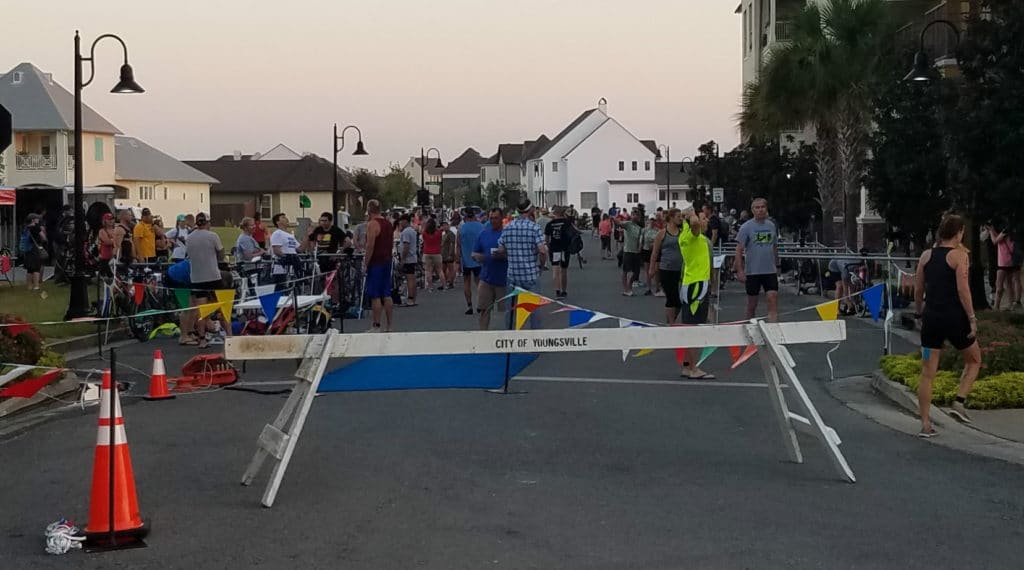
The transition area for the nearly 200 participants occupied the space on Waterview Street between Shore Drive and Prescott Boulevard, in front of the Sugar Mill Athletic Club.

Racers were assigned a rack based on our race number. As is customary, we racked our bikes alternately facing one of the two transition area exits. For example, if the bike occupying the end position faced toward the ‘Bike Out’ end, the next bike would be racked to face opposite this, or toward the ‘Run Out’ location.

Transition area for Sugarman Triathlon on race morning from the ‘Run Out’ end.

How Do You Setup Your Transition Space?

You may have heard the saying, “you cannot win a triathlon in transition, but you can lose it.” Any time spent in transition is just as important as time taken in the individual legs of the race.

Shaving a minute from your transition time is just as good as reducing your swim or bike or run time by a minute.

How To Achieve Faster Transition TImes

One key to faster transition times in a sprint distance triathlon is keeping the setup of the transition area simple. The video below shows how I setup my transition area for this and most other sprint distance races. Simpler is faster.

Video describing setup of my transition area at Sugarman Triathlon.


Before the Start

Race organizers set a pleasant tone for the event, especially during the final moments before the first racers hit the course. Participants, volunteers, and spectators all came together at dockside alongside Sugar Mill Pond. Here, everyone joined in reciting the pledge of allegiance, singing of the National Anthem, and prayer.

Congratulations to the young lady to lead us in the National Anthem. What a beautiful voice!

Swim

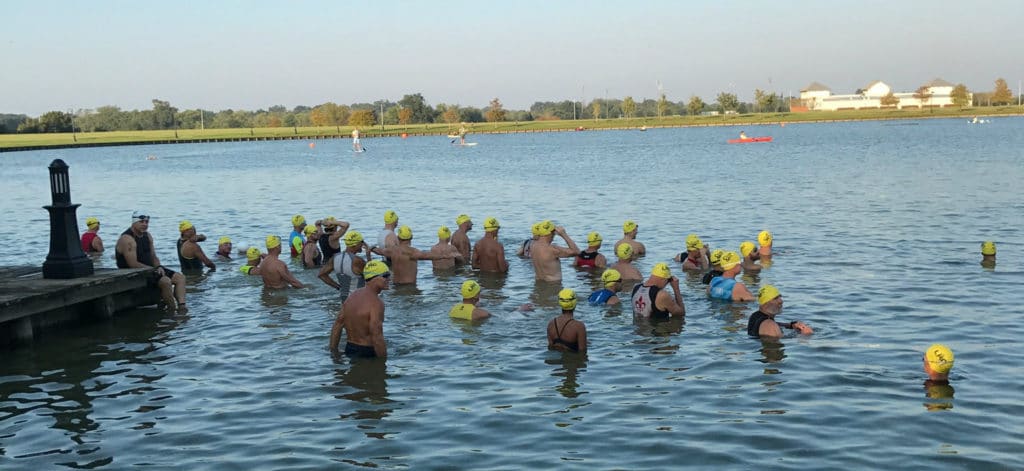
The swim was an in-water start with participants beginning in groups based on gender and age group. The first group (also referred to as the ‘first wave’) included all males aged 50 and over and all Relay participants.

Awaiting the swim start at Sugarman Triathlon.
50 and over male Age Groupers and Clydesdales and swim participants of Relay Teams awaiting the swim start at Sugarman Triathlon.

Swimmers followed a counterclockwise course around a series of buoys that led us to the exit a few hundred yards south of our starting location.

Bike

The 15-mile bike course was well marked and staffed with many volunteers and members of the local police department. There was no question about the course or the safety of the participants. The out-and-back course was nice and flat.

However, the less than ideal road conditions, with many asphalt repairs, kept us “on our toes”. These repairs meant lots of rough patches for those of us who obeyed the call to stay to right.

Fortunately, my fellow racers were forgiving. This was especially true for the guy who I pulled in front of to avoid an exceptionally rough area. 

Thank you, sir. You are a gentleman.

Run

The temperature just before the start of the race was in the low 70s °F. However, it shot up quickly. By the time I finished the run, the temperature was somewhere in the upper 80s and very humid.

Such conditions are not unusual, or even considered hot, for those who live in the South. However, for me, a Minnesotan, the upper 80s with high humidity represents a condition in which I usually say “Maybe later” to running.

My run was slow, with stops at each of the many aid stations. Despite taking a glass of Powerade at each of these, I experienced a cramp in my hamstring with about a half mile to go.

Thankfully, an answer to my quick prayer came as relief from the cramp. I finished the final 1/2-mile of the run around the pond with a respectable sprint through the dockside finish line.

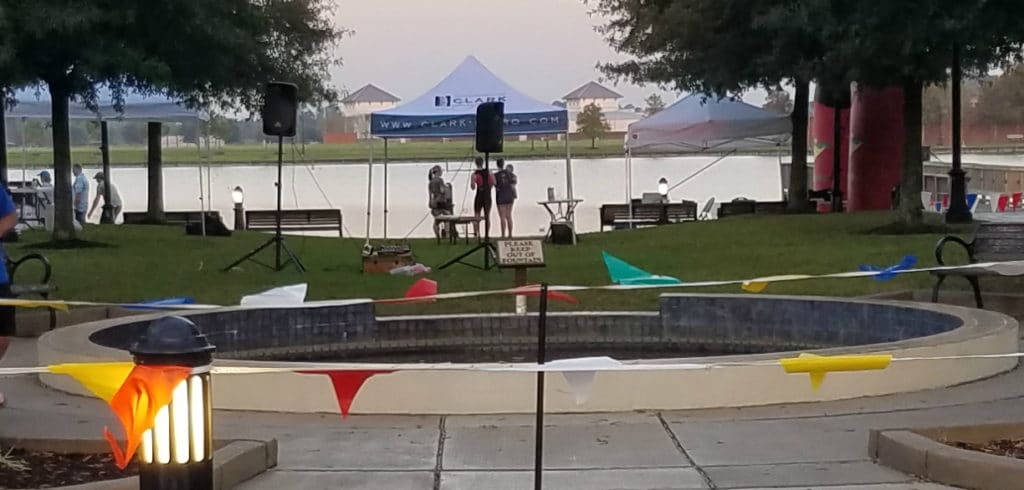
The finish area for the Sugarman Triathlon was in the park next to Sugar Mill Pond.
The finish area for the Sugarman Triathlon was in the park next to Sugar Mill Pond (in the background). The red inflatable at the upper right (seen beneath the tree branches) marks the finish line.

After the Race

With the race finished, Joy and I attended the 11am service at the Bayou Church. Not only did we enjoy the worship and fellowship with other believers, but helped to celebrate the pastor’s 33rd anniversary as pastor. This was another opportunity to experience Acadiana (French Louisiana).

From here, we continued our journey to The Villages, Florida, where we would spend the next two weeks.

Race Firsts

  • First race within a planned residential neighborhood.
  • First race involving swim in a man-made pond.
  • Roundabouts on the bike and run courses was another first.
Triathlon Adventures Across America book cover

A Journey Beyond This Race

“Uplifting, real, and full of heart—I couldn’t put it down.”

Read the full journey in Triathlon Adventures Across America

Comments

Where in Louisiana have you done a triathlon? What did you learn from this race?

Please share your comments below.

Comments: We’d love to hear about your experience. Join the conversation below. All comments are reviewed before they appear.

Reply notifications: Click the bell icon above Post Comment to be notified when someone replies to your comment.

Follow the discussion: Click Subscribe above the comment box and enter your email address to receive notifications whenever a new comment is added—even if you don’t leave a comment. After subscribing, check your email and click Confirm to activate notifications.

Triathlon Across the USA: State #10 – New Hampshire

Rye, New Hampshire; September 23, 2012 – Wallis Sands Triathlon, Rye Beach at Wallis Sands State Beach.

I started this triathlon, the second in as many days, differently than previous ones. I had fresh scrapes on my right arm and right knee. My right shoulder was also injured. After this race, I would not swim for four months while my shoulder healed.

The injuries resulted from a bike crash a day earlier in the Newport 19.7 Triathlon in Newport, Rhode Island. On a positive note, I had a new front tire and tube, thanks to the previous ones being destroyed by a knife-like object I had apparently run over early in the bike leg of that race.

I was glad that my injuries weren’t so severe that they were going to stop me from competing,

This race is one chapter in a 50-state journey—now told in full in Triathlon Adventures Across America .

Getting to the New Hampshire Triathlon

Joy and I left Newport, Rhode Island, late Saturday morning of the day before the Wallis Sands Triathlon. We drove the 140 miles north to the Trek Bicycle Store in Portsmouth, New Hampshire, the triathlon’s main sponsor and location for packet pickup.

Since I was at the shop, I asked a technician to look at my Trek SpeedConcept bike for any damage from the crash. He showed me a large cut in the front tire. My only option was to have the tire replaced.

Following packet pickup, replacement of the front tire, and a lunch of fresh seafood, we drove the bike course checking out the road conditions. One thing that struck us was the number of cyclists, literally hundreds. To this day, I have never seen an area with so many cyclists sharing the road with cars and trucks.

Before heading to the hotel, we stopped at a local pharmacy to purchase a tube of liquid bandage. Joy applied it to the main cuts and scrapes once we had settled in our room.

3rd Annual Wallis Sands Triathlon

Just under 400 men and women competed in the third running of the Wallis Sands Triathlon sponsored by Trek Portsmouth.

Distances for the individual legs of this USAT-sanctioned sprint triathlon were:

  • Swim: 0.33 mile (530 m)
  • Bike: 14.5 mile (23.3 km)
  • Run: 3.1 mile (5 km)
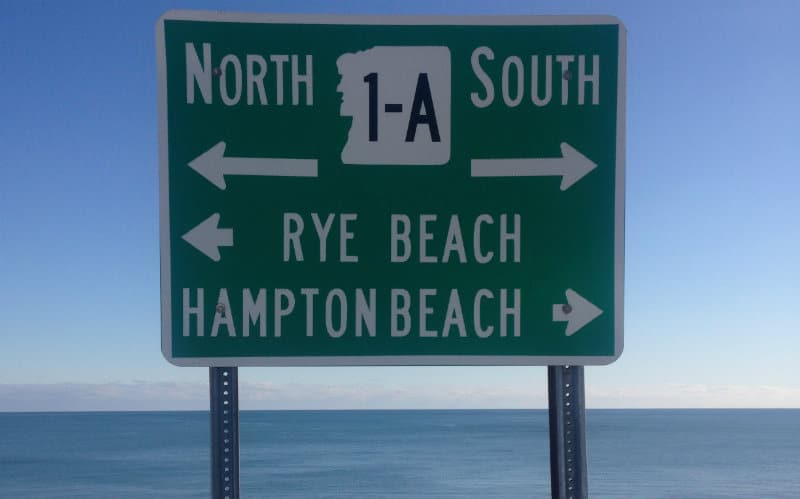
sign for Rye Beach location of the New Hampshire triathlon
Rye Beach, site for the Wallis Sands Triathlon, is on US1-A

Swim

One of the distinguishing features of this race was the swim. The water was “freezing” cold, in the mid-60s °F, making the race definitely ‘wetsuit legal’. Despite this, there were still some hardy souls swimming in only triathlon shorts, without a shirt!

The waves of the surf on race morning were 7 to 8 feet (2.2 to 2.4 meter) high. Just so you don’t think I am a sissy, the race organizers announced that the waves on this day were the highest they had seen all summer.

During the warm-up swim, I learned that getting past the cresting waves was nearly impossible through a frontal attack. Thankfully, the race director gave those of us not experienced with swimming in such conditions some simple advice for getting past the waves and beyond the surf. “Swim under the waves”.

Following this advice made all the difference. Swimming under a wave before it crashed made it straightforward to get into open water where most of the swim occurred. Of course, coming back to shore was much easier, much like body surfing.

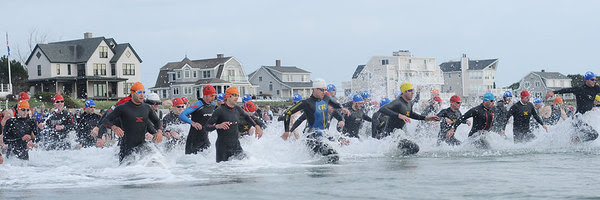
Swim start at Rye Beach New Hampshire
Swim start at Rye Beach. (Photo courtesy of TriME.)

Bike

The ‘flat and fast’ bike leg began and ended on US1-A, where we road between the Atlantic Ocean (on our right side) and houses as shown in the background of the above picture (on the left side).

Leaving Rye Beach, the course consisted of a two-mile ride north on US1-A before turning inland toward the town of Rye and its adjacent neighborhoods. At about mile 10, the course rejoined US1-A south of Rye Beach for the final four and a half miles back to the transition area.

Run

The out-and-back run course also left Rye Beach north on US1-A, with a turnaround at Odiorne Point State Park. From here, it was back to the finish line at Rye Beach.

I made one short stop during the first mile to remove a small rock from my shoe. However, after this, I was able to finish the run with a respectable (for me) time and average speed.

One lesson that I took from this race is that I should wear socks during the run when the air temperature is cold (as it was in this case). My bike shoes are porous to allow air to flow through them. Under normal circumstances when the air temperature is higher, this is good. However, today, my feet were cold after the bike leg. While I normally run without socks (see How to Achieve Faster Transition Times) in sprint triathlons, doing so with cold feet is uncomfortable.

Results

I am not sure what is ‘in the water’ in Rye, New Hampshire. This race will likely go down as one of the fastest in which I have taken part. Despite respectable times for me, times which led to top three finishes in my age group in several other races, I ended up 13th of 16 in my age group.

Race Firsts

  • First time completing sprint triathlons on consecutive days.
  • This race was the first with a swim in the surf of the Atlantic Ocean.
  • First race with bike and run portions on scenic US Highway 1-A.
Triathlon Adventures Across America book cover

A Journey Beyond This Race

“Uplifting, real, and full of heart—I couldn’t put it down.”

Read the full journey in Triathlon Adventures Across America

Leave Your Questions and Comments Below

Have you raced in New Hampshire? Did an open water swim in the Atlantic Ocean? Tell us about your experience in the Comments below.

Comments: We’d love to hear about your experience. Join the conversation below. All comments are reviewed before they appear.

Reply notifications: Click the bell icon above Post Comment to be notified when someone replies to your comment.

Follow the discussion: Click Subscribe above the comment box and enter your email address to receive notifications whenever a new comment is added—even if you don’t leave a comment. After subscribing, check your email and click Confirm to activate notifications.

error

Enjoy this post? Please spread the word :)