Triathlon Across the USA: State #39-Georgia

Buford, Georgia; September 23, 2018 – Lake Lanier Triathlon, Lake Lanier Islands Resort.

About an hour’s drive northeast of downtown Atlanta is the “something for everyone” Lake Lanier Islands Resort, home of the Georgia triathlon in our Triathlon Across the USA adventure.

This race is one chapter in a 50-state journey—now told in full in Triathlon Adventures Across America .

Getting to the Georgia Triathlon

The Georgia triathlon was the third of five triathlons completed in as many states during consecutive weekends in the fall of 2018.

Following the Dixie Triathlon in Huntingdon, Tennessee, Joy and I drove to The Villages, Florida where we relaxed in the hospitality of our friends, Don and Sue.

Before we knew it, the week had passed and it was time to make the drive to Georgia.  We said our farewells on Friday morning and headed toward a suburb a little south of Atlanta, where our nephew Joe, his wife, Alaina, and daughter Ruby treated us to a wonderful evening.

After brunch on Saturday morning, we headed toward Lake Lanier Islands Resort for the triathlon.

14th Lake Lanier Islands Triathlon

While the race took place on Sunday, the race director required that we drop off our bikes on Saturday afternoon. In hindsight, this was probably necessary given the number of racers (around 550) and the parking restrictions we found on race morning.

A Lesson in Bike Maintenance

During the Dixie Triathlon, the chain of my bike had come off while down-shifting before a steep hill. I was concerned this had occurred so soon after a bike tune-up, so I had taken my bike to a Trek bike shop near The Villages, Florida, for a checkup.

The technician found nothing obvious that would have caused the chain to come off. However, he pointed out that there was a significant drag of the rear brake on the rear wheel. 

He explained that since the brake is ‘buried’ within the frame, adjusting it would require disassembling the rear portion of the bike. There was nothing he could do to fix this quickly given our short time in The Villages.

(After returning home after the last triathlon of this trip, I learned that a crack in the carbon fiber frame caused this problem.)

Walking my bike to the transition area for the Lake Lanier Triathlon on Saturday afternoon, I noticed even more drag than I had remembered. Joy suggested that we have the bike mechanic on-site at the packet pickup look at it.

The young mechanic was confident that he could make the adjustment, though found that he had not brought the correct socket with him. I went back to our van and grabbed my socket and torque wrench set. As it turned out, my toolkit had the correct socket for the adjustment.

Even with the correct tool, the technician could not fix the problem. However, he thought that adjusting the wheel could possibly reduce the drag.

After the initial adjustment made matters worse, I asked him to give it another try. The vision of climbing the hills along the course with the brake effectively on, especially in heat and humidity, was not at all appealing. Fortunately – and much to my surprise – the second attempt significantly reduced the drag.

Even Though the Bike Had Been Recently Tuned

The irony of this situation was that I had replaced the front gear set and the bike had been ‘tuned up’ before the trip. However, I had adjusted the position of the clamp on the wheel skewer (which no doubt affected the alignment) before the Ohio triathlon. I had not realized that such a change could affect the wheel-brake alignment.

In hindsight, I should have made the adjustment and ridden the bike before leaving home.

While I cannot swear to it, I am sure that the brake was dragging during the previous two races in Ohio and Tennessee, those during which I had found it necessary to walk the bike up the steepest of hills.

Triathlon tip: Make sure you give yourself time for a thorough test ride of your bike after a tune-up and before your next race with it. During the test ride, simulate the triathlon as much as possible.

A Mix of Athletes

The Lake Lanier event, managed by Georgia Multisports (Marietta, Georgia), included both sprint triathlon and aquabike (swim and bike; no run) competitions. There was also a relay option for the sprint triathlon.

Distances for the individual legs of this USAT-sanctioned sprint triathlon were:

  • Swim: 0.23 mile (400 yds or 366 m)
  • Bike: 13 mile (21 km)
  • Run: 3.1 miles (5 km)

The triathlon was unique in my experience in that there were male and female triathletes from several universities – Auburn University, Clemson University, Emory University, Georgia Institute of Technology, Oakwood University, University of Alabama, University of South Carolina, and University of Tennessee – competing alongside us in the triathlon.

Race Day

The morning started with a walk to the transition area in near pitch darkness. However, once the sun rose, we looked into clear and calm skies with an air temperature in the mid-60’s °F.

The race director held a pre-race meeting near the location of the swim start. He concluded the meeting with the playing of the national anthem, during which one of the collegiate males held the USA flag.

Swim

The swim took place in the Margaritaville water park within the Lake Lanier Islands Resort. Starting from the sugar sand beach, swimmers within a wave walked into the water to just beyond the roped-off area and awaited the start signal, a blast from a compressed air horn.

The official water temperature was 81.7°F. According to USAT rules, anyone competing for prizes or awards could not use a wetsuit.

There were fifteen waves, or groups of swimmers, beginning with collegiate males. Waves continued with groups of males by age from youngest to oldest. My wave, the last group of males, comprised the 69 males aged 50 and over.

It was then time for the female collegiate swimmers to start their race. As with the males, they followed with age group females, from youngest to oldest.

The swim course involved two turns (see the inset in the picture below). After swimming away from the starting area in a direction opposite the exit, we reached the first turn buoy. From here, it was a nearly straight shot toward the exit. The last turn was just before heading to the beach.
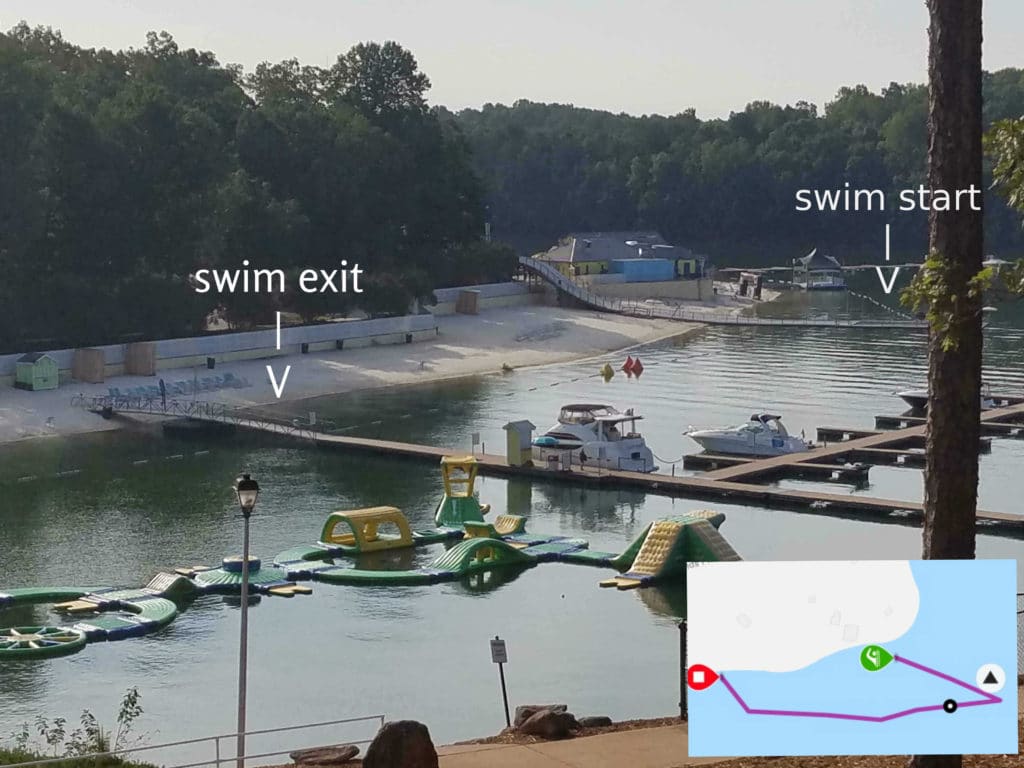
area-of-the-Georgia-triathlon-swim
Location of the swim start and exit. This picture was taken from the elevation of the transition area. The inset picture on the lower right is my actual path from the GPS watch worn during the race.

Once out of the water, it was a few steps to the dock that led us across the water onto a long and steep concrete path toward the parking lot and into the transition area.

Bike

We mounted the bike on a flat area just outside the transition area. From here, it was down a short but steep hill out of the parking lot, followed by a right turn onto the parkway. A block-long flat stretch gave me time to slip my feet into the bike shoes. It was then up the first hill.

The picturesque ride followed a series of gently rolling hills on an open course, one we shared with normal automobile and truck traffic. However, we were protected from the traffic by the many volunteers and police stationed along the course.

The course eventually left the resort property and continued onto a loop on local roads before returning to the resort. While a small stretch of the course was under repair, most of the roads were of good quality.

There were a few areas of congestion caused by the mixed car and bike traffic. Thanks to one area of congestion within the resort, I actually passed a black sports car which had slowed while following another biker.
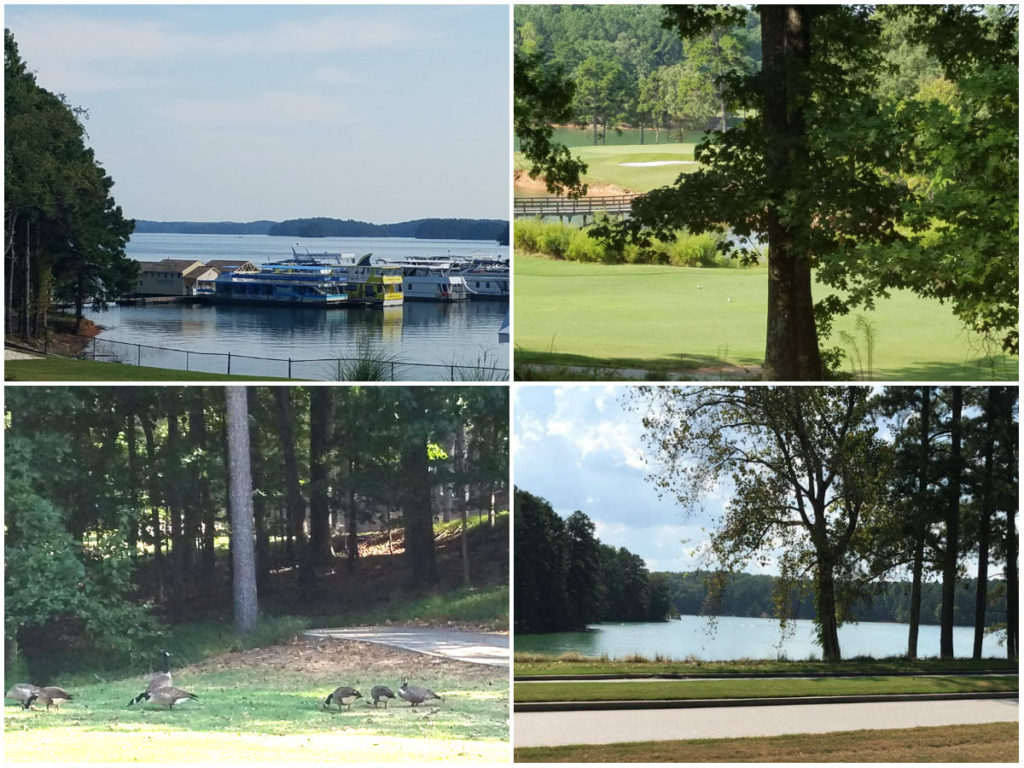
Scenes-from-the-bike-course-of-the-Lake-Lanier-Islands-Sprint-Triathlon.
Scenes from the bike course of the Lake Lanier Islands Sprint Triathlon.

Run

The run course was within the resort and separate from the bike course. The first half to three-quarters of a mile was relatively flat. However, it became progressively hillier as we went through this leg.

Late in the run, I was reminded of the encouragement that characterizes triathlons, especially among us ‘age groupers’ and weekend athletes.

A young lady, who I recognized to be 35 years old by the magic marker labeled left calf, slapped me on the back as she passed by, turned, and said with a big smile ‘Way to go! You’ve got this!’.

The embarrassing part of this for me was that as she slapped my back, I noticed a sloppy, splashing sound. Appreciating the encouragement but feeling embarrassed, I yelled out to her, “Sorry for the sweat.”

Her comeback was precious. Still smiling, she replied, “That’s lake water. Right?”

“Right”, I replied, now also smiling. The memory of that exchange still brings a smile.
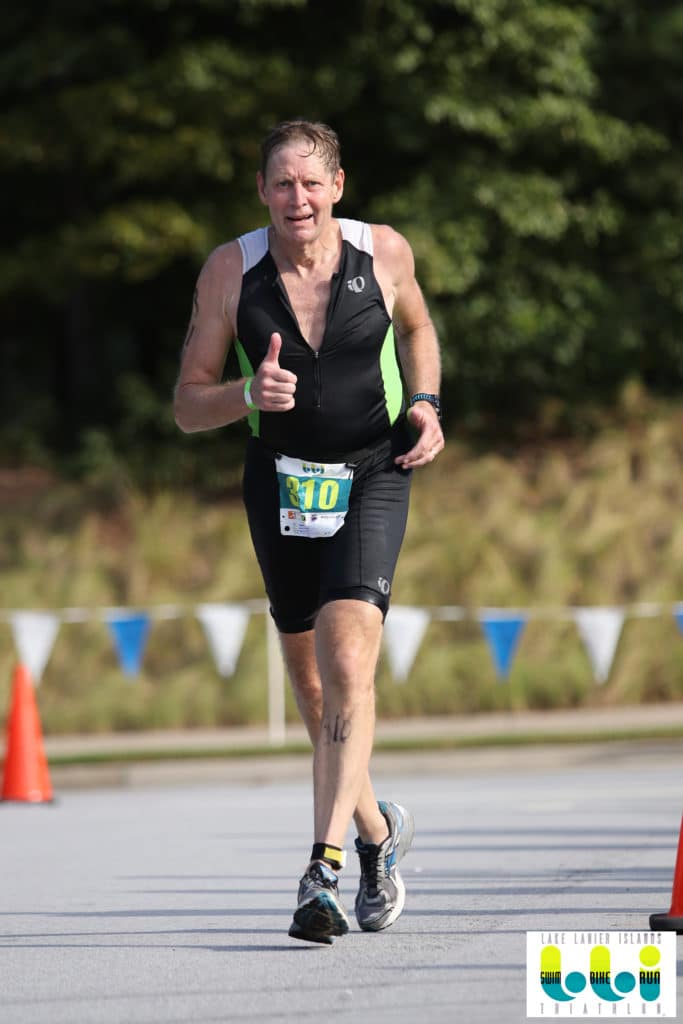
near-the-finish-line-at-the-Georgia-triathlon
My sprint to the finish line at the Lake Lanier Islands Triathlon 2018. The picture was taken by Tim Nettleton for TrueSpeedPhoto.com and provided compliments of Georgia Multisports.

Joy met me at the finish line with a bottle of cold water. We headed over to the food table for a couple of banana halves, a slice of pizza, and some more liquid refreshment.

After the Race

After collecting the gear from the transition area, it was on to the Atlantic Coast in Myrtle Beach, South Carolina. As we left, we wondered what we would find in the wake of Hurricane Florence.

Race Firsts

  • First time competing with collegiate triathletes.
  • First time with a swim at a water park beach.
  • Longest distance from the exit of the water to the transition area.

Triathlon Adventures Across America book cover

What Could Your Journey Be?

“It made me think, ‘Wow, wouldn’t it be fun to try to do this too?’”

Explore the journey across all 50 states

What Experience From Triathlon Makes You Smile?

Tell us about a memory from a past triathlon that still brings a smile. Let us know in the Comments below.
Comments: We’d love to hear about your experience. Join the conversation below. All comments are reviewed before they appear.

Reply notifications: Click the bell icon above Post Comment to be notified when someone replies to your comment.

Follow the discussion: Click Subscribe above the comment box and enter your email address to receive notifications whenever a new comment is added—even if you don’t leave a comment. After subscribing, check your email and click Confirm to activate notifications.

Triathlon Across the USA: State #38-Tennessee

Huntingdon, Tennessee; September 15, 2018 – Dixie Triathlon, Carroll County 1000 Acre Recreation Area.

This race is one chapter in a 50-state journey—now told in full in Triathlon Adventures Across America .

Travel to the Tennessee Triathlon

Joy and I used the week between the Hocking Hills Sprint Triathlon (Logan, Ohio) and the Tennessee triathlon to visit the Creation Museum and Ark Encounter and to camp at Big Bone Lick State Park, all in northern Kentucky.

Meanwhile, my searches for a hotel near the location of the Dixie Triathlon the next weekend had turned up nothing. The few hotels in the communities around Huntingdon were full on Friday night.

As we entered Tennessee on Thursday afternoon, we stopped at one of the first visitor’s centers. My goal was to find a camping site near the race venue. One of the closest options near Huntingdon was Natchez Trace State Park, around 45 minutes drive from the Carroll County Recreation Area.

While checking out camp sites within Natchez Trace State Park, we stumbled upon Pin Oak Lodge. The lodge provided a clean and comfortable air-conditioned room (much preferred since it was hot and humid outside), a restaurant, and a swimming pool, all among pine trees and with the view of a lake in the background.

First Dixie Triathlon

This was the inaugural running of the Dixie Triathlon. This race had been the dream of a local triathlete, Dr. Volker Winkler. Sadly, Dr. Winkler did not see his dream come true as he died unexpectedly earlier in the year.

However, in his honor, Carroll County officials and residents poured their hearts into making this event a success. McKenzie Medical Center, the clinic that Dr. Winkler helped found, served as the title sponsor of the race. The Dixie Carter Performing Arts Center in Huntingdon was the presenting sponsor.

Filled to Capacity

Every one of the 300 spots for the race was filled, despite this being the Dixie Triathlon’s first year.

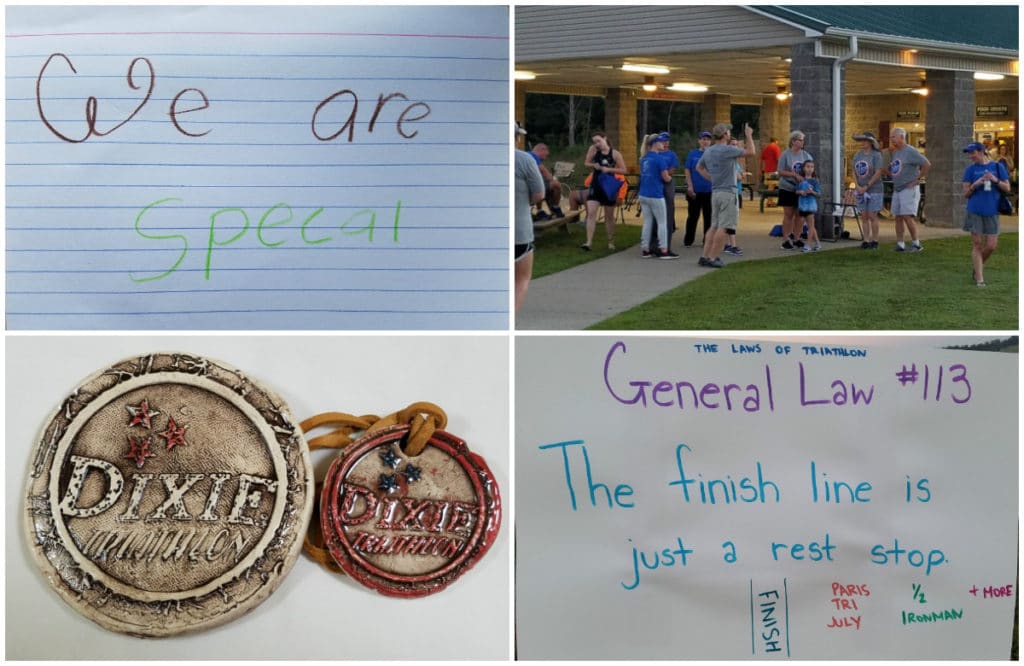
Besides, the number and enthusiasm of volunteers supporting the athletes spoke volumes about the commitment of the community to the triathlon. Personal notes from Huntingdon Middle School students in the race packets and the handmade signs along the race course added to the welcoming feeling.

To top it off, all participants received handcrafted ceramic finisher medals produced in the Dixie Performing Art Center’s Mudslingers Pottery Studio.

pictures-showing-community-support-for-the-Dixie-Triathlon
Carroll County, Tennessee residents put their hearts into welcoming triathletes to the inaugural Dixie Triathlon. Clockwise from the upper left: Note from Bella S. in my race packet (upper left); Pre-race meeting of volunteers (upper right); One of many signs around the transition area and along the race course (lower right); Handcrafted age group award and finisher medal (lower left).

Two Races in One

The Dixie Triathlon, managed by Above The Fold Events & Sport Promotions, Franklin, Tennessee, included both sprint and Olympic distances. There was also an option to compete in the sprint distance as a relay team.

Distances for the individual legs of this USAT-sanctioned sprint triathlon were:

  • Swim: 0.31 mile (500 m)
  • Bike: 16 mile (25.7 km)
  • Run: 3.1 miles (5 km)

Transition Area Setup

The transition area was setup in a grassy area in front of the lake next to the boat ramp and dock. We chose our area on a ‘first come, first served’ basis, with all sprint racers on the side of the main aisle closest to the lake.

I was one of the first people to arrive at the race. Even though we arrived before the official opening of the transition area at 5:45 am, we were not the first. Nevertheless, I had a good location, just one bike position off the main aisle.

In setting up my transition area, I did what I have always done for a quick transition – set my helmet upside down, centered on the aerobars. I set my clear safety glasses inside the helmet, lenses downward and bows standing upward.

Checking back a little later, I found the helmet lying on the ground. Now, however, my glasses were in two pieces – the lenses and the frame.

I didn’t see anything to suggest that the glasses were broken. However, without my reading glasses, I couldn’t see any possibility of putting the two pieces back together. Fortunately, Joy found the solution and reassembled the two pieces.

I returned the glasses to the helmet, still in the transition area. However, this time, I left the helmet and glasses sitting on the ground next to the front bike tire. Just before the beginning of the race, when the transition area was ready to be closed, I put the helmet with glasses back onto the aero-bars.

Triathlon tip: During the setup of transition, plan for items in your personal space to be moved. Just before the close of transition, reinspect the area and reposition any of the items that have been moved.

Pre-Race Ceremony

After race director Joe Fleenor reviewed key points of the race course, we all joined Carroll County mayor, Joseph Butler, in a prayer thanking God for the beauty of His creation and asking for the safety of the participants. Katie Hodges of the Miss Dixie Performing Arts Center concluded the pre-race ceremony with the singing of the national anthem.

Swim

The water temperature was over 81°F so, according to USAT rules, wetsuits were not allowed.

Dixie-Triathlon-sprint-distance-swim-course
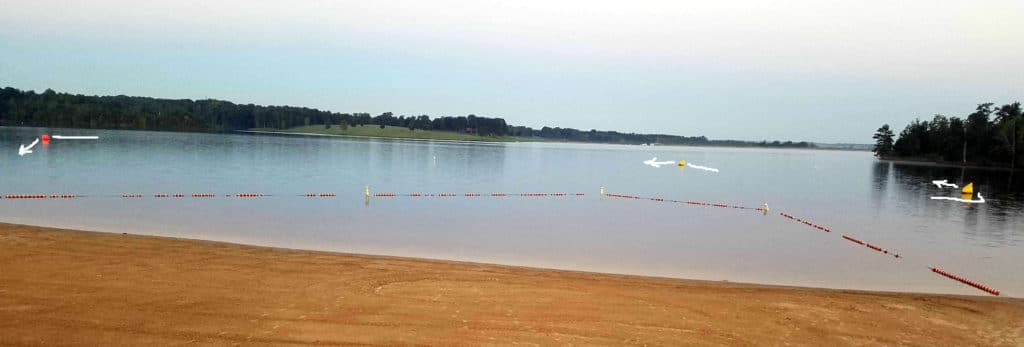
Beach and three buoys on the rectangular swim course of the sprint distance of the Tennessee Triathlon.  The dock from which the swim began and which is next to the exit is located to the left of the picture.

I have learned the hard way to always check the bottom of the lake before the race. Lake bottoms vary considerably, some are rocky, some are muddy, and some are slippery. Today, we were swimming in a lake with an uneven, clay bottom that made walking into and out of the water tricky.

Wave Starts

Participants started in waves by distance, age groups, and gender. All the Olympic distance groups started first. As the first of the Olympic triathletes completed their swim, the male sprint distance racers started according to their age groups. I started in the group of twenty-six males age 50 and over. 

About a minute and a half before the start of our wave, we walked onto the dock and jumped into the water, facing the first yellow buoy. The water was deep enough that I never touched bottom upon jumping in.

The rectangular shape of the sprint distance swim course required three left turns. The first two turns were around yellow buoys shown in the picture above. About 75 yards after making the last left turn, the one around the lone orange buoy, we reached the exit.

The steep drop-off of the bottom meant we could swim within a few feet of shore before touching bottom, one already determined to be uneven and slippery. Thankfully, volunteers stationed at the exit helped racers with their footing as they left the water.

Triathlon tip: In open water swims, it is helpful to swim as close to the exit as possible, especially when the bottom is difficult to walk on.

Bike

The mount location for the bike was also unique in that it sloped downward in two directions at the same time – away from the transition area and downward toward the lake. After riding out of the mount area, there was a short flat section of road during which I slipped my feet into the bike shoes.

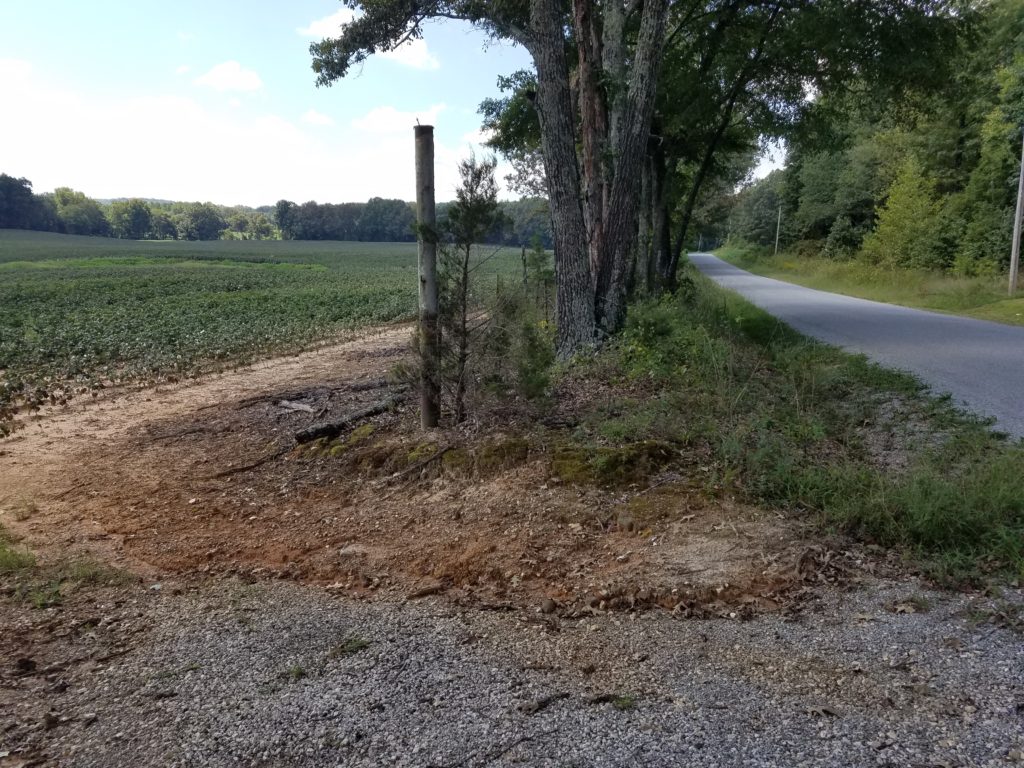
The bike course continued out of the Carroll County 1000 Acre Recreation Area through a small hill onto the road leading into the area. The continuous series of hills took us along country roads past wooded areas and fields of soybeans and cotton (pictured below). 

We continued into and through the center of Huntingdon, past the Dixie Carter Performing Arts Center and the Carroll County Courthouse. From there, we were back on another series of paved country roads.

The ‘Surprise’

The ‘surprise’ for the sprint competitors mentioned by race director Joe Fleenor during the opening announcements was as feared – a hill of the grade and length that required walking the bike up the last portion of the hill. (I would later learn that my bike frame was cracked. This, in turn, led to the rear wheel brake dragging on the rim.)

During the walk, I commiserated with a man of similar age who walked along with me.  He informed me that he had known what was coming because he had ridden the course during training.

We reminded each other that triathlon is, at least for us, a hobby.

Time Wasters

Two events made my time on the bike course longer than necessary. The first was my chain coming off the gears as I downshifted before a steep hill.

Reinstalling the chain required first flipping the bike upside down. In this position, I could free the chain that had become wedged between the frame and gear. With the chain loose, it was a simple matter of flipping the bike right side up and resetting the chain on both sets of gears.

It seemed too risky re-clipping my shoes into the pedals while going uphill. Therefore, I turned the bike around and coasted downhill while clipping my shoes into the pedals. Once my shoes were clipped to the pedals, I made a U-turn to rejoin the race during a break in the flow of bikers.

The second cause of wasted time was misreading a sign containing an arrow marking the bike course.  Thinking that I had continued onto the course for the Olympic distance, I turned around. Immediately, a volunteer yelled out for me to turn back around and make a right turn at the next intersection.

bike-course-of-Dixie-Triathlon-past-cotton-field
A rare flat section of the bike course passed fields of soybeans and cotton.

Run

The temperature at the start of the race was 72°F with a relative humidity of 89%. By the time I hit the run course, the temperature was in the high 80s°F.

The combination of temperature, humidity, and hills made this also one of the toughest runs. Senior triathlete and personal trainer, Jeanne Minder, later explained. She told me I had not trained enough in these conditions of heat, humidity, hills, etc. Another lesson to take from this race.

After the Tennessee Triathlon

Eavesdropping on conversations while re-hydrating after the race, I was comforted to hear from other seasoned triathletes from the southeast part of the USA say that this was ‘the’ or ‘one of the’ hilliest bike courses of a triathlon.  Of course, I also overheard one guy say that people from ‘eastern Tennessee would not even consider this course to be hilly’.

The race committee provided a generous and diverse table of foods – pizza, donuts, bananas, oranges, and chips – and soft drinks and water for us to rehydrate and recover.

Elvis-with-stuffed-giraffe-at-the-Dixie-Triathlon
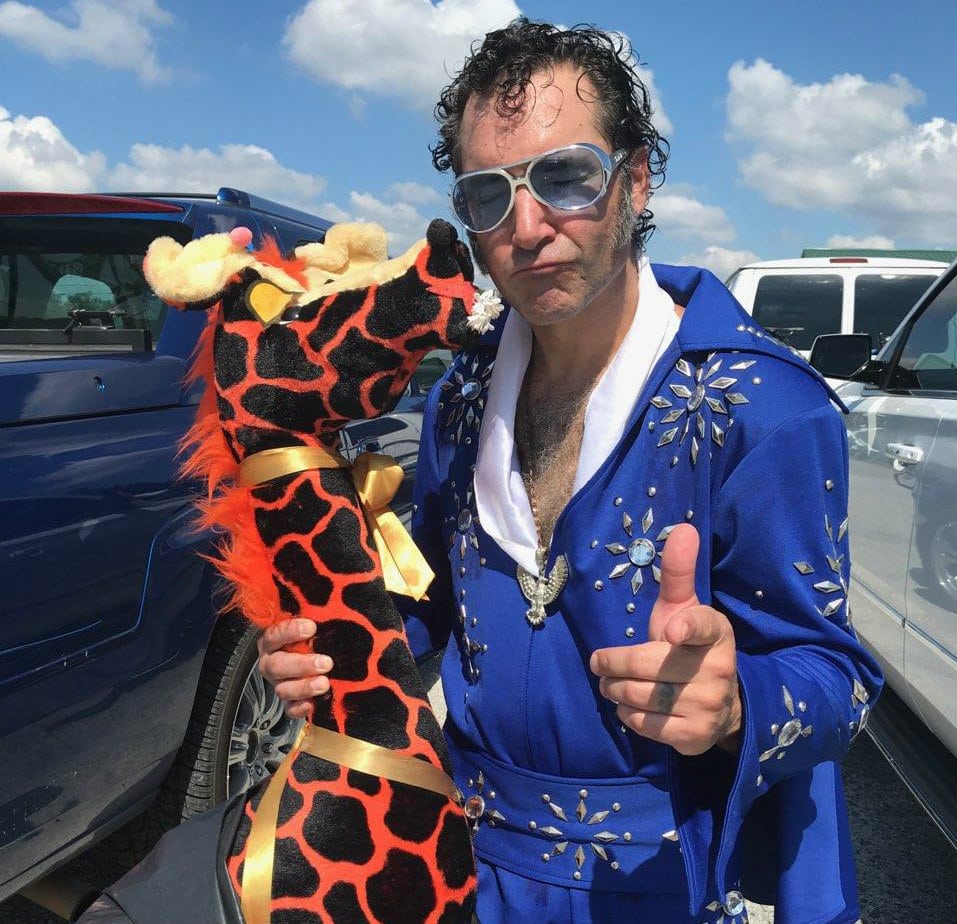
Elvis, one of the triathlon participants, with the Giraffe.

Our Next Destination

Before the Georgia triathlon the next weekend, we headed toward The Villages, Florida for a week with friends, Don & Sue. The stop in Florida would also be the end of the trip for the stuffed giraffe which had hitchhiked a ride in the back of our van. The giraffe would take up residence in central Florida with her owner, Debby P.

Race Firsts

  • First time taking part in an inaugural triathlon.
  • Riding past cotton fields was another first.
  • This was the first triathlon in which I lost time on the bike course because I misread a course marker.
Triathlon Adventures Across America book cover

A Story That Resonates

“A must-read for every athlete and retiring business executive committed to living healthy.”

Discover the complete story

How Do You Prepare For Different Race Conditions?

How do you prepare to race in high temperature and humidity if you live in an area in which these do not occur? Share your thoughts in the Comments below.

Comments: We’d love to hear about your experience. Join the conversation below. All comments are reviewed before they appear.

Reply notifications: Click the bell icon above Post Comment to be notified when someone replies to your comment.

Follow the discussion: Click Subscribe above the comment box and enter your email address to receive notifications whenever a new comment is added—even if you don’t leave a comment. After subscribing, check your email and click Confirm to activate notifications.

Triathlon Across the USA: State #37 – Ohio

Logan, Ohio; September 8, 2018 – Hocking Hills Sprint Triathlon, Lake Logan State Park/Lake Logan Beach.

The location for our Ohio triathlon in the 50-state quest was Logan, Ohio. Situated in the Hocking Hills region about one hour’s drive southeast of Columbus, Logan is a popular destination for camping, hiking, and spelunking.

For Joy and me, Logan was also the venue for the first of five sprint triathlons I would complete in the same number of states on successive weekends of September and the first weekend in October.

It was in Logan that we once again tried tent-camping.

This race is one chapter in a 50-state journey—now told in full in Triathlon Adventures Across America .

Planning the Ohio Triathlon

Joy and I had already decided that we wanted to travel to the southeast part of the USA to celebrate our 45th wedding anniversary. Why not complete triathlons in a couple more states along the way?

While checking out the schedule for fall triathlons in states in which I had not completed a triathlon, a pattern emerged. We found that in one trip to the southeast part of the USA, we could complete five triathlons in five different states on five successive weekends.   

Clearly, this was a lot more than we had planned. Yet, it meant we could ‘kill’ not only two but five of the proverbial birds during one extended trip.

The plan just kept coming together. At the end of August, I registered for triathlons in Ohio, Tennessee, Georgia, North Carolina, and Kentucky.

Making Our Way to the Ohio Triathlon

We left our home in Minnesota at around 9 am on the Wednesday before the Saturday, September 8th triathlon in Logan, Ohio. Our destination for the first day was West Chicago, Illinois, where we would stay with friends, Jim and Kris. Arriving at their home around 4 pm, we settled in for a leisurely evening.

An Unexpected Treat

While relaxing on the patio after dinner, Jim & Kris surprised us with a visit from classical guitarist, Jim Perona. Jim treated us to a variety of songs, a wonderful gift from our friends in recognition of our upcoming wedding anniversary.

Rain fell throughout the next day. We took advantage of the rain to relax around light conversation, even catching an afternoon nap. 

The next morning, we left Jim & Kris’s at little before 6 am for the drive to our destination for Friday and Saturday nights, the Hocking Hills KOA campground. It was at this clean, modern campground that we were going to retry tent camping. Secretly, I was hoping one of their cabins would have become available. However, this didn’t happen.

Dare I say that camping was not my idea? We had given up tent camping years earlier since it rained nearly every time we setup a tent.

Passing the Rain

For more than half the trip between Chicago and Columbus, Ohio, we drove through rain compliments of tropical storm Gordon. A little past Indianapolis, Indiana, we finally passed the rain. However, we were pretty sure the rain would stay on our trail.

The skies were dry when we reached the campground. The weather app on my phone showed there to be only a slight chance of rain in the forecast. And for a while, this held true. We had plenty of time to set up the tent before the rain caught up to us later in the afternoon.

Race packet pickup was on the morning of the race. Despite this, we visited Lake Logan Beach, hoping to preview the bike course. However, the road to the park was closed because of downed power lines. 

With this part of the plan shot and hoping for the road to be cleared overnight, we drove into Logan. Here, we enjoyed dinner, sampling the local barbeque at Millstone BBQ.

With an early morning ahead, we headed to bed for a night of being serenaded by a symphony of raindrops on our tent roof. Thankfully, the raindrops stayed off our heads – and bottoms.

15th Annual Hocking Hills Sprint Triathlon

The Hocking Hills Sprint Triathlon was managed by teamCOLUMBUSevents. The Hocking County Tourism Association was the main sponsor for the triathlon.

Besides men’s Age Group categories, this triathlon was part of the USAT designed WIN (Women’s Initiative) Series. At the time, WIN was a series of USA Triathlon sponsored events across the USA aimed at increasing participation of women in triathlon and other multisport activities.

Distances for the individual legs of this USAT-sanctioned sprint triathlon were:

  • Swim: 0.25 mile (400 m)
  • Bike: 12.4 miles (20 km)
  • Run: 3.1 miles (5 km)

Making New Friends Before the Triathlon

By morning, the rain had stopped. However, the skies remained overcast with a ‘not-if-but-when’ threat of rain. Despite this forecast, the 67°F air temperature was a relief from temperatures in the 90s °F in the days leading up to this race.

We reached Lake Logan a little before 7 am, in time for the opening of the transition area. After setting up my transition area, we chatted with some of the other participants, many who we learned were competing in their first triathlon.

Two future triathletes, daughters of one competitor, posed with the stuffed giraffe that was hitching a ride with us to Florida, one destination of this road trip.

two-young-girls-with-stuffed-giraffe-at-the-Ohio-triathlon
Ava (right) and Ella (left) with Giraffe at Lake Logan Beach.

Racing in the Rain

About 15 minutes before the start of the race, the skies opened. With no wind, the rain fell straight down.

I jogged over to the transition area and covered my running shoes and safety glasses with the green and white striped towel lying beside the front wheel of my bike. With my bike shoes clipped into the pedals and hanging downward, their insides remained dry.

There was no lightning, so the race started on schedule. However, with the heavy rain and wet roads, the race became more about everyone’s safety than about setting speed records.

Swim

With recent air temperatures in Logan over 90°F, the water was warm, probably more than 80°F. In fact, walking into the water felt like crawling into a lukewarm bath.

The swim course left Lake Logan Beach, heading straight out from the beach. We swam around two super-sized beach ball-like blow-ups that were anchored to the bottom of Lake Logan.

All seventy-two racers started together. After the initial chaos associated with this number of swimmers heading for the first buoy, the group spread out, leaving plenty of space between us.

The water was shallow near the beach. I used several dolphin-dives to get into deeper water before beginning a regular swim stroke. The water remained relatively shallow throughout the swim, as I would occasionally feel the scraping of a plant, probably milfoil, on my hands or arms.

Bike

The out-and-back bike course was among the hilliest that I have experienced in a triathlon. We seemed to either be going up a hill or going down one. A few were gradual, but most involved a gear shift. In fact, I used the full range of gears for this relatively short course.

The last hill before the turnaround was one I had never experienced in a sprint triathlon – long and steep enough for me to have to get off the bike and walk it about halfway up the hill. While I may have been the first racer to do so, by the time I went back down this hill, most athletes were walking their bikes.

After this race, I learned that my back brake was dragging on the rear wheel. After completing the five triathlons during this trip, I took the bike to my local bike shop for service of the brake. It was then I learned there was a crack in the carbon fiber bike frame. This crack was causing the back brake to drag.

I would get a brand new bike frame thanks to the Trek warranty.

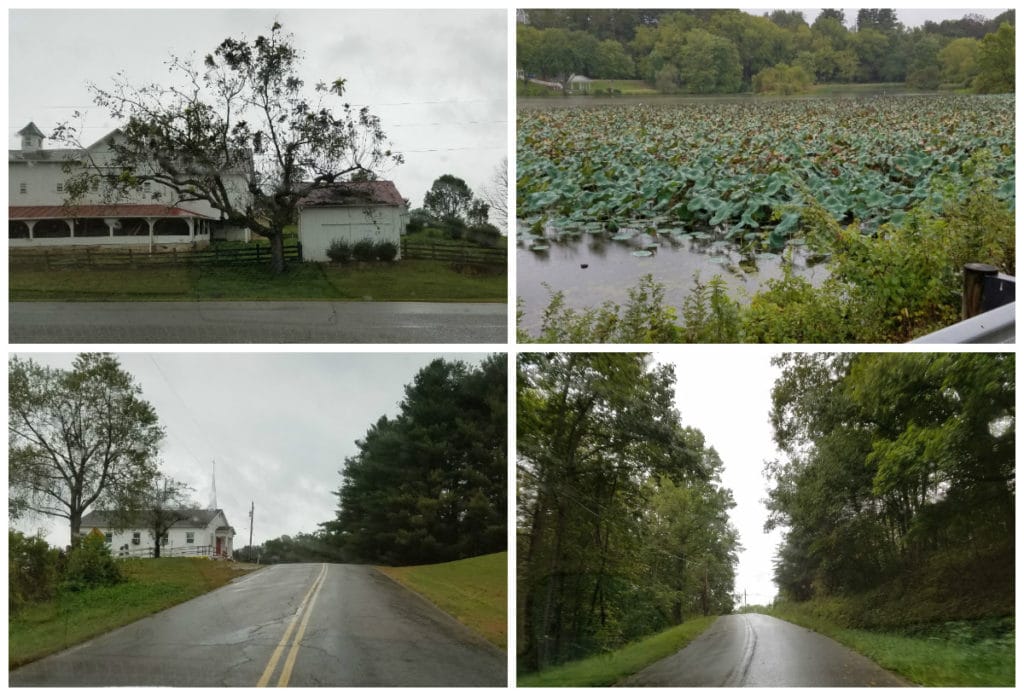
scenes-from-Hocking-Hills-Ohio-triathlon
Scenes from the Hocking Hills Sprint Triathlon bike course. Clockwise from the upper right, water lilies at the north end of Lake Logan (upper right), nearing the top of the last hill before the turnaround (lower right), return past St. Johns Church (lower left), and farm buildings at the intersection of OH-180 and Pleasant Valley Road (upper left).

Run

The run was also on Lake Logan Road, the one used for the beginning and ending portions of the bike course. The course was flat, with only a couple of small rolling hills.

We ran out to the halfway point of the 5k and turned around. Dodging some of the returning bikes, we headed back to the finish line.

Finish-line-for-Hocking-Hills-sprint-triathlon-ohio
Finish line and transition area (right) for the Hocking Hills Sprint Triathlon. Lake Logan is in the background.

After the Ohio Triathlon

The rain was letting up by the end of the race. However, by now, everything was soaked. Joy kindly wiped the excess water off the bike before I put it into the back of our van.

While wrestling with the bike to get it into the back end of the van – remember, we were tent camping so had a lot of supplies – we met senior triathlete Mike Nall and his wife from Cleveland. Mike, a survivor of a rare heart disease, was now doing triathlons.

Next Stop–Tennessee

While the rain stopped for a while after the triathlon, it was far from over.

During heavy rain the next morning, we disassembled and packed our tent along with the other camping gear. After a shower, mostly to dry off, we headed about 45 minutes toward Columbus. Here we joined in Sunday worship with the congregation at Peace Free Lutheran Church in Canal Winchester, Ohio.

After church, we started our trek toward Tennessee and the next race, the Dixie Triathlon in Huntingdon, Tennessee. With almost everything we had brought now wet from the rain, our first night’s stop was at a Staybridge Suites. Here we dried our clothes and aired out the tent and other camping supplies.

Race Firsts

  • First race in which I found it necessary to walk the bike up a portion of a hill.
  • This was my first triathlon during which rain fell throughout the entire race.
  • First triathlon at which Joy and I camped in a tent near the venue the night before the race.
Triathlon Adventures Across America book cover

A Journey Beyond This Race

“Uplifting, real, and full of heart—I couldn’t put it down.”

Read the full journey in Triathlon Adventures Across America

Have You Done a Triathlon in Heavy Rain?

What have you learned about racing in the rain? Have you camped at or near the race venue?

Share your comments and advice below.

Comments: We’d love to hear about your experience. Join the conversation below. All comments are reviewed before they appear.

Reply notifications: Click the bell icon above Post Comment to be notified when someone replies to your comment.

Follow the discussion: Click Subscribe above the comment box and enter your email address to receive notifications whenever a new comment is added—even if you don’t leave a comment. After subscribing, check your email and click Confirm to activate notifications.

Triathlon Across the USA: State #23 – North Dakota

Mandan, North Dakota; July 18, 2015 – Bismarck Triathlon, Harmon Lake Park.

What is it like to do a triathlon in winds gusting to 40 miles per hour (64 km per hour)? Our North Dakota triathlon showed just how much wind can affect a race.

This race is one chapter in a 50-state journey—now told in full in Triathlon Adventures Across America .

Planning the North Dakota Triathlon

How to Choose Your Next Triathlon highlights factors we typically use to select a triathlon, especially those involving overnight travel. For Joy and me, one of the keys to out-of-state triathlons has been to combine travel to the event with a visit to friends or family or a place of special interest (e.g. Savannah, Georgia – Hilton Head, South Carolina).  Sometimes, we accomplish more than one of these.

North Dakota was unique in this respect. Here’s the reason.

In 2015, North Dakota had among the fewest triathlons of any state.  On top of this, one of the three scheduled triathlons involved kayaking and mountain biking as an alternative to swimming and road biking.

I was concerned that the lone conventional sprint triathlon in North Dakota might eventually become extinct.

So, in February, we decided that this would be the year to complete the North Dakota triathlon and put behind us concerns about completing a triathlon in this state.

A Pleasant Surprise at Registration

During registration for the event, I learned I could save $2 on the fee if I shared news of the registration with my Facebook friends.  Of course, I took advantage of this. (Don’t judge.)

After sharing the post, I learned that one of my friends, Tom Lipp, had completed the Bismarck Triathlon a year earlier. 

I also learned that Tom was now training for Ironman Wisconsin. You can read about his experience training for and racing in Ironman Wisconsin here.

Getting to Bismarck for the North Dakota Triathlon

Bismarck is actually a twin city with Mandan, North Dakota, home of Harmon Park and the Bismarck Triathlon. The two cities are separated by the Missouri River with Bismarck, the capital of North Dakota, on the east side of the river. Mandan is on the west side of the Missouri River.

By the way, did you know that the Missouri River is the longest river in the United States, beating out the Mississippi by 21 feet?  And, that’s before it joins the Mississippi River just north of St, Louis, Missouri.

Driving to the Bismarck-Mandan area from our Minneapolis, Minnesota area home was about as easy a trip as one can make – start the audiobook, get on Interstate 94 West, and stay on it for just under six hours past the Red River Valley and some of the flattest parts of the USA.

We left home on Friday around 10:30 am and set our GPS coordinates for Epic Sports in Bismarck, location for race packet pick-up. After collecting the packet, including the race T-shirt, we checked into the Holiday Inn Express & Suites.

We then headed downtown, taking a short detour around the North Dakota State Capital building.

North Dakota state capital building for the Bismark triathlon
The North Dakota capitol building in Bismarck.

Following a short walk around the renovated downtown area, we stopped at one of the restaurants recommended by the hotel desk clerk, Blarney Stone Pub. Dinner tonight included authentic Irish food – creamed cabbage and corned beef for Joy and fish & chips for me.

11th Annual Bismarck Triathlon

The Bismarck event included sprint and Olympic distance triathlons. There was also a sprint distance relay option in which three members of a relay team each completed one of the legs.

Distances for the three legs of this USAT-sanctioned sprint triathlon were:

  • Swim: 0.31 mile (500 m)
  • Bike: 12.4 miles (20 km)
  • Run: 3.1 miles (5 km)

The 10 am starting time for the Bismarck Triathlon was the latest of any I had raced so far. The transition area did not even open until 8:30 am, a time at which most triathlons are starting or well underway.

Because of the later start, I had been concerned about the fact that the average high temperatures during the week before the triathlon had been just under 100°F. (I am not a fan of running in extreme heat.)

Today, however, the air temperature at race time was a chilly 60°F (16°C). On top of this, the wind was howling, with an average speed of 25 miles per hour (40 km per hour) and gusts to 40 miles per hour (64 km per hour).

transition area of Bismark North Dakota triathlon
Transition area of the Bismarck Triathlon in Harmon Park. The picture was taken near the beach of Harmon Lake.

Swim

It quickly became apparent to the poor souls who were assigned the job of placing the race buoys for the sprint and Olympic distances that the wind was too strong for the anchors meant to secure the buoys. The buoys simply would not stay where placed.

On top of this, the volunteers in kayaks who were to provide a rest stop along the course for swimmers needing a break during the swim leg had to spend all of their time paddling to stay near the course. With the wind today, they would not be able to provide the support for swimmers intended by the race director.

So, just before the start of the race, with the wind clearly in control, the race director shortened the swim course. Instead of the original course, he created one that ran parallel to the shore, a few yards away from it.

The revised course, reported to be 250 m by one swimmer with a GPS watch, was judged to be safe for the conditions of the day. Fortunately, everyone was safe through the swim. We completed the remaining legs of the race as planned.

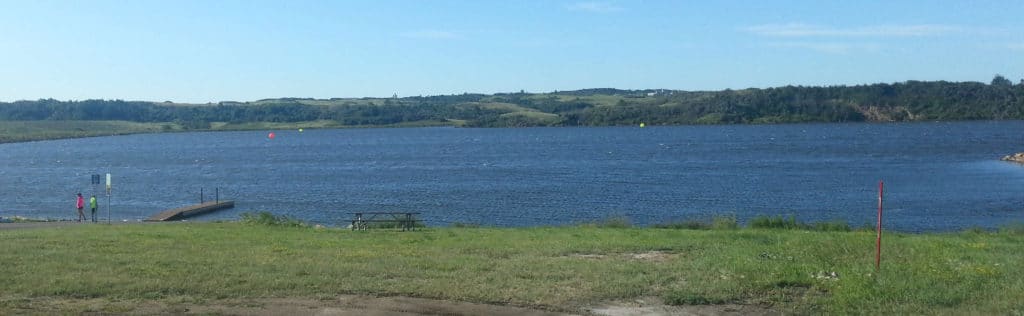
Harmon Lake with triathlon buoys near Mandan North Dakota
Harmon Lake early in the morning before the wind picked up. Note the orange and yellow buoys near the other side of the lake for the sprint and Olympic distances, respectively.

Bike

For the bike leg, the numbers on my bike computer tell the story. The average speed was 14 mph (23 km/hr) while the maximum speed was 37 mph (60 km/hr).

While biking uphill, into the wind, the speed was incredibly slow at between 9 and 11 miles per hour (14-18 km/hr). For most of the ride, I avoided the aero position for fear of being blown off the road.

After the initial approximately two miles into the westerly wind, we turned. Now, the wind was from the side, making the ride even more treacherous.

Triathlon training tip – While we may be inclined to avoid inclement weather when training, we should take advantage of these opportunities, at least some of them. Training in conditions, such as rain or wind, which could be part of race day, helps to prepare for these when we eventually face them during a race. Reminds me of James 1:2-4.

The maximum speed came on the return of this out-and-back course, where we road downhill with the wind at our back.

Run

I prefer that the run course not include a hill immediately out of transition. The legs are already struggling to adapt to running after biking.

But today I was not getting my wish. The run out of transition involved a significant hill on the same road within the park that we had just returned from the bike course. And, with the wind today, my legs were more tired after the tough bike ride.

The run was also on an out-and-back course, sharing a section of the bike route. The initial portion took us past the campground within Harmon Park where campers turned spectators cheered us on.

As with the bike, we ran into the wind for the major portion of the first half of the run. But just as with the bike leg, the wind helped us back to the finish line after the turnaround.

Results

I ended the race with the second best time of five participants in the 60+ year Age Group in which I raced. Nothing to brag about, but no injuries.

Another state closer and nearly half way to the goal.

Race Firsts

  • First race in which strong winds forced a change in the swim course.
  • Latest start time; first race with a start time of 10 am.
Triathlon Adventures Across America book cover

A Story That Resonates

“A must-read for every athlete and retiring business executive committed to living healthy.”

Discover the complete story

Tell Us About Triathlons In Which Weather Was A Major Factor

Have you raced in inclement weather? How did it affect you personally and other racers?

Tell us about it in the Comments below.

Comments: We’d love to hear about your experience. Join the conversation below. All comments are reviewed before they appear.

Reply notifications: Click the bell icon above Post Comment to be notified when someone replies to your comment.

Follow the discussion: Click Subscribe above the comment box and enter your email address to receive notifications whenever a new comment is added—even if you don’t leave a comment. After subscribing, check your email and click Confirm to activate notifications.

error

Enjoy this post? Please spread the word :)