
Adapting Mark Allen’s Strength Training Program for Triathletes Over 50
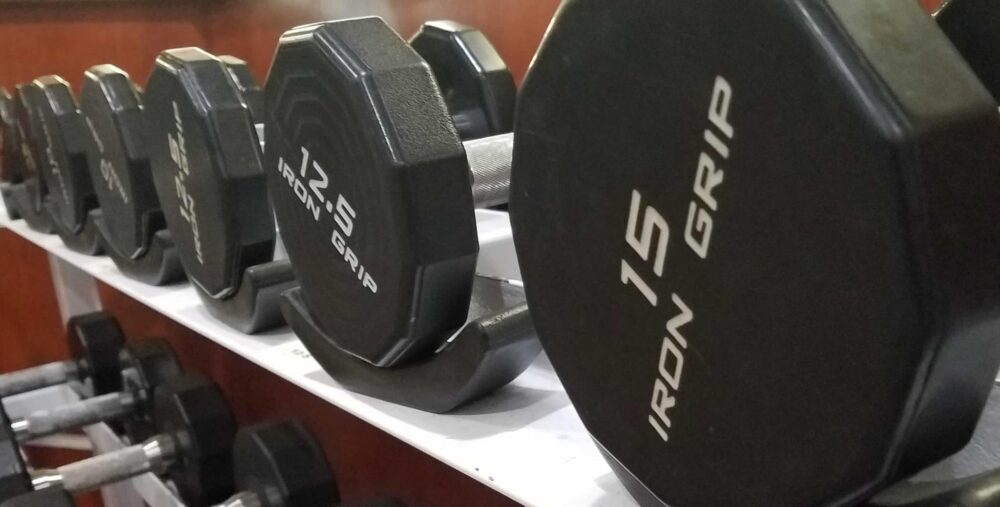
When I first reviewed Mark Allen’s strength training program, I was evaluating it as a triathlete. Since then, SeniorTriathletes.com has grown into a community of older endurance athletes, we’ve surveyed readers, interviewed coaches, followed emerging research on healthy aging, and published articles on recovery, sleep, and nutrition. This rewrite reflects what we’ve learned along the way.
If you’re looking for a complete guide to strength training for triathletes over 50, start here: Strength Training for Senior Endurance Athletes.
Why Strength Training Matters More as We Age
When I first began following Mark Allen’s program, my reason for strength training was straightforward: I wanted to become a better triathlete. Strengthening the muscles used for swimming, biking, and running seemed like a logical way to improve performance and reduce my risk of injury.
As I’ve grown older, I have another reason to keep strength training. Maintaining strength and muscle becomes increasingly important simply to preserve our ability to continue doing the activities we enjoy.
That distinction matters for senior triathletes. Swimming, biking, and running provide tremendous cardiovascular benefits, but endurance exercise alone does not provide the same stimulus for maintaining muscular strength. Research involving older adults consistently shows that progressive resistance training can improve strength and physical function. Studies of masters athletes also suggest that decades of endurance training can preserve exceptional aerobic fitness without providing the same protection against age-related declines in muscular strength.
For a triathlete over 50, then, strength training increasingly serves two purposes:
- helping us swim, bike, and run better; and
- preserving the strength and physical capacity that allow us to keep swimming, biking, and running as we grow older.
I have seen examples of both.
A 71-year-old woman I wrote about began strength training in her late 60s—proof that it’s never too late to start. Judy Cole, a 73-year-old ultrarunner, began running every day in her early 30s. Decades later, however, problems with her knees and hamstrings led her to strengthen her quadriceps and hamstrings. She described the change in those muscles as a “game changer.”
The same theme is emerging from senior triathletes themselves.
What Experienced Senior Triathletes Are Telling Us
In an ongoing SeniorTriathletes.com questionnaire, experienced triathletes age 60 and older described how their training and racing have changed as they’ve aged. Strength and muscle maintenance repeatedly surfaced in their responses, often alongside greater attention to recovery, mobility, and a more deliberate approach to training.
One 78-year-old respondent described doing almost exclusively cardiovascular exercise before age 70. As he grew older, he became increasingly aware of losses in strength and what he called “rapid muscular response”—and of the need to devote more attention to strength and mobility.
If you’re new to triathlon after 50, this guide on how to start triathlon after 50 will help you take the first step.
Introducing Mark Allen’s Strength Training Program
Mark Allen’s program gave me the structure I needed to make strength training a regular part of my routine. It also provides a useful starting point for considering what—if anything—we should change as we grow older.
The table below lists the twelve exercises in this program along with the triathlon leg(s) most impacted by the exercise. While I vary the order in which they are performed, these are the same exercises I do two days per week, except when I do not have access to the equipment.
Mark’s original article includes videos that show how to perform each of them correctly. I urge you to watch the videos before starting the program. And, if you are anything like me, you will find it helpful to watch periodically to make sure your form and breathing are correct.
| Exercise | Helps Most With |
|---|---|
| Lateral Pull-Down | Swim |
| Leg Extension | Run |
| Leg Curl | Bike, Run |
| Bench Press | Swim |
| Squat | Bike, Run |
| Lateral Dumbbell Raise | Swim |
| Calf Raise | Run |
| Dumbbell Pullover | Swim |
| Backward Lunge | Run |
| Bicep Curl | Swim, Bike |
| Tricep Extension | Swim |
| Leg Press | Bike, Run |
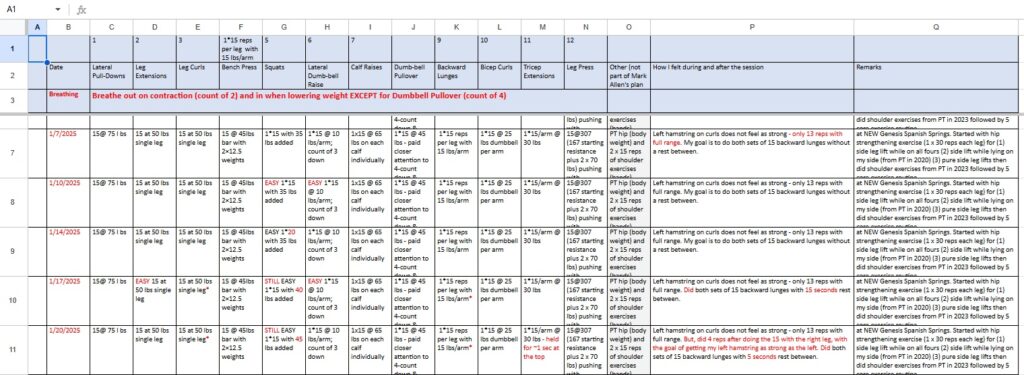
Starting with my first time using Mark’s routine, I have recorded the number of repetitions and weights for each exercise in a Google Sheet. I have also noted when I could use a heavier weight in the next session and any pain or soreness I felt during or after the session.
If you would like to follow Mark Allen’s strength training program, comment below or email me at seniortriathletes@gmail.com. I will share the Google Sheet I use to record my results and progress.
How I Adapted Mark Allen’s Program: My Warm-Up
Mark Allen’s program begins with the strength exercises themselves. Over time, I found that I benefited from preparing my hips, shoulders, upper back, and core before beginning the weights. My warm-up has evolved as I’ve aged and as I’ve dealt with the minor aches, stiffness, and limitations that come with years of training.
I now begin every strength session, regardless of the phase of Mark’s program, with bodyweight and resistance-band exercises. What started as physical therapy for tightness in my right glute and later upper-back spasms evolved into the 15- to 20-minute routine shown below. I vary it somewhat from week to week.
When done properly, I end this 20-minute period having broken a sweat and feeling loose. The table below provides more detail on this part of what is a 70-minute routine, two days each week.
| Warm-Up Target | Details |
|---|---|
| Hips | All-4s side leg lift (“fire hydrants”) – 30 each side Side-lying hip abduction with internal rotation – 30 each side Side-lying leg lift – 30 each side |
| Shoulders, Arms, Upper Back | Shoulder external rotation with scapular retraction – 2 x 15 Shoulder single-arm cross body extension – 2 x 15 Shoulder horizontal abduction – 2 x 15 Standing shoulder row with anchored band resistance – 2 x 15 Shoulder extension with band resistance – 2 x 15 |
| Core | Pallof press – 20 reps each side Oblique twist – 20 reps each side Boat pose – 1 minute Bridge – 15 reps; hold each for a count of five Side plank – 1 minute each side Plank – 1 minute |
Two of the core exercises—the Pallof press and oblique twist wood chopper—are more recent additions. I added them after I began using a body-composition scale that estimates muscle mass in different areas of the body.
My early readings indicated that muscle mass in my core was below the standard range for a person my age, even though the readings for other areas of my body were better. That prompted me to add exercises specifically targeting the core.
More recent readings have placed all areas, including my core, within the standard range. I can’t say that these exercises alone produced the change, but the measurements gave me another reason to address a weakness I might otherwise have overlooked.
Related post: ‘At the Core’ – Strength Training to Help Seniors Perform Better and Avoid Injury
After Strength Training
Depending on the time available, I sometimes complete another 10–15 minutes of cardio after the strength exercises. I finish with static stretches and/or foam rolling of my hamstrings, quadriceps, calves, and upper and lower back.
Endurance Strength Training – Phase 2
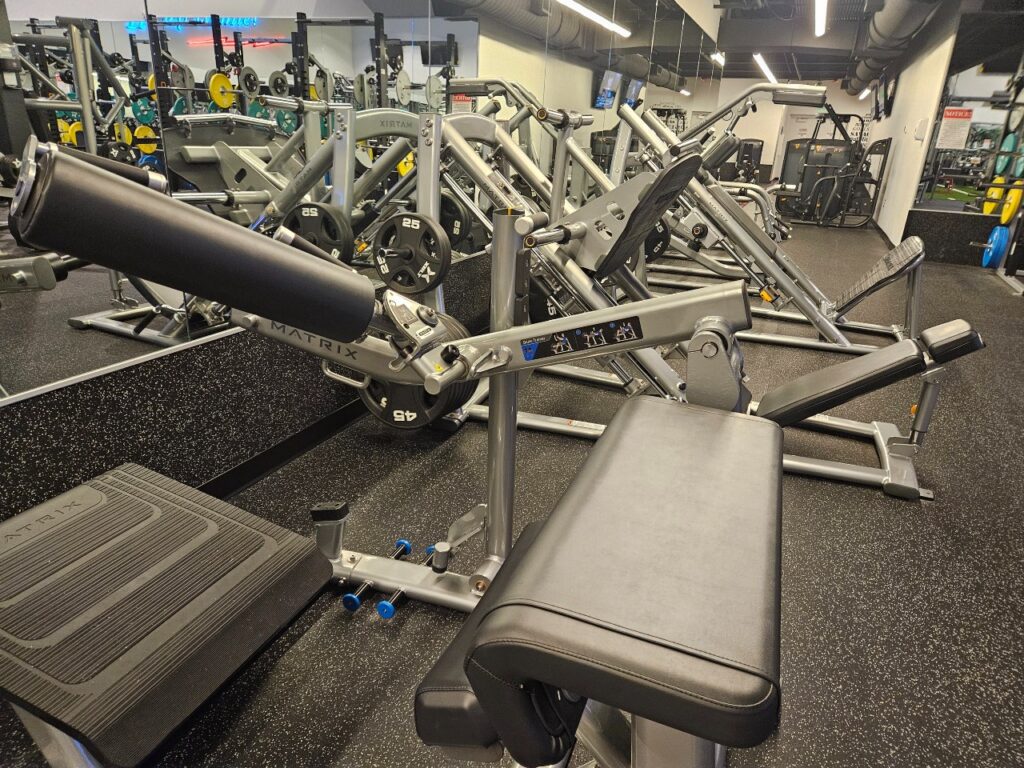
In my initial use of this program, I moved to Phase 2 after a few weeks with the Phase 1. The main difference between these two phases is that Phase 2 involves two sets of 12–15 repetitions of each exercise with 90 seconds rest between sets, rather than one set in Phase 1. As in Phase 1, I completed two sessions per week with at least one day, but usually three days, between them.
During Phase 1, I selected weights for each of the exercises for which I could complete 15 repetitions with good form. For some, I was able to increase the weight slightly during the four weeks.
In transitioning into Phase 2, I used the same weights as at the end of Phase 1. However, in the first two sessions, I completed only 12 (rather than 15) repetitions in each of the two sets (except for squats, for which I completed 15). I did this following the principle of preventing injury by increasing intensity gradually.
Continuing with this principle, I increased the number of repetitions to 15 for the first set in week 2, while the second set still involved 12. In week 3 and beyond of Phase 2, I completed 15 repetitions for both sets.
“Increasing the intensity, time, or type of activity too quickly is one common reason for a sports injury. To prevent this, many fitness experts recommend that both novice and expert athletes follow the ten percent rule, which sets a limit on increases in weekly training. This guideline simply states that you should increase your activity no more than 10 percent per week. That includes distance, intensity, weight lifted, and length of your exercise session.” – Very Well Fit
Lessons from Strength Training for Triathletes
I have learned some important lessons while using this plan:
- Be patient – the results may seem to come slowly, but they will come.
- Become familiar with the specific equipment you will use in the program. In addition to watching the videos in Mark Allen’s article, I watched others, especially those working with a personal trainer.
- Add weight only after a few sessions (minimum two) when the weight feels easy while maintaining good form.
How I Would Adapt Mark Allen’s Program for Triathletes Over 50
Mark Allen’s program has served me well, and many of its basic principles still make sense for an older triathlete. I continue to use the same 12 exercises when I have access to the necessary equipment.
But following the program over the years—and learning more about strength training and aging—has changed how I think about its purpose and how it should fit into an older triathlete’s overall training.
The goal isn’t simply to copy a successful triathlete’s strength routine. It’s to preserve what works while adapting the program to our own abilities, training load, recovery, and goals.
Keep Progressive Resistance at the Center
One principle I would not change is progressive resistance: muscles need an adequate training stimulus if they are going to become stronger.
Research involving older adults consistently shows that progressive resistance training improves muscular strength and physical function. For an endurance athlete, that matters because swimming, biking, and running do not provide the same strength-building stimulus as resistance exercise.
The progression doesn’t have to mean adding weight every workout. As my own experience with Phase 2 illustrates, progression can involve gradually increasing repetitions before increasing the load. The important point is to provide enough challenge to stimulate adaptation without sacrificing good form or increasing the workload faster than your body can accommodate.
Think Beyond Triathlon Performance
This may be the biggest change in how I view Mark’s program.
When I originally adopted it, I wanted stronger muscles for swimming, biking, and running. I still do. But as we grow older, maintaining strength serves another purpose: preserving our ability to keep doing those things.
This is where the experience of senior triathletes in our questionnaire is particularly relevant. Some describe adding strength training as they’ve aged; others say they wish they had started sooner. Strength increasingly appears alongside mobility and recovery as something they deliberately make room for rather than something added only when time permits.
For a younger Mark Allen, strength training could help make an exceptional triathlete even better. For those of us training decades later in life, it can also help preserve the physical capacity that allows us to remain triathletes.
Don’t Forget Power
Strength is our ability to produce force. Power is our ability to produce that force quickly. Both are important to preserve as we age, and power tends to decline faster than strength.
Research in older adults suggests that training performed with an emphasis on moving the resistance relatively quickly during the lifting portion of an exercise can improve muscular power and physical function.
That doesn’t mean an older triathlete should suddenly start performing explosive Olympic lifts. The appropriate exercises, resistance, and speed depend on experience and physical condition. But it does mean that simply moving every resistance as slowly as possible isn’t necessarily the only objective.
The comment from a 78-year-old triathlete in our questionnaire about losing “rapid muscular response” captures the issue remarkably well. Maintaining the ability to generate force quickly can matter both in sport and in everyday life.
Fit Strength Into Your Triathlon Training—Don’t Just Add It
A triathlete already has three sports competing for training time and recovery. Strength training creates another training stress.
Research on concurrent endurance and resistance training shows that older adults can improve strength and aerobic fitness while doing both. The practical question isn’t whether strength training and endurance training can coexist; it’s how to fit them together without allowing the total training load to exceed what we can recover from.
That’s one reason I wouldn’t prescribe Mark Allen’s schedule—or my schedule—to every triathlete over 50.
Two strength sessions per week work well for me when my schedule and recovery allow it. Another athlete may need a different frequency, particularly during periods of heavy swim-bike-run training, following an injury, or when preparing for an important race.
Let Recovery Help Determine the Dose
One of the clearest messages from experienced senior triathletes responding to our aging questionnaire is that they need to pay greater attention to recovery as they age.
Science doesn’t give us a simple formula such as “add another recovery day after age 70.” Individual differences are too great for that.
Instead, pay attention to how well you are recovering from the combination of strength training and swim-bike-run workouts. Persistent soreness, declining workout quality, unusual fatigue, or difficulty maintaining good lifting form may be signs that the overall training load needs adjustment.
For older athletes, doing enough to stimulate adaptation matters. So does being recovered enough to train well again.
Strength Training Doesn’t End When the Workout Ends
Strength training provides the stimulus for our muscles to adapt, but the workout itself is only part of the process. Nutrition, recovery, and sleep all help create the conditions that allow us to respond to that training.
Nutrition: Muscle needs protein to repair and remodel after exercise. This becomes particularly important as we age because older adults generally require a greater protein stimulus to maximize muscle protein synthesis. For senior triathletes, that means paying attention not only to total protein intake but also to consuming adequate protein throughout the day.
Related post: Nutrition for Triathletes After 50 — Healthy Aging, Recovery & Performance
Recovery: Strength training adds to the stress already created by swimming, biking, and running. Recovery therefore needs to be considered across the entire training week rather than separately for each sport. An additional strength workout isn’t necessarily beneficial if it compromises the quality of the training that follows.
Related post: Recovery After 50: What Every Triathlete Must Know
Sleep: Sleep is another part of the recovery environment. Research has associated poor sleep with lower muscular strength in middle-aged and older adults, while adequate sleep also supports the broader physiological processes involved in recovery from training.
Related post: Sleep for Triathletes Over 50: Recovery and Performance Guide
None of these replaces progressive resistance training. Rather, they help us get more from the work we do in the gym.
The older I get, the more I think of strength not as a workout but as a system: provide the stimulus, supply the nutrients, and allow enough recovery for adaptation.
What If You Don’t Have Access to a Gym?
Mark Allen’s program uses a combination of free weights, weight machines, dumbbells, and body weight. But lack of access to a gym doesn’t mean giving up strength training.
Bodyweight exercises such as squats and lunges can provide resistance, while resistance bands can be useful for exercises targeting the hips, shoulders, and upper body. Core exercises such as planks, side planks, glute bridges, and the exercises included in my warm-up require little or no equipment.
During the COVID-19 shutdown, I also used dry-land resistance-band exercises from the Tri Swim Success Online Triathlon Swim Training Program to maintain swim-specific strength.
The equipment may change. The principle doesn’t: provide enough resistance to challenge the muscles and progress that challenge as you become stronger.
Let us know in the Comments what alternates to training in the gym with weights and machines you use.
Where to Go From Here
If you are getting started with triathlon training and/or strength training, here are two must-read posts:
- Strength Training for Senior Endurance Athletes with senior triathlete and triathlon coach Tony Washington
- ‘At the Core’ – Strength Training to Help Seniors Perform Better and Avoid Injury
- Nutrition for Triathletes After 50 — Healthy Aging, Recovery & Performance
- Pay attention to recovery. Recovery After 50: What Every Triathlete Must Know contains valuable insights about recovery from other senior triathletes aged 50 to 80+
- Sleep for Triathletes Over 50: Recovery and Performance Guide
Want to take the next step? Choose your path below.
Whether you’re just getting started or looking to improve, here are your next steps:
New to Triathlon?
Start with a step-by-step guide to triathlon after 50 designed specifically for older athletes.
Already Training?
Learn how to train smarter, recover better, and improve performance after 50.
How Have You Adapted Strength Training as You’ve Aged?
If you’ve been strength training for several years, what have you changed as you’ve grown older? Have you changed the exercises, weight, number of sessions, recovery between workouts—or the importance you place on strength training? Please share your experience in the Comments below.
This post was first published on March 14, 2019, and substantially rewritten and republished in September 2026.





Comments: We’d love to hear about your experience. Join the conversation below. All comments are reviewed before they appear.
Reply notifications: Click the bell icon above Post Comment to be notified when someone replies to your comment.
Follow the discussion: Click Subscribe above the comment box and enter your email address to receive notifications whenever a new comment is added—even if you don’t leave a comment. After subscribing, check your email and click Confirm to activate notifications.