Lessons in Ironman Triathlon Racing – Another Senior Triathlete’s Experience
Laurent Labbe recently finished Ironman Nice, a long course triathlon that boasts swimming in the Mediterranean Sea, biking in the Alps, and running along the French Riviera in Nice’s historic waterfront. While the beautiful venue made the race enjoyable, Nice was even more special for Laurent. It confirmed an Ironman triathlon hydration and nutrition plan he had been working to develop.

Disappointment at Ironman Vietnam

Before diving into the story from Nice, let’s go back a little less than two months to Vietnam. It was here that Laurent competed in Ironman 70.3 Vietnam, his 10th long course triathlon.

Following a disappointing race at Ironman Vietnam, Laurent determined to come up with a better approach to nutrition and hydration for an ironman triathlon. Regarding Ironman Vietnam, Laurent said:

“The bike part was a little bit slower than I had planned, but the running was the worst leg. It was very hot. The temperature at the start of the swim was 29⁰C (84⁰F) and 35⁰C (95⁰F) during the run. I didn’t manage it well. I was overheated and the only way I found to complete the run was to put water on me every 2 km (1.25 mile) to cool down.” 

Laurent had anticipated the heat. He had prepared an adequate amount of water to carry on the bike. He also carried a cereal-based energy bar to eat about halfway through the bike course.

However, he had not included any sports drink with electrolytes. This was his first mistake. He also forgot to eat the cereal bar during the bike leg until much later than planned.

The consequence of not consuming a sports drink with its electrolytes on the bike became especially evident when he got to the run. While his body craved the electrolytes, he found the sports drinks provided by the race organizers to be “disgusting”.

And, when he tried to make up for not eating early enough on the bike by consuming bananas and gels during the run, his stomach revolted.

An Incentive for a New Ironman Triathlon Hydration and Nutrition Plan

Laurent is not alone in forgetting to eat on the bike during an Ironman triathlon. I have lost count of the number of stories of triathletes who were so caught up in the excitement of a race that they forgot to eat or drink until it was too late. As a result, they “bonked” or at least hurt their performance on the run. Maybe it’s happened to you.

With this not-so-pleasant experience in Vietnam, Laurent was determined to finding a better approach to hydration and nutrition for his next race in Nice, France. The challenge was that he had less than two months.

Hydration and Nutrition Plan for Ironman Nice

With the memory of Vietnam fresh in his mind, Laurent stayed focused on developing his race plan for Ironman Nice. He reflected on his experience in training and racing, spoke with other triathletes, scoured the internet, and tested various nutrition and hydration products.

In looking back on the Nice triathlon, he was able to say with a smile, “It seems that all the preparation and, this time, the race management was right”.

So, what was the race plan that made such a big difference?

Let’s start by looking in on Laurent a few days before the Nice triathlon while he was putting the final touches on his plan.

A Pre-Race Test of the Plan

During the week before the race, Laurent rented a bike and he and his son road to the top of Le Mont Ventoux, one of the most famous portions of the Tour de France.

He used this ride to test a bike computer having a screen large enough for him to continuously monitor his heart rate and to watch the time so that he would eat and drink at precise intervals.

It became clear to Laurent during this ride that without a clock his perception of time was wildly inaccurate. However, by maintaining a heart rate within the aerobic zone and drinking a little every 10 minutes, Laurent was able to ride the 40 km (25 km) distance to its 1,909 m (6,260 ft) elevation without stopping.

Laurent felt prepared for Nice.

Laurent Labbe and his oldest son on the bike ride to the summit of Le Mont Ventoux
Laurent Labbe and his oldest son on the climb to the summit of Le Mont Ventoux. Picture courtesy of Laurent Labbe.

Racing Ironman Nice

The temperature on race day in Nice was also high, 27⁰C (80⁰F) at the start of the swim. The day’s high of 34⁰C (93⁰F) occurred during the bike leg. Anticipating these temperatures, race organizers reduced the distance of the race a bit to 150 km (93 miles) for the bike and 30 km (18.6 miles) for the run.

Racing with a Heart Rate Monitor

Laurent used the heart rate monitor to control his effort on both the bike and run to maintain a heart rate within the endurance range.

For the bike leg, this meant maintaining an average rate of 144 beats per minute (bpm); his heart rate never went above 161 bpm. “I could have probably gone faster (on the bike) without any problem. However, the target for this race was to finish within the time limit.”

For the run, Laurent’s target was an average heart rate of 139 bpm, his endurance training rate. The highest rate came in the last 500 m during his sprint to the finish line.

“I saw many people on the bike and run forcing themselves and having difficulty breathing. In contrast, I was able to ride and carry on conversations with other racers including a Chinese guy, a Moroccan lady, and a man from Dubai. 

Hydration and Nutrition for Ironman Nice Triathlon

Laurent’s nutrition and hydration plan reflected his experience in previous hot weather Ironman races and with the week earlier ride to the summit of Le Mont Ventoux.

Specifically, the plan was as follows.

  • On each of the three days leading up to the triathlon, he took a serving of Overstim Malto. Admittedly, this was based solely on the recommendation of a friend and not on any personal experience.
  • On the bike:
    • Alternated drinking from one of the two bottles of sports drink, one bottle each of Overstim Long Distance Hydrixir and Hammer Nutrition Sustained Energy, every 10 minutes throughout the bike leg. Laurent also carried extra packages of the powders. These would be used to refill the bottles if he happened to run out before the end of the bike leg.
    • Ate one packet of a fruit-based energy gel, such as those from Overstim, every hour. Since the gels come either with or without added salt, he took one of the salted versions at the mid-point and near the end of the bike.
    • Stopped eating any solid food around one hour before the end of the bike. This provided time for the food consumed during the bike to be digested before beginning the run. Running with undigested food can cause stomach problems. 
  • On the run:
    • Drank some water with a little added salt provided by race organizers at each aid station.
    • Ate a salted biscuit or a salted gel at each of the aid stations.
    • Used showers provided by race organizers to help cool down.
  • On the day after the race, he took a recovery drink; Hammer Nutrition Recoverite is an example.
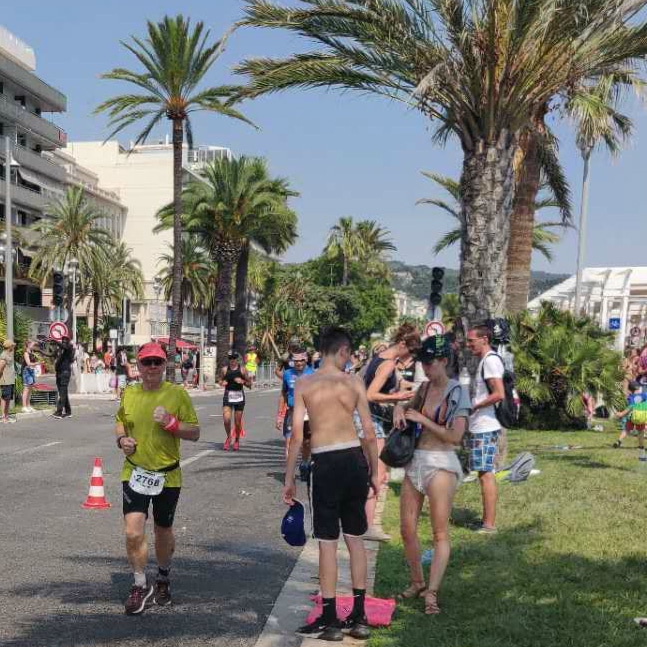
Laurent Labbe on the run at Ironman Nice.
Laurent Labbe on the run at Ironman Nice. Picture courtesy of Laurent Labbe.

Will This Plan Work Next Time?

Laurent completed the race feeling strong, healthy, and with little to no pain during and after the race. Racing with a heart rate monitor, staying hydrated, and consuming calories at the right times appeared to be the key.

Laurent found this approach to be effective, at least for one long bike ride and one long course triathlon. However, he is quick to acknowledge that he has no training in sports medicine or nutrition.

It will be interesting to hear what happens when he uses this approach in the next triathlon.

Please Share Your Questions and Comments

What do you think about Laurent’s racing plan?

Have questions about hydration and nutrition for ironman triathlon?

What are the most important lessons you have learned from training and competing in a triathlon?

Share your thoughts and questions in the Comments section below. 
You May Also Be Interested In These Posts

How Has Your Training Changed After Age 50?

Recently while skimming my email inbox, an article titled “5 Training Tips to Help You Run Strong As You Age” caught my attention. What really caused me to read further was the first part of the tagline: “Getting older doesn’t mean you have to stop running”. Judging from the comments that followed the article,  the author disappointed several readers when they realized that his definition of age differed from theirs – he is 40 years old.   It is common to generalize training plans, dismissing the age effect. Most questions I receive from visitors to Senior Triathletes are from those looking for advice on triathlon training for those of us 50 and over.  Missing from websites, blogs, and books about triathlon training is age-specific training information. Being over 50, we deal with issues that those younger seldom need to consider.  For example, a short time ago, RL posted the following on the Senior Triathletes Facebook page:

“Any of you doing tris/IMs after total hip replacement?  Got a THR 4 weeks ago – thought I would switch to aqua bike – been reading about people running post THR – still seems like a bit of a gamble with respect to increased risk of needing a revision compared to low impact activity.  Thanks for any comments.”

I doubt that the general triathlon sites answer questions about training and racing after joint replacements.  Unfortunately, I cannot answer this question with authority; I do not have the proper training. That’s why I am writing this post.

I Need Your Experience With Triathlon Training After Age 50

We, the age 50+ triathlon community, will appreciate your comments on the following:
  • Have you used or are you using a triathlon training plan specific to your age group or even for those age 50 and over?
    • Are you aware of such training programs and, if so, what have you heard about them?
  • What have you learned about training as you age?
    • What are the main changes you have made in your training?
  • How has your training for swimming, biking, and running changed as you have aged?
  • As someone age 50 or over, how do you advise someone ages 50, 60, 70, or even age 80 to train for a longer race?  For example, how does a person our age who does Olympic distance triathlons train for an Ironman?
  • Are you or someone you know able to answer training questions like that from RL (above)?
  • What can we do to achieve the goal of Senior Triathletes being a valuable resource for information, besides inspiration, for beginner and intermediate triathletes age 50 and over?

Please Share Your Comments About Triathlon Training After Age 50

Please add your comments and questions in the Comment section below or email us at seniortriathletes@gmail.com.. Also, please take a look at the questions and comments from your other Senior Triathletes.

8 Changes in Exercise for Seniors Over 70

By Amanda Turner, Contributor

After 30, inactive people can lose 3% to 5% muscle mass per decade, according to WebMD. Exercise for seniors over 70 can help maintain good health and slow down this loss. Seniors can, unfortunately, experience a range of different health issues that can cause them serious problems as they age. For example, a significant amount of seniors struggle with their balance, this can seriously impact their lives. However, by visiting a physical therapy center like LifeMotion, these problems can be overcome. This allows seniors to enjoy new-found freedom. However, if you’re lucky enough to live in an area like Sunnyvale, you could benefit from home visits by a local physical therapist. That could save you some waiting time, whilst also improving any pains or aches that you may be experiencing. Seniors, and other residents, of Sunnyvale can benefit from these sunnyvale physical therapy professionals that aim to make your life pain-free. However, before you get to the stage of needing that sort of therapy, you could consider participating in some exercises. There are many suitable for you as a senior over 70, here are eight workout routine-related adjustments you can consider. Keeping updated with fitness for seniors is much easier if you have access to a phone. The cellphones from Fanmi might be of use in this regard.

1. Exercise regularly

To get the best benefits from exercise, it’s important that you do it regularly. Five days a week is a good starting point for moderate activities and three days for harder workouts.

2. Strength exercises (bodyweight vs. lifting weights)

Start with bodyweight exercises. Once, you’re able to handle your bodyweight, only then consider lifting weights, says trainer Meghan Kennihan. She uses exercises like squats, pushups, bicycle crunches, etc.

Work on all the major muscles of the body at least twice a week. Try to complete at least one set (up to 12 reps) of each strength exercise. Besides going to the gym and lifting weights, you can also build strength with yoga and doing the harder digging jobs in your yard.

3. Aerobic activity (moderate)

Choose one or more exercises that require moderate effort on your part. Some options include walking and riding a bike on flat surfaces. If you aren’t big on these activities, consider joining and ballroom or line dancing group or cutting your grass with a lawnmower. Go for a daily limit of at least 30 minutes and a weekly limit of 150 minutes. Divide your daily activity into separate sessions if that works best for you.

4. Aerobic exercises (hard)

If you can handle high-intensity workouts, substitute the 150 minutes of moderate aerobic activity for 75 minutes of vigorous activity. There are a few ways you can go about this. Start to jog or run or ride a bike in a hilly area. If you like racket sports, considered playing singles tennis. The more energy-intensive types of dances are another option.

5. Mix moderate with hard activity

If your preferences for the intensity of exercise change often, consider a mix of the two approaches. Remember that one minute of vigorous exercise equals two minutes of moderate activity.

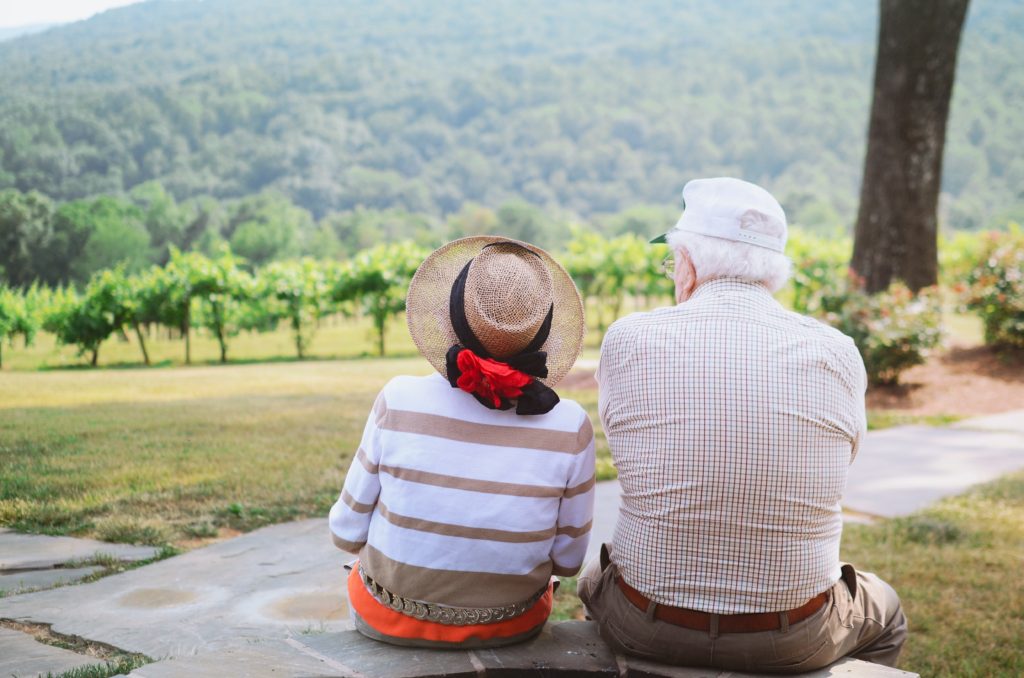
Exercise routines for seniors over 70 can include a mix of structured training and getting out with friends and family.
Exercise routines for seniors over 70 can include a mix of structured training and getting out with friends and family. Photo by Christian Bowen on Unsplash.

6. Mobility (bike vs. treadmill)

By age 75, about 33% of men and 50% of women do no physical activity, says CDC. And, staying sedentary for long periods hurts health. But, staying mobile has its own challenges for people with balance issues and joint pain. For its increased safety, using a stationary bicycle or treadmill can be a better choice compared to biking outside, especially when some research has been conducted into the best type of machine for your abilities and requirements, for example by reading some recumbent exercise bike reviews, the benefits of a recumbent exercise bicycle for the elderly that would like to remain fit and active, are much greater than those of an upright stationary exercise bike.

7. Flexibility (full-body vs. muscle group)

When stretching to stay flexible, try to incorporate full-body multidirectional movements instead of isolating a muscle group, says strength and conditioning specialist Rocky Snyder.

8. Good environment

Your workout environment, both the people and the surroundings, matter when it comes to staying healthy. Ensure that your overall health remains in top condition by maintaining the health of your home environment.

Amanda Turner is a freelance writer and a recent graduate who is taking some time to build her writing portfolio and explore her passions through writing.

Meanwhile, You May Also Be Interested in These Posts

The Road to Ironman Triathlon – Laurent Labbe’s Story

At age 57, senior triathlete Laurent Labbe continues to prove both to himself and others that he is young in heart and body by competing in Ironman triathlons.

But there is more to his story than a personal enjoyment of endurance sports. Laurent has found a way to engage his family, using triathlon to build relationships with his children by training and participating in races with them. See Reason 3 of “15 Reasons for Those 50 and Older to Do Triathlons“.

It Started With Swimming and Biking In The Alps

As a child growing up in France, Laurent Labbe developed a love for the outdoors and for swimming through holidays and vacations with his family in the Alps and central mountains of his home country.

In his early 20’s, he was introduced to mountain biking. His attraction to mountain biking led to rides in many countries throughout Europe, including France, Germany, Hungary, Poland, Wales, Ireland, Scotland, and Belgium.

Then in his 30’s, Laurent began running. In addition to enjoying endurance sports, he found it easier to run than bike while traveling around the world for work. This led to him completing the Paris marathon twice.

“The best run of my life” came as part of a work-related team building exercise in the Gobi desert. One of the activities involved walking more than 30 km (18.6 mile) each day during three days. On the last day, Laurent decided to run, instead of walk, in the desert. Starting at 5 am, he completed a 22 km (13.7 mile) run with a GPS and headlight to guide him in the pre-dawn.

“Running across the dunes in the fresh air and with the sun rising was magic, so beautiful”. 

Transition to Endurance Multisport

During this time, he also connected with a group at work who competed in races involving biking, running, and kayaking; one form of triathlon today.

In 2011, Laurent and a friend participated in the King of Grassland race in Inner Mongolia. This three-day endurance race was across grassy hills and fields populated with herds of sheep and horses and consisted of:

  • Day 1: 60 km (37.3 mile) mountain bike,
  • Day 2: Full running marathon (42 km/26.2 miles) in the morning and 45 km (28 mile) mountain bike in the afternoon,
  • Day 3: 100 km (62 mile) mountain bike.

Laurent described this race as an “exhausting but amazing experience”. In fact, they completed this race two more times in the following years. However, when King of Grassland was canceled during years of drought, Laurent and his friend decided to look for another race.

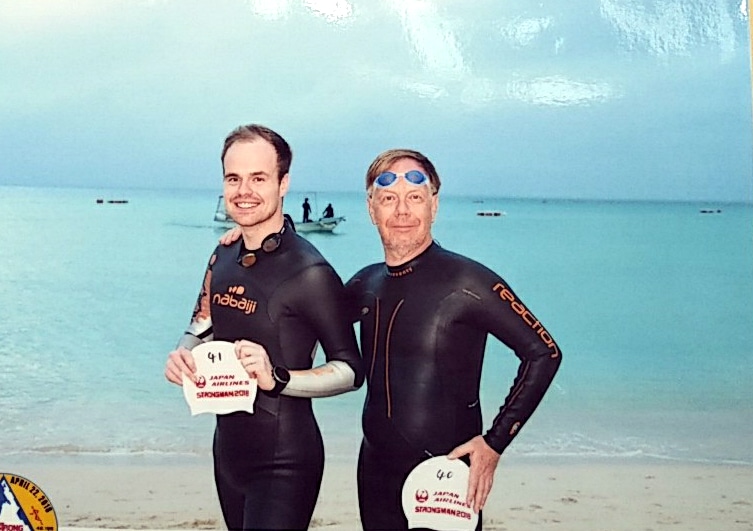
Laurent Labbe and his oldest son on the beach in front of the swim course at the Strongman All Japan Triathlon.
Laurent Labbe and his oldest son on the beach in front of the swim course at the Strongman All Japan Triathlon. Picture courtesy of Laurent Labbe.

Discovering Ironman

His friend finally convinced him to register for the 2017 IRONMAN 70.3 Taiwan half Ironman held in March. It was time for another bike – a carbon fiber road bike.

Training for the race, especially for the bike leg, was a challenge. During this period, he was living and working in Shenzhen, China, a city of 13 million. He used the commute to bike to and from the office ‘rain or shine’, somehow managing to survive the horrendous traffic, heat, and pollution.

“You cannot imagine how dangerous it can be biking 22 km per day in a city like Shenzhen.”

His training for this triathlon proved to be effective, remembering that the bike ride went well. Sadly, however, during the run he mistakenly forgot one of the three loops that made up the run. The DNF (did not finish) was frustrating, especially after the months of training.

“I was so upset that I missed the last 4 km of the run and received the DNF. I decided to run the final 4 km in the rain, just to be able to say I had completed the distance.”

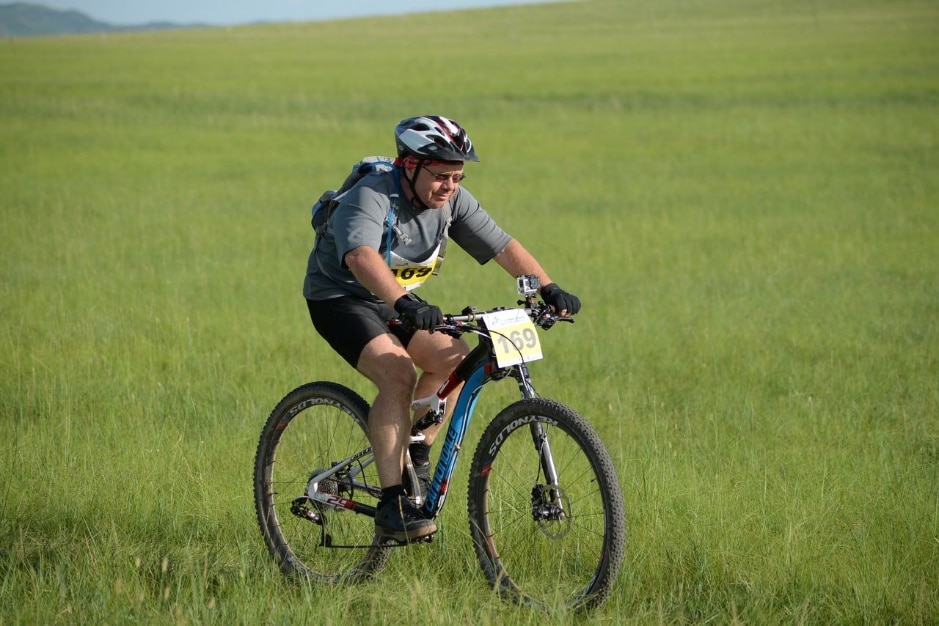
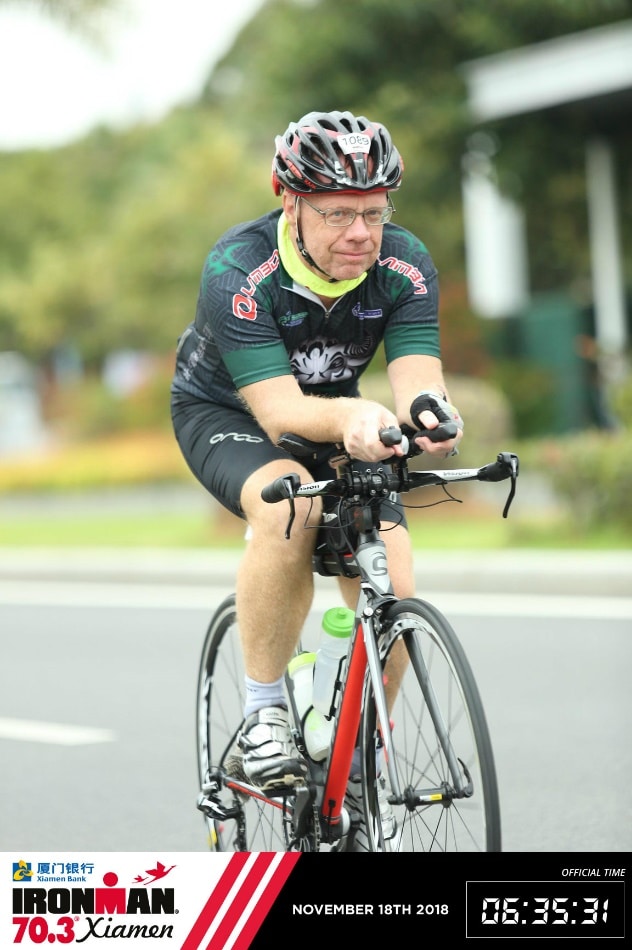
Laurent Labbe on the bike at Ironman 70.3 Xiamen, China
Laurent Labbe at Ironman 70.3 Xiamen. Picture courtesy of Laurent Labbe.

“Overall, I like the challenge [of long course triathlon]. Doing Ironman is magic and it was a new experience. I’m not young anymore but I like to try to do new things.”

Laurent Labbe

A Family Affair

With this experience in long course triathlon, Laurent was hooked.

To illustrate just how much he was smitten by this new challenge, Laurent completed Ironman 70.3 Bintan in Indonesia (August 2017), Ironman 70.3 Thailand (November 2017), Ironman Colombo in Sri Lanka (February 2018), and The Strongman All Japan Triathlon in Miyako-jima (April 2018) – four Ironman distance races within a year.

It was also during this period that Laurent involved two of his sons. His then seven-year-old son competed in the IronKid event that was part of the Colombo, Sri Lanka half Ironman. Then, his oldest son, age 30 at the time, joined him in the Japan race.

To top it off, his daughter was in Japan to cheer on her father and brother. She also caught the ‘triathlon bug’ and shortly thereafter began to train for her first triathlon.

Laurent acknowledges that he is “very lucky to have a wife who supports all of this travel, cheering me on and helping wherever possible”.

Favorite Ironman Triathlons

The races involving his sons have been his favorite so far.

Of the Strongman All Japan Triathlon held on a small island called Miyako-Jima, Laurent noted “I never saw a race with so many people along the road encouraging racers. I think every inhabitant of the island – young kids, school-age kids, old people, disabled people, hospital people, everyone – was on the road from the first competitor to the last one. The course was beautiful and challenging, especially for the bike. And, the organization and volunteers were exceptional.”

Ironman 70.3 Bintan was second favorite, again because of the venue – biking around the island and a beautiful run around the lake – and his younger son taking part in the kid’s race.

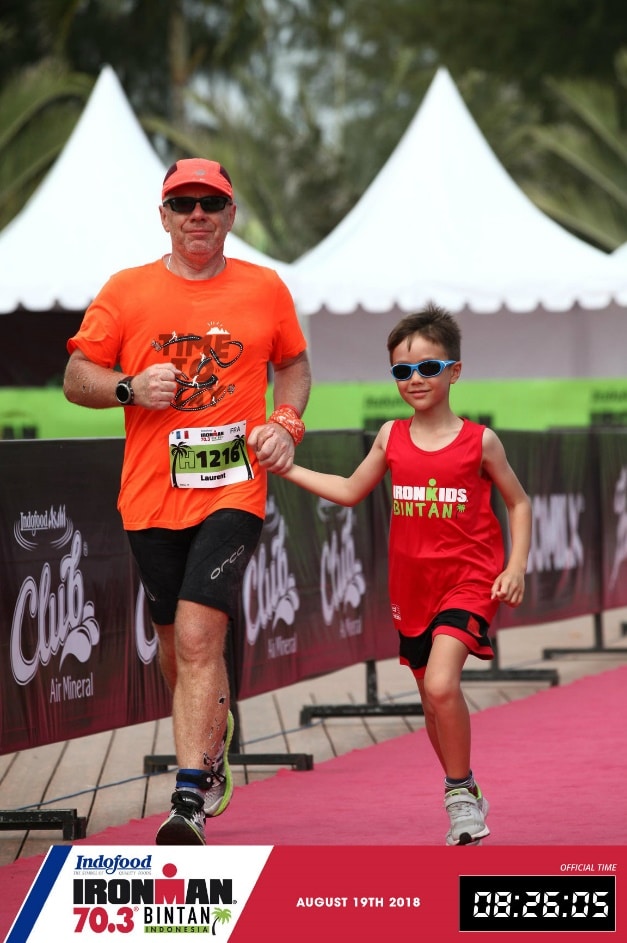
Laurent Labbe and son on the final dash to the finish line at Ironman 70.3 Bintan, Indonesia
Laurent Labbe and son on the final dash to the finish line at Ironman 70.3 Bintan. Picture courtesy of Laurent Labbe.

“Sport is good, for the body and also for the family.”

Laurent Labbe

Lessons for Ironman Triathlon

Laurent has learned some valuable lessons for others in our age group who may be interested in long course triathlon.

Training

  • Sign up for a race. There is nothing like it to motivate you to train.
  • Train seriously. Laurent trains as much as possible, using many opportunities (going to work; family outings; skipping lunch breaks) and always, ALWAYS with a heart rate monitor. Laurent says “The heart is our motor. I believe we need to listen to its rate, not staying too long in the ‘red zone’ (high rate) and train to make it stronger and more efficient in the endurance zone”. (Look for a future article on triathlon training, including with a heart rate monitor, especially for those age 50+.)
  • Do not force yourself or train beyond your limits.

“We need to take care of our body after age 50. I want to continue for at least another 15 years.”

Laurent Labbe
  • Train – and race – with a friend. Friends will push and give advice to each other.
  • Restart training almost immediately after, even the day after, the race. “If we stop training, we go backward. It also helps to have another race in sight.”

Triathlon Gear

  • Find the right shoes, the right ones for your body and running mechanics.
  • Properly fitting bike – any road bike can be used but aerobars can really help by making the ride more comfortable. Most important is to have the right bike ‘fit’ (settings of the seat, handlebars, aerobars, etc.) to avoid back or knee pain. Although, if pain does occur after the triathlon in any areas of your body, you can always try certain products to help counteract this. For example, one may look up how to roll a joint without papers for a more effective and efficient way to consume this pain relief product, but there is plenty to look into in order to see which treatment would be best for your condition. Either way, always ensure you fit your bike properly and wear the right gear to avoid this.

Racing

  • During the race, find a balance between pleasure, effort, and pain. Laurent recalls several times during the swim looking at the fish in the water and thinking how fortunate he is to be able to do such things. Enjoy each moment. Feel free to take time to shoot some pictures.
  • Race to finish. “There is no shame in stopping and walking during the run or even the bike if it becomes too hard. Remember that our goal is to finish a race, which is far more than 90% (or more) of people in our age range are able to do.
  • Be prepared to repair a flat tire. “Flat tires happen sometimes. On one race, it’s happened twice to me. Twice, because in the hurry, I replaced the bad one with a bad one. Fortunately, I had a good one in my pocket.”
  • Don’t rush the transitions (this is especially relevant to Ironman triathlons). “Keep cool during the transition. There is no need to rush. The effort on the legs during the swim and bike is so great that the legs can easily cramp. The best way I found to avoid cramps is to go slowly. Remove the wetsuit smoothly and put on the running shoes smoothly. And, be sure there is not a single stone in the socks.” 

Eating and Drinking During the Triathlon

  • Avoid drinking or eating food you don’t know during the race. Focus on water and your own food. Laurent indicated that he has become sick from bad drink or food before and during races.
  • “I learned from Chinese people to avoid drinking cold or ice-cold liquids, instead taking drinks at ambient (or ‘room’) temperature. These are better assimilated than ice cold drinks. For example, during a race in Dubai it was impossible to get ambient temperature water and I had a lot of stomach pain from drinking only cold water.”

After the Race

  • Always spend time after the race to think about the race. Identify the good, bad, and how to improve next time.

One More Thing

  • A healthy lifestyle is key. Laurent does not smoke or drink alcohol. With the help of his wife, he is also careful about the food he eats. “My Chinese wife is very picky on the balance of vegetable, fish, amount of oil. And, we never eat fast food.”

Just Getting Started

This year, Laurent will compete in Ironman Vietnam and the Ironman Championship in Nice, France with his oldest son. Before his first race, Laurent will be training with a younger son (8) for a kid’s triathlon in Hong Kong. And, during this time, Laurent’s oldest daughter (28) will finish her first triathlon in France.

He is also looking for a way to better connect with other senior triathletes in Hong Kong (where he is currently living) and the surrounding region to share experiences and maybe even train together.

Watch for Laurent to be competing in triathlon for many years to come, including ones in the USA, Australia, and New Zealand.

Meanwhile, also be on the lookout for his children to appear in more races as the next generation builds on their father’s passion for triathlon. In fact, Laurent is looking forward to completing a triathlon together with all five of his children.

Questions? Comments?

Include your questions or comments below or send them to seniortriathletes@gmail.com.

Meanwhile, You May Also Be Interested in These Posts