
Passing It Forward: How Senior Triathletes Can Mentor the Next Generation
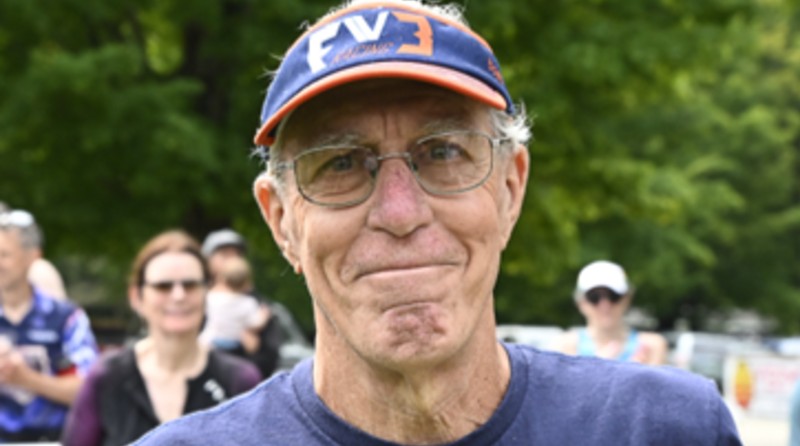
The experience we accumulate in triathlon can become a gift to someone just entering the sport.
By Dave Conover | Editor’s introduction and closing by Terry VanderWert
Editor’s Introduction
A few weeks ago, Dave Conover wrote to suggest that senior triathletes consider “adopting” a younger or first-time triathlete—not financially, but as a mentor. Dave has contributed to SeniorTriathletes.com before, and I immediately saw his idea as a natural follow-up to our The Many Ways We Keep Moving project.
The stories we have collected from senior triathletes show that our reasons for remaining active often evolve. Competition and personal goals still matter, but so do encouraging others, setting an example for children and grandchildren, and giving something back to the sport. Dave’s experience offers a practical example of what triathlon mentoring can look like.
What follows is Dave’s story, edited and expanded with his permission. His idea—and most of the wisdom in this article—came directly from him.
Staying in Touch With the Young Person We Once Were
“Surrounding yourself with young people is a way to stay in tune with the young person you yourself were at some point.” — Margareta Magnusson, The Swedish Art of Aging Exuberantly
That observation by Swedish painter and author Margareta Magnusson has special meaning for me. For the past 10 years, I have spent one day each week as a STEM mentor to fourth- and fifth-grade students at our local elementary school. Working with their teachers, I develop experiments related to what the students are learning, then guide them as they conduct the experiments and—ideally—learn while having fun.
In reality, I receive more from the students than they know. I leave each week feeling more energized and alive because of their enthusiasm. Maybe there is an upcoming movie entitled 75 Going on 10.
A Young Triathlete at a Family Reunion
Magnusson’s observation came back to me at a recent family reunion with five of my cousins, their children, and their grandchildren. I was introduced to one young relative as “the cousin who does triathlons” because she had completed a youth triathlon that morning—a short lake swim, a five-mile bike ride, and a two-mile run.
The number 44 was still written on her upper arm. She was beaming as she told me she had taken first place, loved the experience, and was already signing up for another race—this time, I believe, a more typical sprint triathlon that would include older athletes.
As we talked, it was clear that she could hardly wait for her next race. It was also clear that I had an opportunity to pass along some of the things I had learned over the years.
The Small Lessons Experienced Triathletes Take for Granted
Many young athletes attempting their first triathlon are probably much like many of us were years ago: reasonably athletic, but not yet training with a specific purpose or familiar with how a race flows—or what to do and when to do it.
During our short conversation, I asked about bike shoes, running shoes, socks (or lack thereof), elastic laces, race belts and other details that can make transitions faster and less confusing. She quickly understood the value of saving time in transition. I mentioned that a minute saved there has the same effect on the final result as running roughly 20 seconds per mile faster over a 5K. Essentially ‘free’ time.
When I asked about the swim, it became apparent that she had trained mainly in a pool, as many triathletes do. Her first open-water race introduced her to sighting, swimming in traffic, and making turns around buoys.
Then I mentioned that many triathletes wear their goggles under their swim cap so the goggles are less likely to be knocked off during the swim. Her eyes lit up as though I had given her a secret formula. To an experienced triathlete, it is a small and familiar detail. To a young athlete coming from the pool, it may be something they had never considered.
More Than Race-Day Advice
Mentoring can certainly include practical tips about transitions, open-water swimming, equipment, pacing, knowing the course and ‘flow’ of the race as well as race preparation from weeks before the race to the morning of the race. But the most valuable lessons senior triathletes can offer may be larger than any single race, component in a race, or the myriad of equipment options for training and racing.
Experience teaches us that not every training session goes as planned, not every race produces the result we hoped for, and progress is rarely a straight line. We can help new athletes to our sport learn patience, consistency, sportsmanship, resilience, and the ability to enjoy the sport without allowing results to define them. Like my experiences with 4th and 5th grade science, each race can end with the question I ask after each class – did you learn something and did you have fun?
Those lessons apply whether the person we mentor is 12, 32, or 62. Dave’s encounter happened to involve a young relative, but his idea extends naturally to any newcomer who could benefit from an experienced and encouraging voice.
A New Way to Remain Part of the Sport
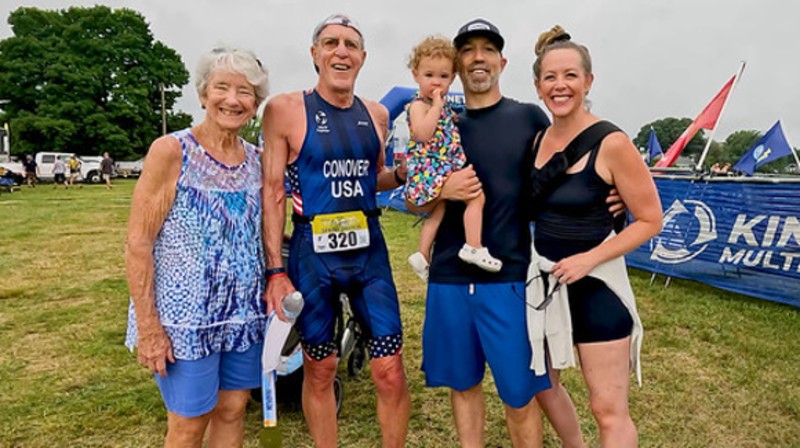
I now plan to become a triathlon mentor to this young relative. I do not know exactly what that relationship will look like. My goal is simply to be available as a resource, encourage and listen to her and, over time, pass along some of what I have learned.
Even if I become slower with age—or eventually have to stop competing—the experience will still be there. I can draw on it to help her and other young people who want to join our ranks. Perhaps some of them will still be competing at the turn of the next century, just as senior triathletes are today.
There may be an opportunity for other senior triathletes to do something similar through a relative, friend, school, youth group, coach, triathlon club, or local race. Giving back in this way may help grow the sport we love. It may also help us rediscover some of the excitement we felt when triathlon was new to us.
Editor’s Closing: Who Could Benefit From What You Know?
Dave’s story raises a question worth considering: After years—or decades—in triathlon, what will we do with everything the sport has taught us?
Mentoring does not require becoming a certified coach or developing a formal mentoring program. It can begin by answering a beginner’s question, walking someone through transition before a race, inviting a newcomer to a training session, or simply offering encouragement after a difficult day.
This is why Dave’s story belongs beside The Many Ways We Keep Moving. Continuing to train and race is one way we remain engaged. Helping someone else begin and continue in the sport may become another. Our accumulated experience does not lose its value when our pace slows; in the right hands, it gains a second life.
Who helped you when you were new to triathlon—and who might benefit from what you know now?
Tell us in the Comments below about a person you have mentored, or someone you would like to help. Your experience could become part of a future Senior Triathletes Giving Back story—and may encourage another reader to do the same.
About Dave Conover
Dave Conover is a senior triathlete who served as a USA Triathlon race official from 1999 to 2022 and was named the 2020 USA Triathlon Race Official of the Year. He is also a longtime STEM mentor to elementary-school students and a returning contributor to SeniorTriathletes.com. His suggestion that experienced triathletes mentor younger and first-time athletes inspired this article.





Comments: We’d love to hear about your experience. Join the conversation below. All comments are reviewed before they appear.
Reply notifications: Click the bell icon above Post Comment to be notified when someone replies to your comment.
Follow the discussion: Click Subscribe above the comment box and enter your email address to receive notifications whenever a new comment is added—even if you don’t leave a comment. After subscribing, check your email and click Confirm to activate notifications.