
Ever Considered an Open-Water Swim Event? Hilary Topper Explores the Possibilities
From charity events to destination adventures, open-water swimming offers older triathletes new ways to challenge themselves, stay active, and enjoy endurance sports.
Over the ten years I’ve been publishing SeniorTriathletes.com, I’ve watched the athletic pursuits of older triathletes evolve. Some continue competing at high levels. Others have reduced their racing distances or moved toward different endurance activities.
One longtime triathlete recently told me he had reconsidered how he wanted to spend his training and racing time. Instead of preparing for another triathlon, he decided to participate in running events while pushing his granddaughter, who uses a wheelchair. His new goal allows him to share his passion for endurance sports with someone he loves.
These different paths reflect a common desire to remain active, challenged, and connected to others as we age.
They also raise a question: What other activities might provide the physical, mental, and social benefits we’ve found in triathlon?
One possibility is an activity most triathletes already know—open-water swimming.
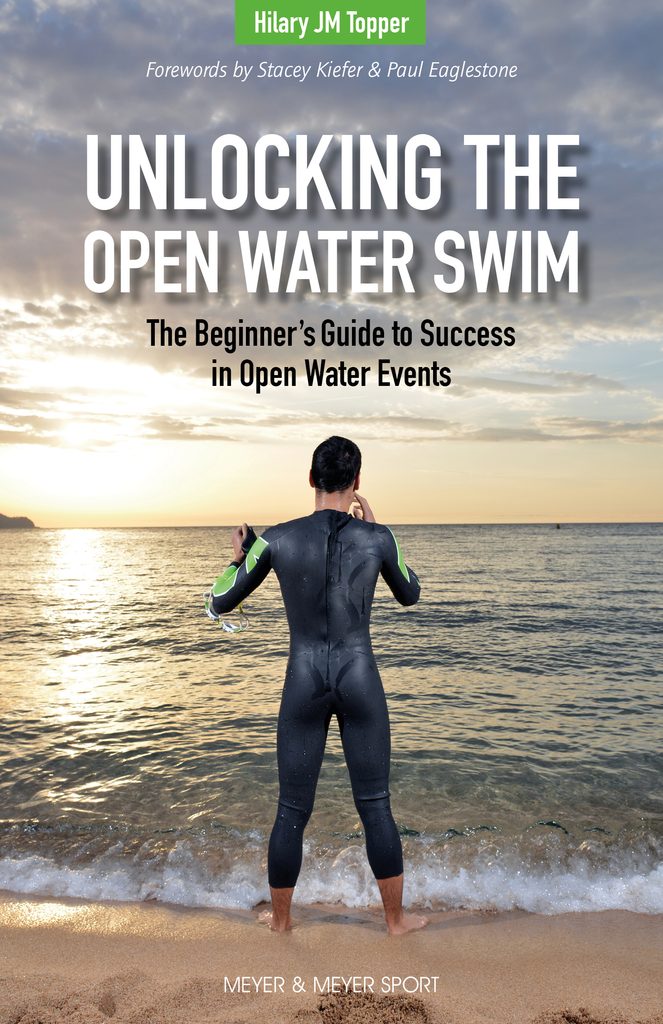
I recently spoke with Hilary Topper, swimming coach and author of Unlocking the Open Water Swim: The Beginner’s Guide to Success in Open Water Events, about opportunities that extend beyond the swimming leg of a triathlon.
From Performance to Experience
Most triathletes approach open-water swimming with one objective: complete the swim efficiently and move on to the bike.
But swimming can also be the entire event.
Hilary distinguishes between competitive open-water swimming, which emphasizes performance and finishing times, and adventure swimming, which places greater value on the experience itself.
When I asked about the difference, Hilary described a shift from performance mode to experience mode.
“It’s not about time. It’s not about who can get there faster,” she explained.
Instead, swimmers can appreciate their surroundings, the sensation of moving through the water, and the satisfaction of completing a challenge.
Hilary recalled an older swimmer who described being very slow but loving swimming anyway. Her response captured the philosophy: “The point is loving it.”
Adventure swimming doesn’t necessarily eliminate time constraints. Events may establish cutoff times for safety and logistical reasons. The distinction is that participants aren’t primarily competing to finish faster than others.
For triathletes accustomed to measuring progress through personal records and age-group placements, this represents a different approach to endurance sports.
An Adventure Around Mackinac Island
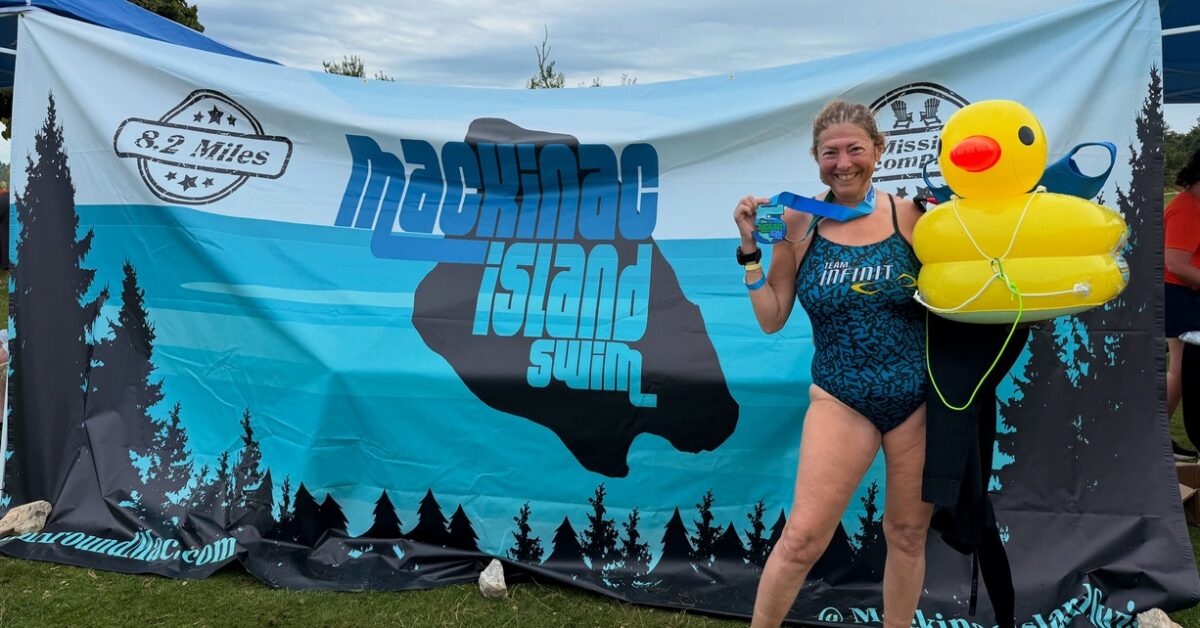
One of Hilary’s memorable experiences was swimming around Mackinac Island in Michigan.
The organized course is approximately 8.2 miles. Hilary covered about 8.3 miles, reflecting the actual route she swam.
Participants had eight hours to complete the swim, and Hilary finished in approximately six hours.
Although the event emphasizes adventure rather than competition, it requires substantial preparation. Hilary trained up to 10 kilometers (6.2 miles) in preparation.
The event also accommodates equipment that competitive swimming events may prohibit, including fins and tow buoys. Given the cold Lake Michigan water, wetsuits are highly encouraged. Swimmers choosing to participate without one must sign a waiver.
What Hilary particularly appreciated was the freedom of the experience. After the swimmers spread out from the start, she could settle into a comfortable rhythm and enjoy the surroundings.
The idea caught my attention. Having visited Mackinac Island as a child, I mentioned the swim to my grandson, a former high school competitive swimmer. He expressed interest in joining me if I ever decide to attempt it.
That possibility illustrates another appeal of open-water swimming events: the opportunity to share a new endurance adventure with family or friends.
Start With an Appropriate Challenge
Adventure swimming need not begin with an eight-mile event.
Hilary described coaching a woman approaching age 75 who participated in Swim Across America, a series of swimming events supporting cancer research. This woman’s husband had died of cancer, giving her participation particular meaning.
She began with a 500-meter swim and progressed to one mile (1,609 meters) the following year.
For a triathlete comfortable swimming the 1,500 meters of an Olympic-distance event, a standalone one-mile swim could be a reasonable starting point. Longer events can follow as interest, experience, and fitness develop.
Hilary’s own progression followed a similar path. She began swimming at age 53, when completing a single 25-yard pool length was difficult. Eventually, she progressed from a one-mile ocean swim to 5K and 10K events.
Her experience demonstrates that ambitious new goals remain possible later in life, provided they are matched with appropriate preparation.
Preparing for Longer Swims
When I asked how to prepare for the Mackinac Island event, Hilary suggested working backward from the event date, gradually increasing training distance over approximately 20 weeks.
She also described occasionally dividing long training swims into separate sessions when completing the full distance at once wasn’t practical.
Beyond endurance, Hilary emphasizes strength training, particularly for the core and swimming muscles, along with shorter, faster intervals during pool workouts.
Longer swims also require attention to hydration and fueling. During the Mackinac Island event, Hilary carried drinks and energy gels in her distinctive duck-shaped tow buoy.
For readers seeking more structured guidance, Unlocking the Open Water Swim includes four sample training plans:
- 16 weeks for a 1.2-mile Half Ironman swim
- 16 weeks for a 2.4-mile Ironman swim
- 16 weeks for a beginner 5K open-water swim
- 20 weeks for a beginner 10K open-water swim
The plans also accommodate athletes who have limited access to open water and complete much of their training in pools.
Prepare for Conditions You Cannot Control
Unlike pool swimming, open-water swimming requires adapting to changing conditions. Hilary recommends practicing several techniques before they’re needed.
Bilateral breathing. Becoming comfortable breathing to either side allows swimmers to turn away from approaching waves, reducing the likelihood of inhaling water. This can also be particularly helpful in salt water where repetitively taking salt water into our mouth can be uncomfortable.
Stroke adaptation. A long stroke with considerable gliding may work well in calm water but become less effective in chop. Practicing a shorter stroke with a somewhat higher turnover provides another option when conditions deteriorate.
Cold-water acclimatization. Swimmers should become familiar with the temperatures they’re likely to encounter, entering cold water gradually and avoiding an immediate strenuous effort.
Water quality and aquatic hazards. Unfamiliar swimming locations may present challenges beyond waves and water temperature. Hilary described encounters with jellyfish and sea lice along the Atlantic Coast. After an unpleasant experience, she began using Safe Sea, a sunscreen marketed as providing protection against these irritants, with positive results. Freshwater swimmers should also be alert to harmful algal blooms, which can cause skin, eye, and respiratory irritation. Before an event, investigate local conditions, check water-quality advisories, and avoid swimming where harmful blooms are suspected.
Wetsuit fit. A wetsuit must provide warmth without restricting breathing or shoulder movement. Hilary emphasizes testing the wetsuit during training, especially before an extended swim.
Equipment rules vary considerably among events. Competitive swims may restrict wetsuits, fins, or other aids, while adventure events often permit them. Always check the requirements of the particular event, including cutoff times and support arrangements.
Recognize When Something Isn’t Right
Hilary also shared a lesson from swimming across Great South Bay on Long Island. During her first attempt, she followed an inexperienced support kayaker who drifted far off course in the currents. Both eventually completed the crossing, but she swam considerably farther than planned.
Her second attempt, with an experienced kayaker with whom she had practiced, went much more smoothly.
The lesson extends beyond navigation: adequate preparation includes competent support and sound judgment.
Even experienced swimmers must recognize when something isn’t right. I recalled becoming light-headed early in a California triathlon swim, possibly in part because of the altitude.
Hilary emphasized that unusual symptoms should never be ignored in the excitement of an event. If dizziness, unexpected breathing difficulty, or other concerning symptoms occur, stop, turn onto your back to stay afloat if it is safe to do so, and signal for assistance.
Knowing when to stop is as important as knowing how to keep going.
Finding Your Next Open-Water Adventure
Perhaps the most appealing discovery in reading Hilary’s book is the variety of organized swimming events available.
Options include competitive races, recreational swims, charity events, and destination adventures. Like many triathlons, some events support worthwhile causes, allowing participants to combine athletic goals with giving back.
Hilary devotes a chapter of her book to finding these opportunities. Resources include the World Open Water Swimming Association (WOWSA), U.S. Masters Swimming, Global Swim Series, and Ray’s Notebook, which catalogs shorter open-water events.
Local swimming clubs and online communities can also provide recommendations.
The best choice depends on what you’re seeking: competition, a personal challenge, a memorable location, or an experience to share with others.
Another Way to Keep Moving After 50
Toward the end of our conversation, I asked Hilary what open-water swimming might offer older endurance athletes.
Her first response was its low-impact nature.
Swimming provides cardiovascular exercise without the repetitive ground impact of running. Although it isn’t free from overuse injuries, it may appeal to athletes seeking to reduce the physical demands of their endurance activities.
Yet the appeal extends beyond exercise.
Open-water swimming can provide new destinations, new friendships, meaningful causes to support, and opportunities for shared experiences.
For those of us who have spent years training and racing in triathlon, it may also offer a different way to measure success.
Not every new challenge needs to be longer, faster, or more competitive than the last.
Sometimes the reward is simply discovering another reason to keep moving.
And sometimes the next endurance adventure doesn’t require a bike or running shoes. Just the water.
About Hilary Topper and Her Latest Book
Hilary Topper is a swimming coach, endurance athlete, and author of Unlocking the Open Water Swim: The Beginner’s Guide to Success in Open Water Events.
Having begun swimming in her 50s, she has completed numerous open-water events, including marathon-distance and adventure swims.
Her book covers swimming skills, training, equipment, safety, and opportunities for participating in open-water events. It also provides sample training plans for distances ranging from 1.2 miles to 10K.
You can find Hilary’s book on Amazon and other on-line booksellers
Join the Conversation
Have you participated in a standalone open-water swim, or considered trying one? What interests you most—competition, adventure, or sharing the experience with others?
Tell us about it in the comments.
Disclaimer: Please note that SeniorTriathletes.com is a participant in the Amazon Services LLC Associates Program. This is an affiliate advertising program that provides a way for sites to earn advertising fees. They do this by advertising and linking to amazon.com. Amazon, the Amazon logo, AmazonSupply, and the AmazonSupply logo are trademarks of Amazon.com, Inc. or its affiliates. As an affiliate, I will receive a small commission for any purchases of this product that you make through Amazon if you use the links in this post.






Comments: We’d love to hear about your experience. Join the conversation below. All comments are reviewed before they appear.
Reply notifications: Click the bell icon above Post Comment to be notified when someone replies to your comment.
Follow the discussion: Click Subscribe above the comment box and enter your email address to receive notifications whenever a new comment is added—even if you don’t leave a comment. After subscribing, check your email and click Confirm to activate notifications.