Racing For Fun – Nikki Austin’s Story

Is it fun to do a triathlon or other multi-sport endurance race? It is the way senior triathlete Nikki Austin does it, with family and friends and in various places she has not previously been.

Meet Nikki Austin

During most of her week, Dr. Nikki Austin serves as an associate professor in the Department of Nursing at Towson University (Towson, Maryland). Besides preparing the next generation of nurses, Nikki has authored or coauthored papers and spoken on a wide range of topics, including nursing care for children and adults in disasters.

When not working, Nikki is most likely training for her next multi-sport race, a triathlon or aquabike event. She is also an important part of the Senior Triathletes community, recently contributing to the post on Becoming a Confident Open Water Swimmer.

Nikki ‘s Triathlon History

Nikki’s introduction to triathlon came while providing medical support at the Eagleman Maryland 70.3 triathlon. The athletes inspired her, causing her to realize she would rather race than watch.

Shortly thereafter, Nikki learned that her youngest brother, Tim, had been doing triathlons for years. In 2013, Nikki completed the Frantic Frog Triathlon with him in his hometown of Scottsboro, Alabama.

Despite its later name change, this triathlon has become an annual racing event for Nikki’s family. Over the past ten years, she has competed in the Frantic Frog and its successor with her three brothers, two sisters-in-law, and many nephews and a niece.

Because of her love for racing, Nikki has, in the last few years, set a goal of doing around six races per year, one each month from May through October. At least one of these is what Nikki calls a ‘bucket list’ race, one in an area of the country she has not previously visited.

Training for Multi-Sport Racing

Signing up for a race provides all the motivation Nikki needs to train. While she is self-coached, in part because of her demanding work schedule, Nikki also sometimes trains with the Baltimore Area Triathlon Club.

Her typical training schedule includes:

  • Two times per week, swim 1.2 miles at her local pool.
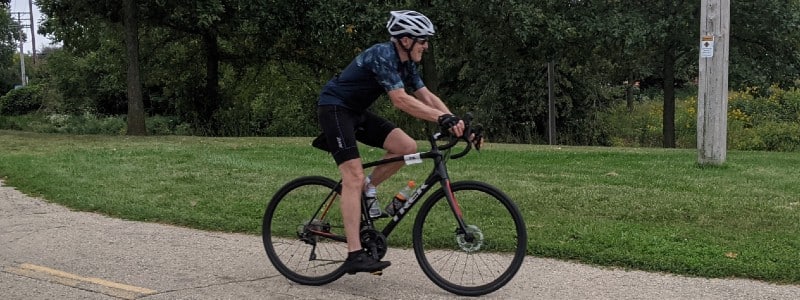
  • At least once per week, ride 20 to 25 miles. Today, these rides are typically on a circuit on the beach near her home in Virginia Beach, Virginia, or on a rail trail, such as the National Capital Rail Trail or Washington Old Dominion Trail. She recommended several other trails as well.
  • One time per week, complete an upper body strength training routine using her Bowflex.

Primarily because of knee pain, Nikki rarely runs. It is also the reason she has recently transitioned from triathlon to the aquabike (swim-bike) event.

To manage other chronic issues, Nikki has found the physical therapists at Dominion Physical Therapy to be incredibly helpful.

Preparing for the Next Race

Before a race, Nikki tries to complete the distance of the race at least once. This approach is good advice for beginners and those moving to a longer distance race.

First, training for the race distance helps develop the required strength and fitness. She also learns about your body’s need for water and calories to comfortably complete the distance.

To the extent possible, she also trains in the weather conditions she could face in the race. For example, if she is doing a spring race, some of her training for each of the legs of the race will be done in cold and windy weather.

Fun Racing With Family & Friends

While the fun of racing with family members has continued year after year, the specific race profile has occasionally changed.

One year after Nikki had suffered a broken ankle, the family group decided to ‘mix it up’ and race as a team. Nikki did the swim and bike, while one of her brothers did the run leg.

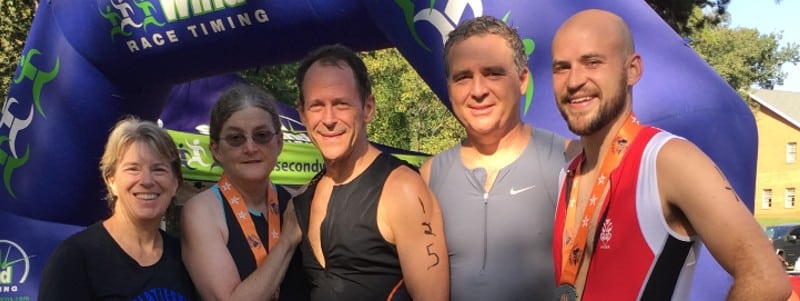
In other races, each of the family members does the event that best matches their skills. For example, in the Charlotteville, Virginia event in September 2019 (see the picture at the top of this post), Nikki’s two brothers and her nephew did the sprint triathlon, sister-in-law Janet completed the duathlon (run-bike-run), and Nikki competed in the sprint aquabike (swim-bike).

Related Post: Christmas in October – Paul Zellner’s Story
racing fun with family and friends
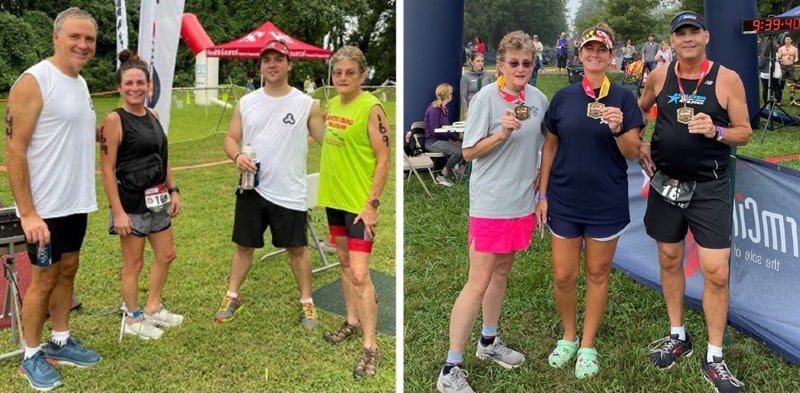
Racing with family and friends. Left picture: Nikki Austin’s brother Tim McKechnie, running partner Kim Wallace, Nikki’s nephew and Tim’s son Mason McKechnie, and Nikki at the September 3, 2022 Racing Rivals Triathlon in Scottsboro, Alabama. Right picture: Nikki (left) with Kathleen Resnick (center) and Howie Cohen (right), members of the Pikesville (Maryland) Volunteer Fire Company at the October 2021 Baltimore Triathlon.

Racing with family and friends is so cool and so fun. Plus, I am creating a retirement wardrobe with the race t-shirts.

Nikki Austin

Making an Impact

Nikki sees part of her role as an educator to model habits that will help her students beyond graduation. This is one reason she rides her bike to work and parks it in her office. On top of this, exercise, particularly swimming, provides relief from the stress of her workday.
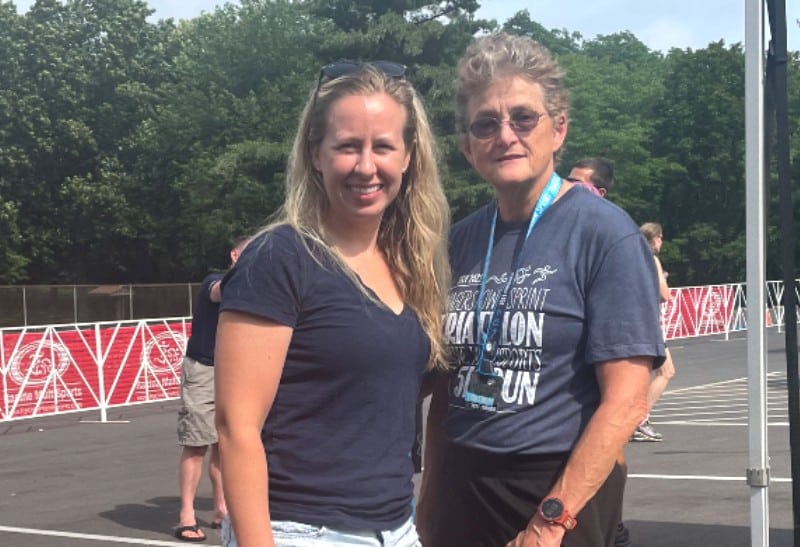
Nikki Austin with former nursing student U.S. Army Captain Meg Cotton at the Hagerstown, Maryland triathlon in July 2021. Captain Cotton’s eight-year-old son took part in the kids’ race during the same weekend.

Exploring New Places

“You’re doing a race in July where?”

This was the nearly unanimous sentiment of family and friends whom Nikki told of her upcoming race in Florida.

Ignoring the nay-sayers, she competed in the July 2022 Fort DeSoto International Aquabike event in St. Petersburg, Florida. To make the event even more memorable, she ended up on the podium with a third place finish in her age group.
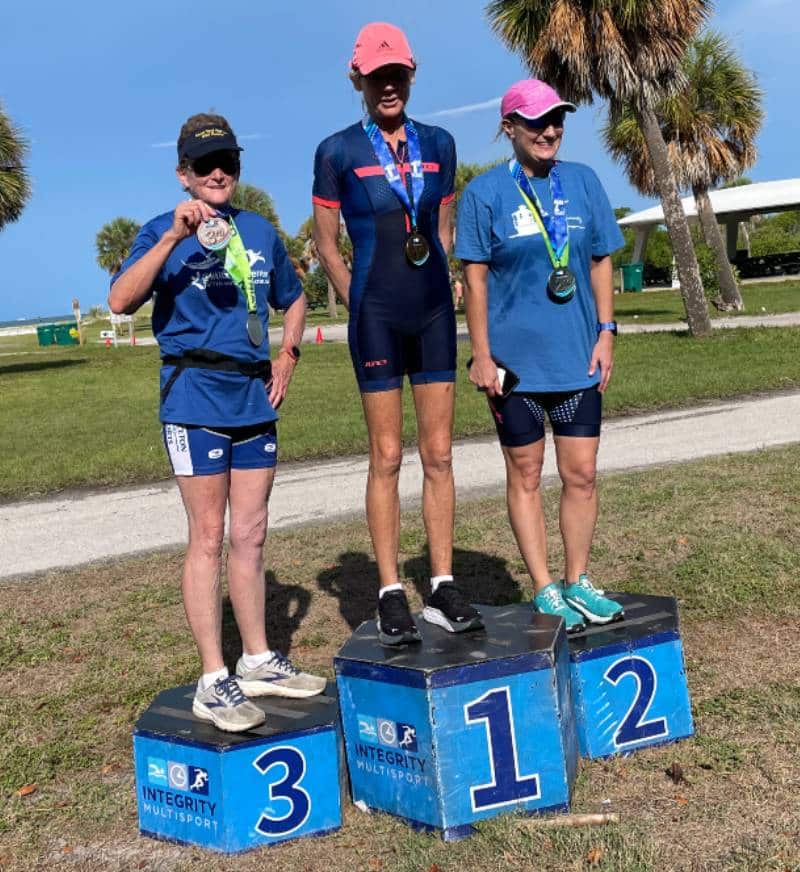
Age group finishers at the 2021 Fort DeSoto International Aquabike event.
Nikki earned a third place finish in her age group at the July 2022 Fort DeSoto International Aquabike event.

Those she told about plans to do the June 2022 Escape the Cape aquabike race also thought she was crazy. After all, who in their right mind would jump off the Cape May Ferry to swim back to shore? One friend was sure that they would be nothing more than ‘shark bait’.

Nikki did this race anyway. “This was a great race. I even enjoyed the long run in the sand to transition.”

I have never been a racer, but I just love to do these races. I love to meet new people and see those I have raced with in other places. The camaraderie is great.

Nikki Austin

Racing With a New Hip

That Nikki continues racing today is proof that joint pain or replacement need not end your racing career. In fact, one of her most fun races was the 2021 Lititz recCenter Triathlon (Lititz, Pennsylvania) which took place a mere nine months after hip replacement surgery.

Each individual should follow the advice of their orthopedic surgeon. In Nikki’s case, her surgeon encouraged her to continue swimming, biking, and even running. “Getting back in the pool was great therapy!”

She’s still racing hard more than three years later even though knee pain has caused her to avoid running and switch to aquabike racing.

Advice For Ensuring Fun In Triathlon

With ten years of racing at various distances, Nikki has learned a few lessons from which others can benefit.

Choosing a Race

If you are racing with family and friends who have different interests and capability, look for races with options to fit everyone. “Races with many options are just great.”

While reading about a race, Nikki also looks for information about the support services that will be available during the race. Running out of water or food during a longer distance race, like half Ironman, can be disastrous if not terribly unpleasant.

By the way, Nikki is looking for what she calls her ideal race, one involving swim-bike-kayak. If you know of one, share this information in the Comments section below.

Related Post: How To Choose Your Next Triathlon

Nutrition

Many of the senior endurance athletes I have interviewed have told me of the importance of pre-race nutrition. Arriving at the race fully fueled is essential.

Nikki echoed this advice. In fact, she eats a breakfast on race day like one she has every other day of the week, typically two egg sandwiches.

For the typical aquabike race involving international (Olympic) or half Ironman distances, she has a banana and protein shake in the swim to bike transition and consumes water and a couple of GU packs during the bike leg.

Nikki told me about a race in which she ran out of water and, because of cold weather and a delayed start to the race, burned more calories than expected. Because of this, she became thirsty and hungry during the race. From this unpleasant experience, she now arrives at the race with food and water based on the race distance and level of on-course support.

Gear

Being prepared for a race requires training in each of the sports of a triathlon or other multi-sport event. For proper training, one must have clothing and equipment that fits correctly and is in good condition. Sources of quality gear are “worth their weight in gold”.

Nikki recommends having a bike shop staffed with those who will make sure the bike fits correctly and works well. She also makes sure she has biking socks and shoes that are quick and easy to put on and prevent foot cramps and blisters.

Be Flexible

Nikki’s final piece of advice is also golden.

Some days we arrive at the race feeling better than on others. If you are feeling unable to complete the race for which you originally signed up, try to change your race.

Nikki found this to be her situation for one race for which she had registered to complete the Olympic distance triathlon. Rather than drop out of the race, she competed in the sprint distance race. Another option would have been to race as a team instead of individuals.

Is Triathlon Racing Fun?

What do you enjoy most about racing in triathlon or other multi-sport events? Has there been a particular race in which you have had the most fun?

Let us know in the Comments below.
Comments: We’d love to hear about your experience. Join the conversation below. All comments are reviewed before they appear.

Reply notifications: Click the bell icon above Post Comment to be notified when someone replies to your comment.

Follow the discussion: Click Subscribe above the comment box and enter your email address to receive notifications whenever a new comment is added—even if you don’t leave a comment. After subscribing, check your email and click Confirm to activate notifications.

Age-Specific Injury Prevention and Recovery

What can older endurance athletes do to minimize injury and speed recovery from injury when it occurs? Triathlon coach John Hansen shares his advice for our community of senior triathletes, duathletes, and other multisport athletes.

Introducing John Hansen

John Hansen is a USA Triathlon Level II, USA Swimming Level I, and USA Cycling Level III Certified coach. He coaches the University of California Davis Collegiate Club Triathlon team. He also has his own coaching business, focusing on long-course athletes, 70.3 and 140.6.

About one month ago, I read an article he had written for USA Triathlon titled Transitioning Back to Training After Injury. The article contained easy to follow guidelines for returning to training after injury. The guidelines he provided differed based on when in a training cycle the injury had occurred.

John’s advice for starting or restarting training is good advice for all of us. However, it is especially good for seniors training for their first triathlon.

The ’40-20 rule’ he described was new to me. This rule combines “training volume that is 40% of the volume you were at prior to the injury” with adding “20% of the new volume every 1-2 weeks”. We can modify the rule to be more conservative or more aggressive, depending upon the severity of the injury.

In the article, John also recommended adjustments to equipment and gear depending on where in the training cycle the athlete is.

How Age Affects One Coach’s Advice

John wrote the article for the general population of endurance athletes, not any specific age group. As I read, I was curious if he would change the approach if focused on the SeniorTriathletes.com demographic. So, I asked him the following question by email:

“How, if any way, might you change your advice if writing to 50-80+ year old triathletes, aqua-bikers, and duathletes?”

Following is John’s response, included here with his permission.

“Thank you for the question. With respect to the article, many of the points, especially the general points I made in the beginning of the article, are easily applied to triathletes in the 50+ age groups. However, there are several key elements this population should focus on to prevent injuries and optimize their transition back to training. All these elements are related to the injury recovery process, which takes longer for triathletes ages 50+. With that in mind, there are a few key prevention pieces of this puzzle to focus on:

Preventing Injury for Senior Endurance Athletes

First is strength training. Strength training for this age group is all about minimizing muscle mass loss, managing the quality of the muscle as it ages and sustaining connective tissue (tendons/ligaments/fascia) strength. Muscle mass decreases approximately 3–8% per decade after the age of 30 for non-active adults.

As triathletes, this population is helping to stem these issues, but the curve can be further reduced if the 50+ population engages in a full body strength routine 3x week. These positive benefits then result in a lower frequency and/or severity of injuries and ultimately a quicker recovery time.

Second is muscle pliability and connective tissue mobility. Muscles that are more pliable and connective tissue that allows for greater joint mobility, leads to lower frequency and/or severity of injuries and ultimately a quicker recovery time.

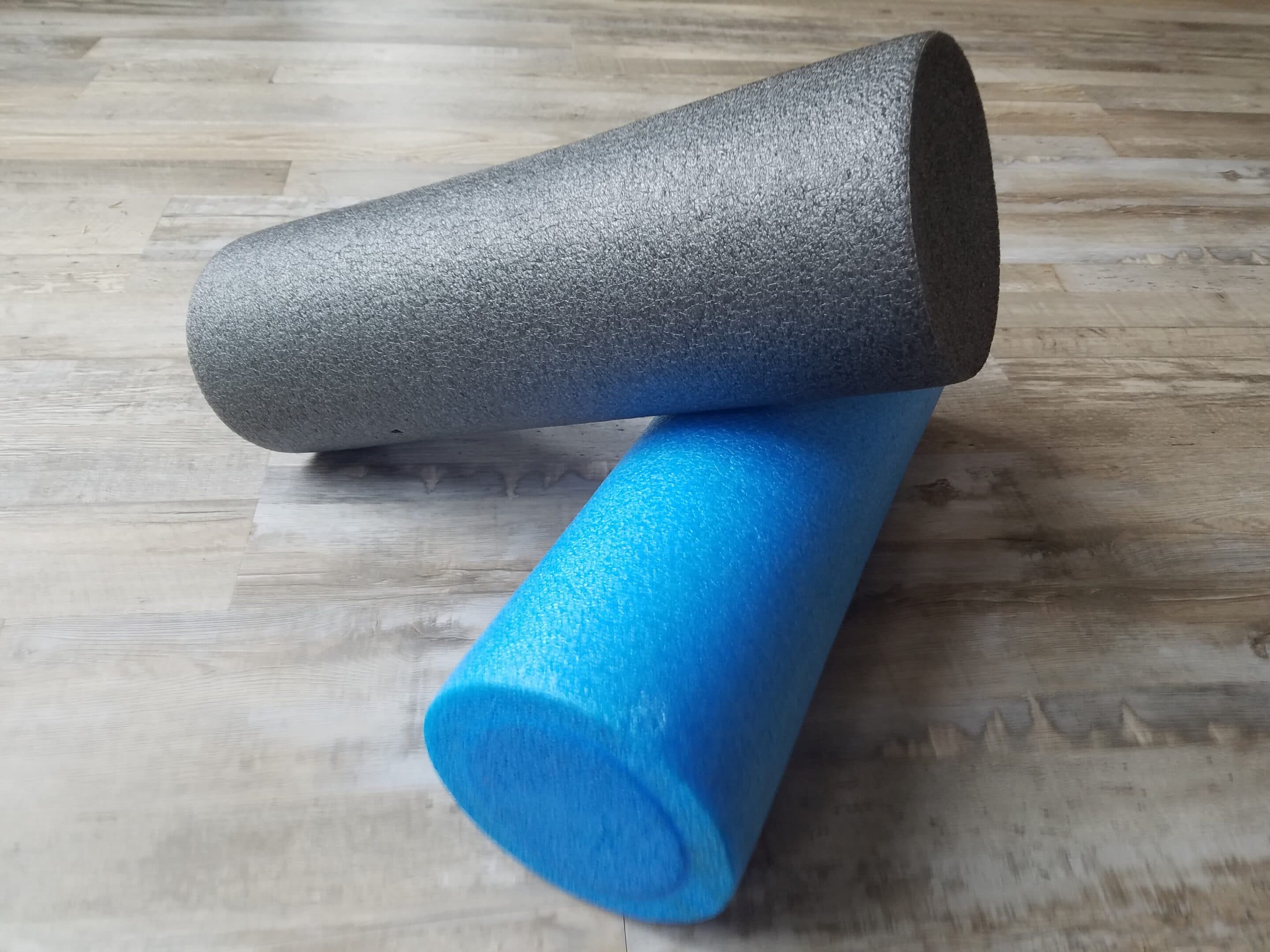
As we age, our muscles become less pliable because they retain less fluid, making them more rigid. Aging also affects connective tissue, reducing the mobility in our joints. Connective tissue loses fluid and collagen over time, making joints less mobile and more rigid and stiff. However, stretching, rolling, and myofascial release stimulate the production or retention of lubricants between the connective tissue fibers, thus preventing the formation of adhesions, creating more flexibility in muscles and greater mobility in joints.

The most vulnerable time for reinjury is when you feel normal as you return to training.

John Hansen, TRANSITIONING BACK TO TRAINING AFTER INJURY, October 14, 2022.

Recovery After Injury for Older Athletes

With respect to returning from an injury, key areas for this population [of senior endurance athletes] to focus on would be the following:

  • Rebuilding volume and intensity modestly; follow a more conservative plan than what I discussed in the article.
  • Follow a two-week training cycle instead of a one-week training cycle so the harder and/or long workouts can be spread apart with more rest or light training days in between these efforts.
  • Follow walk-run protocols and minimize hill training on runs.
  • Incorporate exercises, such as standing on one foot, standing on a wobble board or Bosu ball, to develop greater balance, coordination and proprioception.
  • Spend more timing warming up to allow the body (muscles and connective tissue in particular) to be better prepared (enhanced blood flow, fluid in the joints, central nervous system and more) to tackle the main body of the workout.

Related post: Rest and Recovery: Why It’s Important for Senior Triathletes

How Has Your Recovery Changed With Age?

Do you have questions for John? Or, can you share your experience with recovering from injury? Post these in the Comments below.

Comments: We’d love to hear about your experience. Join the conversation below. All comments are reviewed before they appear.

Reply notifications: Click the bell icon above Post Comment to be notified when someone replies to your comment.

Follow the discussion: Click Subscribe above the comment box and enter your email address to receive notifications whenever a new comment is added—even if you don’t leave a comment. After subscribing, check your email and click Confirm to activate notifications.

It’s The Journey, Not The Destination – Steve Stewart’s Story

At 70 years old and moving into retirement, I pulled out my bucket list to see ‘Ironman triathlon’ at the top.

Before I go any farther, I should let you know that I have a mythical Uncle Max whose philosophy for life was “If it’s worth doing, it’s worth overdoing”. Following Max’s approach, I thought that full distance triathlons were worth doing. With that, I began my planning and training.

Ironman Triathlon on My Bucket List

I swam competitively in high school and college. I ran several marathons in my 20s and 30s and picked up road biking in my 30s and 40s. In the early 1980s, I tried a 70.3 triathlon, my only triathlon until now.

The Ironman triathlon on my bucket list would be a real challenge, but something worth doing.

I started my training from a level of moderate fitness. Biking and walking were enjoyable. However, I had done no swimming in over 45 years.

I tried to be creative in my training as I had total hip replacement on both hips about 15 years earlier. My surgeon had told me to not run since running would wear out the new joints prematurely. Arthritis was also entering the picture.

Training initially went well. I trained with speed walking and occasionally a walk/run strategy.

Then I tore a hamstring. That didn’t stop me from swimming or some strength training. However, it limited my walking and biking.

Obviously, my training wasn’t going well. Eventually, I got back on track and was looking forward to my inaugural full distance (140.6 mile) triathlon, Ironman Wisconsin 2020.

However, Covid entered the picture and the race was canceled.

Setting My Sights on Ironman Wisconsin 2021

I regrouped and began a slightly more intense training program to prepare for the 2021 event. However, with the increased intensity and distance, I suffered a stress reaction and strained muscle in my left leg.

For the next ten weeks, I wore a boot and did no running or speed walking. After about eight weeks I could bike, but only for short periods and at low intensity. I basically took those 10 weeks off and started over again.

After restarting my training, I gained in fitness and confidence, lost some weight, and, despite a sense of chronic fatigue, felt good. I was well on my way to achieving my goal.

My goal was to finish the Ironman race, not win it. That meant I had 17 hours to swim 2.4 miles, bike 112 miles over a technical and hilly course, and run (walk) 26.2 miles through the streets of Madison.

Nutrition is known as the “fourth discipline” of triathlon. It is a crucial component for people like me who will be on the course for nearly 17 hours.

I developed what I thought was a solid nutrition and hydration plan for the day. I wanted to stay hydrated and take in enough calories to maintain strength without causing an upset stomach.

Related post: What If I Want to Do An Ironman Triathlon? – Tom Lipp’s Story

Ironman Wisconsin 2021

Race day 2021 arrived. I thought I was ready to complete my top bucket list item, my first Ironman triathlon. The weather cooperated as temperatures were in the upper 60s. The wind didn’t start building until later in the day.

My swim went surprisingly well, I started out too fast, but settled into a manageable pace and came out of the lake feeling good.

Trouble on the Bike

However, within four miles of starting the bike course, my legs felt heavy and tired. I tried backing off the pace, but that didn’t seem to help.

The bike course is essentially a two lap route. I struggled to climb all the hills on the first lap. I also noticed pain in my quadriceps. Then they started cramping. These were hard cramps. I struggled but did finish the bike course. However, I was behind schedule.

I was also somewhat demoralized as I started the 26.2-mile run. I continued to experience cramping, was light headed, and was walking at a snail’s pace.

The reason? I was dehydrated and short on calories.

My hydration and nutrition plan was solid, but I “forgot” to follow it. Caught up in the excitement, and focused on the technical and challenging bike course, I didn’t eat or drink nearly as much as I should have. I struggled until just past mile 19 when I realized I would not be able to finish in 17 hours, the official cut off for the race. Because the dehydration had affected my reasoning power as well as my general wellbeing, I painfully withdrew from the race less than seven miles from the finish line.

Looking Back After the Triathlon

At the time, I considered this a failure. I felt I didn’t have the physical stamina, the mental toughness, and the discipline to complete this challenge.

However, in the weeks following the race, I looked back at all I had accomplished. I learned and improved swimming, biking, and pacing skills. I enjoyed pool and open water swimming and the long bike rides through the countryside. Most of the time, I had successfully completed challenging daily workouts. My overall health had improved. I was proud of my fitness level and that I had successfully met the rigors of a challenging training program.

Planning for Ironman Wisconsin 2022

Now it’s on to 2022. There was some unfinished business in Madison. I developed a better training plan, enhanced my nutrition and hydration plan (and resolved to follow it closely), and sought the advice of a biking consultant. The training was tough, but I had that sense of pride after each workout, because I faced the daily challenges and met them. Over the next 10 months I again gained confidence, strength, and endurance. I was ready to become and Ironman.

When training as a “senior” athlete, the concept of age is a huge challenge. I don’t mean that if you are old, you cannot train. When I was going through an intense workout I would think that this is way too hard for a 72 year old so I should back off on the intensity and the duration, and even add more rest after the workout. But I don’t think of myself as a 72 year old and won’t use that as an excuse. There are times I feel so good that I forget I am 72 and think I am 40 and I should be doing more. Logically, I should back off and train smart, but I still don’t feel 72 so the battle continues

Unexpected Weather on Race Day

I watched the weather forecast daily as we approached race day. I was expecting moderate to warm temperatures and strong winds. Not ideal, but I was ready.

Unfortunately, as we know, weather forecasts are not always accurate. The night before the race, rain entered the picture and stayed with us for the next 40 hours. Not only was it raining, it was “cold” (55 degrees) and the wind was averaging 15 to 18 miles per hour.

It was pointed out to me that at 72 I was the oldest competitor in this year’s race. I began to wonder what I was doing in cold, rainy and windy weather for 17 hours

Swim

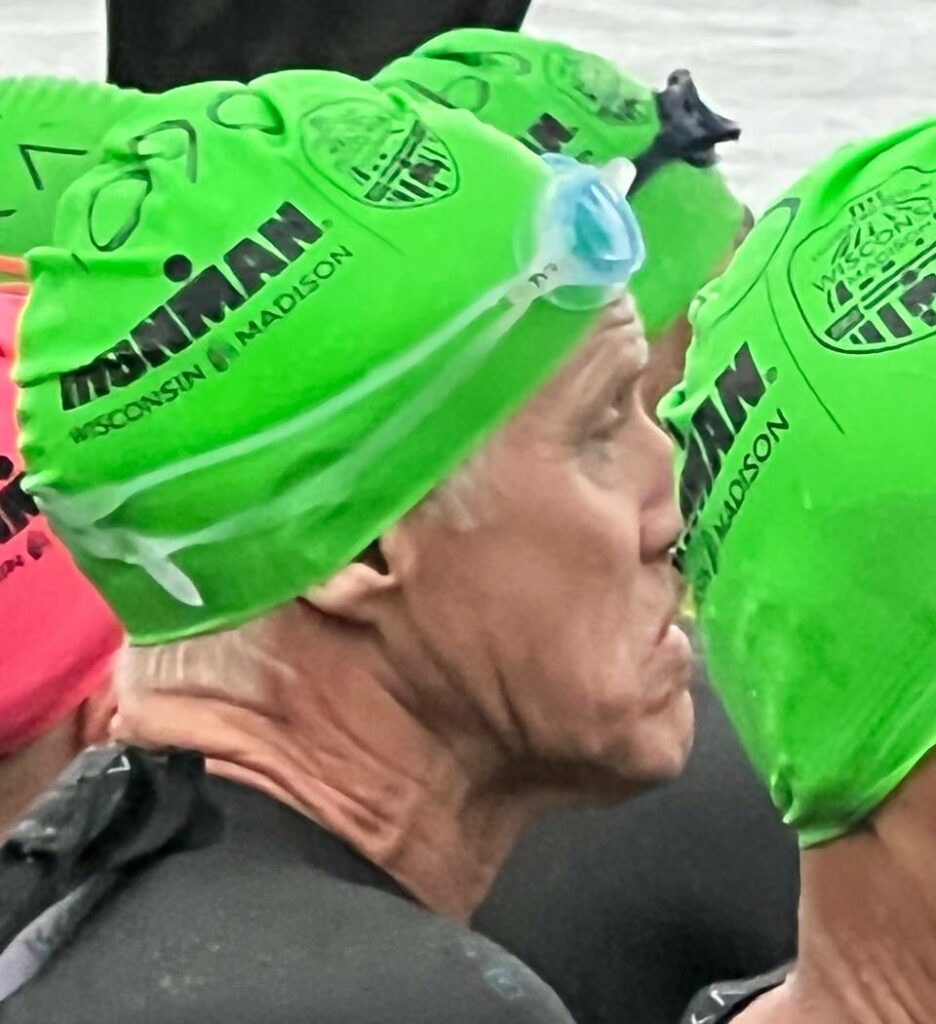
As we wait to start the race, we are standing in mud, with rain and wind. We are wearing wet suits and swim caps but somehow are still cold. When the race begins we hit the water which was 71 degrees and actually felt good. Although I had a very strong year of swim training, my swim went poorly. I never found a rhythm and had some difficulty dealing with the rough water. I finished and actually felt okay as I exited the lake and moved toward the bike.

Steve Stewart ready for the swim at Ironman Wisconsin 2022.

Bike

When changing into bike clothes, I was cold and shivering. I had difficulty using my hands. But after a few extra minutes, I was on my bike, ready for 112 miles in the rain and cold.

I followed my nutrition and hydration plan closely. However, because my hands were becoming numb, I had to stop on the side of the road to open packets or squeeze my water bottle. Despite that, my mindset was good. I was on pace to complete the triathlon.

I ignored the cold and kept pedaling. By 40 miles, I had difficulty braking and switching gears and even holding on to the handlebars and was shivering violently. No cramps this time. My legs were cold but working fine.

Then, at about mile 82, I felt my back tire go flat. Normally, a flat tire would not have been a big deal. I would hop off the bike, repair the flat, and move on. I’m not very good at repairing flats. This would normally be about a 10 minute process.

This was not the case today. Because of the cold, my hands weren’t working properly. I was shivering violently. It took nearly 10 minutes for me just to open my saddlebag and to remove the wheel from my bike.

But it got worse. I could not remove the tire from the wheel because I had no feeling in my hands. On top of this, my core temperature continued dropping because I was no longer working hard.

The End of My Race

I was finally rescued by spectators who gave me a ride to a rest stop where I could warm up. There were five other bikers already at that rest stop suffering from the cold and wet conditions. Eventually, the weather conditions caused over 35% of the participants to not complete the race. I was one of them.

Reflecting on My Race

Was I disappointed? Yes.

But I was also proud because my mindset during the race was to continue despite the rain and cold. I withdrew because of safety issues (couldn’t brake, switch gears, or hold on to handlebars) and because I could not repair a flat tire.

Again, I reflect on the journey. I have trained for nearly 3 years, learned new skills, developed improved physical and mental toughness, enjoyed the training and felt an almost daily sense of accomplishment. My wife has given me continuous support and encouragement. I may have even inspired my son to take up running and be more active.

My Bucket List Still Includes an Ironman Triathlon

I am proud of the journey and the accomplishments. Since I believe I can check off the box on my bucket list next to ‘Ironman triathlon’, I will be back again next year.

If I fall short, I will look back on all the satisfaction, sense of accomplishment and fun I have had along the way. It is a long journey but I enjoy the ride.

A race is just one day, but the training is months and years. The rewards from daily training and accomplishments far outweigh one day.

About Steve Stewart
Steve and his wife Karna live in Big Lake, Minnesota. Steve is retired after 36 years in residential real estate sales and 13 years in school administration and teaching. He also coached high school swimmers for nearly 25 years. Steve and Karna have four adult children and two grandchildren. When not training, Steve enjoys travel, reading, and volunteering at his church.

Do You Have Questions or Comments for Steve?

Editor’s Note: Please leave your questions and comments for Steve in the section below.

Comments: We’d love to hear about your experience. Join the conversation below. All comments are reviewed before they appear.

Reply notifications: Click the bell icon above Post Comment to be notified when someone replies to your comment.

Follow the discussion: Click Subscribe above the comment box and enter your email address to receive notifications whenever a new comment is added—even if you don’t leave a comment. After subscribing, check your email and click Confirm to activate notifications.

Triathlon Across the USA: State #48 – Idaho

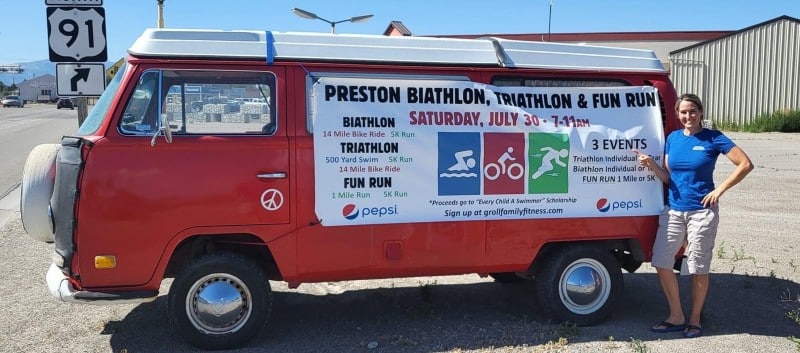
Preston, Idaho; July 30, 2022 – Preston Biathlon, Triathlon and Fun Run; Preston Aquatic Center.

Our Idaho triathlon represented the many triathlons in smaller communities across this country, which are managed and supported by local businesses to benefit local causes.

The Preston Triathlon was also the second of three triathlons in northwestern states during late July and early August. I completed the Donner Lake Triathlon outside Truckee, California, the previous weekend. The following weekend, we would be in Seeley Lake, Montana.

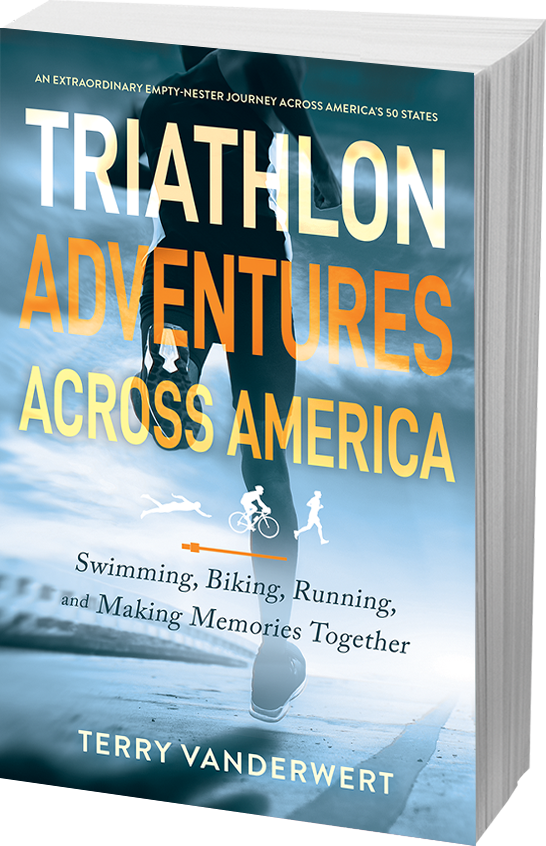
This race is one chapter in a 50-state journey—now told in full in Triathlon Adventures Across America .

Before the Idaho Triathlon

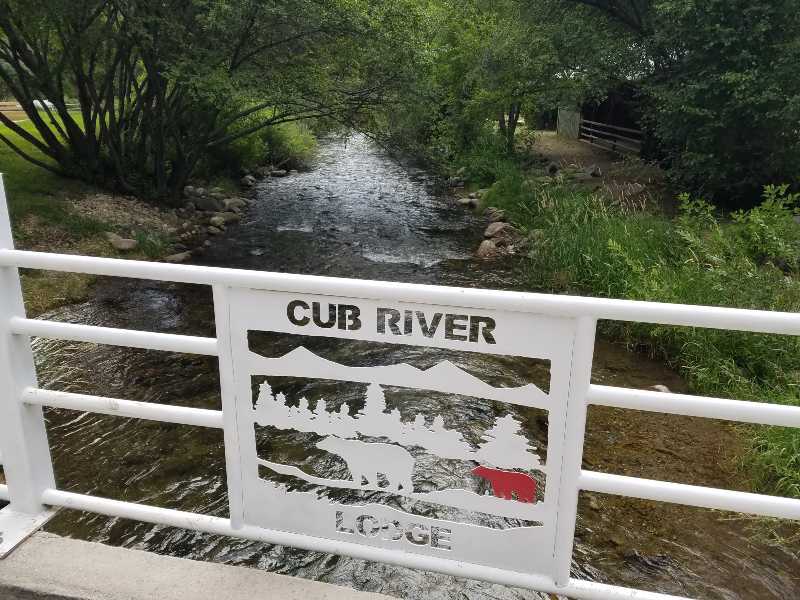
A few days before the Idaho triathlon, we met up with our friends Steve and Lori at the Cub River Campground outside Preston. We camped in a rented Class C motorhome while our friends used theirs.

bridge over the Cub River at RV campground near Preston, Idaho
During the three days before the Idaho triathlon in Preston, we camped in our rented RV at the Cub River Campground outside Preston.

On Friday afternoon, we drove the 13 miles from our RV park into Preston. We went for two purposes. First, and probably expected, was to pickup my race packet.

The second reason, to complete the triathlon swim, is one you probably did not expect. Completing the swim on the day before the bike and run legs of the triathlon was a first.

A Vibrant Community

Between the swim and packet pickup, we checked out this rural community of just over 5,000 residents.

With Preston abuzz with the excitement of Rodeo Days and the nightly parades, we found the main street lined with people shopping at the outdoor displays of local shops and sampling the treats of street vendors.

While in Preston, we also stopped for groceries. The family-owned grocery store at which we shopped impressed us with their range of products and prices. The big corporate stores in larger cities have nothing on this local store.

Sadly, many towns the size of Preston have shriveled and died over my lifetime. Joy and I spent our early years, until high school graduation, in a small town in Minnesota. We remember when towns like our hometown were as vibrant as Preston.

10th (Maybe More) Annual Biathlon and Triathlon

The Preston Triathlon is one of several running and multisport events managed by Groll Family Fitness Center (Preston, Idaho). The center offers many services, including personal training, weight loss coaching, strength training, and group classes in aerobics and yoga.

According to Chris and Jeannine Groll, this event began as a biathlon (bike-run) event “ten, maybe twelve years ago”.

Since there was not a facility for swimming in Preston in the early years, it was impossible to hold a triathlon. However, that changed three years ago with the opening of the Preston Aquatic Center and its lap pool.

Today, the Preston event includes a sprint triathlon, biathlon (bike-run involving the distances of the triathlon), and 1 mile and 5 km ‘fun runs’.

The advertised distances for the individual legs of the sprint triathlon in which I competed were:

  • Swim: 500 yards (457 meters) – Actual: 500 yards (457 meters)
  • Bike: 14 miles (22.5 km) – Actual: 14.1 miles (22.6 km)
  • Run: 5 km (3.1 miles) – Actual: 4.8 km (3 miles)

Actual distances shown above are from my Garmin Forerunner 920XT.

“Every Child A Swimmer”

The Preston biathlon, triathlon, and running event doubled as a fundraiser for the Preston Aquatic Center (PAC). Funds from this race support the “Every Child A Swimmer” scholarship fund for underprivileged children who want to learn to swim but whose parents cannot afford lessons.

One staff member of PAC told me, “I grew up in California and learned to swim when I was old enough to walk. I want every child who wants to learn to swim to have the opportunity.”

This is an example of causes supported by local triathlons and other multisport and running events.

Swim

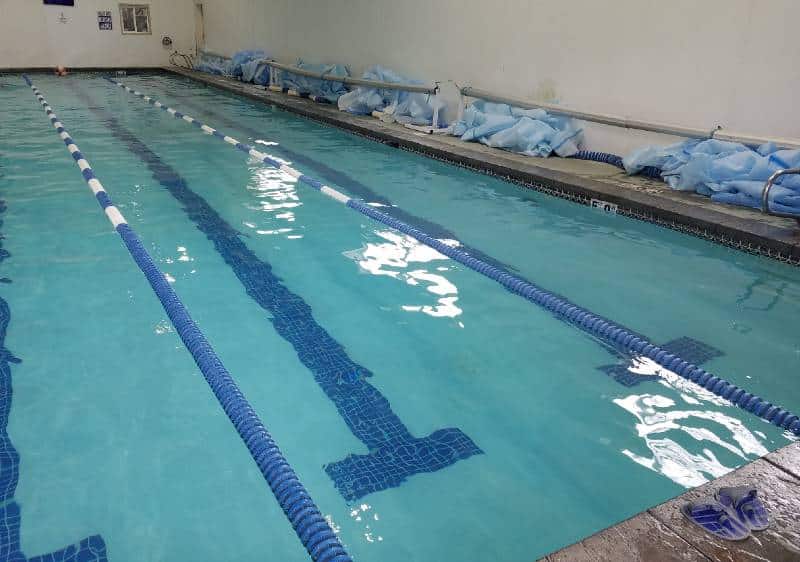
With only two lanes in the PAC pool, competitors swam the 500 yards on Friday (my choice) or early on Saturday, before the start of the triathlon and biathlon. Each triathlete brought someone, in my case Steve, to count their laps, record their swim time, and report the time to a PAC staff member.

The swim for the Preston Idaho triathlon was in the pool of the Preston Aquatic Center
The swim leg of the triathlon took place in the pool at the Preston Aquatic Center.

Bike

For Saturday’s bike and run legs for the triathlon and biathlon, race organizers converted the parking lot behind the Preston Aquatic Center into the transition area. Just before the race began, all competitors mounted their bike inside the transition area.

Following a ten-second countdown, we all left the transition. Our race officially began as we rode over the timing mat.

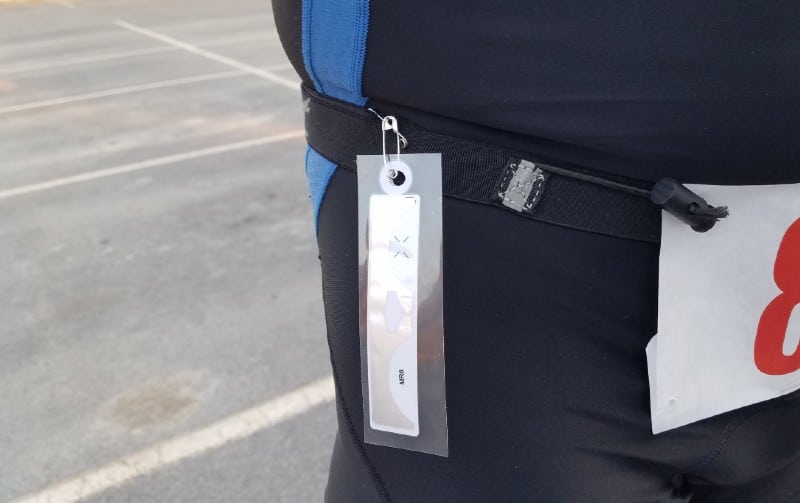
This race used a unique method for capturing our times as we crossed the timing mat. Typically, a timing chip is on a velcro strap attached to our left ankle. Some running races use a race number bib with the timing chip embedded in it.

For this race, the organizer gave each of us two plastic-encapsulated metal foils. We pinned one each on the left and right sides of our race number belt or shorts.

Timing for this race used a plastic enclosed metal foil pinned to the race number belt on each side of our waist.

The bike course left the transition area using the alley behind the aquatic center. Upon reaching the street, volunteers directed us to turn left (east) onto Oneida Street.

A Ride in the Country

We followed the road out of Preston into the country with its rolling hills. The many volunteers made it easy for us to follow the course and its many turns. Because of this, we could enjoy the sights and smells of this gorgeous farmland.

Most of the ride was between hayfields interrupted only by the occasional small farm, many containing a mix of dairy and beef cows, goats, and horses.

We witnessed hay in various stages of maturity – from being irrigated to help its growth to that already cut and being raked to speed up its drying. At one point, the spray from the irrigation rig crossed the road. The mist felt good.

Throughout the bike leg, we rode in traffic with cars and trucks. There was also the occasional farming implement we encountered during the ride. This triathlon was the first in which I met a tractor pulling a hay rake, one wide enough to leave only six to eight feet for me to pass between it and the edge of the road.

Despite the plentiful traffic, I found the drivers to be considerate. At no time did I feel unsafe.

Following a rectangular loop at the midway part of the course, we soon reconnected with Oneida Street, meeting some of the apparent late-comers to the biathlon and triathlon. As we returned to the eastern edge of Preston, we saw those taking part in the 5 km fun run. They were on the course I would be in a few minutes.

Run

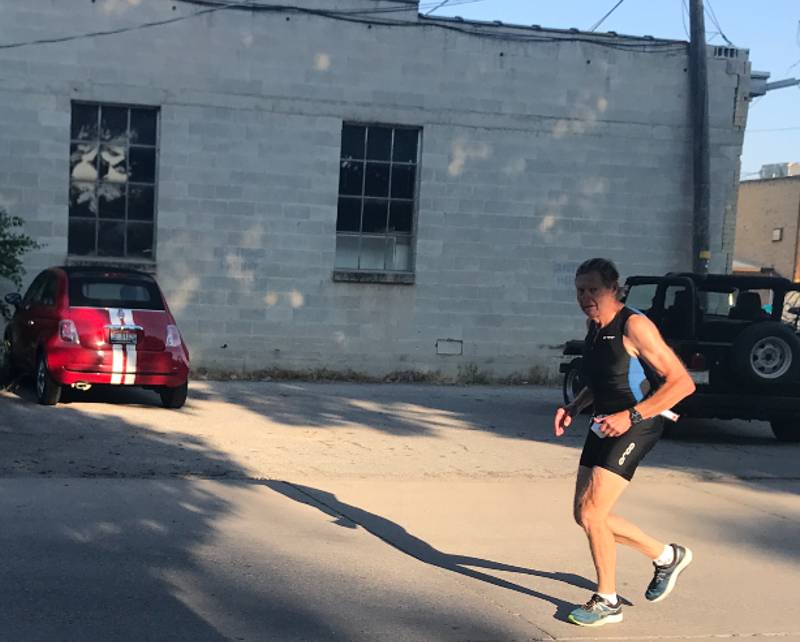
The flat run course followed part of the bike course on streets leading to the eastern edge of Preston. As with the bike course, we left the transition area through the alley onto Oneida Street.

Near the edge of town, we turned left to follow a rectangular path that included three left turns. Upon reaching Oneida Street near the post office, we turned right and returned to the finish line.

The run left the transition area located behind the Preston Aquatic Center through the alley leading to East Oneida Street.

After the Idaho Triathlon

After the Preston Triathlon, Joy and I traveled with our friends Steve and Lori in our two motorhomes toward our next destination, Montana, for the Seeley Lake Triathlon.

The trip to our first stop, Dillon, Montana, initially took us past the bright green alfalfa fields around Preston. These soon gave way to bright yellow fields of canola (rapeseed) then to massive fields of potatoes with their vibrant purple flowers.

A short stretch of lava fields reminiscent of the big island of Hawaii led to more potatoes and corn. It wasn’t long before we were driving past grassy areas with grazing cattle.

We soon reached our destination for the next two nights, the Southside RV Park in Dillon. Our campsite, next to a small river, was the perfect spot from which to watch the life of an osprey family – dad, mom, and two young ones.

Race Firsts

  • First time doing the swim leg on the day before the bike and run legs.
  • First time using a method of timing with metal flags, one pinned to each side.
  • Being sprinkled by an irrigation system used to water a hay field was a first.
Triathlon Adventures Across America book cover

What Could Your Journey Be?

“It made me think, ‘Wow, wouldn’t it be fun to try to do this too?’”

Explore the journey across all 50 states

What Size Triathlon Do You Prefer?

Triathlons with many competitors are exciting. Often, we see others with whom we have raced before. On the other hand, small races are more intimate and often support important local causes.

Which do you prefer? (There is no wrong answer.)

Share your thoughts in the Comments below.

Comments: We’d love to hear about your experience. Join the conversation below. All comments are reviewed before they appear.

Reply notifications: Click the bell icon above Post Comment to be notified when someone replies to your comment.

Follow the discussion: Click Subscribe above the comment box and enter your email address to receive notifications whenever a new comment is added—even if you don’t leave a comment. After subscribing, check your email and click Confirm to activate notifications.

error

Enjoy this post? Please spread the word :)