
Becoming a Confident Open Water Swimmer
Editor’s Note (First published October 15, 2022 • Updated May 2026): Since first publishing this article, I have continued hearing from senior triathletes about their experiences with open water swimming — including discussions at triathlon club meetings, conversations at races, and stories from readers. Many of the same themes continue to emerge: confidence, sighting, physical contact, staying calm, and learning to adapt to changing conditions. I’ve updated this article to include additional lessons and experiences shared by the senior triathlon community.
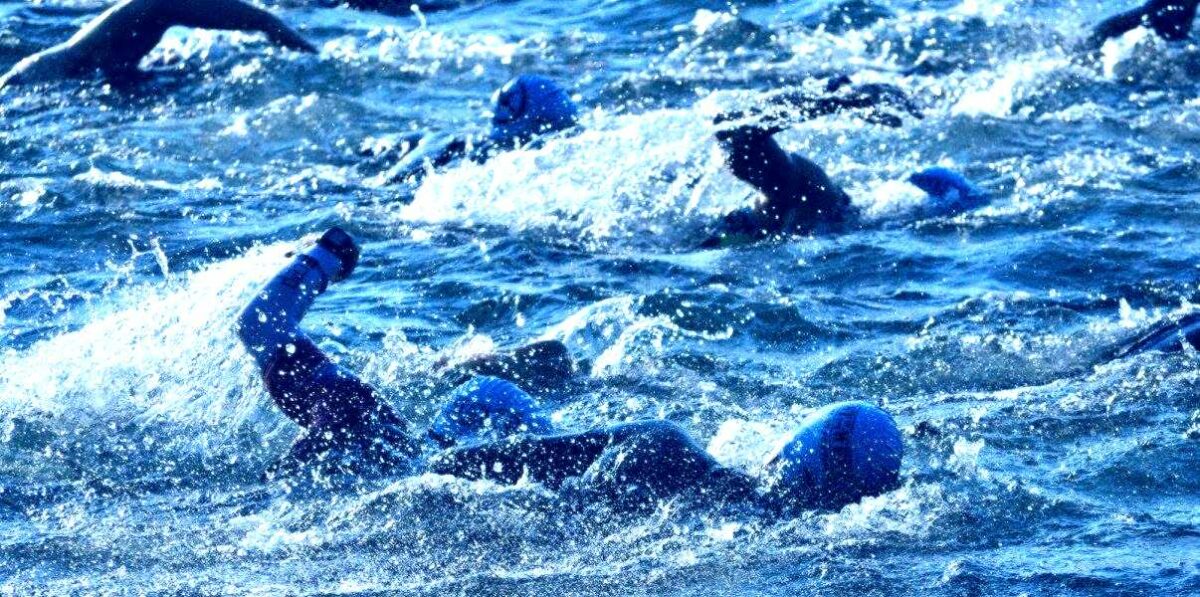
Lack of confidence in open water swimming is one of the top reasons many adults over 50 hesitate to try a triathlon. For some, the concern is not fitness but anxiety about swimming in deep, dark water with limited visibility, dealing with waves, or handling the physical contact that often occurs during races.
Many older triathletes describe discomfort not only from being unable to see the bottom, but also from not knowing what else may be in the water around them.
This post contains advice from senior triathletes who overcame those fears and went on to complete many triathlons and open water swim races.
Background
In early 2021, I conducted a survey about triathlon’s greatest challenges for seniors, both beginners and experienced triathletes. Nearly one of four respondents identified concern about the swim as a challenge.
My recent conversation with Pat and Joan Hogan about their triathlon journeys reminded me of this statistic. Fortunately, many seniors, including Joan Hogan, have “slain that dragon” to go on and compete in triathlons.
How have they done this?
And, perhaps more importantly, what mistakes and lessons have they learned along the way?
Approach
I asked three experienced senior triathletes who previously struggled with the open water swim how they had become more confident in open water. The three who generously and openly shared their experiences and advice, making this post as insightful as it is, are (in alphabetical order of last name):
- Nikki Austin, Virginia Beach, Virginia
- Donna Maguire, The Villages, Florida
- Paul Zellner, Chicago, Illinois
Here is what I heard them say.
Some Discomfort With Open Water Swimming Is Normal
“You are not alone” was a common phrase I heard during my conversations with Nikki, Donna, and Paul.
The first step is to realize that some anxiety about open water swimming is normal. Truthfully, fear is beneficial when it causes us to avoid self-destructive actions and unnecessarily dangerous situations.
Donna recalled watching from a boat the swim leg of a half Ironman triathlon whose swim was in Savannah River. She was amazed to see the number of triathletes who were on their back, hanging onto a kayak (which is allowed by USAT rules), or showed other signs of struggling.
Swimming is the most technical of the three disciplines of a triathlon. While it requires fitness and endurance, the technique, which includes how your hands and arms enter the water and your posture throughout the stroke, is key to a comfortable swim.
At a recent The Villages Triathlon Club “Ask the Experts” panel discussion, experienced triathletes repeatedly emphasized that open water confidence comes as much from skill and composure as from conditioning. Questions from newer athletes focused heavily on sighting, contact with other swimmers, swimming off course, and managing anxiety during crowded race starts.
If you’re new to triathlon after 50, this guide on how to start triathlon after 50 will help you take the first step.
Ways to Develop More Confidence as an Open Water Swimmer
Nikki, Donna, and Paul prove you can become a confident open water swimmer.
What is the secret? Following is the picture they painted as they related their experiences.
First, Become Confident in the Pool
The three contributors to this post each mentioned the need to become confident swimming in a pool before heading into the open water.
What this will require depends on your experience with swimming. Some, who never learned to swim as a child, will need to start from the beginning, often with lessons. (If you are starting from the beginning, the first goal is to learn proper breathing.)
Others will develop confidence by swimming with a Masters swim or triathlon club. For others, hiring a swim coach to help them develop a more efficient swim stroke or kick will be the answer.
Paul said that when he was learning to swim, putting on flippers helped him to get enough forward momentum that he could focus on coordinating his arm movement and breathing. Once breathing during the swim stroke felt natural and relaxed, he put the flippers aside and focused on kicking.
Several experienced triathletes also emphasized something that surprises many beginners: open water swimming should not feel like a fight for survival. Efficient technique matters because wasted energy and poor body position can quickly increase anxiety in open water.
Practice Sighting in the Pool
One of the most common mistakes beginner triathletes make in open water is swimming off course. Even experienced swimmers can drift surprisingly far without realizing it.
At the Villages Triathlon Club panel discussion, several athletes described how poor sighting decisions added unnecessary distance, increased contact with other swimmers, or created confusion near swim exits and turn buoys.
Good sighting is NOT lifting your entire head high out of the water every few strokes. In fact, experienced coaches warn that lifting too high causes the hips and legs to sink, creating drag and disrupting rhythm.
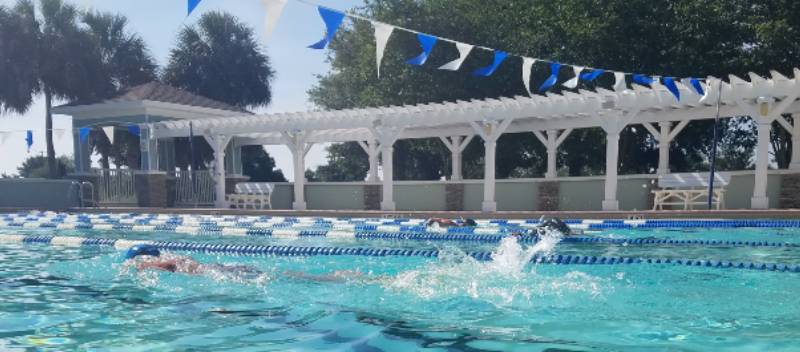
Instead, practice “alligator eyes” sighting in the pool — quickly lifting just your eyes high enough to locate a water bottle before returning immediately to your normal stroke. For open water, the water bottle will be replaced by a turn buoy or other landmark (e.g. tree, “wacky waving inflatable arm flailing tube man”).
In my book Triathlon Adventures Across America, I describe several races where sighting mistakes became both humorous and instructive lessons. In Washington, for example, I briefly sighted toward the wrong landmark for the swim exit. Then, in Michigan, I learned firsthand how easy it is to swim off course when not paying attention as the race director described the course layout during the pre-race meeting.
Stay Calm and Focused
Even as you develop confidence in the pool, remember to stay focused on what you are trying to accomplish in each session. Avoid daydreaming.
Whether you are learning to swim or training to improve your stroke, focus is key to becoming a more efficient swimmer.
Many experienced triathletes emphasized that panic usually makes open water situations worse. Physical contact, waves, missed breaths, or temporary disorientation happen even to experienced swimmers.
The key is learning to remain composed long enough to recover rhythm and breathing.
During one race in California, I became temporarily dizzy during the swim. Remaining calm instead of reacting emotionally allowed me to regain control and continue safely. Open water swimming often rewards composure more than toughness.
Practice with Race Day Nutrition
We often think of muscle cramps as an issue for runners. However, cramps have ended a race for many a triathlete during the swim.
While swimming in the pool, learn of any issues you have with cramps. Some people experience these in their calf or foot muscles. Others can experience them in their lower back. I remember a cramp in one of my hamstring muscles cutting a swim session short.
For most people, preventing cramps is a matter of paying attention to nutrition and hydration before a swim.
Being adequately hydrated before the swim is a must to prevent cramps. Others benefit from eating a banana (potassium) or taking an electrolyte supplement thirty minutes before swimming.
Next, Practice in Open Water
Your next goal is to swim in the open water. For safety reasons, it is always best to swim with a training partner or coach.
A first principle of triathlon is “never do anything for the first time on race day”. This is especially true for open water swimming.
Start with a short distance, aiming to eventually swim at least two times the distance required in a short course (Sprint, Olympic) triathlon or the distance of your long-course triathlon.
If possible, complete this swim in different weather and water conditions. For example, don’t swim only if the water is calm. Practice swimming with wind and more choppy weather. You should even practice sighting with the sun in your eyes, a common situation during early morning races.
If the race will be in the ocean, practice getting past the breaking waves near shore by swimming through them. The experience in my triathlon in the Atlantic Ocean in New Hampshire taught me the value of this technique.
Experienced open water swimmers also learn to adapt to conditions instead of fighting them. Sun glare, chop, waves, current, and crowded starts are part of the sport.
Practicing only in calm, ideal conditions can create a false sense of readiness. Confidence grows by gradually experiencing different water conditions while staying within your comfort and safety limits.
Get the Right Gear
Arming yourself with a few items can eliminate some common sources of anxiety. Others can make you more visible while you are sharing the open water with boats and personal watercraft.
Besides a pair of good fitting goggles, including one pair with tinted lenses for those times when you are swimming into the sun, two must-have items for open water swim practice are:
While more expensive than these two items, a triathlon wetsuit is another wise investment. A wetsuit is great when the water or air temperature is cold. In addition, it adds buoyancy to keep your legs at the top of the water, making this one less thing with which to concern yourself.
Join Others to be More Confident as an Open Water Swimmer
When you first swim in open water, do so with other people. If possible, find a triathlon or swim club. If this doesn’t work because of where you live, find a place where experienced swimmers go, such as a public beach, and go with a friend.
Swim only in areas where swimming is specifically allowed. Swimming in “any old place” can mean swimming with unfriendly critters such as alligators, snakes, and jelly fish.
An ideal place to swim is at a public beach with lifeguards. According to the United States Lifesaving Association (USLA), the chance of a person drowning while at a beach protected by USLA affiliated lifeguards is 1 in 18 million.
Swim back and forth between lifeguard towers or, if there is only one, within the distance the single lifeguard covers. You can even inform the lifeguard of your situation.
Then, if possible, swim in water no deeper than that in which you can stand. This will eliminate another possible source of anxiety.
Ways to Maintain and Even Build Confidence in Open Water Swimming
Even after you have become confident in the open water, it is essential that you follow safe practices.
Nikki told me that before she heads out for a swim in the ocean or nearby Chesapeake Bay, she checks the surf forecast for the beach at which she plans to swim. In particular, she looks at the forecast for rip currents and wave height.
“I might still swim if there are waves a couple of feet, maybe more, but that changes the dynamics of the swim. I might not swim a mile but will be happy to work on my sighting, breathing, and other skills. I have actually found it to be quite fun and inspiring to see my skill level increase when swimming in more challenging water conditions.”
To learn more about rip currents, how to identify them, and how to swim in water where they are present; watch this short but information-packed video presentation by a representative of the National Weather Service.
Nikki’s comments on the benefit of swimming in different weather conditions and bodies of water (lakes, rivers, ocean) were echoed by Donna and Paul.
Other advice from the three for growing your confidence in the open water is:
- Swim in open water every opportunity you have.
- Continue to improve your swim fitness and technique. Learn to swim more efficiently. This does not have to mean swimming faster, but with less effort, using less energy because you are more efficient. Feeling out of breath, on the other hand, can bring on panic.
- Finally, train yourself to mute any negative voices in your head. Some swimmers count from 1 to 100 over and over. Others sing. Do what works for you to stay calm.
“Do the thing you fear to do and keep on doing it… that is the quickest and surest way ever yet discovered to conquer fear.”
Dale Carnegie
Race Day Tips
Race day can present its own challenges. There is the almost inevitable contact with other swimmers. A race can also unleash an adrenaline-driven desire to keep up with or pass other racers.
Ways to mitigate these are:
- If possible, swim in the open water of the race in the minutes leading up to the start of the race. This falls into the category of minimizing surprises that can come from:
- Knowing the condition of the water in which you will walk into and swim. Are there sharp or slippery rocks on the way into the water? Are there weeds that I will touch when swimming? How quickly does the bottom drop-off?
- Kick-starting your heart rate. If your heart rate spikes when starting fast, a pre-race swim will help prevent this.
- Getting wet. The pre-race swim gets any shock of first entering the water out of the way before the race starts.
- If there is a wave start, position yourself to one side of other swimmers or at the back of the pack.
- Find and get into a rhythm as quickly as possible and stick to it. Stay calm. Nothing goes well when you tense up. This is just as true for swimming as it is for other sports.
- Try to swim near others you can follow. As long as they stay on course, you can follow them, which reduces the amount of sighting you must do.
Position Yourself Strategically
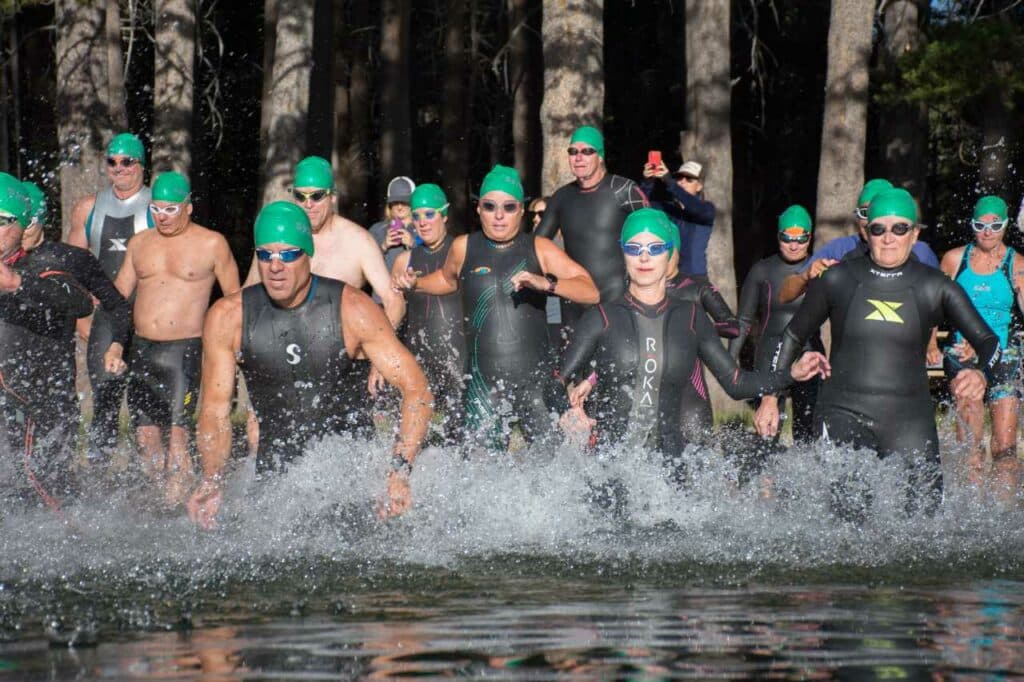
Several experienced athletes at the Villages panel discussion shared stories about being kicked in the shoulder, leg, or face during races. Their advice was not to fear contact, but to make smarter positioning decisions that reduce unnecessary congestion.
For newer swimmers, starting slightly to the outside or farther back can lead to a calmer and often faster swim experience overall.
In Triathlon Adventures Across America, I describe accidentally striking another swimmer during my first triathlon after the athlete unexpectedly stopped in the main swimming line. I also describe getting kicked hard in the chest during another race in Illinois.
Both experiences reinforced an important lesson: physical contact in open water swimming is normal. Expecting it — and staying calm when it happens — reduces anxiety significantly.
Resources for Becoming a More Confident Open Water Swimmer
Nikki, Donna, and Paul told me of the resources they have found helpful in becoming and staying confident while swimming in the open water.
Related post: Quickest Way To Your Faster Triathlon Swim
Thank You
Thank you to Nikki, Donna, and Paul for sharing your time and insights that are the basis for this post.
If you found this article useful, please add a Comment to thank them.
Is There More You Need to Know to Become a Confident Open Water Swimmer?
One of the strengths of the senior triathlon community is the willingness of athletes to share lessons learned — including mistakes, fears, and humorous race experiences.
What helped you become more confident in open water?
What advice would you give someone preparing for their first triathlon swim?





Comments: We’d love to hear about your experience. Join the conversation below. All comments are reviewed before they appear.
Reply notifications: Click the bell icon above Post Comment to be notified when someone replies to your comment.
Follow the discussion: Click Subscribe above the comment box and enter your email address to receive notifications whenever a new comment is added—even if you don’t leave a comment. After subscribing, check your email and click Confirm to activate notifications.