Tis the Season for Fresh Tart Cherry Juice
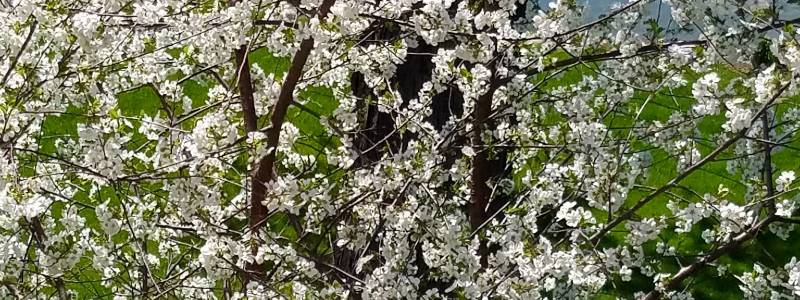
A few weeks ago, bright white blossoms covered the Montmorency cherry trees in our backyard. My thought? First, I was reminded at how beautiful they are. Next, I began to imagine the fresh cherry juice, cherry flavored kombucha, and tart cherry salsa we would soon enjoy.

The taste of freshly picked and pitted fruit from these cherry trees is wonderful. However, the mouth puckering liquid from this fruit also heals and strengthens. You see, tart cherries are packed with anti-inflammatory and anti-oxidant compounds.

Incorporating tart cherry juice as part of a healthy eating pattern can be a great way to add variety into an individual’s diet.

Sikako Minagawa, MS, RDN, Peak Performance Sports Nutrition, LLC

Related post: What Masters Athletes Need To Know About Nutrition

What Does the Science Say?

On February 20, 2020, the Cherry Marketing Institute issued a press release titled “New Meta-Analysis: Tart Cherry Juice Concentrate Found to Help Improve Endurance Exercise Performance”.

For the report cited in this release, researchers analyzed results of ten separate studies on the role of tart cherry juice on performance in endurance exercise. Only those based on randomized controlled trials were included in the research.

For their work, researchers used meta-analysis to analyze the combined results of individual studies. For reference, meta-analysis is a common research method. Meta-analysis applies statistical analysis to dig deeper into combined results of multiple scientific studies that address the same question.

According to the press release, co-author Philip Chilibeck, PhD, professor in the College of Kinesiology at the University of Saskatchewan concluded:

“The results of this meta-analysis found that tart cherries did help improve performance, and we gained greater insight into the potential mechanism responsible for this benefit.

Other findings of the study were:

  • Timing: Tart cherry concentrate is effective when taken for 7 days to up to 1-1/2 hours before exercise.
  • Fitness level: The least trained athletes showed the lowest improvement from consuming tart cherry juice.
  • Dose: The daily consumption of anthocyanins (compounds with anti-oxidant properties) by study participants ranged from 66 to 2,760 mg. However, the study did not identify the relationship between the amount of tart cherry concentrate consumed and athletic performance.
  • Mechanism: Improvements in performance are most likely related to the low glycemic index, anti-inflammatory, anti-oxidative, and blood flow enhancing effects of tart cherry concentrate.

How Can Triathletes Most Benefit from Tart Cherry Juice?

According to registered dietician Beth Schutt, tart cherry juice has the greatest benefit for athletes who are well into their training plan. In an article for USA Triathlon, she wrote:

“It is readily agreed upon, though, that prior to racing and directly after racing, tart cherry is most useful.  For the athlete who is deep into racing season and in a cycle of race, recover, repeat, tart cherry should be on the menu consistently.”

As the study cited above shows, there is less benefit when beginning to train and during the base building phase. Conversely, tart cherry juice’s benefits for recovery and performance become more valuable as race day approaches.

Benefits Beyond Sports Performance

For older adults, there are additional reasons for consuming tart cherries. According to registered dietician Sakiko Minagawa:

“In addition to sports performance, research suggests other benefits for older adults. Tart cherry juice may help reduce cardiovascular risk factors such as blood pressure and LDL cholesterol in this group.”

Looking for Tart Cherry Juice?

Not sure where to purchase tart cherry juice or its other forms (powder, juice concentrate)? One source is Swanson Vitamins. Please note that Senior Triathletes is an affiliate of this business. This means I will earn a small commission on any purchases from this company if you use this link.

Leave Your Questions and Comments Below

What is your go-to food or drink for post exercise recovery?

How Are Multisport Businesses Coping With COVID-19?

April 14, 2020 – We hear a lot these days about the effect of the COVID-19 pandemic on small businesses. Among these businesses are the ones near and dear to our hearts who put on multisport events.

While the triathlon season has not started for most of the northern hemisphere, there is an air of uncertainty. Some races have been canceled for this year. Other early season races have been postponed when it is possible for the organizers to reschedule them.

Having participated in triathlons across the country, I am on the mailing list for many multisport businesses. I thought you might be interested to see how one race organizer is dealing with this uncertainty while working to keep their business afloat during this crisis.

Georgia Multisports Productions

logo for Georgia Multisports Productions, sponsor of the 2020 8-week endurance challenge.

Race Director and Senior Triathlete Jim Rainey sent information about the Georgia Multisports Productions (GMP) 8-week challenge.

Jim wrote in his email:

“We have recently created a Georgia Multisports Strava page to try and help us stay together and motivated so when the pandemic is over, and our lives are back to normal we are ready for what comes next.”

The event began April 1st and will continue through May 30th so you still have time to participate. Running and cycling miles will be tracked through a FREE account for the George Multisports Club on Strava. After joining the running and cycling events, register on runsignup. With the registration, you to receive awards, a t-shirt and discount for a future race.

How Is Your Favorite Race Business Handling the Crisis?

Let us know in the Comments section below what your favorite race company is doing about their early-season races, whether triathlon, 5k, or other.

Triathlon Across the USA: State #11 – Florida

Clearwater, Florida; November 11, 2012—TriRock Clearwater Triathlon

Joy and I used the timing of this triathlon to schedule a Florida vacation of a little over a week. The trip, in honor of our 39th wedding anniversary, provided opportunity to spend time with friends (Lyle & Diane in Deerfield Beach; Don & Sue in The Villages) and relax at the Holiday Inn in Highland Beach, one of our few romantic getaways.

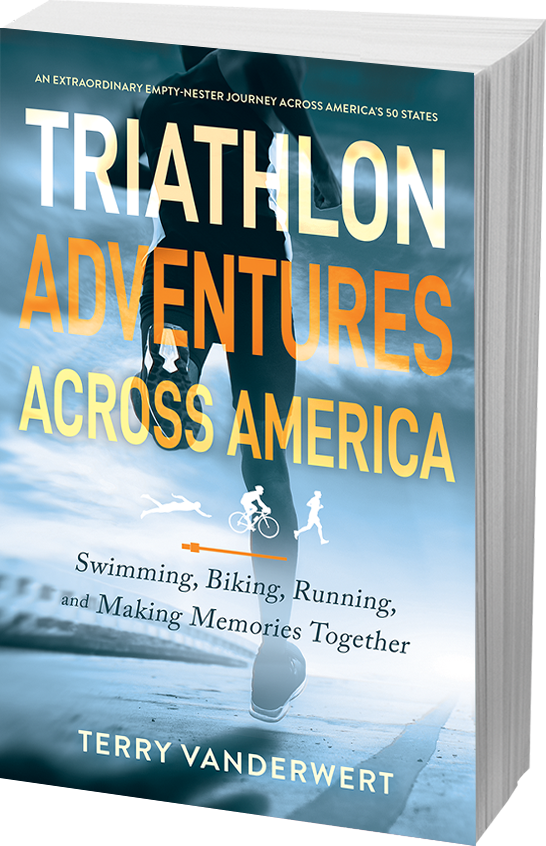
This race is one chapter in a 50-state journey—now told in full in Triathlon Adventures Across America .

Getting to the Florida Triathlon

We flew with my bike from Minnesota to West Palm Beach, Florida on Friday, November 2nd. Following a short drive south, we reached the Holiday Inn in Highland Beach, our base for a weekend visit with friends in nearby Deerfield Beach. 

On Monday morning, we drove to The Villages, about one hour northwest of Orlando, where we spent the night with friends Don and Sue in the house they had rented.  The next morning, we moved to a house in The Villages we had rented for four nights as part of a get-to-know-the-area package. 

Through the rest of the week, I ran and cycled with a group of 60- and 70-year-olds. Joy and I also played golf with Don and Sue, took in a movie, went dancing every night, shopped, ate out, etc. In short, we had a blast.

On Saturday, we drove from The Villages to Clearwater Beach, the venue for the triathlon the next day.  Before picking up the race packet, we enjoyed a fresh seafood lunch at Crabby Bill’s situated directly across the street from Pier 60, location of the transition area. After picking up the race packet and before driving to our hotel, we walked around the expo that was part of the triathlon.

1st TriRock Clearwater Triathlon

About 150 male and female triathletes from thirty-two states and five countries met for the inaugural TriRock Clearwater Triathlon on what was a near-perfect morning for a triathlon.  Skies were blue with a few wispy clouds. The air temperature was comfortable, though cool, especially with a light breeze coming off the water.

Distances for the individual legs of this USAT-sanctioned sprint triathlon were:

  • Swim: 0.34 mile (550 m)
  • Bike: 13.4 mile (21 km)
  • Run: 3.1 mile (5 km)
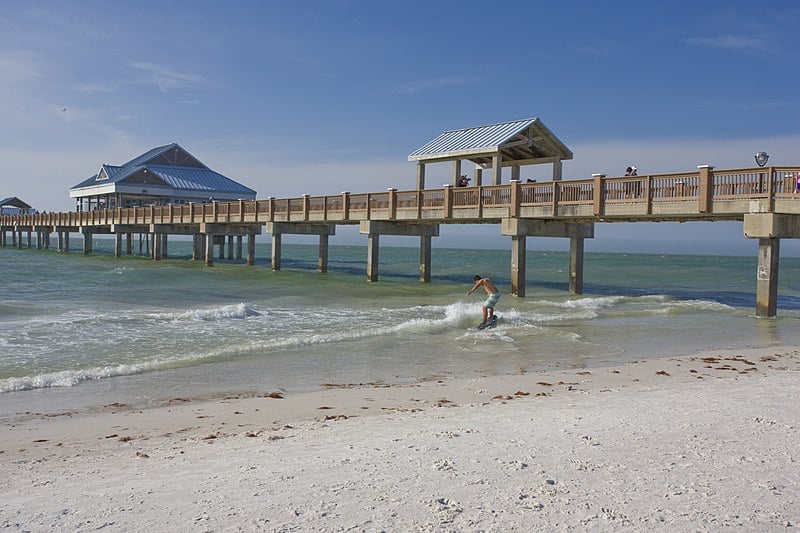
The swim for the Florida triathlon was in the cool water of the Gulf of Mexico at Clearwater Beach.  The exit for the swim was near the pier shown in the picture.  Source: commons.wikimedia.org
The swim leg of the Florida triathlon was in the cool water of the Gulf of Mexico at Clearwater Beach. The exit for the swim was near the pier shown in the picture. Source: commons.wikimedia.org

Swim

The water in the Gulf of Mexico was unexpectedly cold, around 65ºF. This meant that according to USA Triathlon rules, wetsuits were not only allowed but encouraged.

Swimmers started in waves based on age groups. The water was calm, making for a comfortable swim once I absorbed the initial shock of the cold water.  Upon exiting the water, we ran to the grassy transition area across the beach with its mixture of sand and small shells.

Bike

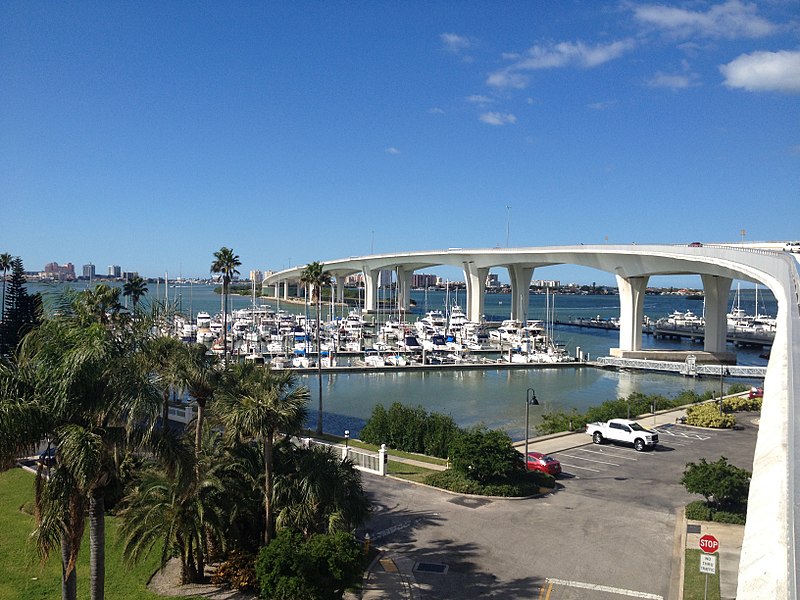
The distinctive feature of this race’s bicycle leg was the ride up and over three bridges spanning inner coastal portions of water.  The climb up and ride down from these bridges led to a challenging and, occasionally, fast (over 30 miles per hour) ride.

The first part of the bike leg of the TriRock Clearwater Triathlon took us across Clearwater Bay on the Memorial Causeway. Source: commons.wikimedia.org.

When not on a bridge, we snaked our way through neighborhoods in Clearwater, Belleair Beach, and Clearwater Beach, finishing the ride on Gulf Boulevard and Coronado Drive.

Run

The initial section of the run was along the causeway (bridge) that was also part of the bike course. On the way to the turnaround, we passed the first of several bands providing live music along the run course, another of the signature features of this race.

About one-mile into the run, we turned around and headed back in the direction of the park. At the roundabout across from the transition area, we continued on the completely flat running path along South Gulfview Boulevard, the street running parallel to Clearwater Beach. Here we encountered the next series of bands.

Following a second turnaround, we headed toward the finish line.

Results

Who says that ‘old people’ don’t take these races seriously? Maybe young people, but not those of us racing in the higher age groups.

This race again showed the competitiveness of older triathletes. The race for the second, third, and fourth places for the Males 55-59 Age Group was close; only 19 seconds separated the second and fourth place finishers.

I finished third in my age group, 8 seconds behind the second-place finisher and 11 seconds ahead of the fourth place finisher.

After the Florida Triathlon

Before traveling back to Minnesota, we made one more overnight stop in The Villages. With this visit, we could see our friends once more, enjoy more dancing at Lake Sumter Landing, and pack my bike for the airline ride home.

Race Firsts

  • First triathlon performed with a vacation to celebrate our wedding anniversary.
  • First triathlon with the swim portion in the Gulf of Mexico.
Triathlon Adventures Across America book cover

A Story That Resonates

“A must-read for every athlete and retiring business executive committed to living healthy.”

Discover the complete story

Leave Your Questions and Comments Below

What type swim do you prefer? ocean? lake? pool? Why?

Have you combined a race and vacation? If so, what has been your favorite?

Please share your comments below.

“Atomic Habits” for Triathletes

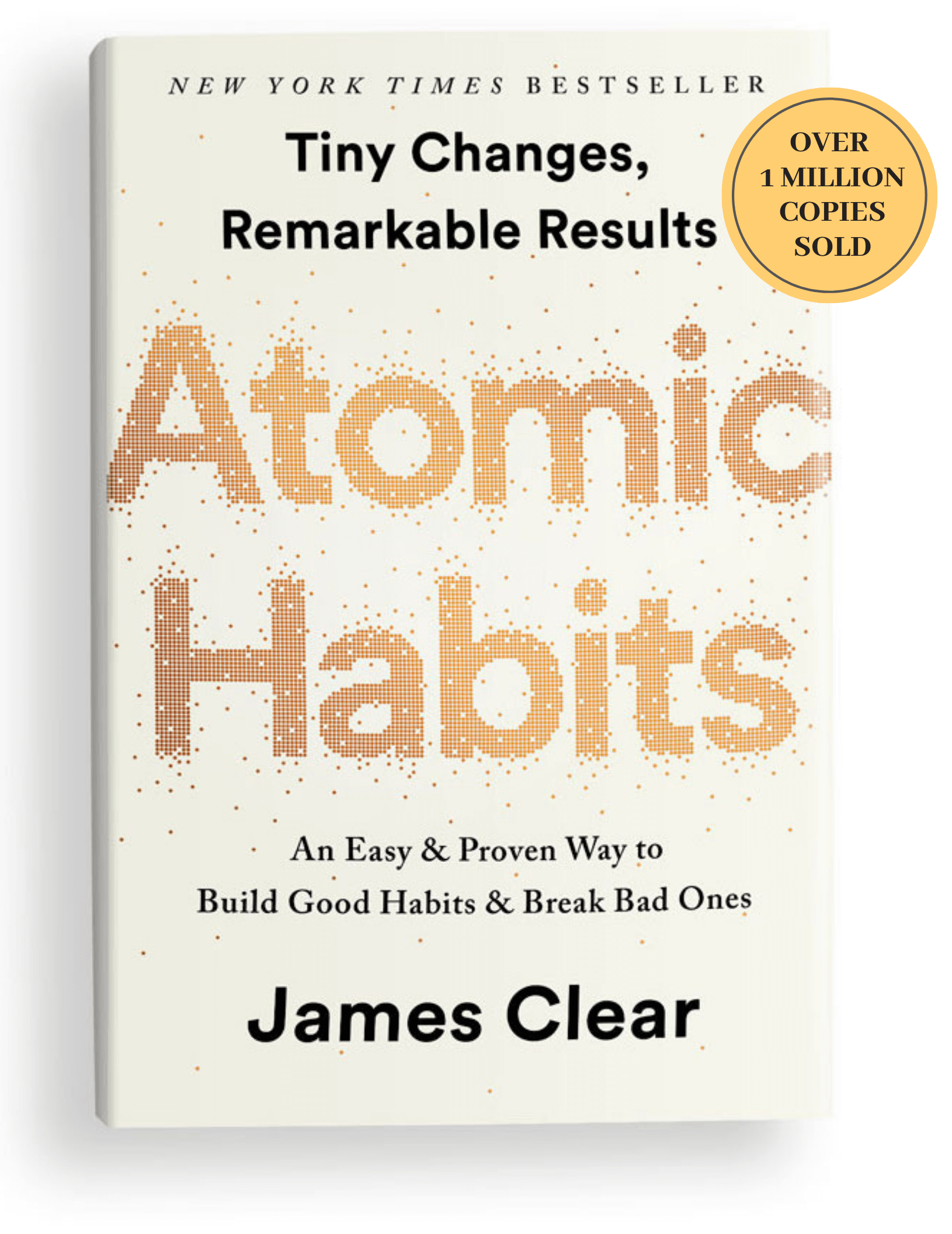
“Atomic Habits: An Easy & Proven Way to Build Good Habits & Break Bad Ones” by James Clear is for those, including triathletes, who wish to create new, performance-enhancing habits. It is also for those who want to eliminate destructive habits.

In the introduction to the book, Mr. Clear shares a powerful case study involving the British Cycling team. By applying the principles in this book, the team went from a perennial loser on the world stage during the 20th and early 21st centuries to the dominant competitor from 2007 to 2017.

During this ten-year period, British cyclists earned 178 world championships and sixty-six Olympic or Paralympic gold medals. They also won five Tour de France races.

This is the first example of many that highlights how so-called atomic habits have been used to improve fitness training, running, and personal and professional development efforts.

Following are my takeaways from the book, from the perspective of a triathlete.

What are ‘Atomic Habits’?

Atomic habits are regular activities or routines that, while small (hence the word ‘atomic’) and easy to do, provide significant impact (also related to ‘atomic’) on a process. Repeating these over time (as a habit) leads to a compounding effect.

According to James Clear, “Habits are the compound interest of self-improvement. The same way that money multiplies through compound interest, the effects of your habits multiply as you repeat them.”1

Developing the habit of consistent, regular, and structured training is an example of an atomic habit related to triathlon.

How to Develop Positive ‘Atomic Habits’

“Atomic Habits” summarizes the approach to developing new, performance-enhancing habits in a two-step process:

  • Determine the person you want to be and how you want to be defined.
  • Take small actions that prove that you are this person. Repeat these actions.

In How to Build a New Habit: This is Your Strategy Guide, James Clear clarifies what he means by ‘small’ relative to new actions.

One of the actionable pieces of advice from this book is “Start with a small habit”. Or, to say it another way, begin with an activity to which you cannot say ‘No’ because it is so easy to do.

This can, for example, mean combining walking and running until your fitness reaches the point that you can run for an entire session. It can also mean breaking up a larger activity into smaller ones. An example of this principle is swimming 10 minutes separated by a rest rather than swimming 20 minutes right away.

Before you know it, you are running the entire distance or swimming for 20 minutes (or more) without a break.

Related post: Book Review: The New Psycho-Cybernetics

Focus On Who You Want To Become

Rather than focusing on the action you want to achieve (such as to complete an Olympic-distance triathlon), the approach described in “Atomic Habits” starts with defining yourself in terms of the person who will achieve the goal.

In the triathlon example, the person makes the subtle but important change to define him/herself as an Olympic triathlete. From here, the triathlete develops a training plan, eating habits, sleep behaviors, and so on (the process) consistent with an Olympic-distance triathlete.

The new habits develop through a four-step process detailed in the book and described in the first column of the table below.

StepMakes an object of a good habitMakes an object of a bad habit
CueObviousInvisible
CravingAttractiveUnattractive
ResponseEasyDifficult
RewardSatisfyingUnsatisfying

James Clear also describes ways to make sure the new habit sticks. These include habit stacking (combining an existing positive habit with the desired new habit), changing the environment, and reframing a habit (from “I have to go for a run” to “I get to go out into the fresh air and improve my heart health”).

You will also learn about the Diderot Effect and the Goldilocks Rule and how these can support building new habits.

Be Patient, New Habits Require Time

It often takes time to make new habits part of our new-normal routine. Mr. Clear cautions us to be wary of how we interpret the results as we work to develop new habits.

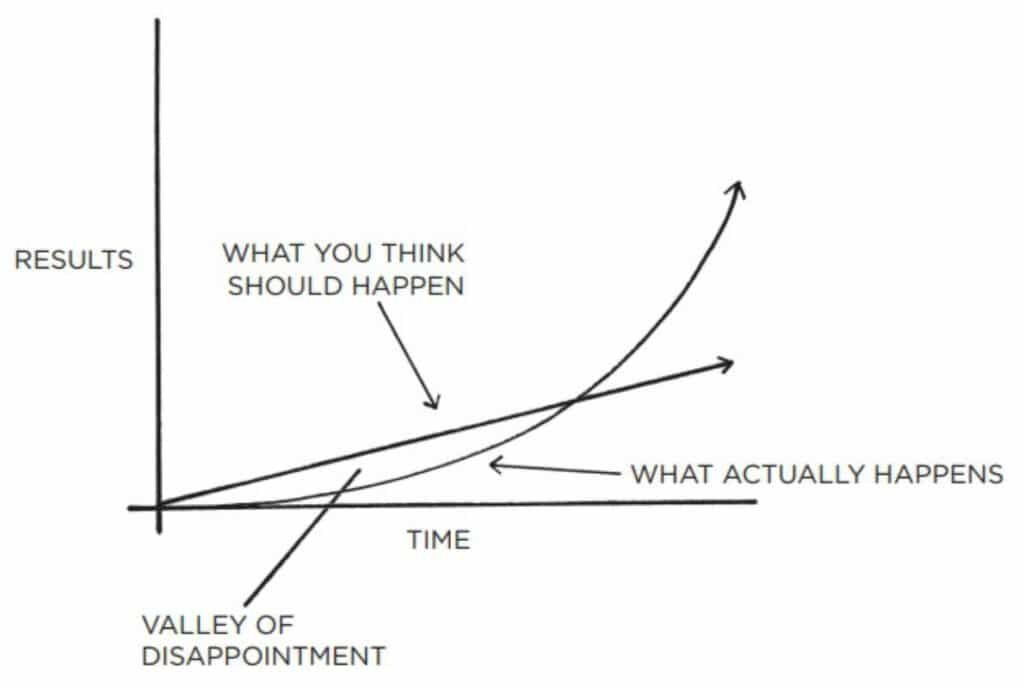
The tendency is to expect linear results. For example, in my training, I expect to see consistent (linear) reductions in my 5k time as I restart running after a break. However, this is not the way results typically come.

The graph of Results vs. Time below shows Mr. Clear’s representation of our expectations and experience as we build new habits.

Figure 1: Plateau of Latent Potential from page 22 of “Atomic Habits” by James Clear.

While we expect linear results, actual results are non-linear. The gap between the expected and actual results creates what Clear calls a “Valley of Disappointment”.

Seeing this graph for the first time created an ‘Aha-moment’. My experiences in run training definitely follow this, one reason that patience is so important. When impatience wins, I will try to speed up the results by training harder or longer. The result is usually injury and longer recovery time.

Summary

Our beliefs and the views of ourself can be engaged to drive processes that help us achieve our goals. Focusing on becoming the person we want to be can lead to greater performance than if we had focused on the goal. Atomic habits help us become who we want to be and perform at a higher level.

For More Information About “Atomic Habits”

“Atomic Habits: An Easy & Proven Way to Build Good Habits & Break Bad Ones” is available in print and audio versions at Amazon.com by clicking the link or picture below.

Throughout the book, James Clear refers to resources on his website for creating atomic habits. Please checkout the website at https://jamesclear.com/.

  1. Clear, James, “Atomic Habits: An Easy & Proven Way to Build Good Habits & Break Bad Ones”, Avery, 1st edition (October 16, 2018), p. 17.)

Affiliate disclosure

Share Your Questions and Comments Below

What has helped you develop new habits related to triathlon? Let me know what you think about the ideas presented here.

This post, originally published in March 2020, was updated on February 23, 2022.

error

Enjoy this post? Please spread the word :)