Triathlon in the Year of COVID-19

We will remember 2020 in triathlon, as in every corner of life, as the year of COVID-19. By now, we should have enjoyed family reunions, community parades, and the Tokyo Olympics. Furthermore, I should have completed three sprint triathlons in three states.

Instead, over the past weekend I competed in my first triathlon of the season, the Arkansas triathlon in my Triathlon Across the USA quest. It was also the first triathlon of the season for most, if not all, of those with me at this event.

The race had much of the same feel as other sprint triathlons. However, many adjustments had been made by the race organizer, All Sports Productions, through discussions with USA Triathlon, the Arkansas Department of Health, and the U.S. Army Corps of Engineers who manage the area containing the triathlon course.

In the rest of this post, I will share some of the changes forced upon this and other live, in-person triathlons and other multisport events by COVID-19.

Small Differences in Packet Pickup; Some Even Welcome

Not surprising, we were required to wear a mask during packet pickup, at least when unable to maintain spacing of 6 feet or more.
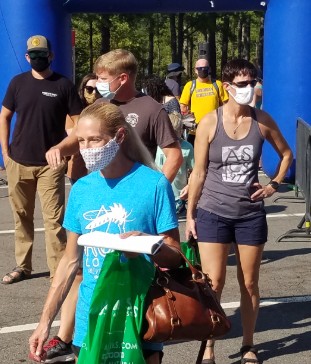
Masked triathletes waiting in line to pickup their race packets on the afternoon before the race.

Health questionnaire

We were also required to submit a completed USA Triathlon health declaration. This declaration (see the picture below) indicated any COVID-19 symptoms we were currently experiencing. It also documented contact we had had with those who had symptons.
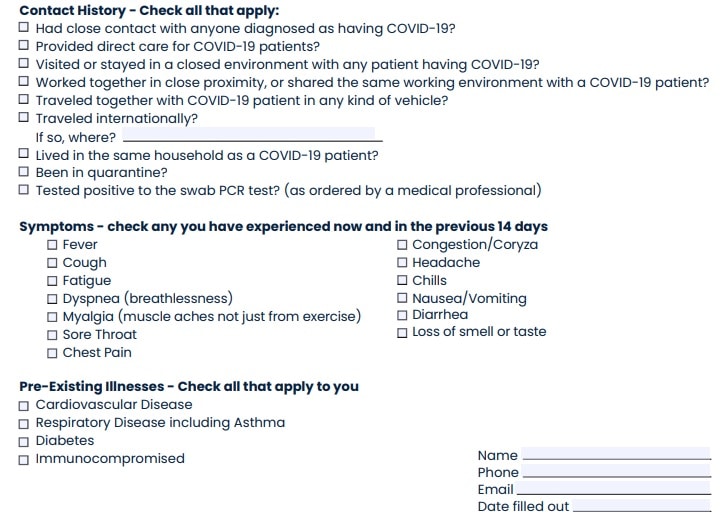
covid-19 portion of USA Triathlon Medical COVID-19 questionnaire
Self-declaration portion of the USA Triathlon “Athlete Medical COVID-19 Questionnaire”.

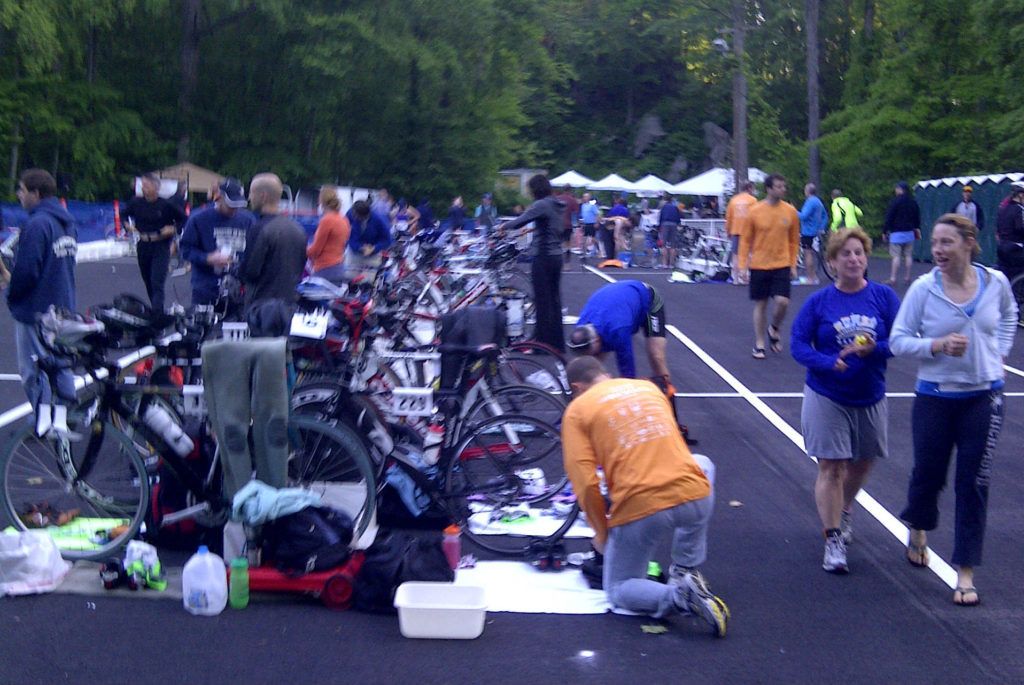
Leave bikes in the transition area overnight

To minimize contact between triathletes on race morning, organizers provided the option of leaving our bikes racked in transition over night. Of course, the area was secured and monitored the entire time.

For me, leaving the bike in the transition area was welcomed. It meant I did not have to get up before daylight and be at the race site when the transition area opened in order to get a preferred spot on the bike rack.

Race Morning – Before the Start

This was the first triathlon I attended without my wife, Joy. In their pre-race email, race organizers wrote:

  • Spectators are encouraged to stay home to assist in meeting guidelines for safe events.
  • Any spectators in attendance will be required to wear masks and will have limited event access.

Joy was more than willing to ‘take one for the team’. She was able to sleep in, getting some much wanted rest. Furthermore, she did not have to wear a mask, an onerous requirement for her given the temperature and humidity. She did, however, tour the gorgeous race venue during and after packet pickup, mostly from within our air conditioned van.

Self body marking

In most triathlons, even those for which the stick-on race numbers (tattoos) are used, volunteers will mark our age on one of our calves using a felt tip marker. To minimize human contact, each athlete was instructed on the location of each body mark.

While the race organizer provided race number tattoos, I goofed up when applying one of them. As a result, I marked my race number on my right shoulder and left hand. I also marked my age on my right calf, even though I later found the age tattoo.

Masks, of course

Racers were handed a white disposable mask upon entering the transition area. Like most racers, I wore this mask until just before beginning the swim leg. When within a few yards of the water, I removed the mask and tossed it into a garbage can.

Swim, Bike, Run Against COVID

There were few significant changes to the most important part of the event – the race.

Time trial start

In past years, the DeGray Lake Triathlon involved a mass, in-water start. To reduce contact between racers, organizers decided to use a ‘time trial’ start.

With a time trial start, often used when the triathlon involves a pool swim, a racer begins every few seconds, typically from 5 to 30 seconds. Today, a swimmer began about every 5 seconds.

The time trial start leads to less interaction between racers not only during the swim but throughout the race. At one point, I heard the race director announce that, from what he observed, they may use a time trial start for all future races, even after the current crisis caused by the virus has passed.

Aid stations

The run included two aid stations at which volunteers (one per station) served water or sports drink. On this day, there were fewer people handing out drinks. Those who did had gloved hands.

After Crossing the Finish Line

After finishing the course, there were a few more differences from previous races. However, most were not significant.

Replacing some volunteers

In previous triathlons, a volunteer will remove the timing chip from the racers ankle once they have crossed the finish line. Today, we removed the timing chip ourselves and handed it to a gloved volunteer.

Also, instead of a volunteer placing the finisher medal around our neck, we collected our medal from a table.

Good food and drink even with COVID-19

Post race food, a hot dog and fruit, was provided in to-go style containers. Beverages were presented by gloved hands.

Wear a mask. Really?

Even after the race and food, we were encouraged to wear a face mask and follow social distancing protocols. The latter was possible, but with the way I was sweating after the race, there was no way I was going to wear a face mask and breathe. One had to give; you can guess which one did.

No awards ceremony

Again, to minimize contact between participants, awards were given individually by a staff member. I did not miss seeing the awards ceremony. However, if I knew more people who were racing, I may have wished it were still held.

Leave Your Questions and Comments Below

Tell us about your experience in a recent triathlon. What changes did you find?

If you haven’t raced this year, are there questions or concerns you have?

#JustKeepMovingForward 

Triathlon Across the USA: State #15 – Maryland

Flintstone, Maryland; June 1, 2013—Rocky Gap Triathlon, Rocky Gap State Park.

Our Maryland triathlon took us to the northwest corner of Maryland, about two miles south of the border with Pennsylvania. We had been to the urban areas of eastern Maryland before. However, this part of Maryland, in which rugged tree-covered mountains seemed to wrap their arms around us, was like another state.

This race is one chapter in a 50-state journey—now told in full in Triathlon Adventures Across America .

Traveling to the Maryland Triathlon

We left our house in Chicopee, Massachusetts, on Friday morning, heading in a southwesterly direction. The approximately 450-mile drive took us through Connecticut and past New York City. Once in Pennsylvania, we traveled through Allentown and Harrisburg, making a stop in chocolate themed Hershey.

Before driving to our hotel in Cumberland, Maryland, we stopped at Rocky Gap State Park in Western Maryland’s Allegany County. During the brief visit, I checked out portions of the swim, bike, and run courses.

We then headed to the Cumberland YMCA to pickup the race packet. While managed by Tri Columbia, this triathlon doubled as a fundraiser for the Cumberland YMCA.

After dinner at Henny’s Bar & Grill near our hotel, we turned in for the night, ready for a pre-dawn departure to compete in the Maryland triathlon.

26th Annual Rocky Gap Triathlon

The sun shone brightly as participants of the sprint and International distance triathlons gathered at the park.

Distances for the individual legs of this USAT-sanctioned sprint triathlon were slightly shorter than normal:

  • Swim: 0.25 mile (400 m)
  • Bike: 8 mile (12.9 km)
  • Run: 2.5 mile (4 km)

Swim

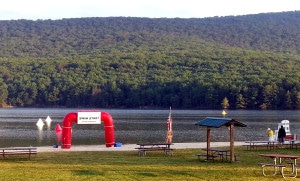
The swim portion of the race took place in 243-acre Lake Habeeb. The lake lies in the shadow of Evitt’s Mountain, named for one of the first European settlers in Allegany County.

The water temperature was around 72° F, making the race ‘wetsuit legal’. Swimmers started in four waves (groups), with the sprint men being in the first wave.

The sprint course was triangular shaped. From the beach, we swam diagonally toward an orange buoy. After turning at this buoy, we returned to shore, swimming perpendicular to the beach.

Rocky Gap State Park
Rocky Gap State Park in western Maryland. Lake Habeeb was the location for the open water swim portion of the Rocky Gap Sprint Triathlon.

Bike

The bike course left the park through a quick ride up a short, gradual hill that exits the park. At the first intersection, the course turned left and followed the rolling Pleasant Valley Road with a gradual rise of 150 feet (45 meters) over the 4-mile distance to the halfway mark of the course.

At the half-way point, we turned around to return to the transition area with the ride in this direction being mostly downhill.

Run

The 2.5-mile, out-and-back run course began by passing the Rocky Gap Casino Resort on Old Hancock Road Northeast. At a little over a halfway into the ‘out’ portion of the run, we turned right onto Lakeside Loop Trail/Gorge Road Northeast heading toward Rocky Gap Dam.

Reaching the dam meant that we had nearly reached the turnaround point, which was a little over halfway across the dam. From here, it was back to the Finish Line along the same route. The only difference was that during the last few hundred yards (meters), we sprinted on a grassy path.

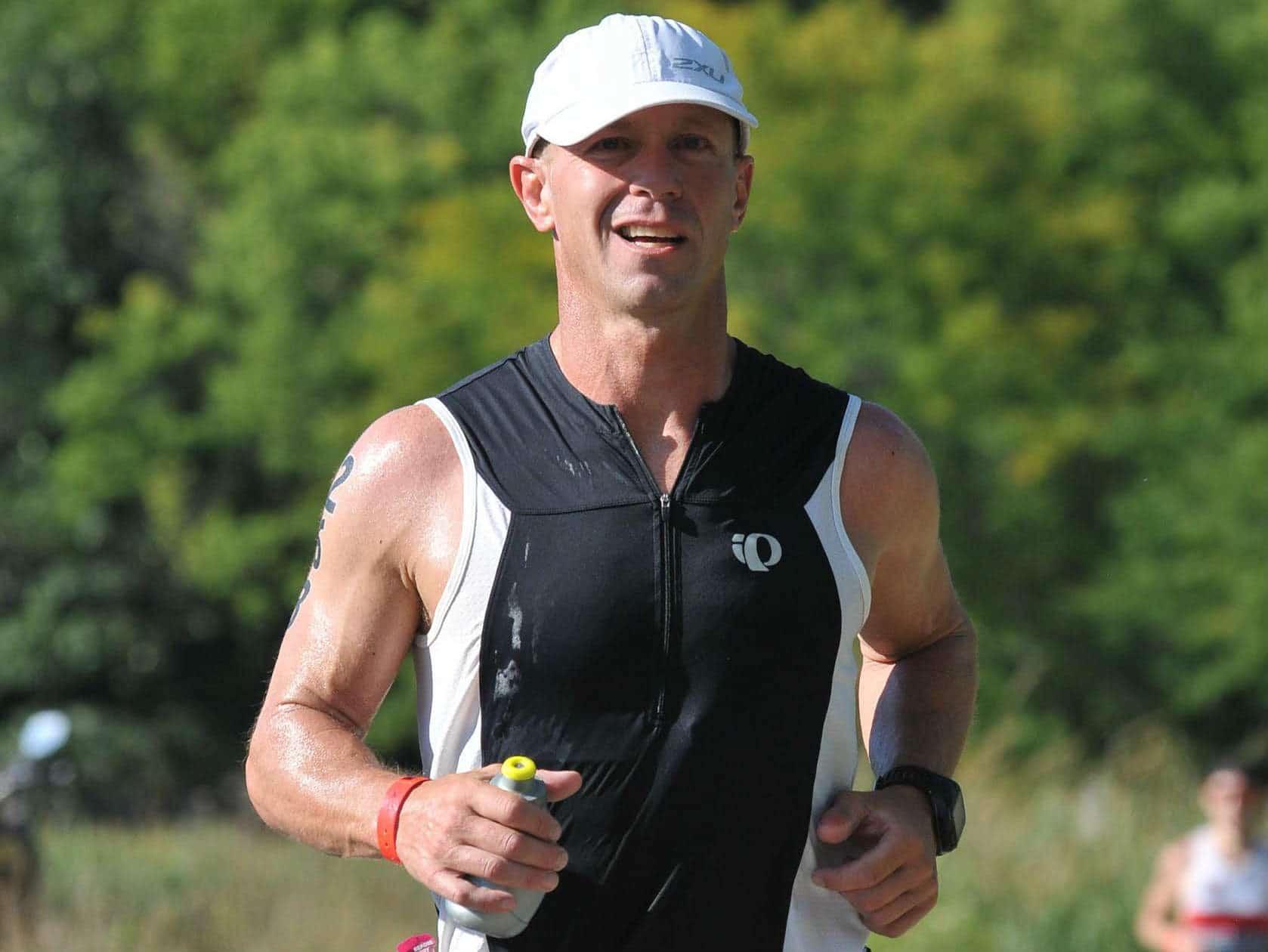
During the last mile, it surprised me to watch as a man with a 70-something number written on his right calf passed me.  (For those of you who have taken part in a few triathlons, chances are that in at least one of those, you will have had your age marked on one of your calves.)

Learning From the More Experienced, No Matter Their Age

I am not comfortable striking up a conversation with a stranger. However, I have found it easier to start a discussion with a fellow triathlete. The shared interest in the sport and our mutual desire to see others succeed at it, especially at the amateur level, is clear.

During the cool-down after the race, I met the 70-something man who had passed me on the run, James Chapman.  Being both impressed by his overall ability and curious to learn how to improve my running ability, I struck up a conversation with Jim about his training program. More specifically, I asked him how I should train to run faster.

During the conversation, Jim also shared information about his fueling approach. I recorded his comments about fueling in What I Learned About Race Fueling at the Rocky Gap Triathlon.

Triathlon run training for faster seniors

Jim summarized his run training program as follows:

  • Start with a couple of months of 3 to 5 mile easy runs three times per week. This will build a base level of fitness.
  • After the initial phase, introduce hill repeats. Hill repeats are done after a 20-minute warm-up run. Start with 3-5 repeats of 10-20 seconds running up a moderately (5-10% grade) steep hill during one of the weekly runs. Over several weeks, gradually (to avoid injury) increase the duration to 1 minute. End the session with an easy one mile cool down run.
    • NOTE: Hill repeats can be done on a treadmill since you can precisely control the grade and pace.
  • A third key to faster running is intervals. Jim’s coach had him “doing 30 second to 3 minute pickups where you gradually run at race pace (not as fast as you can go – that leads to injury).” Jim said “My favorite interval session is a one mile repeat where I run one mile at race pace and then either jog or walk for 2 minutes and then do two more repeats. After the last repeat, run an easy one mile to cool down.”

For Jim, there are two other components of an effective run training program:

Stretching: For Jim, it is critical to stretch the Achilles tendon and calves after every workout, including after swimming. I can echo the importance of stretching after every workout, whether swim, bike, or run.

Related post: Optimal Stretching Pre and Post Workout

Strength training: Jim’s major exercises for strengthening the legs and hips are (1) step ups, (2) body squats, and (3) one leg squats.

Related post: Review of Mark Allen’s Strength Training for Triathletes

After the Maryland Triathlon

Since I was racing the next day in the Independence Triathlon in Pennsylvania, Joy and I started our northeasterly journey toward Quakertown – after a shower and change of clothes, in the park facilities.

Race Firsts

  • First triathlon during which a portion of the run course was on a dam.
  • This was the first time I sat down for a long conversation with a fellow triathlete after the race.
Triathlon Adventures Across America book cover

What Could Your Journey Be?

“It made me think, ‘Wow, wouldn’t it be fun to try to do this too?’”

Explore the journey across all 50 states

Have You Done a Triathlon in Maryland?

Tell us about the race or races you have done in Maryland.

What have you learned from other triathletes during or after a race?

Comments: We’d love to hear about your experience. Join the conversation below. All comments are reviewed before they appear.

Reply notifications: Click the bell icon above Post Comment to be notified when someone replies to your comment.

Follow the discussion: Click Subscribe above the comment box and enter your email address to receive notifications whenever a new comment is added—even if you don’t leave a comment. After subscribing, check your email and click Confirm to activate notifications.

How Will Social Distancing Change Triathlon?

Strict social distancing in triathlon is impractical. This is the major reason for two of the three triathlons I had planned for June, those in Arkansas and Oklahoma, being rescheduled for the fall. Meanwhile, organizers of the Kansas triathlon canceled the event for 2020.

What will a triathlon be like in 2020? I asked race directors this question. This is what I learned.

In-Person Racing Will Resume in Phase 3

Guidelines for Opening Up America Again” published by the White House and CDC (Centers for Disease Control) defines a three-phase plan for re-opening the USA. Under this plan, state governors determine the schedule for re-opening their state based on trends in virus cases.

In the three phases, physical distancing requirements gradually reduce from strict (Phase 1) to moderate (Phase 2) to limited (Phase 3).

USA Triathlon has interpreted the Federal government guidelines for the triathlon community in its May 7, 2020 publication titled “Return to Racing Recommendations for Race Directors“.

Having read the USA Triathlon publication, I better appreciate why race directors have canceled or rescheduled the 2020 triathlons.

Even Moderate Physical Distancing Is Not Practical For Triathlon

If you have competed in a triathlon of over 50 people, you probably agree that guaranteeing social distancing (6 feet or roughly 2 meters between individuals) in triathlon would require major changes.

According to Bruce Dunn, owner of All Sports Productions, he and a group of a dozen race directors have been meeting weekly by video to discuss how they could resume putting on races while in Phase 2 as defined by the Federal government.

The group has simulated races considering how to ensure moderate social distancing. Some requirements for a 300-person race that came from the simulations were comical:

  • Time-trial swim start with 5 minutes between individual starts; this would lead to 25 hours to start all 300 swimmers.
  • Transition area that covered 2 acres (0.8 hectares).

Imagine forgetting where you racked your bike in this race. As an alternative, one group member recommended using each racer’s car for the transition space, making the parking lot the transition area.

From these brainstorming sessions, the group concluded that the only practical solution was to wait until Phase 3 to restart triathlons. It avoids extreme measures and/or unacceptably high entry fees.

social distancing in triathlon will mean more space
Will more spacious transition areas be an unexpected benefit of the pandemic?

What Changes In Triathlon Should You Plan For?

Phase 3 is supposed to mean a ‘return to normalcy’. However, there will still be many differences from triathlons of previous years.

First, triathlon organizers must pay attention to physical distancing and sanitation.  USA Triathlon’s “Return to Racing Recommendations for Race Directors” identifies “continuing to adhere to physical distancing and sanitation protocols” as a requirement for races conducted in Phase 3.

According to Jim Rainey, race director for Georgia Multisports, “we plan to make many changes to help ensure your (the triathlete’s) safety.”

Jim explained that this will mean more disinfecting stations throughout areas of high traffic. Race staff will wear masks or shields. In addition, athletes will have their temperatures measured and be asked to wear masks when not racing.

Other changes before, during, and after the race we should expect are:

  • Self body marking.
  • More spacious transition areas to allow for greater separation of individual transition areas, a change probably welcomed by most racers.
  • Time-trial (one person at a time at a fixed interval) starts rather than mass or wave starts for the swim.
  • Fewer “pinch points” on the bike course where cyclists must ride close to each other.
  • More loop, rather than out-and-back, run courses.
  • Self-service aid stations on the run course.
  • Fewer goodies such as free samples in the swag bag.
  • Changes to the awards ceremony.
  • Fewer spectators.

Doing a triathlon in this new era will definitely be different!

Will You Race in 2020?

Comment below to let us know about your plans to race in one or more triathlons during 2020? Which race(s)? What are your concerns? Are there changes you welcome?

Why Senior Triathletes Should Use Interval Training

Interval training for senior triathletes provides important health and fitness benefits through short, intense periods of exercise. It is not surprising that, in recent years, high intensity interval training, or HIIT, has been among the most researched type of fitness program.

The interest in HIIT comes in part because of its value for the growing population of seniors. For the older athlete, HIIT can be an important part of a training plan. Why? Because it reduces the wear and tear of continuous, low to medium intensity exercise used to help us stay competitive as we age.

What is HIIT?

According to the American College of Sports Medicine (ACSM), high-intensity intervals are defined as those exercises performed at 80 to 95 per cent of one’s maximum heart rate. Intervals are between five seconds and eight minutes long.

The periods of high intensity are followed by periods of complete rest or active recovery performed at 40 to 50 per cent of one’s maximum heart rate. These periods depend on a person’s fitness but are generally longer than the high intensity period. As you will read further on, recovery is a critical part of an effective HIIT protocol.

Since there are so many ways to apply the principles of HIIT, this technique is used by elite and amateur athletes. It is even used as part of cardiac rehabilitation.

HIIT exercises can be performed in the gym using stationary bikes and treadmills, in the pool or lake, and at home using only bodyweight.

You May Already Be Using HIIT

If you have taken a cycling class at your local fitness center, you have probably made use of HIIT. Tabata, one of the most well known methods of applying HIIT, consists of eight repetitions of 20 seconds pedaling at 170% of maximum sustainable oxygen uptake followed by 10 seconds of rest. Done properly, the cyclist will maintain the same level of power for each repetition, rather than have the power taper off with each successive interval or even vary between intervals.

Other examples of high intensity interval training for the swim and run legs of a sprint triathlon are:

Interval training helps senior triathletes be more competitive racers.
High intensity interval training can help athletes of any age become more fit and competitive racers.

Benefits of High Intensity Intervals

High intensity interval training has three main benefits:

  • Reduces the tendency for overuse injuries,
  • Minimizes boredom – and the tendency to skip workouts – from repeating the same routine day after day,
  • Increases performance, that is, helps us become faster.

While longer, moderate intensity workouts build our body’s aerobic system, high intensity intervals tap into and strengthen both the aerobic and anaerobic systems.

In a May 22, 2019 article in Science Focus magazine titled “HIIT is changing the way we work out, here’s the science why it works“, author Jamie Millar explains the changes occurring during and as a result of high intensity intervals:

“Ramping up the intensity forces your body to tap into its anaerobic system for energy, because it can’t supply the oxygen required to work aerobically quickly enough; in the recovery intervals, your body reverts to its aerobic system. As the session goes on, your body relies less on the anaerobic system, because quick-release energy sources of phosphocreatine and glycogen (glucose stored in your muscles) become depleted. Your body will therefore start to rely more on the aerobic system, which releases energy more sustainably but slowly from fat.”

In Millar’s comments, we see benefits in developing our anaerobic system and in burning more fat. The latter is one reason why HIIT (along with proper nutrition) is great for weight loss.

What Senior Triathletes Should Know About Interval Training

Getting the most from HIIT and avoiding injury from it requires a well-thought out and properly executed plan. Here are three fundamentals of this type of routine.

First, Warmup

Before engaging in intense intervals, it is essential to warm up our muscles and get our heart rate up. My typical warmup is a 10 to 15 minute swim, bike, or run before the interval portion of the session.

Second, Recover Properly

Recovery in the context of HIIT (High Intensity Interval Training) has three meanings:

  • Recovery between each interval of a session,
  • Proper recovery at the end of HIIT session, and
  • Fully recovering between sessions.

Recovery during a HIIT session – Experts remind us to honor the recovery time specified in each interval. During the so-called ‘recovery interval’, our body clears out lactic acid from our muscles. One study showed that a recovery of 3 minutes between 4 minute running intervals led to faster, more productive intervals than when shorter or self-selected recovery intervals were used.

Recovery after a HIIT sessionA study by the German Federal Institute of Sport Science showed that active recovery, such as 15 minutes of moderate jogging after a HIIT session, led to a beneficial increase in anaerobic lactate threshold compared to passive recovery.

Recovery between sessions – Between HIIT sessions, it is important for our body to eliminate the lactic acid, hydrogen ions, and hormones (e.g. adrenaline) produced during the anaerobic exercise. For some types of HIIT, recovery also involves repair of micro tears of the muscles.

It is because of the time and need for complete recovery between intense sessions that most training programs include no more than one HIIT session per week.

Third, Be Patient

As with any form of physical activity that I can think of, doing too much too soon is a formula for injury. The key is to progress slowly.

For example, here is an example of a progression I have used, one that has NOT led to injury:

  • Hill repeats – start with 2 x 15-20 seconds running up a hill with at least 8% grade (8 feet [meters] rise over 100 feet [meters] distance) after a 10-15 minute warm-up run. Repeat every 7 to 14 days adding two repeats each session to a maximum of 10 per session. (Source: Stryd.)

On the other hand, I have become injured twice while trying to run intervals too fast. Too fast in this case means significantly faster than my 5k race pace. In one case, I injured a hamstring. Another time, I injured muscles around both knees.

Both injuries required a week without running. I am sure that I lost more than I gained from the sessions.

Managing Risks

The idea of becoming fit for little investment in time may sound appealing. However, that should not be the takeaway from this post.

To gain the benefits and avoid possible serious injury, HIIT must be done properly. The risk of high intensity can outweigh the benefits if done improperly.

Before starting a HIIT program, proponents of HIIT unanimously agree that you should discuss your plans with your physician.

How Do You Use High Intensity Intervals in Your Training?

Comment below to let us know how you are using intervals in your training? What have been the results?

Affilitate Disclosure

error

Enjoy this post? Please spread the word :)