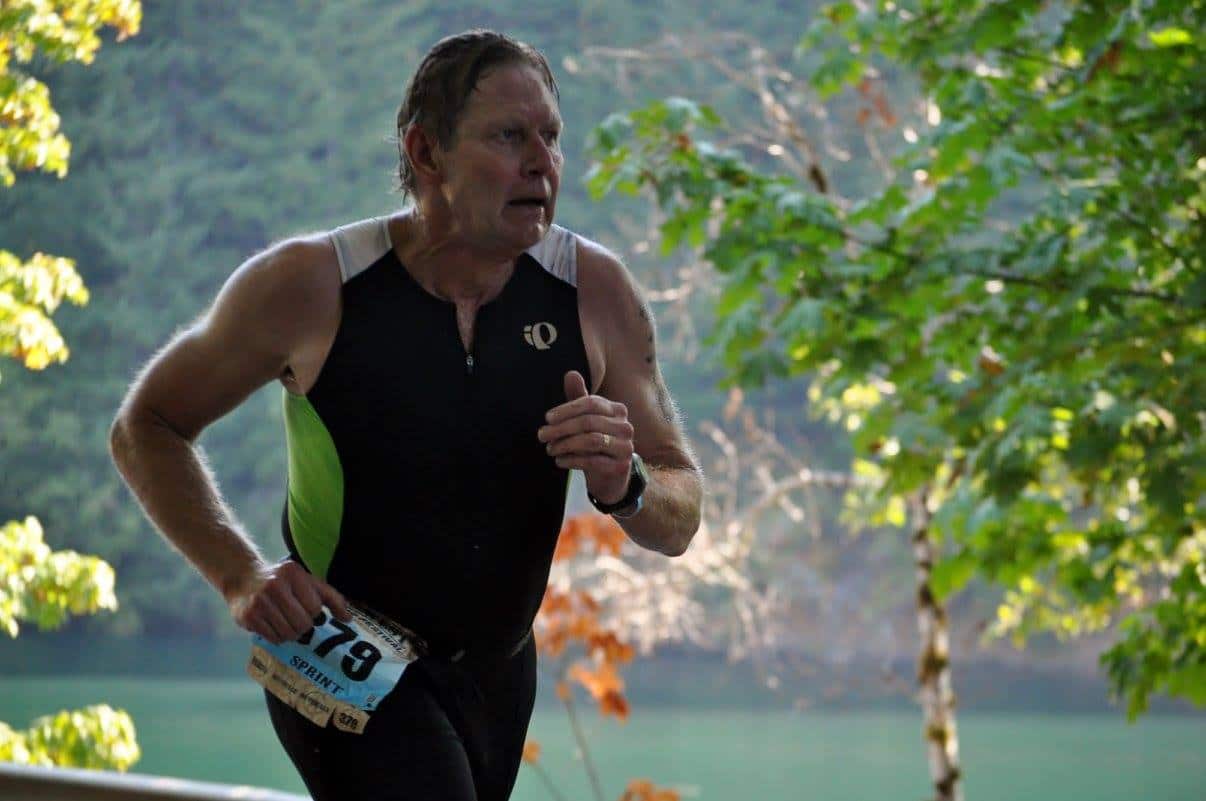
Triathlon Across The USA: State #27 – Nevada

Boulder City, Nevada; April 16, 2016 – Lake Mead Recreation Area, Rage Triathlon

Traveling 3,659 miles through 12 states in six days, all to participate in a sprint triathlon in Nevada lasting about one and a half hours. 

Was it worth it? Absolutely.

This race is one chapter in a 50-state journey—now told in full in Triathlon Adventures Across America .

Triathlon and Visits With Family

During November 2015, Joy and I decided on Nevada as the location for the next triathlon in our 50 state adventure. I used the approach described in How to Choose Your Next Triathlon.

Since my mother’s passing last June, my father has been living alone in his home in the Denver, Colorado area.  My parents were six months short of having been married 65 years when my mother died.  My father was lonely. I wanted to see him.

Nevada was our first choice.  I had already completed a triathlon in Colorado. Nevada was one (and the closest) of the last two western USA states in which I had yet to complete a triathlon. California was the other.

A search on Running in the USA led me to the Rage Triathlon.  After reviewing the race website, we decided to register for it.

Travel to the Nevada Triathlon

My dad had planned to join us on the trip from his home to Nevada.  However, even before beginning the trip, I knew that he would not make the trip with us.  He had fallen in March and injured one of his legs.  While he was steadily recovering, he had decided it best to not make the trip.

Joy and I left our Minnesota home at noon on Tuesday, April 12 for our first stop, an overnight stay at our son’s home in Bennington, Nebraska.  The weather was perfect for time outdoors with our two grandaughters. After a good night’s rest, we headed toward my dad’s house in Parker, Colorado.

A Second Overnight Stop

We arrived at my dad’s late Wednesday afternoon. During an early dinner at the Texas Roadhouse restaurant near his home, my dad told us about the forecast of snow on I-70 west of Denver during the weekend in which we were to return from Nevada to Denver. We had planned to return home through Denver for a second night’s stay at my dad’s. Now, this seemed unlikely.

The next morning following a leisurely breakfast and wonderful conversation, we started the drive to Nevada.
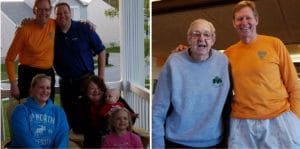
family members
Travel to the Rage Triathlon in Boulder City, Nevada included visits with our son and his family (left) and with my dad (right).

It was not long after leaving my dad’s house that I read of a winter storm warning for a major part of Utah, including the area into which we were traveling.  We managed to get through the area affected by the storm seeing only a few snowflakes.  However, this was the leading edge of the storm that eventually dumped 3 to 5 feet (90 to 150 cm) of snow on the road that we had used to travel from Denver to Boulder City.

Triathlon in the Lake Mead Recreation Area

The Rage Triathlon was held in the Lake Mead National Recreation Area, minutes from Boulder City, Nevada and from Hoover Dam.

After picking up the race packet and t-shirt in Henderson, we checked into our hotel in Boulder City. Next, it was time to start preparing for the triathlon. This included checking tire pressure, adding race numbers to the bike and race belt, and filling water bottles.

While I was taking care of these, Joy was searching for a restaurant for dinner.  A list of restaurants in the hotel room contained a handwritten note made by a previous guest with a glowing endorsement of Evan’s Old Town Grille.

We decided to follow the recommendation having an early dinner at Evan’s in the historic section of Boulder City (nice area). The referral turned out to be a good one.  Evan’s is a small restaurant with an extensive, economically priced menu.    We recommend Evan’s too.  We also recommend that you make reservations – it is a busy place with a good mix of locals and visitors.

Evan's Old Town Grille
The service and food at Evan’s Old Time Grille in the historic district of Boulder City, Nevada was excellent.

Race Day

I am not sure if the wind was related to the winter snowstorm to the north. Nevertheless, it caused a restless night as I listened to it howling, at times wondering if the race would be canceled. As the wind seemed to become louder, I started to imagine being blown off the road during the bike leg if the race were held.

Upon rising in the morning, I checked the weather report on my phone. It confirmed what I had been hearing from the bed – high winds, including a ‘Wind Advisory’.
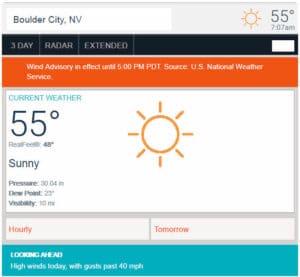
wind advisory
The weather report for the Rage Triathlon race day included a Wind Advisory.

16th Annual Rage Triathlon

The race, first held in 2001 and managed by BBSC Endurance Sports, included Sprint (my choice) and Olympic distances, including relays of these.  While the wind was still a factor in the race, it had calmed with daybreak.
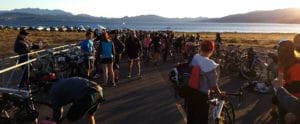
triathlon transition area
The transition area for the Rage Triathlon was a corridor with bikes racked on each side. The ‘Bike Out’ was on one end of the area, while the ‘Run Out’ was at the Lake Mead end.

The advertised distances for the individual legs of this USAT-sanctioned sprint triathlon were:

  • Swim: 750 m (820 yards)
  • Bike: 12.4 miles (20 km)
  • Run: 3.1 miles (5 km)

Swim

There were small waves on Lake Mead.  Just before the start of the triathlon, the race director announced a change to the swim course motivated by the wind.

The open water swim involved groups based on gender and age group – I was in the group of men, 40 and over plus  Clydesdales.  The post-race results showed that the swim group numbered slightly more than 90.
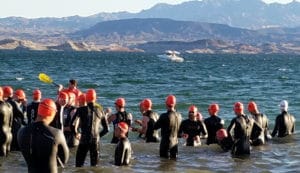
Lake Mead triathlon
The swim leg of the Rage Triathlon was in Lake Mead. The wind on race day made the swim a bit more challenging.

The water was clear with a bottom containing sharp rocks and small shells. After the race, I found three small cuts on my feet. 

There were also the typical triathlon open water swim challenges. First, there was the person who determined to pass me at all cost, including swimming over top of me. Then, there was the guy who could not swim in a straight line. Instead, this guy followed a ‘zig-zag’ path, repeatedly swimming in front of me. I finally got in front of him.

Bike

The bike course was hilly and windy. My average speed was a little over 15 miles per hour (24 km per hour). However, I also reached a top speed of 36 miles per hour (58 km per hour) going downhill, probably with the wind at my back. 

The wind gusts made me skiddish about getting into the aero (short for ‘aerodynamic’) position for fear of being blown off the road.

After I returned home, I spoke with a person at my local bike shop (Maple Grove Cycling)  about this experience and my concern about riding in the aero position with gusty side winds.  His suggestion was that confidence would come with experience riding in similar conditions during training rides.  I guess that I need more time in the saddle.

Run

The out-and-back run course was relatively flat and unaffected by the windy conditions.  I started out more slowly until my legs had adjusted to running. I was then able to end strong and finish with a time good for me.

Results

The result was a first place finish in the Men’s 60-64 age group and 67th place finish among 157 men of all ages.

Avoiding Snow on the Way Home from the Nevada Triathlon

In November, while I was beginning to plan the 2016 triathlon season, I assumed that it would be safe to travel through the Rocky Mountains of Colorado in April.  Little did I know that April is actually the month with the second highest snowfall in Colorado.
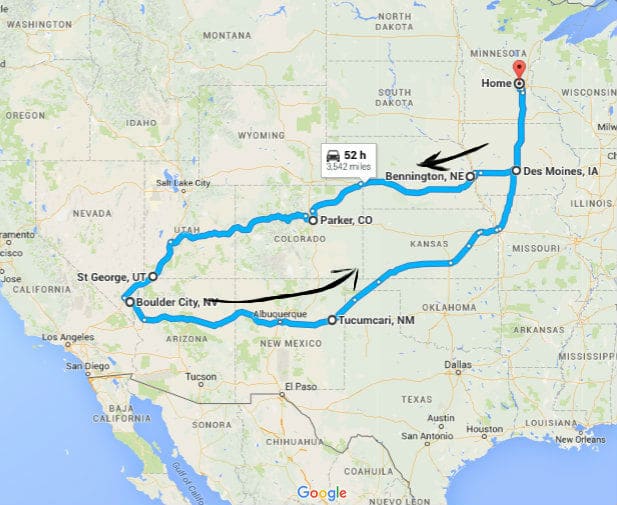
Road trip Nevada
Map showing route traveled to and from Minnesota to participate in the Rage Triathlon in Boulder City, Nevada. Dots indicate locations of overnight stops.

The winter snowstorm that occurred while we were in Nevada produced enough snow to close Interstate 70 for several hours on at least two days.  This made a return trip using the same route we had used to travel to Nevada impossible. That is, unless we would have had delayed our return by two days.

Delaying the return was not possible because of commitments at home.  Therefore, we returned using a southern route taking us across Arizona, New Mexico, Texas, Oklahoma, Kansas, and Missouri.

Another Fascinating Road Trip

Once again, a triathlon provided multiple, enjoyable experiences – a road trip during which Joy and I enjoyed conversation and several audio books (“The Wright Brothers” by David McCullough, “How to Win Friends & Influence People in the Digital Age” with Brent Cole to name our favorites) and time with family members. We also saw new parts of this great country while enjoying the opportunity to race with others who enjoy triathlon.

Race Firsts

First time experiences or observations associated with this triathlon were:

  • First race in a national park.
  • The Rage Triathlon was the first race in which the transition area was setup as a long corridor with bikes lined up along the edges.  This approach did make it more challenging to find my transition space since I could not simply count the number of rows from the entrance to my transition area.
  • First race in which an age-group podium finisher had only one arm. Inspiring.
Triathlon Adventures Across America book cover

What Could Your Journey Be?

“It made me think, ‘Wow, wouldn’t it be fun to try to do this too?’”

Explore the journey across all 50 states

Share Your Questions and Comments

Have you done a triathlon in Nevada? Which one?

Have you done a triathlon in high wind? What was your experience? Any problems? Tell us in the Comments below.
8 Reasons to Tri in the UK

I was introduced to Sue Faulkner through her story in BBC’s Get Inspired. Her story, titled “Grandmother of six completes first triathlon at 63“, reported how she decided to get involved in triathlon through a classic, “I will, if you will” agreement. The article also described Sue’s training for her first triathlon and her race day experience.

Inspired by her, I contacted Sue by email and began a conversation that has continued up to this day. Following is what I learned about Sue’s experience.

Inspiration for My First Triathlon

Truth be told, Sue’s decision was not as impulsive as the BBC article suggested. Sue told me that the motivation for triathlon came even before watching her son compete in a triathlon. “I had been with my family on the beach and had watched the grandchildren running about and having a wonderful time and I wanted to be part of that. Sitting back and waiting for old age to catch me up was not for me.”

I had been with my family on the beach and had watched the grandchildren running about and having a wonderful time and I wanted to be part of that.”

Lake District run
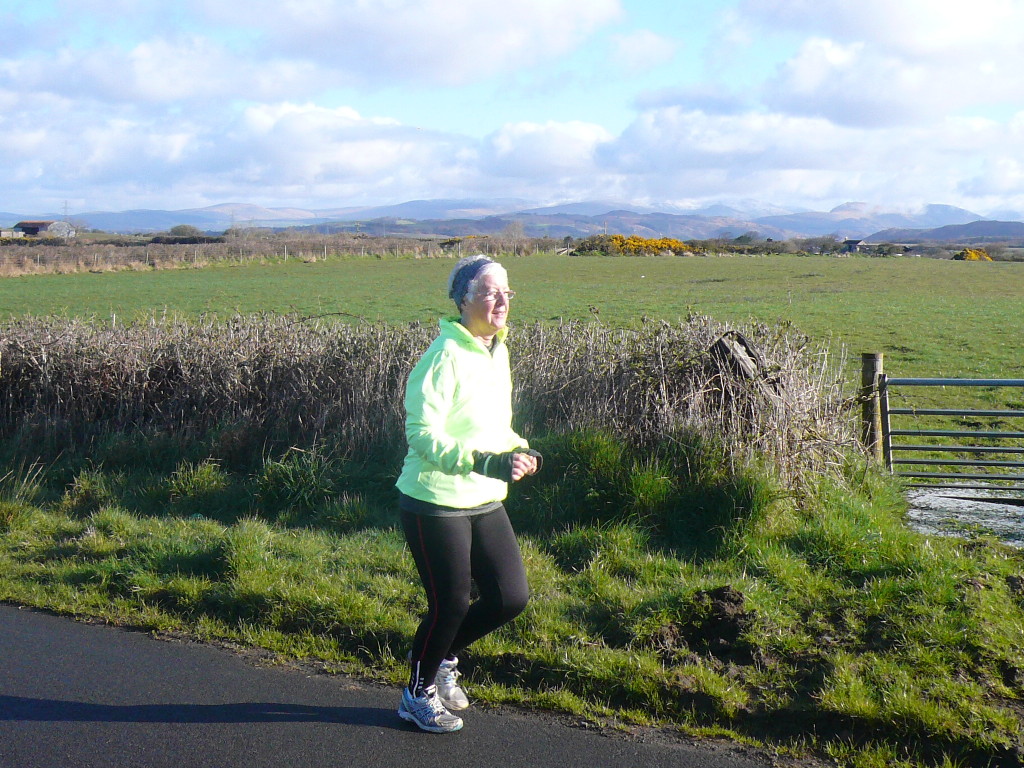
Sue Faulkner on a training run near her home in the Lake District in the UK. (Source: Sue Faulkner)

There was also an element of wanting to inspire her children and now eight grandchildren to explore new activities (Reason #3 of “15 Reasons for Those 50 and Older to Do Triathlons“) – “I wanted to let my grandchildren realise that even though I will seem old to them, age should not be a barrier to trying new things.”

From the preparation up to the first triathlon, Sue learned a number of lessons. Most importantly, she learned that “I can still swim/bike/run. Four years ago I would not have believed it, especially since my previous memory of running was 25 years earlier at the mother’s race at my children’s primary school sports day.”

I love being on my bike – it feels so free and as if I am 12 years old again.”

Advice

From the experience in preparing for her first triathlon, Sue shared several valuable insights for seniors. By the way, her advice is also relevant to first-time triathletes of any age.

Advice for training

Following is a summary of the main lessons learned from this experience.

  • “Start small, and increase by small steps. Pay attention to not overdo things and hurt yourself.”
  • For running, ‘starting small’ can mean “running just a few paces then walking until you are ready to run a few more.” Sue said “I used to work with children with special needs. They were able to make progress through small steps that they could achieve.” (Click here to read another article about starting running as a senior triathlete.)
  • Listen to your body and adjust your training as needed. “If something hurt one day, I would train in a different discipline for a couple of days. The variety is one of the great things about triathlon.”
  • Set achievable goals. “Far better to set achievable goals than set the bar too high and become disheartened.” Note that as a beginner, knowing what are ‘reasonable goals’ can sometimes be difficult to determine. Revert to the first bullet above (‘Start small’) if there is any question.

Advice for the triathlon ‘gear’

There is also the matter of having proper clothing and equipment.

  • “Treat yourself to some nice running and cycling clothes.” Don’t worry if the clothes show bulges in all the wrong places. After a few weeks, you might have dropped a dress size and those muscles will be more toned.” Not only will proper clothing provide comfort and safety during training, but having invested money in the clothes and equipment could be the extra incentive needed for you to continue when you may be inclined to stop.
  • “Get trainers (running shoes) from a proper running shop who can advise you on the best ones for your running style.”
  • Even if you borrow a bike, make sure you use one that fits and one on which you are safe. Get padded shorts and a comfortable saddle, in addition to a helmet.

Sue’s training schedule involved two days of swimming, two days of running, and two days of cycling per week, typically outdoors (rather than in a gym/fitness center) and before breakfast when the sky was clear and crisp. She also started riding her bike shopping. “I was surprised how quickly my fitness improved by doing a little and often.”

As her fitness increased, Sue started training in two of the three disciplines each day. However, she purposely avoided training in the same discipline two days in a row.

“I also maintained time in one day each week for walking with some friends on our wonderful Lake District fells, something I had been doing for the last 25 years.”

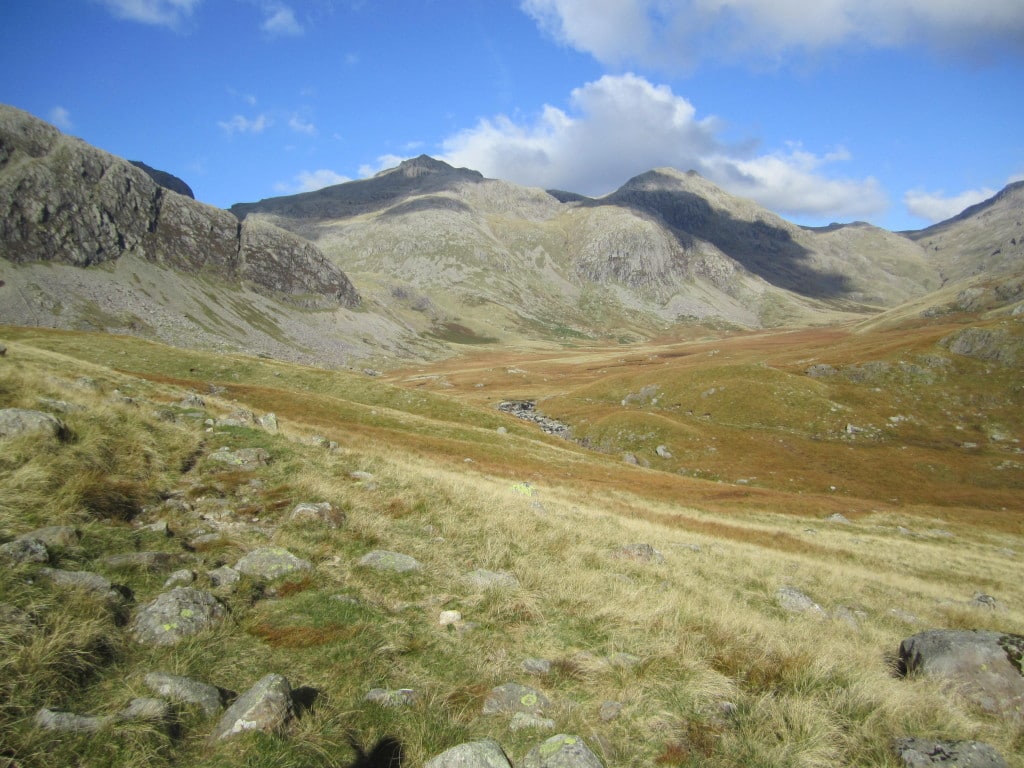
Scafell Range UK
Scafell Range from Upper Eskdale in the Lake District, UK. (Source: Sue Faulkner)
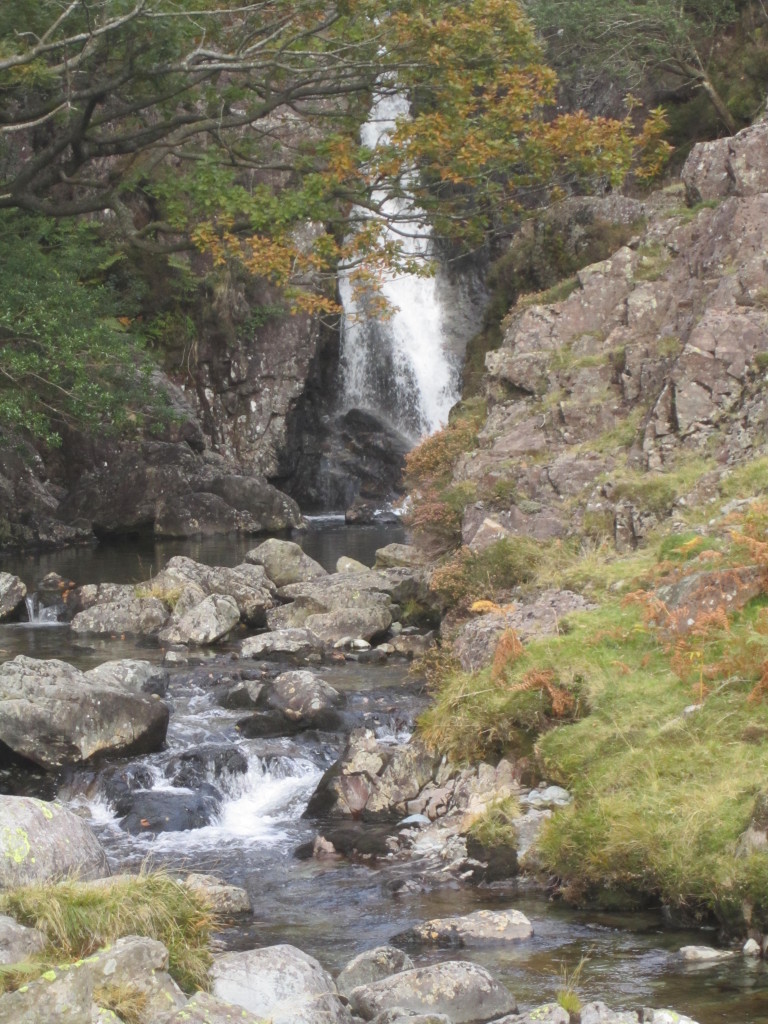
waterfall Upper Eskdale
Waterfall at Upper Eskdale in the Lake District, UK. (Source: Sue Faulkner)

Looking Forward

Sue’s first triathlon left her with a sense of accomplishment. “Although it is nice to beat people, just crossing the finish line is a real achievement. There is fulfillment in just taking part.”

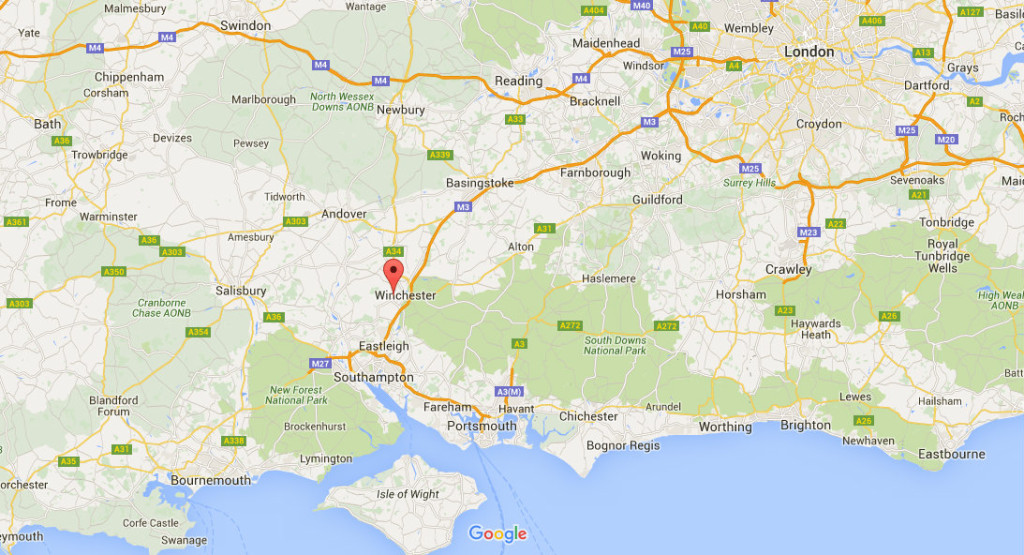
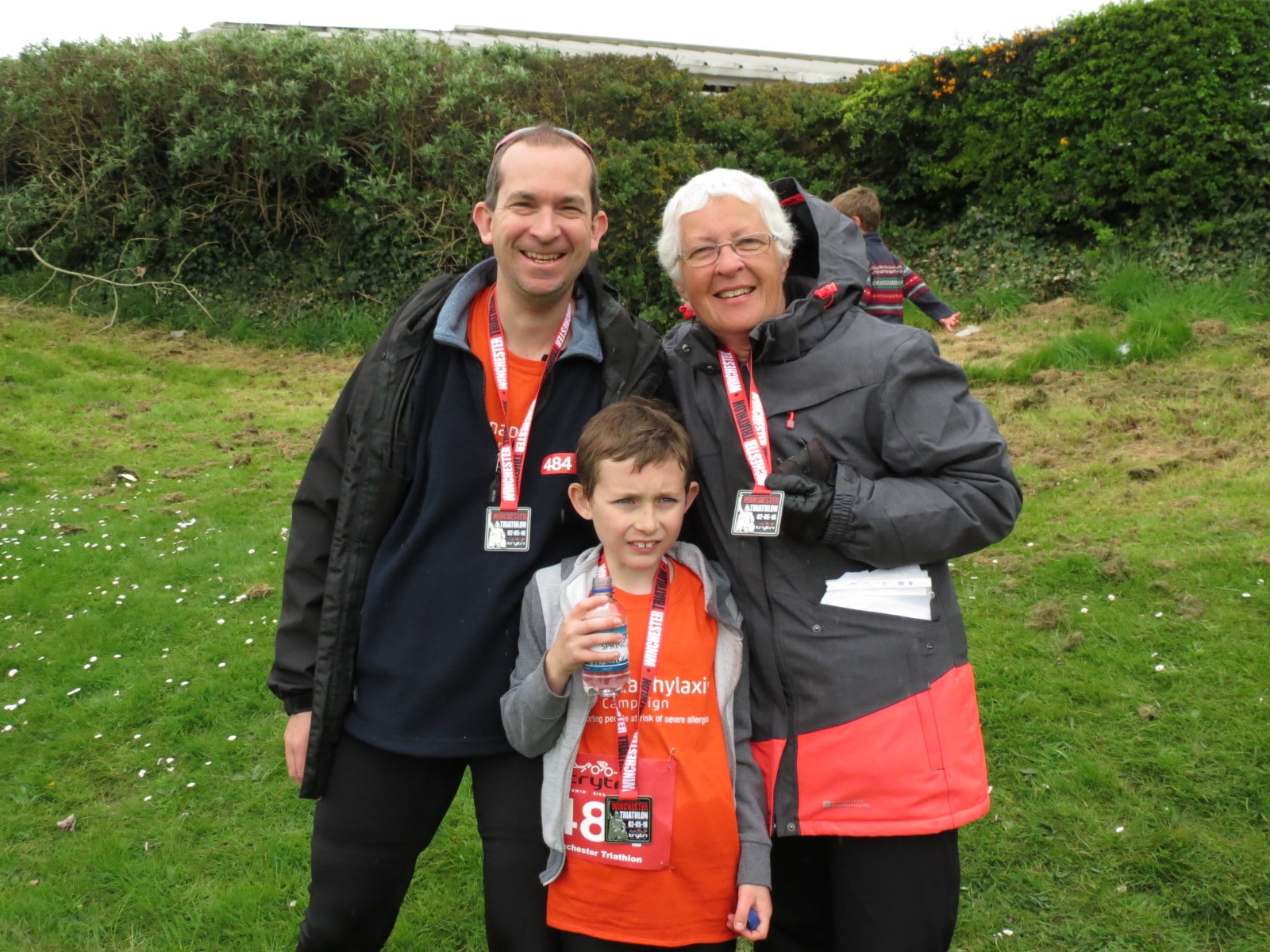
Following the experience with her first triathlon, results of on-going training, and the “very supportive people around me”, Sue decided to participate in a second triathlon. This one, the Winchester Triathlon, is held in the historic medieval city of Winchester in Hampshire County on May 2nd. Sue’s daughter, son-in-law, and 8-year-old grandson joined her in this triathlon, albeit on different courses.

Winchester triathlon
Sue Faulkner’s second triathlon, the Winchester Triathlon, will be held in Winchester, Hampshire, UK on May 2nd.

Stories like this are what make triathlon such a rewarding adventure—no matter when you begin.

Want to take the next step? Choose your path below.

Whether you’re just getting started or looking to improve, here are your next steps:

New to Triathlon?

Start with a step-by-step guide to triathlon after 50 designed specifically for older athletes.

Start Here →

Already Training?

Learn how to train smarter, recover better, and improve performance after 50.

Improve Performance →

Continuing to Inspire

I am quite sure that Sue’s children and grandchildren are watching her closely and benefiting from her commitment to fitness. She is also gaining inspiration from others, including older friends, who have remained active well into their senior years. “People who have inspired me are 80+ and still going strong.”

No doubt, Sue will continue to be among those who also inspire other ‘60-somethings’, both today and as she continues in her fitness journey in years to come.

Comments: We’d love to hear about your experience. Join the conversation below. All comments are reviewed before they appear.

Reply notifications: Click the bell icon above Post Comment to be notified when someone replies to your comment.

Follow the discussion: Click Subscribe above the comment box and enter your email address to receive notifications whenever a new comment is added—even if you don’t leave a comment. After subscribing, check your email and click Confirm to activate notifications.

What Does Science Say About Running for Seniors?

Is running safe for seniors, defined here as those age 50 and over? What if our joints are showing early or advanced signs of arthritis?

This post summarizes what I learned while investigating what science has to say about running for seniors.

What Does the Research About Seniors and Running Tell Us?

A majority of senior triathletes come to the sport from a background of running. However, those who have not spent their ‘before triathlon’ lives as runners face at least some level of confusion about whether they should begin running later in life. The ‘conventional wisdom’ is that running is hard on our joints, especially those that may already show signs of age.

An internet search of the phrase ‘running vs. walking’ produced interesting and even pleasantly surprising results from academic research. It turns out that academic research results do not support the conventional wisdom.

I must preface the following comments with the disclaimer that the physicians of some, including my wife, who have artificial knees, hips, or other joints may advise their patients against running. I am not qualified to debate this advice.

However, if your doctor has given you the ‘ok’ to run, then consider the following.

Running and Injuries for Seniors

A review of 400 articles which covered 15 studies based on data gathered for the same subjects over time produced the following conclusions:

A drawback of running is the relatively high risk of injury, with an incidence varying between 19% and 79% according to a review of several studies. . . . Acute running injuries are rare, consisting mainly of muscle injuries, sprain, or skin lesions (blisters and abrasions).[1]

The major conclusions from this review were that the tendency for injury is higher for those, especially men, with a history of leg injuries and that shoe inserts/orthotics should be avoided. Podiatrist treatment could be beneficial to people who suffer these types of injuries (such as places like heartlandpodiatry.com). The authors admitted that there could be a connection between previous injury and the use of inserts. “It is possible that runners who are more prone to injury are given orthotic/inserts earlier”.

Only one of eight studies included in the review showed that age had a significant effect on injuries. In the one study which did show an effect, age was shown to make subjects more susceptible to overuse injuries, especially to the hamstrings and Achilles tendon.

Another report showed that the link to leg injuries is primarily related to two anatomical factors – feet with high arches (cavus feet) and unequal leg length.[2]

There is also evidence that for older runners, the loss of shock-absorbing capability can increase overuse injuries. However, this can be countered through the use of running shoes with optimal cushioning properties and by limiting running under high impact conditions.[3]

The Benefits of Running Outweigh the Risks

Even if we interpret these studies to mean that older runners are more susceptible to overuse injuries, the conclusions suggest that these factors can be managed.

On the other hand, there is plenty of evidence from research to show that there are important benefits of running.

Muscular efficiency – improved ability for ‘moving young

One study[4] showed that “older runners had a 7-10% better walking economy than older walkers over the range of speeds tested . . . and had walking economy similar to young sedentary adults over a similar range of speeds”. The researchers concluded that “Running mitigates the age-related deterioration of walking economy whereas walking for exercise appears to have minimal effect on the age-related deterioration in walking economy.”

Another study[5] concluded that older runners had modified their biomechanics to adjust for reduced strength of some muscles of the calf. The result was more effective movement of older runners during walking as compared to their non-runner counterparts. Researchers concluded that “runners may be able to transfer motor adaptation from running to walking even in old age.”

One other study[6] concluded similarly that “vigorous exercise, such as running, prevents the age related deterioration of muscular efficiency and, therefore, may make everyday activities easier.” The study showed that “running economy”, which is determined primarily by the storage and release of elastic energy from the leg, is only minimally different between young runners and those over 65 years.

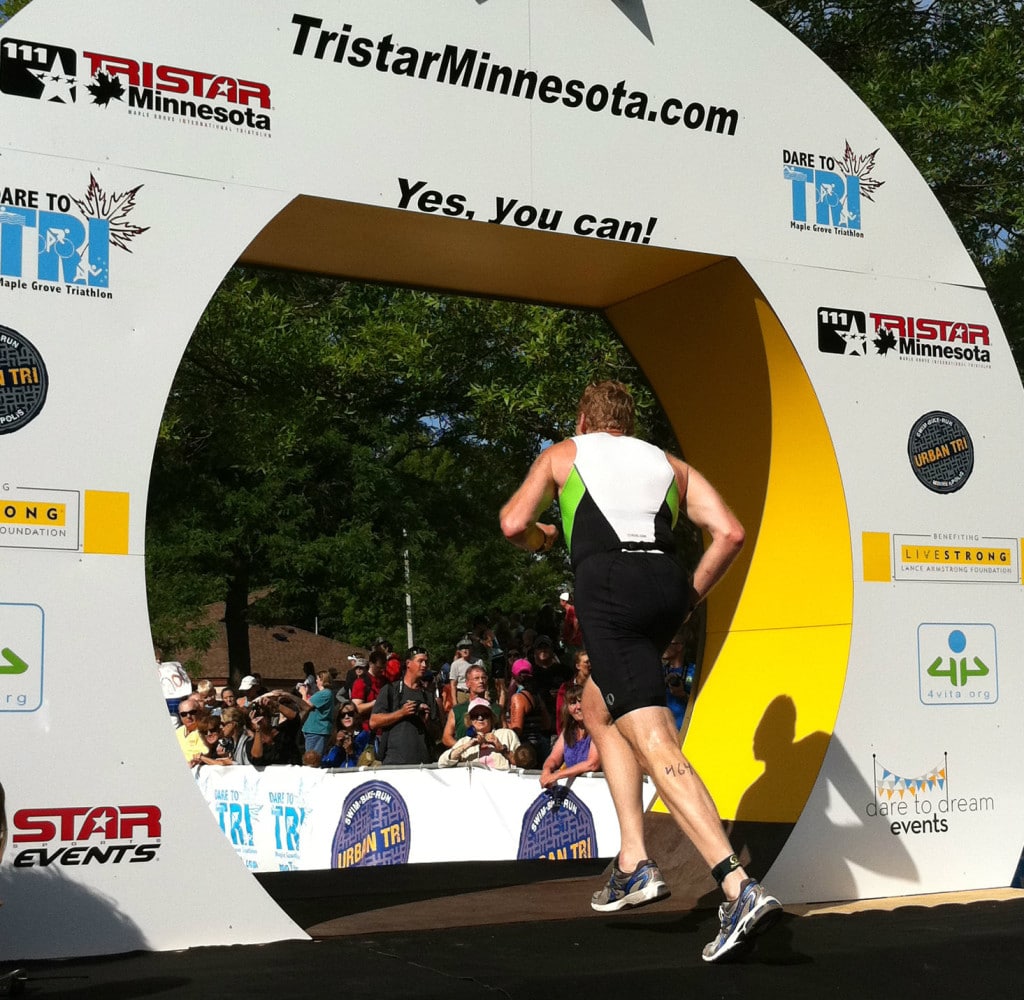
A senior triathlete running across the finish line of the Maple Grove Minnesota triathlon

Crossing the finish line at the Maple Grove, Minnesota triathlon

Weight control through running for seniors

Running has also been shown to be more effective for weight control than walking alone. In one study[7], researchers attempted to determine if running and other exercises, including walking, would produce the same benefits in terms of weight control (BMI and waist circumference). The conclusion was that non-running exercises could not be substituted for running to achieve the same weight loss results.

Similarly, another study[8] showed that even though the change in BMI is strongly related to the change in energy expended for both running and walking, the change in BMI was greater for running than walking This means that running would be good to get involved in, and getting some appropriate clothing (such as that from https://www.ryderwear.com/collections/womens-shorts
) can help the process be easier and less dragging on the body.

Reduced mortality from certain chronic diseases and cancers

Studies have also shown that exercise, whether running or walking, significantly reduces cardiovascular disease, Chronic Kidney Disease, pneumonia, influenza and other illnesses in people with diabetes. [9] Likewise, the risk for fatal brain cancer has been shown to be reduced by both running and walking. [10]

Running has also been shown to significantly reduce mortality of breast cancer after diagnosis, whereas walking was shown to have a non-significant effect. [11]

More Running is Not Always Better?

People who are physically active have at least a 30% lower risk of death compared to those who are inactive. However, according to conclusions of the Copenhagen City Heart Study [12], the ideal amount of exercise for improving longevity is uncertain.

Findings of the study found that light and moderate runners have lower mortality than sedentary non-runners. On the other hand, “people who run most days of the week at a pace faster than 7 miles per hour have the same risk of death as sedentary individuals.” [13] That’s good news for slow runners like me!

Running Can Be Good For Seniors

Science shows that running has a number of health benefits. The benefits of running are generally greater than those from walking alone, especially when done in moderation.

While running is more likely to lead to injury than walking, paying attention to and minimizing conditions that lead to overuse injuries – along with strength training and stretching – will minimize the occurrence of injuries.

Remember, if you have not been running recently, start slowly (see How To Start – Or Re-Start – Running). If you have been running, don’t increase distance or intensity too quickly.

Leave Your Comments and Questions Below

What are your thoughts about the conclusions presented here?

Has your running changed with age? If so, how?

References

[1] van der Worp, Maarten P., et al., “Injuries in Runners; A Systematic Review on Risk Factors and Sex Differences”, PLoS One, 2015; 10(2): e0114937.

[2] Fields, Karl B., et al., “Prevention of Running Injuries“, Current Sports Medicine Reports: May/June 2010 – Volume 9 – Issue 3 – pp 176-182.

[3] Bus S. A., “Ground reaction forces and kinematics in distance running in older-aged men“, Med Sci Sports Exerc. 2003 Jul;35(7):1167-75.

[4] Ortega J. D., et al., “Running for exercise mitigates age-related deterioration of walking economy“, PLoS One. 2014 Nov 20;9(11):e113471.

[5] Karamanidis, K., et al., “Aging and running experience affects the gearing in the musculoskeletal system of the lower extremities while walking“, Gait & Posture, April 2007; 25(4):590-6.

[6] Beck O. N., et al., “Older Runners Retain Youthful Running Economy despite Biomechanical Differences.” Med Sci Sports Exerc. 2016 Apr;48(4):697-704.

[7] Williams P. T., “Non-exchangeability of running vs. other exercise in their association with adiposity, and its implications for public health recommendations“, PLoS One. 2012;7(7):e36360.

[8] Williams, Paul T., “Greater Weight Loss from Running than Walking during 6.2-yr Prospective Follow-up“, Med Sci Sports Exerc. 2013 Apr; 45(4): 706–713.

[9] Williams P. T., “Reduced total and cause-specific mortality from walking and running in diabetes“, Med Sci Sports Exerc. 2014;46(5):933-9.

[10] Williams P. T., “Significantly greater reduction in breast cancer mortality from post-diagnosis running than walking“, Int J Cancer. 2014 Sep 1;135(5):1195-202.

[11] Williams P. T., “Reduced risk of brain cancer mortality from walking and running“, Med Sci Sports Exerc. 2014;46(5):927-32.

[12] Schnohr P., et al., “Dose of jogging and long-term mortality: the Copenhagen City Heart Study“, J Am Coll Cardiol. 2015 Feb 10;65(5):411-9.

[13] Greenfield, Paige, “Why Walking Is Better Than Running”, http://www.huffingtonpost.com/prevention/walking-versus-running_b_8123084.html.