Review – Train to Tri: Your First Triathlon
Looking to complete your first triathlon? Want to inspire and motivate your children, grandchildren, parents, friends, or co-workers?

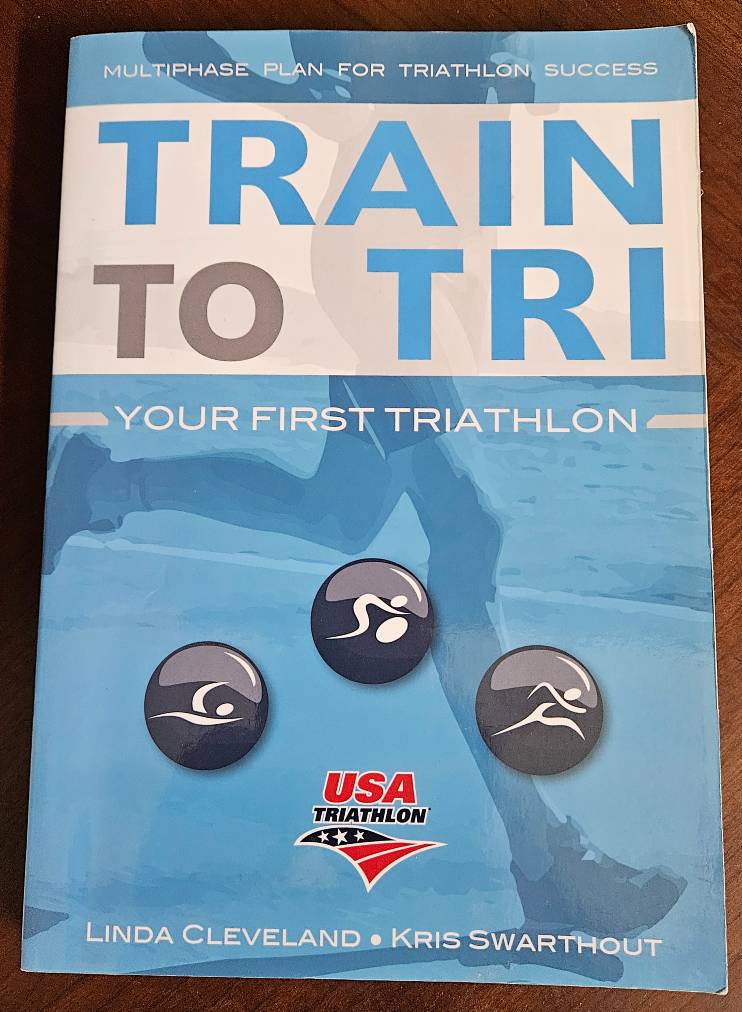
If so, Train To Tri: Your First Triathlon by Linda Cleveland and Kris Swarthout is for you.  This 246-page guide provides the essential information needed to prepare for your first triathlon.

Authors: Linda Cleveland and Kris Swarthout, both USA Triathlon Level 2 coaches with lots of experience competing in triathlon and coaching triathletes.

Publisher: Human Kinetics

Who is this book for?

Train To Tri is written primarily for those considering or already committed to completing their first sprint or standard (formerly called Olympic) distance triathlon.

Even though it is aimed at first-timers, it is not just for those doing their first triathlon.  While I have completed over 40 sprint triathlons, I found several useful training tipsI have already put some of them to use.

What does the book cover?

The book opens with a 24-question Triathlon Readiness Assessment.  Results of the self-assessment help the future triathlete identify with one of three categories – bronze, silver, or gold – and select the training plan included later in the book.  This initial section also provides guidelines for choosing the specific race for your first triathlon.

I like the basic strategy of the first triathlon training plan laid out by the authors – to focus most of the training effort on your weakest leg.

You should focus the most time and effort on [your third strongest sport] to develop strength and endurance as well as improve technique. (page 9)

Gear

Once you decide to do a triathlon, you will quickly learn about the incredible amount of clothing and equipment (called ‘gear’ in the triathlon world) surrounding the sport.  Since not all the gear is necessary for your first triathlon, the authors distinguish between the ‘necessary’ and the ‘nice to have’ or ‘you can wait and decide after your first race’ gear.

Your Triathlon Support Group

Training with a group can provide the extra motivation needed to push through a training program and reap the rewards of completing your first triathlon.  A group can also help you to improve your technique more quickly.

In this chapter, the authors suggest ways to create a support network for your training in swimming, biking, and running that includes various clubs and your family, friends, and co-workers.

You may have various support group options.  For example, if you live in a retirement community, such as The Villages, Florida, you have a built-in support group in The Villages Triathlon Club.  Members train and race together with encouragement galore.

If you are working in an area without a triathlon training club in the area, you can create your own support group through a local fitness center, community pool, bike shop, and running store.  This provides flexibility to follow your specific training plan while enlisting the support of instructors and others with experience from which you can benefit.


Swim

The chapter on swimming covers the basic elements of an efficient stroke with illustrations for a proper freestyle technique.  I appreciated the suggestion for traveling and swimming, especially the advice for making use of the typical small hotel pool.

Interestingly, many triathletes find swimming to be their weakest sport.  If you are in that group, get comfortable being in the water and with swimming with other people as you will experience on race day.  Whether swimming in a pool or in open water, you will inevitably come close to, if not in contact with, other swimmers.  Staying calm is the key to finishing the swim.

If the race you choose includes an open water swim, you will want to practice swimming in open water to become familiar with ‘sighting’.   For safety reasons, I recommend adding the ISHOF Safe Swimmer (see also below) to your list of gear.

Bike

Most of us know how to ride a bicycle.  However, many have never ridden in a large group at speeds associated with a triathlon.

Therefore, the focus of this chapter is safety.  According to the authors, safety in biking begins with a review of the various components of the bicycle to make sure that they are each in good working order.   They also describe the most important cycling skills and suggestions on how to hone these, both individually and in group rides.

When riding on the road in traffic, you need to follow the rules of the road as if you were driving a car. (page 78)

Run

We all know how to run. Right?  Well, not necessarily in a way that is the most efficient or that minimizes the possibility for injuries.  About half of this chapter is dedicated to proper cadence (steps per minute) and body form.  The rest of the chapter introduces training with a heart rate monitor and training involving the three-run types included in the weekly training plans.

If you take one thing from this chapter, remember to progress slowly (the ‘10% per week’ rule) to minimize the likelihood of injury.  Unfortunately, we need to be reminded of this every so often.

Strength and Flexibility

Building strength and increasing flexibility are two keys to increasing your performance in triathlon.   For many of us who spend a lot of time sitting during their workday, lack of flexibility can be the major root cause of injury.   The authors show that a relatively small amount of time spent in strength training and stretching can lead to better performance and fewer injuries.  Plus, these are another way to ‘mix it up’ and keep the training interesting and fresh.

Nutrition and Rest

If we all know how to run, most of us are even better at fueling (aka eating).  The challenge is to eat properly.  It becomes even more complicated when we are exercising, burning more calories, trying to build muscle, and recovering from the stress of training.

Triathlon training can be a great way to shed pounds and improve your health.   Eating the right foods in the right amount and at the right time is the focus of this chapter.  The authors are clear: “Although your daily caloric burn will certainly increase based on your training volume, you don’t have a license to hit the buffet for every meal”.

The chapter begins by showing us how to calculate two important numbers related to exercise – resting metabolic rate (RMR) and caloric burn rate.  The authors discuss how to eat (or ‘fuel’ as they define it) throughout the day. This includes eating before, during, and after workouts.  Sample menus for triathlon training days help to illustrate the principles of proper fueling.

The chapter concludes with a discussion about the importance of rest within a process known as periodization.  The authors even provide a simple test to help us determine when our body is telling us to take a day of rest.

If you do not get adequate rest, the muscles will fatigue and eventually fail, resulting in injury. (page 139)

Training plans

It’s now time to put the information from the previous chapters together and begin to train for your first triathlon.   Sample 8-week training plans are provided for bronze-, silver-, and gold-level athletes for both sprint and standard distance triathlons.    I appreciate that the authors show readers how to tailor the plans to meet their particular strengths and weaknesses and their individual schedules.

Preparing to race

I love this section.  Here, the authors take the new triathlete down the ‘home stretch’ to completing their first race.

Filled with practical advice, the authors walk us through the two weeks leading up to the race.  With greater detail for race day, you can feel the thrill that begins upon waking and includes crossing the finish line and heading to the refreshment area for a cold drink and banana.

Related post: How to Choose Your Next Triathlon

Why get this book?

Train To Tri is pragmatic and focused.  It includes essential information for each of the sports of triathlon.  The authors season the information with the nuances of practicing them within a triathlon.

You can trust the USAT-certified coaches with this ‘no-nonsense’ guide.

Let us know what you think of Train To Tri

Share your experience with this book in the Comments below.

Comments: Join the conversation below — Click on “Subscribe” (located above the Comment box) if you’d like to be alerted to replies to your Comment. Even if you do not submit a comment, you may subscribe to be notified when a new comment is published. Please note that I review all comments before they are posted.

Disclaimer: Please note that SeniorTriathletes.com is a participant in the Amazon Services LLC Associates Program.  This is an affiliate advertising program that provide a way for sites to earn advertising fees.  They do this by advertising and linking to amazon.com. Amazon, the Amazon logo, AmazonSupply, and the AmazonSupply logo are trademarks of Amazon.com, Inc. or its affiliates.  As an affiliate, I will receive a small commission for any purchases of this product that you make through Amazon.

This post was originally published on January 21, 2018.  It was updated on September 5, 2025.
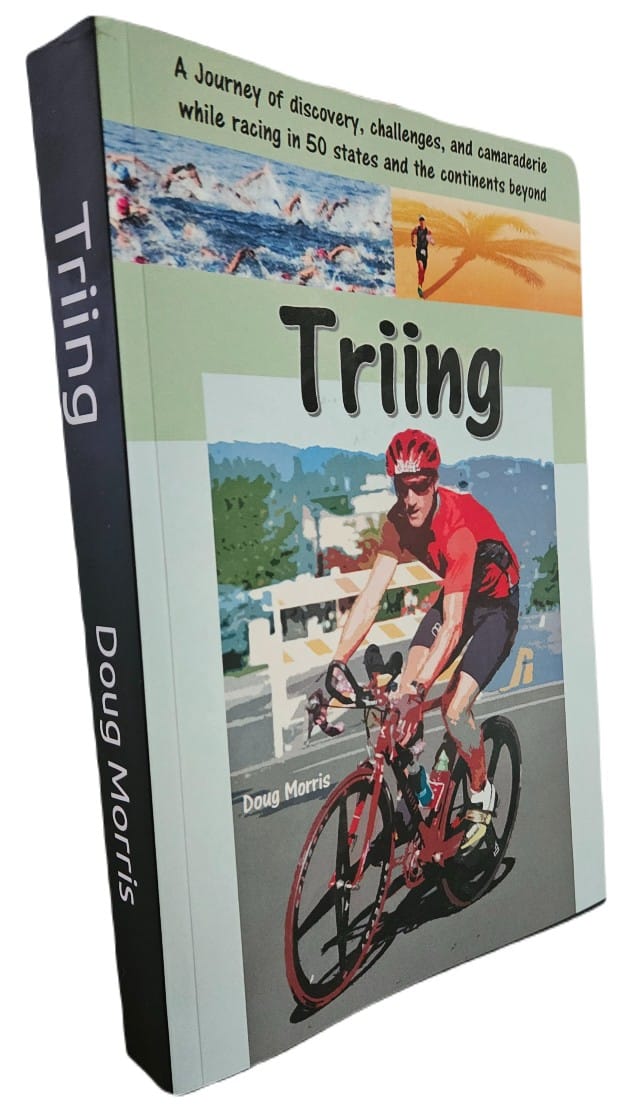
Book Review: Triing by Senior Triathlete Doug Morris

Between 1986 and early 2016, Doug Morris did 168 triathlons in the 50 states of the USA and on six continents. Doug’s story, Triing, is full of practical lessons about the sport of triathlon around the world. It also shows how he juggled family life, work, and triathlon training and racing throughout what he termed the “Journey.”

Following are my key takeaways from reading Triing: A Journey of discovery, challenges, and camaraderie while racing in 50 states and the continents beyond.

About the Author

As a boy growing up in rural Indiana, Doug Morris raced imaginary competitors on a mock racecourse filled with obstacles. It was here that he began to hone his self-identified competitive Type A personality. This early interest in racing blossomed into competitive running while studying at Indiana University. Here, Doug specialized in 800 meter racing, including at several national championships. However, that was still just the beginning as he continued racing for the next seven years after graduating.

Then, in 1986, Doug’s girlfriend and now wife of over 35 years, Chris, suggested they do their first triathlon, an Olympic distance race in Chicago, Illinois. A couple of years passed before his next triathlon, after which he completed about one race per year. As the triathlon bug grew within a competitive host, Doug soon set new goals. Among the first was to qualify for and race in the IRONMAN World Championships in Kona, Hawaii.

“A finisher may sport a tattoo, but whether she raced in a full-distance race or any other triathlon, she will forever be a triathlete after the first race.” – Doug Morris in Triing

In the meantime, Doug and Chris married and had two daughters. Both girls were born with an extremely rare neurodevelopmental disorder, alternating hemiplegia of childhood (AHC). Doug’s work provided the family with the opportunity to live in various places in the United States and in Thailand.

Triathlon training and racing continued to be an integral part of Doug’s life. Training was his form of stress relief. And when the stress was gone, he persevered long, difficult, and sometimes dangerous training sessions. Still, through challenges of many kinds, he stayed true to his race day mantra, “I chose to be a competitor instead of a spectator”. The reward was awesome results, including first place overall and age-group finishes in short and long course triathlons.

What I Learned From Reading Doug’s Story

Through Doug’s description of his triathlons, I learned about various places around the United States and in ten countries on six of the seven continents of the world. Some places I had visited before, some even for a triathlon. Still, I appreciated Doug’s perspective on the people he met, food he ate, places he and his family members visited, and their experiences. It was especially interesting to learn about racing in significantly different cultures, especially those of Thailand, Australia, and South Africa.

Triing highlights the special importance of mental toughness for longer triathlons. It was also inspiring to read the demonstrations of camaraderie, especially among “middle to back-of-the-packers”, who shared their resources with each other during races so they could all take home a finisher medal.

Doug also confirmed an observation I made during my triathlon career, that not everyone, especially some bosses, appreciated his love of triathlon.

The Morris family (left to right): Eldest daughter, Hayes; Rita Tweed (Doug’s “adopted mother-in-law” and originator of the idea for Triing); youngest daughter, Caroline: Chris; Doug. 

What I Especially Enjoyed About Triing by Doug Morris

Throughout this book, I enjoyed seeing how Doug integrated triathlon into both his family life and career. Early on, Doug’s two young daughters joined him on training rides, seated in a trailer towed by his bike. Later, his daughters’ knowledge of triathlon grew as they accompanied him to races.

For many triathlons, one or more family members joined Doug while traveling to a new part of the country or world. While Doug raced, they often volunteered and always encouraged other racers. Through such experiences, Doug watched his daughters mature.

Doug credits Chris for his success. First, she managed the home while he was training and racing. But she also provided much-needed encouragement, notably when he was on the verge of quitting.

After taking a year off from racing following a career-related blow, Chris told Doug, “It’s time to signup and race, or you’ll be a bitter, miserable middle-aged man regretting a missed opportunity.” That was the end of his sabbatical from triathlon, and when he went all-in to complete the Journey.

Triathlon Mimics Life

Doug also documents the connections between triathlon and his career. I enjoyed reading how Doug took lessons from training and racing into the office and his work. Sometimes, he also found lessons from college and work influencing his training.

Since the story begins with Doug’s first triathlon through completing the 50-state and six continent Journey, you will also see how he changed physically, mentally, and emotionally. I appreciated the many people along this path who influenced, pushed, and even inspired him.

Here is one example. In what appeared to be his most difficult triathlon, when he was barely able to keep going, a woman ran by him and said, “You did not come all this way here to walk.” He agreed and finished the last 10 km of the race.

I also appreciated that he stayed true to following the rules, even when competitors did not. This was especially evident is his description of some non-draft legal triathlons in which many of his competitors ignored the no drafting rule. Doug was both competitive and, in most races, a contender for a spot on the podium. Following the rules when others weren’t could cost him. Still, he followed them.

For Whom Is This a Must-Read

Given the number of triathlons documented, anyone interested in an in-depth view of triathlon, the triathlete’s mind, and the challenges and rewards of the sport will find Doug’s story interesting and inspiring. However, in particular, anyone with aspirations for long course (70.3 or 140.6) triathlon ought to read Triing. You will learn of issues that seldom or never come into play for shorter races. You will also see how his training schedule adjusted based on the upcoming schedule of races and their distances.

For a sport in which there are an inordinately high number of ways to spend a lot of money, Doug’s insights are also worth considering.

What I Would Have Liked to Learn More About

In a few locations, Doug mentions triathlon coaches. Some provide value commensurate with their cost. Still, others are not as good. As a triathlete who has never hired a coach, I would have liked to read what he learned about how to spot a good coach and know when to make a change.

Want to Buy Triing?

If you want to purchase a copy of the book, please consider using my Amazon affiliate link. With this purchase, I earn a small commission that helps cover the costs of maintaining and growing SeniorTriathletes.com.

Doug Morris also recently released an audiobook version which can be purchased at Triing: A Journey of discovery, challenges, and camaraderie while racing in 50 states and the continents beyond by Doug Morris – Audiobooks on Google Play.

Share Your Questions and Comments With Doug Morris

Do you have questions or comments for Doug? Please leave them below and I will make sure he gets them.

Comments: Join the conversation below — Click on “Subscribe” (located above the Comment box) if you’d like to be alerted to replies to your Comment. Even if you do not submit a comment, you may subscribe to be notified when a new comment is published. Please note that I review all comments before they are posted.

Affiliate Disclosure

Product Review: Bob and Brad Air 2 Mini Massage Gun

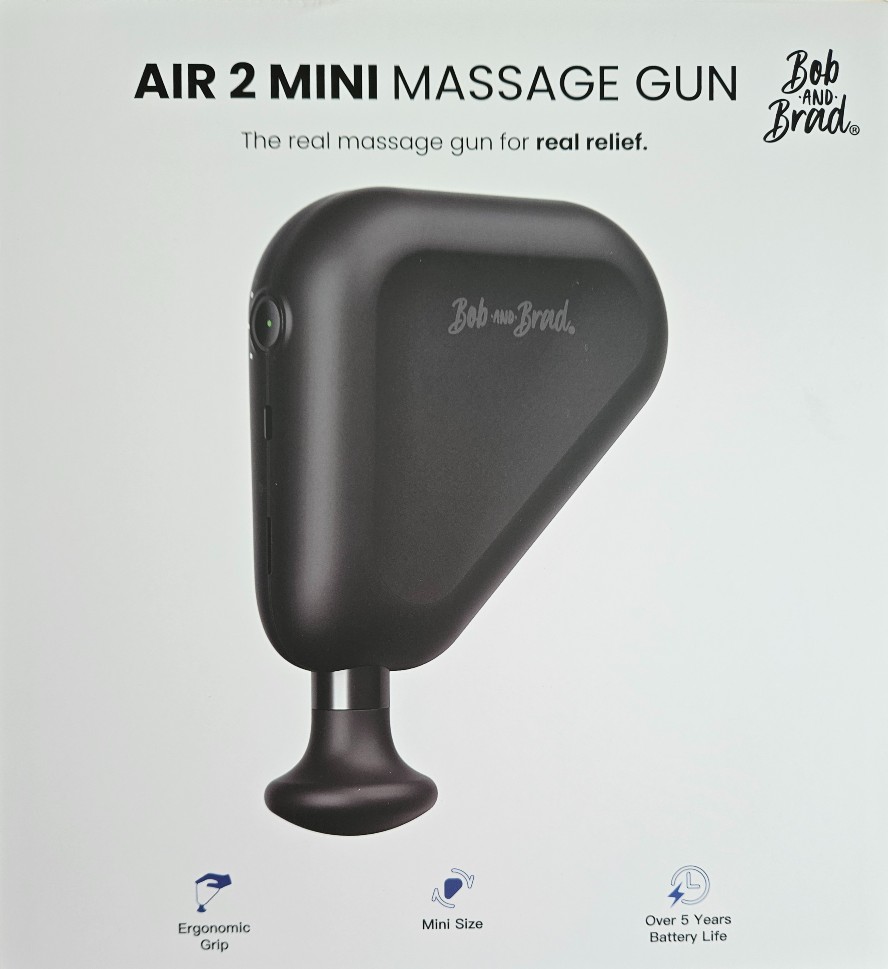
This post contains a review of the compact Air 2 Mini Massage Gun sent to me by Bob and Brad. In addition to my feedback, I have included thoughts provided by a licensed massage therapist.

Introduction

As older athletes, we know that recovery can be slower than when we were younger. Yet we want to train consistently. Tools and techniques that help us prevent injury and recover faster are especially important as we age.

Even though the days of ‘No Pain, No Gain’ are behind us, we may still occasionally experience pain, stiffness, or sore muscles after a workout. Massage guns have become a popular and effective tool for relieving pain and tight muscles.

About Bob and Brad

Bob and Brad is a brand built around two “physical therapists trusted by millions of followers.”

Almost one year ago, I reviewed the C2 Massage Gun from Bob and Brad. Both my wife, Joy, and I found the C2 to be effective in treating a painful area we were dealing with during that time.

In the earlier review, I wrote, “I am confident in their products because I trust these guys.” I trust them even more today, having since watched more videos on the Bob and Brad website.

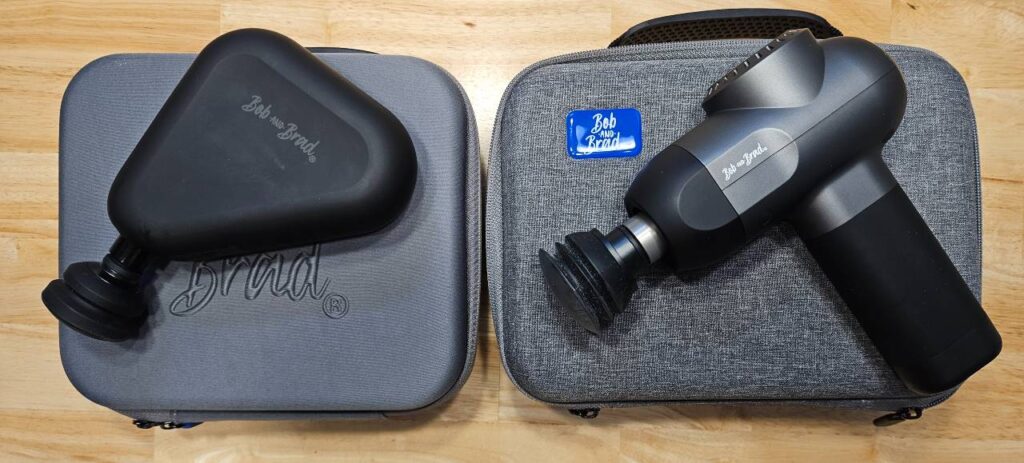
picture comparing the shape and size of the Air 2 Mini and C2 massage guns.
Air 2 Mini (left) and C2 (right) massage guns from Bob and Brad.

What You Get With the Air 2 Mini Massage Gun

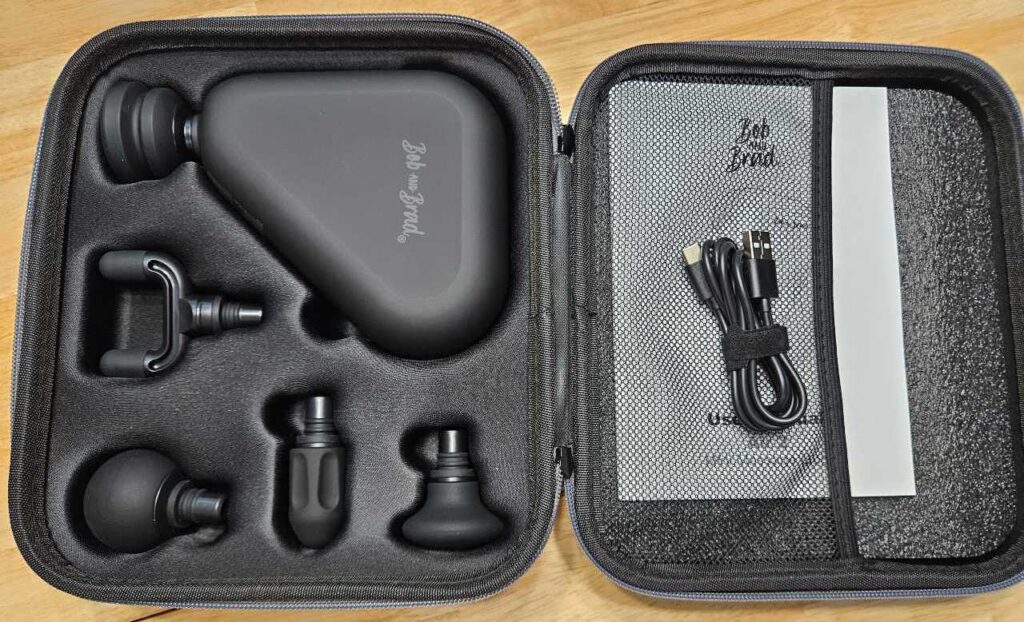
Here is what you will find inside the Air 2 Mini massage gun box:

  • Zippered carrying case with an insert for organizing the massager and its five heads.
  • Air 2 Mini massage gun.
  • Five quick change heads for different applications.
  • USB-C to USB charging cable
  • Extra grommets for quick change heads (2)
  • Manual in English, German, French, Italian, and Spanish languages.

Specifications

The table below shows the main specifications for the Air 2 Mini Massage Gun.

SpecificationWhy It’s ImportantValue for Bob and Brad Air 2 Mini Massage Gun
SpeedAlong with amplitude, speed determines the power of the massage gun. Lower speed is for a lighter duty massage, while higher speed is for a faster or more aggressive one.1750 – 2050 – 2400 rpm (3 speeds)
AmplitudeDetermines the depth of the penetration of the head. The higher this value, the deeper the massaging tool can press into the muscle.12 mm
Stall ForceThis measures the amount of force at which the gun stops vibrating. Stalling is a way the unit protects itself.28 pounds
WeightThe weight of the gun affects how easy it is to hold during use.1.25 pounds with air cushion head
Noise levelThe sound produced by the gun during operation determines if you can use it while talking or listening to others or while listening to TV or other audio or video recordings. The value for this gun is within the normal range of human conversation.not specified, though listed as their quietest massage gun

Why Five Different Heads?

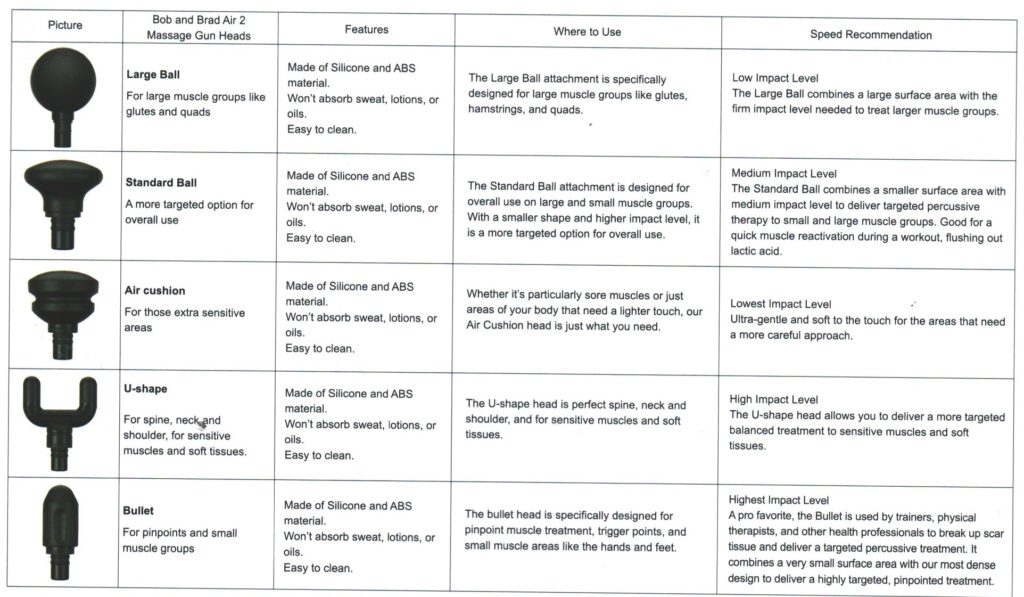
The User Manual included with the Air 2 Mini Massage Gun pictures the five heads and their typical uses. These range from activating muscles before a workout to recovering after exercise and managing chronic pain from injury.

uses of different heads for the Bob and Brad Air 2 Mini massage gun
Page from the Air 2 Mini massage gun User Manual showing uses for different heads.

Our Experience

After opening the Air 2 Mini box earlier in the day, Joy and I took it to a dance where we met friends. One friend, Sheri C., a licensed massage therapist, had not heard of this massage gun. While talking at our table on the dance floor, Sheri started to use it. She seemed to like it. The next day after Joy and I finished golfing with Sheri and her husband, I left the Air 2 Mini with her for more testing.

Following is Sheri’s and my comments on the Air 2 Mini.

A Licensed Massage Therapist’s Review

As a Licensed Massage Therapist, I had the opportunity to try out the Bob & Brad Air 2 Mini Massage Gun, and I must say, it exceeded my expectations. From the moment I picked it up, I found it incredibly easy to hold and maneuver, allowing me to target specific muscle groups with precision.

The pulsing percussive movements offer three levels of strength, but what stood out to me was the versatility. Despite having the option of higher intensities, I personally found the lowest setting to be perfect for my needs. It provided just the right amount of pressure without causing any discomfort.

I primarily used the massage gun on my upper traps and hips, areas that tend to hold a lot of tension, especially after long days of giving massages. As I do not always find time to get a professional massage for myself, I found this to be a great utensil to help with those nagging areas of tight muscles that develop from my work as a Licensed Massage Therapist. The results were truly impressive. My muscles felt relaxed, rejuvenated, and most importantly, not overworked or sore. It’s clear that the device effectively alleviated tension and helped promote recovery.

One of the standout features of the Bob & Brad Air 2 Mini Massage Gun is the inclusion of several adapters, which allows for the targeting of even more specific areas with ease. This level of customization is invaluable in my line of work, as everyone has unique needs.

Additionally, I appreciate the thoughtful design of the device itself. It’s evident that a lot of consideration went into its construction, from the ergonomic design, to the compact carrying case it comes in. The case makes it convenient to transport between clients or while traveling, ensuring that I always have access to relief whenever I need it.

Overall, I believe the Bob & Brad Air 2 Mini Massage Gun is a well-thought-out device that delivers exceptional results. This will definitely become an essential tool for me, to keep me moving when I am not able to obtain a professional massage. I would whole-heartedly recommend it to fellow massage therapists or anyone looking for effective quick relief of tight muscles.

My Thoughts

From its specifications for amplitude and stall force, the Air 2 Mini Massage Gun is a light to medium duty gun. I was able to stall it easily using the air cushion head. Still, I found it to have plenty of power to release tension in stiff muscles.

The Air 2 Mini is compact yet powerful enough to treat stiffness on the go. Since I suffer with stiff upper back muscles while golfing, I took the Air 2 Mini on the golf course. I appreciated the way it relaxed tight muscles while waiting to tee off.

For some cases, like self massaging the upper back muscles, I find the C2 Massage gun easier to hold. But the Air 2 Mini is ideal for carrying in a computer bag, backpack, gym bag, and golf bag.

Want to Order the Air 2 Mini Massage Gun?

If you want to buy the Bob and Brad C2 Massage Gun on Amazon, please use this link: https://amzn.to/3QR6qSn.

If you purchase the Air 2 Mini using this link, I earn a small commission which helps to cover the cost of maintaining this website.

Affiliate Disclosure

How Do You Use a Massage Gun?

What do you use a massage gun for?

What massage gun do you use? How did you choose it? What is the most important specification for you?

Comments: Join the conversation below — Click on “Subscribe” (located above the Comment box) if you’d like to be alerted to replies to your Comment. Even if you do not submit a comment, you may subscribe to be notified when a new comment is published. Please note that I review all comments before they are posted.

Product Review: Bob and Brad C2 Massage Gun

While we were talking about how seniors can adapt general training plans, Coach Kurt Madden reached around and grabbed a massage gun. He told me that a massage gun can help prevent injury by loosening connective tissue.

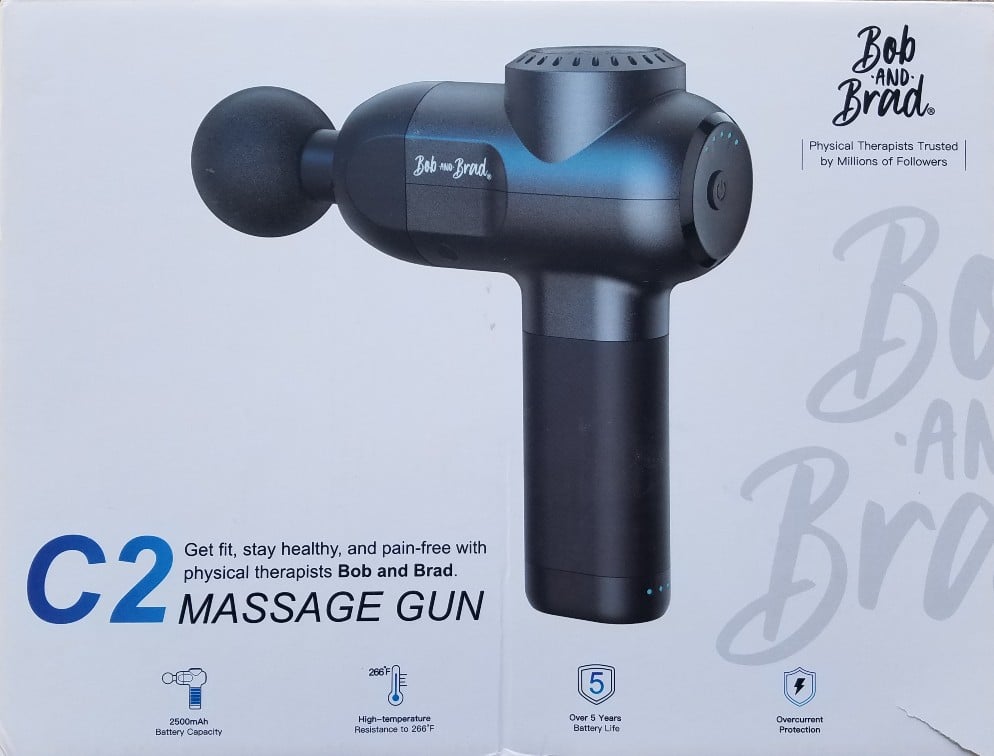
In this post, I share Joy’s and my experience with the C2 Massage Gun sent to me by Bob and Brad. I have also included an unboxing video to show the C2 and what you get with it.

Introduction

As older athletes, we know that recovery can be slower than when we were younger. Yet we want to train consistently. Tools and techniques that help us prevent injury and recover faster are especially important as we age.

Even though the days of ‘No Pain, No Gain’ are behind us, we may still occasionally experience pain, stiffness, or sore muscles after a workout. Massage guns have become a popular and effective tool for relieving pain and tight muscles. However, as I will show in this post, massage guns have other uses for the multi-sport endurance athlete.

What Do You Get With the C2 Massage Gun?

Bob and Brad is a brand built around two “physical therapists trusted by millions of followers.”

The first thing I noticed when I learned about Bob and Brad was the many free resources on their website.

We had purchased another massage gun a couple of months earlier; there were no instructions with it. More recently, our daughter purchased a massage gun. It came with a miniature instruction manual, but little information on how to use the gun.

It impressed me to see the dozens of free programs on the Bob and Brad website. These include instructions for treating various types of pain, including hip, back, knee, and neck pain. One program is focused on treating sciatica.

The Bob and Brad website includes instruction on the Meeks Method for treating osteoporosis. I also found free stretch and strength training videos. And, I haven’t gotten through the entire site.

Unboxing Video

The YouTube video shows the unboxing of the C2 Massage Gun that Bob and Brad sent me to use. You can also click on the picture below to see what’s inside the box.

Specifications

The table below shows the main specifications for the C2 Massage Gun.

SpecificationWhy It’s ImportantValue for Bob and Brad C2 Massage Gun
SpeedAlong with amplitude, speed determines the power of the massage gun. Lower speed is for a lighter duty massage, while higher speed is for a faster or more aggressive one.2000 – 3200 rpm over 5 speeds
AmplitudeDetermines the depth of the penetration of the head. The higher this value, the deeper the massaging tool can press into the muscle.8 mm
Stall ForceThis measures the amount of force that can be applied before the gun stops vibrating. Stalling is a way the unit protects itself.35 pounds
WeightThe weight of the gun affects how easy it is to hold during use.1.5 pounds
Noise levelThe sound produced by the gun during operation determines if you can use it while talking or listening to others or while listening to TV or other audio or video recordings. The value for this gun is within the normal range of human conversation.55 dB

With these values of amplitude and stall force, the C2 is a light to medium duty gun. Yet, in our experience, it has plenty of power to work tense muscles.

What Are Uses For The C2 Massage Gun

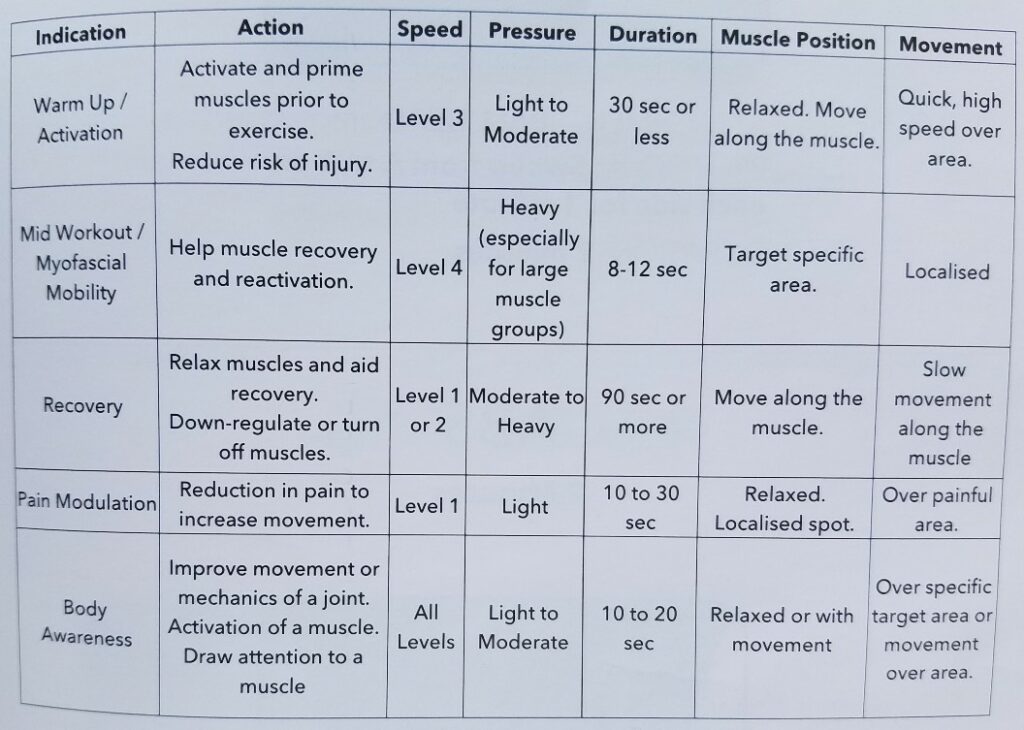
The User Manual included with the C2 Massage Gun shows several of its uses. These range from activating muscles before a workout to recovering after exercise and managing chronic pain from injury.

Picture from a page of the C2 Massage Gun manual showing uses of the product.

Our Experience

In addition to looking at the company behind the product and its specifications, we put the C2 Massage Gun to use on some issues we were having. Following is our initial experience with the product.

Treating Shoulder Joint Pain

My wife, Joy, had been receiving physical therapy (PT) for a sore shoulder. Since we were traveling, she had put the PT on hold.

Upon receiving the C2 massage gun, Joy used it with the round, ball head in the muscles around and underneath her shoulder.

By moving the gun around her arm, she found a tight muscle near her armpit. This muscle had not been addressed in PT.

After lightly massaging this area for a couple of minutes with the gun, her pain was reduced. The pain from the tight muscle was still gone after several days.

Treating a Tingling Shoulder Muscle with Neck Pain

I used the gun to massage the area of my neck that was sore and shoulder that would occasionally become ‘tingly’. The neck pain disappeared after the first two applications. However, my shoulder would still ‘tingle’ from time to time

I found more relief for the shoulder after spending time on the Bob and Brad website and doing a neck stretch they recommend.

Finally, I convinced Joy to massage the stiff muscle area in this shoulder because I was having difficulty applying the needed pressure. She started massaging it using the flat head at speed setting 3, After a while, she replaced the flat head with the bullet (more pointed) head. This allowed her to apply more pressure on the small area that was most tight.

After several applications, the tingling ceased.

Activating Muscles Before a Workout

Doing some hip and core strengthening exercises before going for a run prevents pain during the initial part of a run. For this review, I decided to substitute a session using the C2 Massage Gun for these exercises.

I followed the protocol for ‘Warm Up/Activation’ shown in the picture above. Then, I completed the hip and leg up warmup routine described in this Bob and Brad post.

Following this with a short run convinced me that the warm-up was effective, similar to other pre-run hip, quad, and hamstring stretches I have used,

Our Assessment

While considered light to medium duty, the C2 Massage Gun has plenty of power to work our tight muscles. With the bullet head, we are able to provide more pressure than I have found necessary.

If all Bob and Brad were trying to do was sell products, it is unlikely they would provide so many free resources that require no product. I appreciate their commitment to pain relief.

I am confident in their products because I trust these guys.

Want to Order the C2 Massage Gun?

If you want to buy the Bob and Brad C2 Massage Gun on Amazon, please use this link: https://amzn.to/42q9yaG.

Use Discount Code: BOBBRADG10 for 10% OFF the purchase price,

If you purchase the C2 using this link, I earn a small commission which helps to cover the cost of maintaining this website.

Affiliate Disclosure

How Do You Use a Massage Gun?

For what do you mostly use a massage gun?

What massage gun do you use? How did you choose it? Was there a particular specification you looked for?

Comments: Join the conversation below — Click on “Subscribe” (located above the Comment box) if you’d like to be alerted to replies to your Comment. Even if you do not submit a comment, you may subscribe to be notified when a new comment is published. Please note that I review all comments before they are posted.

error

Enjoy this post? Please spread the word :)