Strength Training for Triathletes: My Experience With Mark Allen’s Approach

This post documents the approach I have used for strength training for triathlon over the past several years. If you’re looking for a complete guide to strength training for triathletes over 50, start here: Strength Training for Senior Endurance Athletes

Credible Endorsements for Strength Training

After competing in sprint triathlons for eight years, my training had become sloppy. I had lost the discipline of the early years. I had nearly stopped strength training, focusing instead on cardio and endurance training. And to top it off, my performance was poorer. I was slower than ever and struggling with knee pain while running.

The article entitled Mark Allen’s 12 Best Strength Exercises jumped out at me as I skimmed my emails one winter morning. Having read about triathlon for over eight years, I knew of Mark Allen and considered him a credible source of information. I became even more interested in the plan once I realized that this strength training plan had also been a turning point for Mark. In the first full season after following this program, Mark won three international multi-sport endurance events, including the IRONMAN World Championship in Kona-Kailua, Hawaii.

A recent example of the benefit of strength training for seniors comes from a 71-year-old who began strength training in her late 60s—proof that it’s never too late to start. You can read more about that story here: At 71, She Got Stronger—What That Means for Triathletes Over 50.

Another testimonial for strength training came from Judy Cole, a 73-year-old ultra runner. Judy had started running every day during her early 30s. However, early on, she had problems with her knees. Following the advice of her running partner to strengthen her quads and hamstrings “became a game changer.”

I had also been struggling with knee pain, something I had not faced for several years. Judy’s experience sounded oh-so-familiar, so I committed to Mark’s plan.

If you’re new to triathlon after 50, this guide on how to start triathlon after 50 will help you take the first step.

Introducing Mark Allen’s Strength Training Program

This post is part introduction to and part journal of my experience with Mark Allen’s strength training program.

The table below lists the twelve exercises in this program along with the triathlon event(s) most impacted by the exercise. While I vary the order in which they are performed, these are the same exercises I do two days per week, except when I do not have access to the equipment.

Mark’s original article includes videos that show how to perform each of them correctly. I urge you to watch the videos before starting the program. And, if you are anything like me, you will find it helpful to watch periodically to make sure your form and breathing are correct.

ExerciseHelps Most With
Lateral Pull-DownSwim
Leg ExtensionRun
Leg CurlBike, Run
Bench PressSwim
SquatBike, Run
Lateral Dumbbell RaiseSwim
Calf RaiseRun
Dumbbell PulloverSwim
Backward LungeRun
Bicep CurlSwim, Bike
Tricep ExtensionSwim
Leg PressBike, Run

Starting with my first time using Mark’s routine, I have recorded the number of repetitions and weights for each exercise in a Google Sheet. I have also noted when I could use a heavier weight in the next session and any pain or soreness I felt during or after the session.

If you would like to follow Mark Allen’s strength training program, comment below or email me at seniortriathletes@gmail.com. I will share the Google Sheet I use to record my results and progress.

Strength Training Modified: Custom Warm-Up

Like most training, warming up the muscles is helpful, and may prevent injury. Over the years, I have varied the warmup,

I now start each session, no matter the Phase, with a series of bodyweight and band exercises that serve as a whole-body warm-up. I began the hip, shoulder, arms, and back exercises through physical therapy, first to address pain in my right glute and later to eliminate upper back spasms.

When done properly, I end this 20-minute period having broken a sweat and feeling loose. The table below provides more detail on this part of what is a 70-minute routine, two days each week.

Warm-Up TargetDetails
HipsAll-4s side leg lift (“fire hydrants”) – 30 each side
Side-lying hip abduction with internal rotation – 30 each side
Side-lying leg lift – 30 each side
Shoulders, Arms, Upper BackShoulder external rotation with scapular retraction – 2 x 15
Shoulder single-arm cross body extension – 2 x 15
Shoulder horizontal abduction – 2 x 15
Standing shoulder row with anchored band resistance – 2 x 15
Shoulder extension with band resistance – 2 x 15
CoreBoat pose – 1 minute
Bridge – 1 minute
Side plank – 1 minute each side
Plank – 1 minute

Related post: ‘At the Core’ – Strength Training to Help Seniors Perform Better and Avoid Injury

After some sessions (depending on time available), I complete another 10–15 minutes of cardio. I finish with static stretches and/or foam rolling of my hamstrings, quads, calves, and upper and lower back.

Periodically, I re-read the original article and watch the videos to make certain I perform each exercise using the correct form and breathing.

exercise  machines
Mark Allen’s strength training program for triathletes involves a mix of exercises that involve free weights, weight machines, dumbbells, and body weight.

Endurance Strength Training – Phase 2

In my initial use of this program, I moved to Phase 2 after a few weeks with the Phase 1. The main difference between these two phases is that Phase 2 involves two sets of 12–15 repetitions of each exercise with 90 seconds rest between sets, rather than one set in Phase 1. As in Phase 1, I completed two sessions per week with at least one day, but usually three days, between them.

During Phase 1, I selected weights for each of the exercises for which I could complete 15 repetitions with good form. For some, I was able to increase the weight slightly during the four weeks.

In transitioning into Phase 2, I used the same weights as at the end of Phase 1. However, in the first two sessions, I completed only 12 (rather than 15) repetitions in each of the two sets (except for squats, for which I completed 15). I did this following the principle of preventing injury by increasing intensity gradually.

Continuing with this principle, I increased the number of repetitions to 15 for the first set in week 2, while the second set still involved 12. In week 3 and beyond of Phase 2, I completed 15 repetitions for both sets.

“Increasing the intensity, time, or type of activity too quickly is one common reason for a sports injury. To prevent this, many fitness experts recommend that both novice and expert athletes follow the ten percent rule, which sets a limit on increases in weekly training. This guideline simply states that you should increase your activity no more than 10 percent per week. That includes distance, intensity, weight lifted, and length of your exercise session.” – Very Well Fit

Lessons from Strength Training for Triathletes

I have learned some important lessons while using this plan:

  • Be patient – the results may seem to come slowly, but they will come.
  • Become familiar with the specific equipment you will use in the program. In addition to watching the videos in Mark Allen’s article, I watched others, especially those working with a personal trainer.
  • Add weight only after a few sessions (minimum two) when the weight feels easy while maintaining good form.
Sample of Google sheet used for tracking progress with my strength training based on Mark Allen’s program for triathletes.

What If You Don’t Have Access to a Gym?

There are many reasons for us not having access to weights or weight machines used in Mark Allen’s program. If you don’t have gym equipment, consider the approaches described by two other sources.

Training for the Run

In a Stryd For the Love of Running webinar, Dr. Jinger Gottschall presented six at-home exercises for a strong core and improved run mechanics.

The six include three bodyweight moves aimed at improving run mechanics:

  • Squats – also useful for bike training.
  • Lunges.
  • Abductor movements using an elastic band.

Dr. Gottschall recommends performing 100 repetitions (50 on each side for lunges and abductors). I have reached 50 reps per session twice per week. If you want more challenge, add weight. If you don’t have free weights, use a water bottle or milk jug. (Water weighs 8.3 lbs per gallon / 1 kg per liter.)

The second part of Jinger’s session includes three core exercises (front plank, side plank, glute bridge). These overlap with the five core exercises (front plank, side plank each side, glute bridge, and boat pose) that I perform.

Training for the Swim

During the 2020 quarantine around COVID-19, I joined Tri Swim Success Online Triathlon Swim Training Program. As part of the membership, I received access to video training with dry-land resistance band exercises for swim fitness.

Let us know in the Comments what alternates to training in the gym with weights and machines you have found.

New to Strength Training?

If you are getting started with triathlon training and/or strength training, here are two must-read posts:

You may be interested in this article from Silver Sneakers with advice on how to begin a strength training program.

Want to take the next step? Choose your path below.

Whether you’re just getting started or looking to improve, here are your next steps:

New to Triathlon?

Start with a step-by-step guide to triathlon after 50 designed specifically for older athletes.

Start Here →

Already Training?

Learn how to train smarter, recover better, and improve performance after 50.

Improve Performance →

What is Your Approach to Strength Training?

Let us know below what you have learned from your strength training? Have you found any “must-do” exercises or targets? Have you found exercises in yoga or other sports to be effective? Please share your thoughts in the Comments below.

Comments: We’d love to hear about your experience. Join the conversation below. All comments are reviewed before they appear.

Reply notifications: Click the bell icon above Post Comment to be notified when someone replies to your comment.

Follow the discussion: Click Subscribe above the comment box and enter your email address to receive notifications whenever a new comment is added—even if you don’t leave a comment. After subscribing, check your email and click Confirm to activate notifications.

This post was first published on March 14, 2019. The latest update was published on August 21, 2025.

Joe Simonetta Brings Home Gold At 2025 National Senior Games

In 2023, I introduced readers to Joe Simonetta, who, at age 80, competed in his first-ever race of any kind—a triathlon, no less—and won gold in his age group at the National Senior Games in Pittsburgh. Read how Joe completed his first-ever triathlon at age 80: My First Race of Any Kind: Triathlon – Joe Simonetta’s Story.

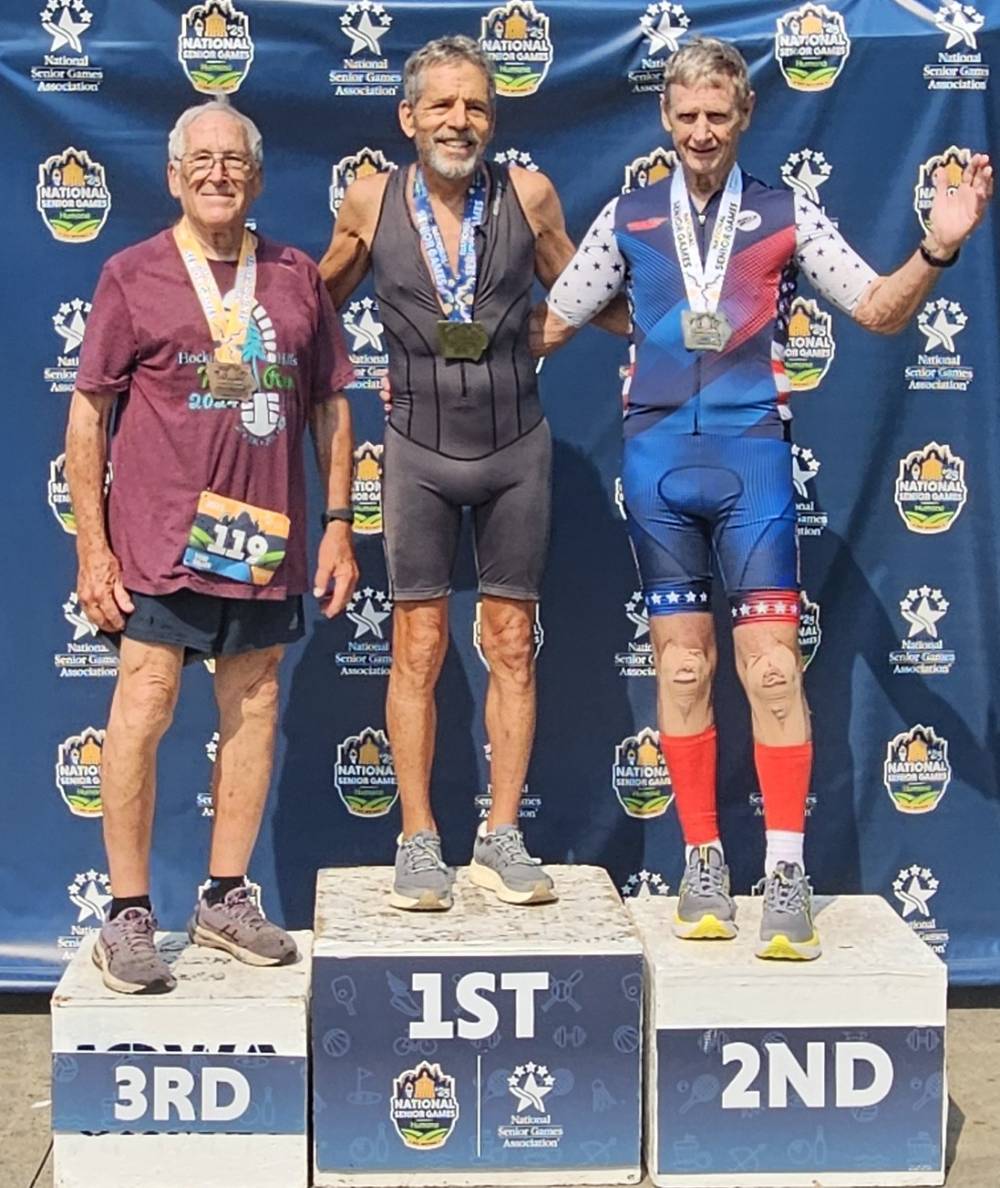
Two years later, Joe returned to the National Senior Games, this time in West Des Moines, Iowa, for the 2025 edition of the triathlon—and once again, he came out on top in the Men’s 80-84 age group.

“I previously won in 2023 in Pittsburgh—so this was a successful title defense,” Joe wrote in an email following the event. While it’s easy to focus on his back-to-back gold medals, Joe’s story is about much more than podium finishes. It’s about the spirit of healthy aging, embracing new adventures later in life, and finding joy in competition and camaraderie.

Joe’s story reflects a growing movement of older adults using endurance sports not just for competition, but for purpose, health, community, and continued personal growth.

Extra Rain Forces Change

The 2025 National Senior Games’ triathlon reminded competitors of the importance of adaptability. Because of the heavy rainfall leading up to the event, the lake used for the swim leg recorded high E. coli levels. This forced race organizers to change the race, replacing the 400-meter swim with a one-mile run on a course separate from the 3.1 mile (5 km) course for the third leg of the triathlon. Fortunately, the organizers adapted quickly, making sure all participants knew the change well in advance so there was no confusion on race morning.

Therefore, the format for this triathlon became:

  • 1-mile (1.6 km) run
  • 12.4-mile (20 km) bike
  • 3.1-mile (5 km) run
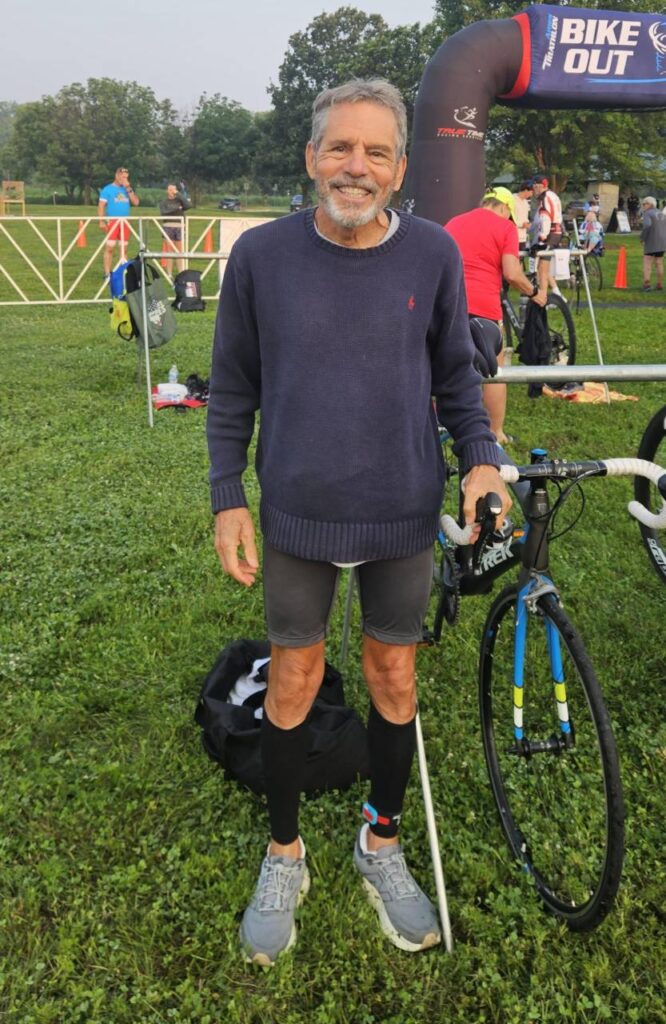
Joe Simonetta awaits the start of the 2025 National Senior Games triathlon.

A Dry Start

Joe came to Des Moines determined to defend his 2023 win. “I had more knowledge and experience this time. I improved my swim stroke and planned to use a wetsuit for the first time.” He had also included more interval work in his run training until calf injuries slowed him down.

He also bought a quality road bike for training and racing—unlike in Pittsburgh, where he rented a less competitive bike. Other changes included racing in a tri suit and using a bib holder race belt to reduce his transition times.

The race began at 7:40 am under clear skies and cool temperatures in the high 50s. Joe described the pre-race atmosphere as calm and friendly, with athletes chatting and volunteers offering encouragement. “There was an undercurrent of excitement as we all knew we’d be starting differently than planned,” he said.

Joe admitted his disappointment at not using his swim training in this race. He was also concerned about the additional running. “Heading into the race, I was concerned about the 5k run because I had been dealing with calf injuries in both legs that had severely limited my run training.” While he had recovered from the injuries using rest, massage gun therapy, magnesium glycinate, compression sleeves, and pickle juice, he ran with greater caution.

Still, the modified format made for an interesting challenge. “It was a fast start that got everyone’s heart rate up right away,” he recalled. Joe said that he ran the 1-mile and the 5k at a conservative pace to avoid a recurrence of injury. After the race, he said that he could have run a bit faster without risking injury.

Hills, Lakes, and Tree-Lined Trails

According to Joe, the bike leg was “hilly and challenging,” featuring several long, gradual climbs that tested endurance, plus a few short, steeper sections that forced competitors to dig deep. “The downhill sections were fast and exhilarating, but you had to stay alert,” he explained. “The course was well-marked and well-monitored by volunteers and law enforcement, which made it feel safe despite the traffic on some stretches.”

The final 5-km run looped around a picturesque lake inside West Des Moines’ Raccoon River Park. Joe described it as a pleasant mix of shaded, tree-lined paths and open sections that offered sweeping lake views. “It was a beautiful setting,” he said, noting that the scenery helped distract him from fatigue during the last miles.

A Competitive But Friendly Race Atmosphere

Joe was quick to highlight the volunteers and organizers, who made the event run smoothly, even with the late change to the racecourse. “Everything was well-organized, and the staff and volunteers were friendly and responsive—both on site and via email before the event. The overall atmosphere was positive and supportive.”

This atmosphere continued throughout the race. Despite the Senior Games triathletes being serious and competitive, they were also friendly. “While everyone was pushing hard during the bike and run, words of encouragement were common.”

Many senior triathletes begin later in life than people realize. If you’re considering your first triathlon, our Start Here guide can help you begin safely and confidently.

A Familiar Rival and a Warm Finish

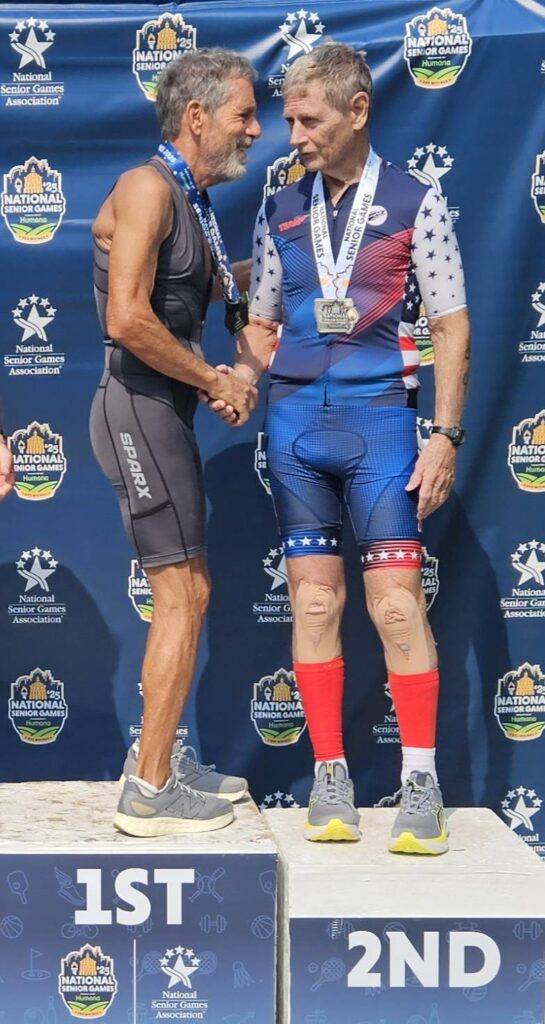
At the awards ceremony, Joe was seen shaking hands with second-place finisher Rob Norris from Michigan—a fellow triathlete with whom he’s now shared three race start lines.

Joe recalled that Rob was also his main competitor in Pittsburgh in 2023. “We’ve developed a friendly rivalry,” Joe said. “Seeing familiar faces out here makes it even more enjoyable.”

Joe Simonetta and Rob Norris share congratulations on finishing the 2025 National Senior Games triathlon.

That handshake wasn’t just a sportsmanlike gesture. It celebrated persistence, sportsmanship, and the connections formed through shared challenges.

A Laid-Back, Hassle-Free Venue

Joe also had high praise for West Des Moines, Iowa, as a host city. “From the easy-to-navigate Des Moines airport, to the excellent bike rental shop, to my hotel and the race venue—all close to one another—it was hassle-free.” Joe characterized West Des Moines as wholesome, open, and relaxed, with lots of green in the hillsides, forests, and cornfields.

“The people I met were friendly, and the pace of life felt more laid-back than in many places.”

Still Inspired

Joe’s performance in 2025 is impressive, but what’s more powerful is the example he continues to set. In his words, “The goal is to keep moving, keep challenging yourself, and enjoy the process.”

Whether you’re 58 or 85, getting started is always worth it. Joe’s first race was at 80. His second gold came at 82.

Joe’s story reminds us that endurance sports are not reserved for youth. New adventures, meaningful goals, and competitive joy can continue well into our 80s and beyond.

To learn more about the National Senior Games and how you can get involved, visit the official NSGA website.

Thinking about trying triathlon later in life? Start with our guide to triathlon after 50.

Were You In Des Moines?

Let us know in the Comments if you attended the 2025 National Senior Games either as a participant, volunteer, or spectator.

Comments: Please note that I review all comments before they are posted. You will be notified by email when your comment is approved. Even if you do not submit a comment, you may subscribe to be notified when a comment is published.

Foam Rolling vs. Massage Gun for Senior Triathletes: Which Recovery Tool Works Best?

by Jim Riley and Terry VanderWert

After publishing an update on my experience with foam rolling, a reader asked for information comparing foam rolling and muscle relaxation using a massage gun. Jim Riley, senior triathlete and co-author for this post, commented on the request. Later, we agreed to collaborate on this post in which we compare foam rolling and massage gun therapy for recovery based on science and our experiences.

Why Recovery Matters More as We Age

Recovery is crucial for senior triathletes. As we age, our muscles demand more attention to maintain flexibility, support training volume, and prevent injuries. Two popular self-massage tools used by older multisport endurance athletes are foam rollers and massage guns.

Is one better than the other? Should you invest in both? Which one fits better into your daily routine? These are the questions we set out to answer.

Where Are You Today?

  • Frequently stiff after workouts → Foam rolling may help more
  • Short on time → Massage gun may fit better
  • Training for longer distances → Consider using both
  • Returning after injury → Prioritize recovery consistency

How These Tools Actually Work

Foam Rolling: The Foundation Method

Foam rolling is a form of self-myofascial release (SMR)—essentially, you’re giving yourself a deep tissue massage. You apply your body weight to a firm roller, then roll back and forth to loosen tight spots or along the length of muscles to work out tension. The advantage over traditional stretching is that foam rolling lets you target tight areas and smaller muscles more effectively and efficiently.

Some newer foam rollers include low-frequency vibration (37 to 67 cycles per second) in addition to the rolling action, though the research on added benefits is still developing.

Massage Guns: Precision Power Tools

Massage guns deliver what researchers call percussive therapy—rapid, repetitive pulses that penetrate deep into tissue, mimicking the tapotement technique used in professional massage. These handheld devices excel at targeting specific pressure points with precision rather than covering broad areas. Advanced models, like Theragun, even combine the percussive action with heat or cold therapy.

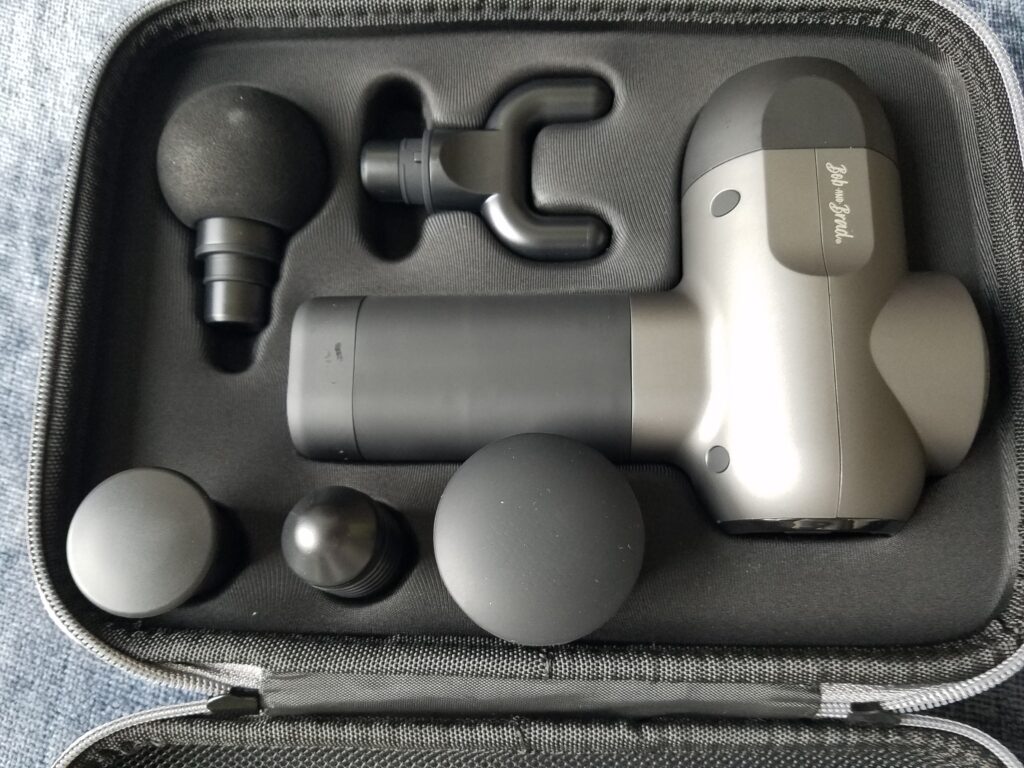
Foam rolling vs. massage gun. Picture shows the Bob and Brad C2 massage gun with its five head options.
Bob and Brad C2 Massage Gun and its five heads for controlling pressure and coverage.

What the Research Actually Shows

We reviewed several studies and comprehensive research reviews to understand what science says about both tools. Click here if you want to go a little deeper into the research finds. In the meantime, here’s what matters most for senior triathletes.

Recovery and Flexibility Benefits

Both tools deliver real benefits for range of motion and muscle stiffness—the areas most important for aging athletes. Multiple large-scale research reviews confirm that both foam rolling and massage guns significantly improve flexibility and help muscles recover between training sessions.

What this means for you: Either tool will help you maintain the flexibility needed for efficient swimming, cycling, and running as you age.

Performance Impact

Here’s where the research gets interesting. Neither tool consistently improves strength or explosive power, but both can enhance your warm-up routine. Studies show foam rolling works best when integrated into pre-workout routines, improving flexibility without hampering performance. Massage guns excel at reducing perceived fatigue and preparing muscles for activity.

What this means for you: Don’t expect either tool to make you faster, but they’ll help you feel more prepared and move better during workouts.

Pain and Soreness Relief

Both tools help reduce muscle soreness and perceived pain, though through different mechanisms. Foam rolling appears to work by improving blood flow and reducing muscle tension. Massage guns seem to interrupt pain signals while promoting circulation in targeted areas.

What this means for you: Both can help you recover faster between training sessions and reduce the nagging aches that come with higher training loads.

Timing Matters

Research consistently shows that timing affects effectiveness:

  • Pre-workout: Both tools improve warm-up effectiveness
  • Post-workout: Foam rolling may have a slight edge for overall recovery
  • Between sets: Massage guns work well for targeted muscle preparation
  • Off days: Gentle foam rolling supports active recovery

Coach’s Rule

Recovery tools only work when recovery becomes routine.

Important Research Limitation

Most studies focus on younger adults, not specifically on triathletes over 50. However, the mechanisms these tools target—muscle stiffness, blood flow, and pain perception—become more important with age, suggesting the benefits may be even greater for senior athletes.

Other Recovery Tools Worth Considering

During our research, we discovered several emerging options that combine elements of both approaches or extend their benefits. These include vibrating foam rollers, heated massage devices, and combination tools that offer both rolling and percussive therapy.

Key Research Findings Summary

✅ Both tools improve flexibility and range of motion
✅ Both reduce muscle soreness and perceived pain
✅ Both enhance warm-up effectiveness
✅ Neither significantly improves strength or power
✅ Both support faster recovery between sessions

How to Get the Most From Foam Rolling and Massage Gun Therapy: Senior Triathletes’ Experiences

While Coach Kurt Madden and I [Terry] were talking about how seniors can adapt general training plans, Kurt noted that a massage gun can help prevent injury by loosening connective tissue. This led to me trying a massage gun provided by Bob and Brad. In Product Review: Bob and Brad C2 Massage Gun, I reported on my wife Joy’s and my experience, with Joy treating her shoulder pain and me treating spasms of a muscle in my upper back.

Here’s what Jim has learned from practical experience:

Massage Gun: Quick Relief When Time is Short

The massage gun excels when you have limited time but need to address muscle pain or tightness. The key insights from Jim’s experience:

Speed control matters: Don’t default to the highest setting. Use just enough speed to stimulate the muscle without causing pain. You want stimulation, not punishment.

Direction technique: Move the gun up and down the length of the muscle, not across it. This follows the muscle fiber direction and feels more natural.

Time efficiency: You’ll be amazed how just one to two minutes of targeted work can make a significant difference. This makes the massage gun perfect for pre-workout preparation or quick relief during busy days.

Foam Rolling: Total Body Recovery System

The foam roller shines as a comprehensive recovery tool that can address your entire body more efficiently than any massage device. For senior triathletes dealing with the cumulative fatigue of longer training sessions, this whole-body approach is invaluable.

Combining techniques: The secret to profound results lies in combining two movements:

  1. Cross-friction: Roll perpendicular to the muscle fibers first
  2. Lengthwise rolling: Then roll up and down the length of the muscle

This two-step approach for each muscle group delivers significantly better results than simple up-and-down rolling alone.

A proven routine: Rebecca Kennedy’s 20-minute foam roller class on Peloton [Try for free] provides an excellent template that makes the technique simple to follow. Doing this routine every evening while watching TV has proven transformative—even after challenging rides like 80 miles with 3,000 feet of elevation gain, morning stiffness becomes virtually non-existent.

Target muscle groups for comprehensive coverage:

  • Back: Focus on the thoracic spine area
  • Lats: Essential for swimmers and cyclists
  • Abductors: Often neglected but crucial for hip stability
  • Calves: Critical for runners and cyclists
  • Glutes: Key for power and injury prevention
  • Quads: Major workhorses for cycling and running
  • Hamstrings: Balance the quad work and support hip function

Daily routine recommendation: Twenty minutes of evening foam rolling while watching television creates a sustainable habit that delivers consistent results. The key is making it routine rather than something you only do when problems arise.

In Summary: The Bottom Line for Senior Triathletes

Here’s how foam rolling and massage guns stack up across key areas that matter to senior triathletes:

Quick Decision Guide

GoalFoam RollingMassage Gun
Large muscle groups✅Covers big areas (quads, hamstrings, calves, glutes) efficiently❌ Small coverage area; time-consuming for large muscles
Target specific knots❌ Less precise pressure control✅ Excellent pinpoint targeting
Pre-workout flexibility✅ Proven to improve range of motion✅ Great for warming up smaller muscles
Deep tissue work⚠️ Limited by body weight and roller hardness✅ Deeper tissue penetration
Daily routine friendly✅ Inexpensive, silent, no batteries required⚠️ Higher initial cost, may be noisy, requires charging
Learning curve⚠️ Requires proper skill✅ Easier to target problem areas
Main variablesFoam hardness, individual weight, surface on which rolling occursHead speed and amplitude, stall force, head design

Choose foam rolling if: You want a cost-effective, quiet tool for daily use that covers large muscle groups efficiently and fits easily into any routine.

Choose a massage gun if: You need precise targeting of problem areas, want deeper tissue penetration, and don’t mind the higher cost and noise.

Choose both if: Your budget allows and you want the most comprehensive recovery toolkit. Use the massage gun for pre-workout preparation and spot treatment, foam rolling for post-workout recovery and daily maintenance.

The science supports both approaches for the recovery challenges that matter most to senior triathletes—maintaining flexibility, reducing soreness, and supporting consistent training. Neither is a magic bullet, but both are valuable tools when used correctly and consistently.

It’s also important to remember that recovery tools work best when paired with consistent sleep, appropriate training load, hydration, and nutrition.

What’s Your Experience?

What more would you like to learn about using foam rolling and massage gun therapy to improve your flexibility and reduce recovery time? Have you tried combining both approaches? Let us know in the Comments below.

Comments: We’d love to hear about your experience. Join the conversation below. All comments are reviewed before they appear.

Reply notifications: Click the bell icon above Post Comment to be notified when someone replies to your comment.

Follow the discussion: Click Subscribe above the comment box and enter your email address to receive notifications whenever a new comment is added—even if you don’t leave a comment. After subscribing, check your email and click Confirm to activate notifications.

Medical Disclaimer

The content on SeniorTriathletes.com is for informational and educational purposes only and is not intended as medical advice, diagnosis, or treatment. Always consult with your physician or a qualified healthcare provider before beginning or modifying any exercise, training, nutrition, or recovery program—especially if you have existing health conditions or concerns.

Participation in triathlon training and related activities involves inherent risks. By using this information, you acknowledge and accept full responsibility for your health and well-being. The author and contributors are not liable for any injuries or health issues that may result from the use of this content.

Science Speaks: Evidence-Based Insights On Foam Rolling vs. Massage Gun Therapy

Science Speaks: Evidence-Based Insights

A search on “foam rolling for endurance athletes” and “massage gun therapy for endurance athletes” reveals hundreds of studies and expert reviews. Meta-analyses are especially common because individual studies often report inconsistent results and have small sample sizes. These tools are widely used in sports and rehab settings, but protocols, target muscles, and outcome measures (e.g., flexibility, pain, or performance) vary greatly. Meta-analyses allow researchers to pool results, improve statistical power, and draw more reliable conclusions. They also help identify best practices and clarify how these tools affect performance and recovery—particularly relevant given the growing use of both foam rollers and massage guns.

Foam Rolling: What the Meta-Analyses Show

A 2020 meta-analysis by Skinner et al. reviewed 32 studies and concluded that foam rolling can increase range of motion (ROM), aid recovery from exercise-induced muscle damage, and does not negatively impact athletic performance. However, except for improvements in ROM, evidence of direct performance benefits was limited. [1]

Another meta-analysis by Wiewelhove et al. (2019) compared pre- and post-exercise foam rolling. The authors found that while effects on performance and recovery were minor and often negligible, foam rolling may still increase sprint performance, flexibility, and reduce muscle pain. They suggested it is best used as a warm-up rather than recovery tool. [2]

Wilke et al. (2020) analyzed 26 trials and confirmed that foam rolling significantly improves acute joint ROM, reinforcing its usefulness as a flexibility-enhancing intervention. [3]

Massage Guns: Insights from Systematic Reviews

Martin (2021) emphasized that percussion massage guns are best used during a warm-up to increase ROM and reduce perceived fatigue without impairing muscle function. He also noted their utility between sets during resistance training. [4]

A 2023 systematic review by Ferreira et al. found that massage guns can improve short-term flexibility, ROM, and perceived recovery but are not effective for improving strength, agility, or explosive movements. [5]

Similarly, Cheatham et al. (2023) confirmed benefits for ROM and stiffness reduction, while Sams et al. (2023) highlighted improvements in musculoskeletal performance and pain reduction. [6][7]

In a 2024 randomized controlled trial, Ahmed et al. compared massage therapy, foam rolling, and stretching. They found that while all three improved ROM, massage therapy led to the greatest improvements, primarily by reducing muscle stiffness and pain perception. [8]

Nevin et al. (2025) also showed percussion therapy was as effective as manual stretching in improving hamstring length. [9]

Summary of Scientific Findings

Across multiple high-quality reviews and trials, both foam rolling and massage gun therapy improve range of motion and help reduce muscle stiffness. The one caveat is that most studies involved younger adults and not specifically on triathletes age 50+.

Foam rolling appears particularly useful when integrated into a warm-up, especially for improving flexibility without harming performance. Massage guns offer rapid, targeted relief, especially for reducing fatigue and enhancing mobility before strength training or competition. While neither tool consistently enhances strength or explosive performance, their roles in recovery and warm-up protocols are well-supported. For older triathletes, both can be valuable—used correctly, they reduce soreness, improve flexibility, and support consistency in training.

References

  1. Skinner, B., et al. “A systematic review and meta-analysis of the effects of foam rolling on range of motion, recovery and markers of athletic performance.” Journal of Bodywork and Movement Therapies 24, no. 3 (2020): 105-122. https://doi.org/10.1016/j.jbmt.2020.02.003
  2. Wiewelhove, T., et al. “A Meta-Analysis of the Effects of Foam Rolling on Performance and Recovery.” Frontiers in Physiology 10 (2019): 376. https://doi.org/10.3389/fphys.2019.00376
  3. Wilke, J., et al. “Acute Effects of Foam Rolling on Range of Motion in Healthy Adults: A Systematic Review with Multilevel Meta-analysis.” Sports Medicine 50, no. 2 (2020): 387-402. https://doi.org/10.1007/s40279-019-01205-7
  4. Martin, J. “A critical evaluation of percussion massage gun devices as a rehabilitation tool focusing on lower limb mobility: A literature review.” OSF Preprints (2021). https://doi.org/10.31236/osf.io/j9ya8
  5. Ferreira, R. M., et al. “The Effects of Massage Guns on Performance and Recovery: A Systematic Review.” Journal of Functional Morphology and Kinesiology 8, no. 3 (2023): 138. https://doi.org/10.3390/jfmk8030138
  6. Cheatham, S. W., et al. “The Effects of Self-Myofascial Release Using a Percussive Massage Device.” Journal of Bodywork and Movement Therapies 32 (2023): 123-129.
  7. Sams, L., et al. “The Effect Of Percussive Therapy On Musculoskeletal Performance And Experiences Of Pain: A Systematic Literature Review.” International Journal of Sports Physical Therapy 18, no. 2 (2023): 309-327. https://doi.org/10.26603/001c.73795
  8. Ahmed, S., et al. “The comparison of the effects of percussive massage therapy, foam rolling and hamstring stretching on flexibility, knee range of motion, and jumping performance in junior athletes: a randomized controlled trial.” Bulletin of Faculty of Physical Therapy 29, no. 44 (2024). https://doi.org/10.1186/s43161-024-00211-9
  9. Nevin, N., et al. “The Comparison of Mechanical Percussion Therapy and Manual Stretching on Hamstring Length.” International Journal of Sports Physical Therapy 20, no. 4 (2025): 553-561. https://doi.org/10.26603/001c.130907
error

Enjoy this post? Please spread the word :)