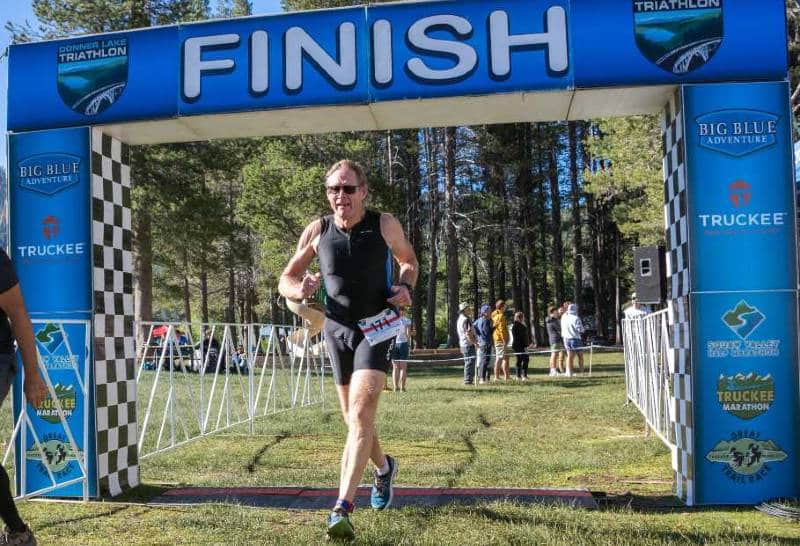
How To Build Confidence For Triathlon

Triathlon is much more enjoyable when we approach it mentally prepared and with confidence.

I’m sure that New York Yankees Hall of Fame catcher Yogi Berra would agree. Undoubtedly, had he been a triathlete, Yogi would have confidently said, “Triathlon is 90 percent mental. The other half is physical.”

Confidence is Part of Mental Toughness

In multi-sport endurance competition, confidence is an athlete’s belief in their ability to perform well and successfully complete the physical and mental challenges of the sport. Confidence includes the self-assurance and positive mindset that carries an athlete into and through the event.

An athlete’s confidence not only affects their performance but also their overall experience. Athletes who approach a race with confidence are more likely to perform at their best. They are ones who push through challenges and derive more satisfaction from their efforts, regardless of the outcome.

In short, confident athletes perform better and have more fun.

Assessing Your Confidence

In The Champion Mindset: An Athlete’s Guide to Mental Toughness, Dr. Joanna Zeiger shares personal lessons about the mental component of sports competition. Beginning from her rocky start as a seven-year-old swimmer, she describes how mental toughness has been key to her experience as an amateur, later professional triathlete who finished fourth in the triathlon at the 2000 Olympic Games.

If you are interested in getting an assessment of your confidence today, take Dr. Zeiger’s free Sisu Survey. Your answers to the questionnaire will be used to measure your confidence and seven more components of mental toughness.

How Can Senior Multi-Sport Endurance Athletes Increase Confidence?

If you want to improve your confidence, here are several ways to accomplish it. Some ways may apply to you, while others may not.

Prepare Physically

This is the belief in one’s physical fitness and training preparation. Athletes who are confident in their physical abilities are more likely to believe they have the stamina, strength, and conditioning to endure the demands of the event. From my experience, consistent, structured training leading up to a race is a real confidence builder.

If, like many triathletes, you have a weaker leg that causes some anxiety before a race, make sure you train to improve it. For example, my weakest leg has always been the run. For this reason, I have spent more time reading about run training and training for the run than on training for the swim and bike. Of course, I regularly swim and bike. However, the time spent running, including after a bike workout, is about twice that spent on the others.

Two keys to getting the most from your physical training are:

  1. Train wisely to avoid injury. Set realistic expectations, increase training stress gradually, get enough quality rest, and eat well.
  2. Keep a training diary or log. Documenting your training progress will build confidence. It may also show when you need to rest or when other things in your life are affecting your training. Remember, your body treats all stress the same. Your total stress on any day is the sum of stress from physical activity, mental tasks, and emotional challenges.

Related Post: Becoming a Confident Open Water Swimmer

Have the Right Attitude

How do you feel about being able to handle the psychological challenges that come with multi-sport endurance events? You can feel more confident when you have set and managed your expectations for the race and learned to manage discomfort, fatigue, and self-doubt.

Thoughts are the most effective weapon in the human arsenal. . . [I]t is powerful to realize that goals are reached primarily by establishing the proper state of mind.

David Miller, AWOL ON THE APPALACHIAN TRAIL

For every one of the community of triathletes over age 50 who train for winning in triathlon, many more train to complete their triathlon. Sure, we all like to win. However, our greater desire is to remain physically active, benefit from the social aspect of the sport, and grow mentally as we learn something new.

According to Experiences of Older Adults Preparing for Their First Triathlon: “A Qualitative Study of the Participation in an Endurance Training Intervention”:

In Scandinavia, there is a general tendency for . . . older adults today to exercise and compete in sports including triathlon. [F]or most active people today, endurance exercising is more about ‘completing’ than ‘competing’.

Weekend-warrior athletes can feel perfectly comfortable setting their primary goal to complete the triathlon.

Plan Your Race

You will be more confident entering a race if you have a clear plan for pacing, nutrition, and hydration. You will also be more confident if you are sure that the gear you will use is in good condition and comfortable. The adage ‘Never use something for the first time on race day’ is solid advice.

Familiarity with the course and its conditions will also boost your confidence. My typical pre-race ritual is to drive the bike course, or better yet have my wife drive, to observe the road conditions (e.g. potholes) and its turns. Then, during the race, I will be more relaxed during the ride.

Confident triathletes are also adaptable. It helps to believe you can handle unexpected challenges that might arise during the race. Training in less-than-ideal weather conditions, which could be present on race day, is one way to increase adaptability. Practice changing a bike tire with a race mindset. You will ride with more confidence.

Related Post: Pros and Cons of Running in the Heat

Raining before a triathlon. Training in inclement conditions, at least ocassionally, can build confidence for completing a triathlon in less-than-ideal weather.
Training in inclement conditions, at least occasionally, can build confidence for completing a triathlon in less-than-ideal weather.

Build on Previous Success

Success breeds success. Past successes in training and in previous races build a foundation of confidence. If you are training for your first triathlon, consider setting up a mock course representing the distance and topography. Complete this course one to two weeks before your first race.

Think hard before signing up for a race on a course with conditions that will work against you being successful. For example, is the course especially hilly but you have trained on flat terrain? Is it at a higher altitude than you live and have trained? Is the weather where the race is being held typically hotter or colder than you are comfortable?

Give yourself an opportunity to be successful under the known or most likely conditions for a race before ‘diving in’.

Related Post: Planning for a Triathlon at Higher Altitude

Within a day or two of completing a race, review its results and your experience, preferably with a friend or coach. Make note of things you did well and those for which you will better prepare for your next race.

Leverage Your Support

Having a strong support network can also enhance a triathlete’s confidence. Knowing you have family, coaches, teammates, and friends who believe in you and are cheering you on adds to one’s confidence.

What Do You Think?

Are you a confident triathlete? If so, what have you learned about confidence in your triathlon journey? What helps you be more confident on race day?

Share your thoughts and comments below.

Comments: Join the conversation below — Click on “Subscribe” (located above the Comment box) if you’d like to be alerted to replies to your Comment. Even if you do not submit a comment, you may subscribe to be notified when a new comment is published. Please note that I review all comments before they are posted.
Affiliate Disclosure

My First Race Of Any Kind – Joe Simonetta’s Story

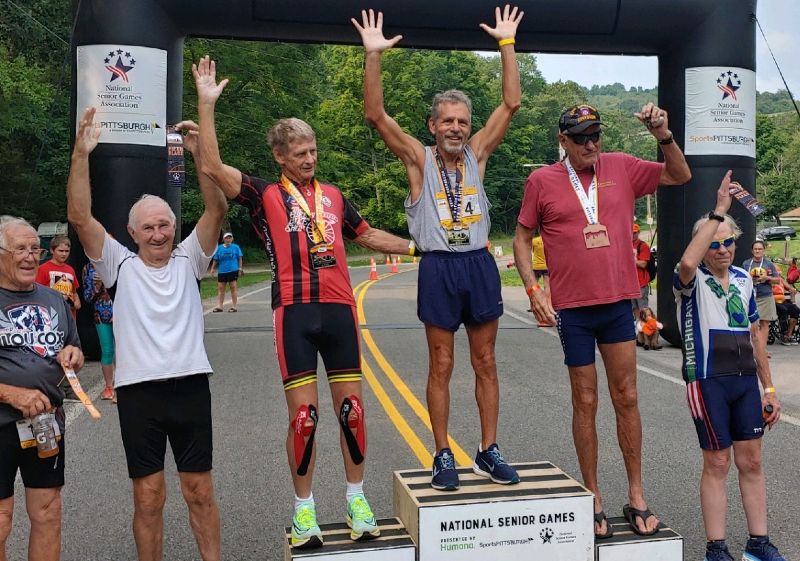
“The National Senior Games triathlon was the first race of any kind in which I competed in all my life,” wrote Joe Simonetta.

How This Post Came About

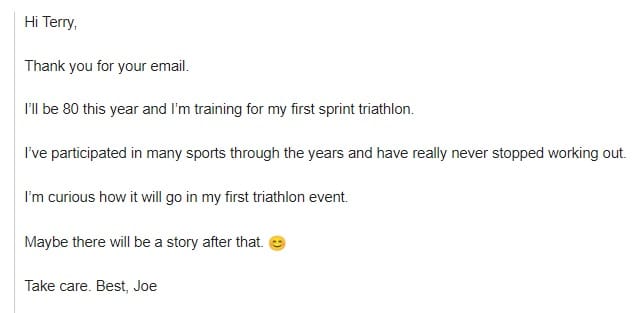
Earlier this year, I received an email from Joe Simonetta, from Sarasota, Florida. He was responding to the ‘welcome email’ sent to new subscribers of the Senior Triathletes Highlights newsletter. This email invites them to contact me if they would be interested in having their triathlon story published.

I later learned that Joe’s first triathlon was at the 2023 U.S. National Senior Games held in Pittsburgh, Pennsylvania, on Tuesday, July 18th.

How did Joe prepare for his first triathlon? What did he learn in his first race, a sprint triathlon?

No Stranger to Competitive Sports

Joe has led an active life and is an experienced competitor, despite completing his first triathlon a month ago.

“I’ve never stopped working out and playing sports. I have a comprehensive workout routine. And I have learned a lot about nutrition and have practiced a healthy lifestyle for many years.”

From his college days until today, Joe has a long list of accomplishments.

While attending Penn State, Joe lettered in soccer and tennis. He also competed in inter-fraternity football, basketball, wrestling, swimming, volleyball, and racquetball. He won the Penn State racquetball championship twice.

In the early 1970s, Joe was a USPTA (United States Professional Tennis Association) professional. During this time, he also quarterbacked a flag football team in Sarasota. The team won their league championship three consecutive years.

In 1979, Joe won the Colorado racquetball tournament for the 35 and over group while studying for a master’s degree in architecture at the University of Colorado.

After graduation, he continued to play racquet sports, swam, played volleyball, and lifted weights. During 2005 through 2014, Joe worked on a real estate project in the Andes Mountains in southern Ecuador.

During this time, he played Ecuadorian volleyball, aka Ecua-volley. This game is a variant of international volleyball that involves three players on each team, a higher net, and heavier ball.

Back in Sarasota, Joe continued with racquetball and swimming. However, in 2020, he gave up racquetball and returned to running; earlier, he had regularly run six miles a day.

Getting Ready For His First Race at the Senior Games Triathlon

During the fall of 2022, Joe started looking at the swim, bike, and run times for past triathlons on the National Senior Games Association (NSGA) website. He thought he could compete with others in his age group, men 80 to 84. With this in mind, he registered for the triathlon at the 2023 National Senior Games.

For reasons still not known, NSGA officials opened registration for triathlon to everyone. Competitors did not have to qualify for triathlon at one of the state games. In this way, Joe could compete in triathlon at the National Senior Games without ever having completed a triathlon.

By that time, Joe was running a 5k three to four times per week. He was also swimming regularly, though not as frequently as he was running.

In early December, after deciding to compete in the National Senior Games triathlon, Joe began bike training.

He started by dusting off a used Cannondale road bike he had purchased seven years earlier.

He then laid out a 3.1 mile course in the community where he, his wife, and their two children (a son, age 10, and a daughter 7) live. This course, complete with eight cul de sacs, became his training course for the bike and run legs of the triathlon. Training for the triathlon swim took place in the family’s 44 by 18 foot pool.

Joe supplemented the swim-bike-run training with lifting weights, jumping rope, and hitting a speed bag in his garage. In addition, upon awakening each morning, he did core, range of motion, and balancing exercises.

What Joe Learned During the Triathlon

“When I showed up on race day, I knew these guys had been doing triathlon for many years,” Joe told me.

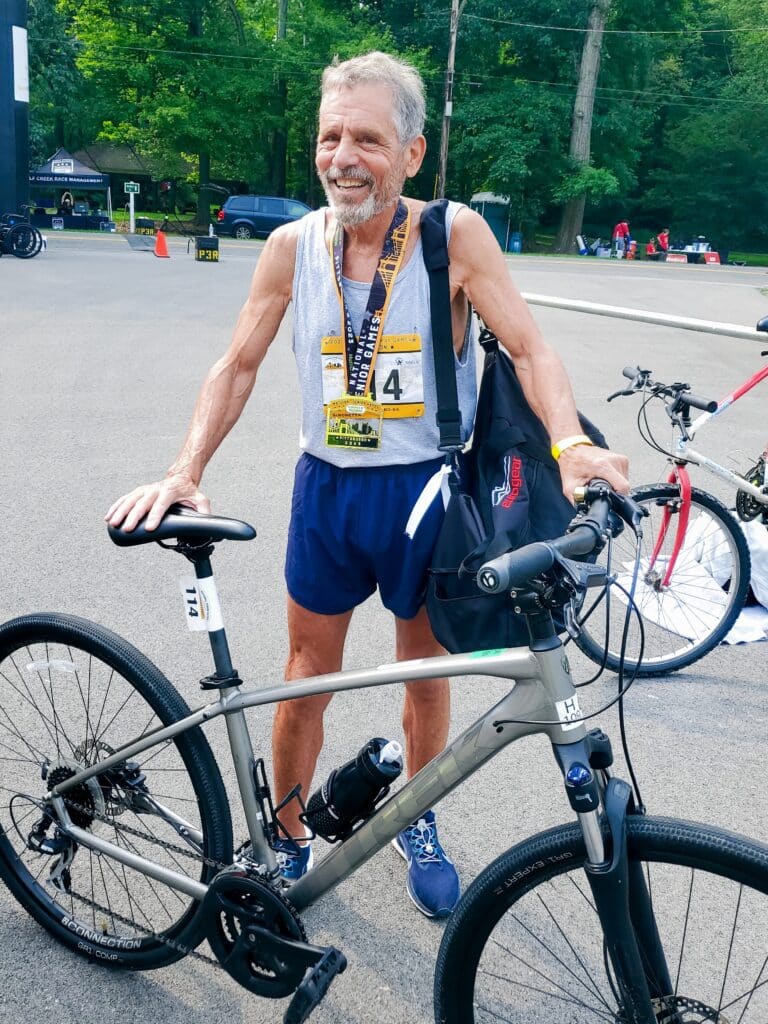
“Most triathletes have expensive bikes and gear, including special clothes, bike shoes, wetsuits, watches, and so forth. I showed up in a pair of running shorts, inexpensive running shoes, and a rented bike I had picked up in downtown Pittsburgh. The other competitors laughed. in a friendly way, that I had a bike with a kickstand.”

Joe Simonetta with his rented bike for the 2023 National Senior Games triathlon.
Joe Simonetta used a rented bike, complete with kickstand, for the 2023 National Senior Games triathlon.

Here is what Joe said about his experience in his first triathlon.

“The one mistake I made was in the swim leg. Normally, the quarter of a mile swim—and far more—would be very easy for me. However, today, I tried to keep up with guys in my wave (age 65-84) who were much younger than me. Because I was going faster than my normal pace, I couldn’t breathe. I struggled and had a horrible time for the swim. I was one of the last to finish. It was a terrible rookie error that I could have avoided easily.

“At that point, I figured there was no way I was going to win the triathlon or even place.

“However, I came back strong on the bike and run. I overtook all the guys in my age group who were ahead of me and finished first to win the gold medal. You can see my times on the NSGA website.

“The guys in the triathlon, all very nice, were shocked that I won my first race.”

What Next?

From what he learned in his first race, Joe is confident he can do far better in his next triathlon.

Look for him at the City Island Triathlon in Sarasota on October 8, 2023.

Comments

I also did my first triathlon using a bike with a kickstand. It was also where I first saw a tri-bike.

Tell us about a ‘rookie mistake’ you made in your first triathlon. How about the most important lesson you learned in your first race?

Comments: Join the conversation below — Click on “Subscribe” (located above the Comment box) if you’d like to be alerted to replies to your Comment. Even if you do not submit a comment, you may subscribe to be notified when a new comment is published. Please note that I review all comments before they are posted.
Restarting To Bike After A Crash

A bike crash, whether it involves another vehicle or not, can be traumatizing, It can end one’s triathlon career even if the physical wounds heal.

This post is meant to answer a question from a member of the Senior Triathletes community about restarting to bike after an accident with injury.

Restarting to Bike After a Crash Can Be Physical and Emotional

One of Our Community members, Marty Hunter, knows too well how devastating a bike crash can be. She wrote the following when I asked our readers to share topics about which they would like to learn:

“[I am e]xperiencing difficulties recovering from a bike accident. Wondering what other athletes did to cope.”

Here is the background.

Training for Ironman Arizona in 2021, Marty fell on her bike while clipped into the pedals. A femur was broken in the fall, After surgery to repair it, she went through a period of walking with a cane and through many physical therapy appointments.

Even after healing physically, Marty has not recovered emotionally. She has ridden on a trainer but struggled to ride her bike outdoors on roads or trails. She told me “mentally, I’m mush”.

I am rooting for Marty to realize her dream of completing Ironman Arizona. So, I tapped into the experiences of others in our community who have been through this process of recovering from a bike crash. I am hoping their advice will help Marty return to training and racing.

Advice from Coach Jenn Reinhart

The first one to offer help was Senior Triathletes coach Jenn Reinhart. She is familiar with recovering from a bike crash having experienced a few, including being hit by a car, during her triathlon career.

Jenn and Marty spoke, after which Marty shared what she had learned from Jenn.

“Jenn found the right words to cut through my anxiety, especially my fear of being too old [to pursue my Ironman goal]. I tend to look way-way too far ahead instead of celebrating smaller but no less significant triumphs. 140.6 miles [of the Ironman] is huge. However, an 800 yard swim, 25 mile ride, and three to six mile run are totally doable. Each of these is great on it’s own. Being able to thread them together will be a mental podium finish for me.

“The basics are what I need to return to. Just get on the bike without any pressure for distance or pace at this time. Get confidence back for clipping [biking shoes] in and out. Eventually get the legs ready for power drills on the trainer.”

Advice from Other Senior Triathletes

I also spoke with two senior triathletes, Donna Maquire and Gene Peters. Both are Ironman finishers and have been injured in a bike crash.

Donna Maquire

During a triathlon in 2022, an impatient driver decided to turn when he should have waited. Because the bike course made a left turn, Donna was slowing down. These two factors – the car moving at a still low speed while accelerating from a stop and bikers slowing down for the turn – led to Donna ‘bouncing off’ the car’s side.

While her bike was undamaged, her back was fractured in three places. This was the beginning of nearly a year of back-pain as the back bones mended and aggravated discs were treated.

Within a couple of weeks of the accident, Donna was able to ride inside on the trainer. Four months after the crash, she did her first ride outside. This ride was not long and in her neighborhood where traffic is light and slow. She has continued to ride longer as time went by.

Given her experience following the crash, she does most of her training rides on a relatively flat trail near her home. She still struggles with pain when riding on hills.

Donna’s advice for Marty is to get back on a bike or trainer. When outside, never ride alone and always stay alert for cars. She uses a rear view mirror mounted on her glasses and a Garmin Varia radar that detects traffic from behind her.

She added, “Go slow. Increase the distance you ride a little at a time. And, be patient. As you ride more, you can expect your fitness and confidence to improve.”

Gene Peters

Gene Peters (look for his story here soon) told me of his experience while on his first ride after moving to Park City, Utah. During this ride, he collided with a car. In the accident, his back was broken in two places.

How did he get back to riding after healing?

The first time out after recovering, Gene rode less than six miles, enough to get comfortable riding.

Gene says that he is always concerned about cars, but realizes that there are some times when you can’t avoid riding with them around. This is another reason he does a lot of this bike training on the Computrainer his wife bought for him.

My Experience With Clip-In Shoes

I have not been in a serious accident with my bike. However, I have fallen twice during races, once because I was clipped in the pedals and unable to unclip quickly enough.

My first fall, at my Rhode Island triathlon, occurred because of a flat front tire.

I fell a second time, at a triathlon in Arkansas. This time, the fall was because I was not able to unclip my shoes quickly enough after the chain came off and jammed between the wheel and sprocket.

Interestingly, upon returning to the transition area after the bike leg of this triathlon, I saw another racer use traditional pedals with a toe cage (not clip-in) with his triathlon bike. I followed this example for the next several triathlons.

Besides making it easier to get in and out of the pedals, this configuration eliminates time in T2 to put on running shoes.

One qualifier: I am not sure this is valid for longer distance races. However, it can be helpful for restarting to bike after a crash.

Conclusions

A bike crash, especially one with an injury, can produce a major setback in one’s triathlon training. However, in most cases, it need not be career ending.

The concensus among other senior triathletes for restarting biking after a crash is to begin by getting on the bike for short rides. Ride in a safe area. And, if appropriate, use equipment that makes you feel safe, such as pedals and normal running shoes instead of clip-in shoes and pedals.

While you are regaining confidence riding outdoors, build your biking endurance using a bike trainer or stationary bike. Eventually, you will be able to put the bike handling and bike fitness pieces together.

Comments

What advice do you have for restarting to bike after a crash? Share your comment below.

Comments: Join the conversation below — Click on “Subscribe” (located above the Comment box) if you’d like to be alerted to replies to your Comment. Even if you do not submit a comment, you may subscribe to be notified when a new comment is published. Please note that I review all comments before they are posted.
America’s Marathon Man Leads Change For Senior Triathletes

A few weeks ago, I received an email from Jerry Dunn. In the message, he described his latest project, one benefiting senior triathletes.

What surprised me was seeing the place from which he had sent the message, Rapid City, South Dakota. Why? Because Joy and I had just returned from a short trip to Rapid City and Hot Springs, South Dakota, for a couple of days at the Angostura Reservoir with Joy’s cousin. You will read more about Angostura Reservoir later in this post.

Meet Jerry Dunn, America’s Marathon Man

According to his Wikipedia page, Jerry became hooked on running at age 29, after running along the beach near Sarasota, Florida with a lifeguard friend. He completed his first marathon in 1981. Over the next twelve years, he completed ever increasing goals for running distance and frequency.

In 1993, Los Angeles Times sports writer Jim Murray dubbed Jerry Dunn ‘America’s Marathon Man’. This came after Jerry set a world record by completing 104 marathons that year.

Then, at age 50, Jerry ran the official Boston Marathon course on 26 consecutive mornings.  The 26th morning was for ‘The Run of the Century’, the 100th running of The Boston Marathon.  He told one reporter that he ran these marathons to encourage others to “stay healthy and stay fit.”

“Don’t limit your challenges; challenge your limits.”

Jerry Dunn

Not stopping here, in the year 2000, Jerry completed 186 of an attempted 200 marathons, all on certified marathon courses. On his 60th birthday, he ran 60 miles. This was followed by running 65 miles on his 65th birthday. 

This year, to celebrate his 77th birthday, Jerry biked the full length of the Ecuadorian Pacific coast. He also rode across South Dakota during RASDAK.

Jerry as Endurance Event Organizer

Jerry’s love for running and his desire to see others lead healthy, active lives shows in other ways. In 2002, he created, promoted and directed the Deadwood Mickelson Trail Marathon. This was followed in 2005, by the Lean Horse 100. Both races take place in the Black Hills of western South Dakota.

Through Jerry’s leadership, these races open the competition to a greater number of people seeking to stay active. Changes include a longer than normal cutoff time for walkers and slower runners. He also added age group categories for older competitors.

In addition to benefiting their participants, these races have raised money for causes, including Habitat for Humanity and Special Olympics.

Related post: How A Wisconsin Triathlon Benefits Kids In The Caribbean

Jerry Dunn, America’s Marathon Man, has left his mark on endurance racing by creating competitions that encourage older athletes to stay active.

Joining the Triathlon Community as a Senior Triathlete

In September 2022, Jerry joined friends Paulette and Bob as a relay team at the 25th Anniversary Southern Hills Triathlon at Angostura Reservoir outside Hot Springs, South Dakota.

After the race, Jerry said, “Paulette, Bob and I had agreed that we were just going to ‘have fun’. And, we did. However, we’re also all still somewhat competitive, just not against the youngsters whose combined ages were 100 to150”. The combined ages of Jerry’s team, called Team PBJ, was 221.

Jerry contacted Brendan Murphy, race director for the Southern Hills Triathlon. He suggested a never-before-heard-of age category for the Olympic distance team relay, the 200 and over age group.

With Jerry’s success as the creator and race director of the Deadwood Mickelson Trail Marathon, Brendan agreed. The 2023 Southern Hills Triathlon will be the first to include a 200+ age group for the Olympic Relay competition.

Go here for more infomation about or to register for the 2023 Southern Hills Triathlon.

Comments

Leave your questions or comments for Jerry Dunn below.

Comments: Join the conversation below — Click on “Subscribe” (located above the Comment box) if you’d like to be alerted to replies to your Comment. Even if you do not submit a comment, you may subscribe to be notified when a new comment is published. Please note that I review all comments before they are posted.
error

Enjoy this post? Please spread the word :)