The Road to Ironman Triathlon – Laurent Labbe’s Story
At age 57, senior triathlete Laurent Labbe continues to prove both to himself and others that he is young in heart and body by competing in Ironman triathlons.

But there is more to his story than a personal enjoyment of endurance sports. Laurent has found a way to engage his family, using triathlon to build relationships with his children by training and participating in races with them. See Reason 3 of “15 Reasons for Those 50 and Older to Do Triathlons“.

It Started With Swimming and Biking In The Alps

As a child growing up in France, Laurent Labbe developed a love for the outdoors and for swimming through holidays and vacations with his family in the Alps and central mountains of his home country.

In his early 20’s, he was introduced to mountain biking. His attraction to mountain biking led to rides in many countries throughout Europe, including France, Germany, Hungary, Poland, Wales, Ireland, Scotland, and Belgium.

Then in his 30’s, Laurent began running. In addition to enjoying endurance sports, he found it easier to run than bike while traveling around the world for work. This led to him completing the Paris marathon twice.

“The best run of my life” came as part of a work-related team building exercise in the Gobi desert. One of the activities involved walking more than 30 km (18.6 mile) each day during three days. On the last day, Laurent decided to run, instead of walk, in the desert. Starting at 5 am, he completed a 22 km (13.7 mile) run with a GPS and headlight to guide him in the pre-dawn.

“Running across the dunes in the fresh air and with the sun rising was magic, so beautiful”. 

Transition to Endurance Multisport

During this time, he also connected with a group at work who competed in races involving biking, running, and kayaking; one form of triathlon today.

In 2011, Laurent and a friend participated in the King of Grassland race in Inner Mongolia. This three-day endurance race was across grassy hills and fields populated with herds of sheep and horses and consisted of:

  • Day 1: 60 km (37.3 mile) mountain bike,
  • Day 2: Full running marathon (42 km/26.2 miles) in the morning and 45 km (28 mile) mountain bike in the afternoon,
  • Day 3: 100 km (62 mile) mountain bike.

Laurent described this race as an “exhausting but amazing experience”. In fact, they completed this race two more times in the following years. However, when King of Grassland was canceled during years of drought, Laurent and his friend decided to look for another race.
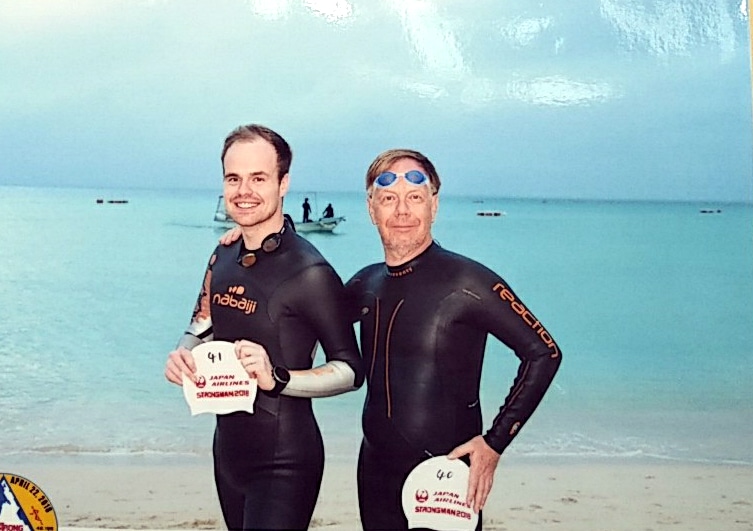
Laurent Labbe and his oldest son on the beach in front of the swim course at the Strongman All Japan Triathlon.
Laurent Labbe and his oldest son on the beach in front of the swim course at the Strongman All Japan Triathlon. Picture courtesy of Laurent Labbe.

Discovering Ironman

His friend finally convinced him to register for the 2017 IRONMAN 70.3 Taiwan half Ironman held in March. It was time for another bike – a carbon fiber road bike.

Training for the race, especially for the bike leg, was a challenge. During this period, he was living and working in Shenzhen, China, a city of 13 million. He used the commute to bike to and from the office ‘rain or shine’, somehow managing to survive the horrendous traffic, heat, and pollution.

“You cannot imagine how dangerous it can be biking 22 km per day in a city like Shenzhen.”

His training for this triathlon proved to be effective, remembering that the bike ride went well. Sadly, however, during the run he mistakenly forgot one of the three loops that made up the run. The DNF (did not finish) was frustrating, especially after the months of training.

“I was so upset that I missed the last 4 km of the run and received the DNF. I decided to run the final 4 km in the rain, just to be able to say I had completed the distance.”
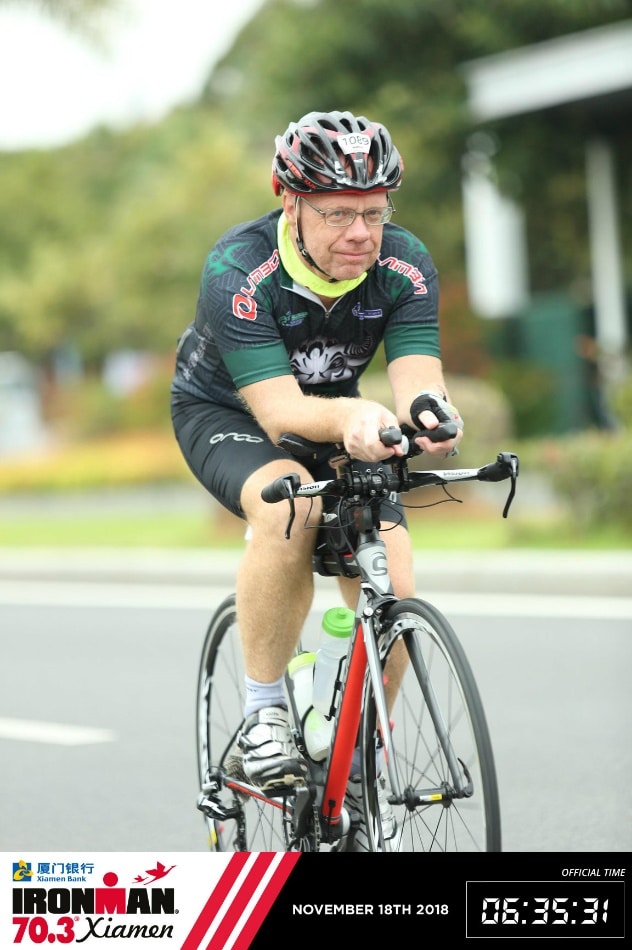
Laurent Labbe on the bike at Ironman 70.3 Xiamen, China
Laurent Labbe at Ironman 70.3 Xiamen. Picture courtesy of Laurent Labbe.

“Overall, I like the challenge [of long course triathlon]. Doing Ironman is magic and it was a new experience. I’m not young anymore but I like to try to do new things.”

Laurent Labbe

A Family Affair

With this experience in long course triathlon, Laurent was hooked.

To illustrate just how much he was smitten by this new challenge, Laurent completed Ironman 70.3 Bintan in Indonesia (August 2017), Ironman 70.3 Thailand (November 2017), Ironman Colombo in Sri Lanka (February 2018), and The Strongman All Japan Triathlon in Miyako-jima (April 2018) – four Ironman distance races within a year.

It was also during this period that Laurent involved two of his sons. His then seven-year-old son competed in the IronKid event that was part of the Colombo, Sri Lanka half Ironman. Then, his oldest son, age 30 at the time, joined him in the Japan race.

To top it off, his daughter was in Japan to cheer on her father and brother. She also caught the ‘triathlon bug’ and shortly thereafter began to train for her first triathlon.

Laurent acknowledges that he is “very lucky to have a wife who supports all of this travel, cheering me on and helping wherever possible”.

Favorite Ironman Triathlons

The races involving his sons have been his favorite so far.

Of the Strongman All Japan Triathlon held on a small island called Miyako-Jima, Laurent noted “I never saw a race with so many people along the road encouraging racers. I think every inhabitant of the island – young kids, school-age kids, old people, disabled people, hospital people, everyone – was on the road from the first competitor to the last one. The course was beautiful and challenging, especially for the bike. And, the organization and volunteers were exceptional.”

Ironman 70.3 Bintan was second favorite, again because of the venue – biking around the island and a beautiful run around the lake – and his younger son taking part in the kid’s race.
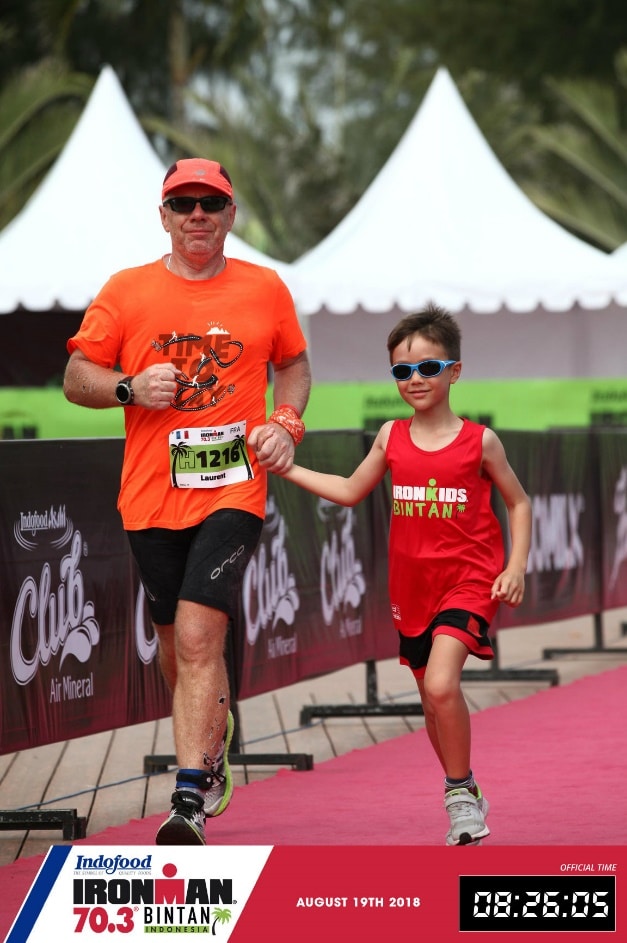
Laurent Labbe and son on the final dash to the finish line at Ironman 70.3 Bintan, Indonesia
Laurent Labbe and son on the final dash to the finish line at Ironman 70.3 Bintan. Picture courtesy of Laurent Labbe.

“Sport is good, for the body and also for the family.”

Laurent Labbe

Lessons for Ironman Triathlon

Laurent has learned some valuable lessons for others in our age group who may be interested in long course triathlon.

Training

  • Sign up for a race. There is nothing like it to motivate you to train.
  • Train seriously. Laurent trains as much as possible, using many opportunities (going to work; family outings; skipping lunch breaks) and always, ALWAYS with a heart rate monitor. Laurent says “The heart is our motor. I believe we need to listen to its rate, not staying too long in the ‘red zone’ (high rate) and train to make it stronger and more efficient in the endurance zone”. (Look for a future article on triathlon training, including with a heart rate monitor, especially for those age 50+.)
  • Do not force yourself or train beyond your limits.

“We need to take care of our body after age 50. I want to continue for at least another 15 years.”

Laurent Labbe
  • Train – and race – with a friend. Friends will push and give advice to each other.
  • Restart training almost immediately after, even the day after, the race. “If we stop training, we go backward. It also helps to have another race in sight.”

Triathlon Gear

  • Find the right shoes, the right ones for your body and running mechanics.
  • Properly fitting bike – any road bike can be used but aerobars can really help by making the ride more comfortable. Most important is to have the right bike ‘fit’ (settings of the seat, handlebars, aerobars, etc.) to avoid back or knee pain. Although, if pain does occur after the triathlon in any areas of your body, you can always try certain products to help counteract this. For example, one may look up how to roll a joint without papers for a more effective and efficient way to consume this pain relief product, but there is plenty to look into in order to see which treatment would be best for your condition. Either way, always ensure you fit your bike properly and wear the right gear to avoid this.

Racing

  • During the race, find a balance between pleasure, effort, and pain. Laurent recalls several times during the swim looking at the fish in the water and thinking how fortunate he is to be able to do such things. Enjoy each moment. Feel free to take time to shoot some pictures.
  • Race to finish. “There is no shame in stopping and walking during the run or even the bike if it becomes too hard. Remember that our goal is to finish a race, which is far more than 90% (or more) of people in our age range are able to do.
  • Be prepared to repair a flat tire. “Flat tires happen sometimes. On one race, it’s happened twice to me. Twice, because in the hurry, I replaced the bad one with a bad one. Fortunately, I had a good one in my pocket.”
  • Don’t rush the transitions (this is especially relevant to Ironman triathlons). “Keep cool during the transition. There is no need to rush. The effort on the legs during the swim and bike is so great that the legs can easily cramp. The best way I found to avoid cramps is to go slowly. Remove the wetsuit smoothly and put on the running shoes smoothly. And, be sure there is not a single stone in the socks.” 

Eating and Drinking During the Triathlon

  • Avoid drinking or eating food you don’t know during the race. Focus on water and your own food. Laurent indicated that he has become sick from bad drink or food before and during races.
  • “I learned from Chinese people to avoid drinking cold or ice-cold liquids, instead taking drinks at ambient (or ‘room’) temperature. These are better assimilated than ice cold drinks. For example, during a race in Dubai it was impossible to get ambient temperature water and I had a lot of stomach pain from drinking only cold water.”

After the Race

  • Always spend time after the race to think about the race. Identify the good, bad, and how to improve next time.

One More Thing

  • A healthy lifestyle is key. Laurent does not smoke or drink alcohol. With the help of his wife, he is also careful about the food he eats. “My Chinese wife is very picky on the balance of vegetable, fish, amount of oil. And, we never eat fast food.”

Just Getting Started

This year, Laurent will compete in Ironman Vietnam and the Ironman Championship in Nice, France with his oldest son. Before his first race, Laurent will be training with a younger son (8) for a kid’s triathlon in Hong Kong. And, during this time, Laurent’s oldest daughter (28) will finish her first triathlon in France.

He is also looking for a way to better connect with other senior triathletes in Hong Kong (where he is currently living) and the surrounding region to share experiences and maybe even train together.

Watch for Laurent to be competing in triathlon for many years to come, including ones in the USA, Australia, and New Zealand.

Meanwhile, also be on the lookout for his children to appear in more races as the next generation builds on their father’s passion for triathlon. In fact, Laurent is looking forward to completing a triathlon together with all five of his children.

Questions? Comments?

Include your questions or comments below or send them to seniortriathletes@gmail.com.
Meanwhile, You May Also Be Interested in These Posts

Favorite Swim Training Tools & Gear

What if you are not from a swimming background though want to be more competitive in the triathlon swim? One answer is to add more structure to your swim training.

I Want To Be A More Competitive Swimmer

There are many triathletes whose goal for the swim is to “just get through it so that I can get on the bike”.

I am not one of these.

Swimming is enjoyable to me. I have spent many hours reading books and blog posts and watching videos about swimming in order to be a faster swimmer. I have also gotten advice from my son, a former college swimmer, on how to improve my swim.

As with most sports, improvement comes by developing better technique, a more efficient form, greater full body strength, and aerobic fitness.

Increasing Stroke Rate Using the FINIS Tempo Trainer Pro

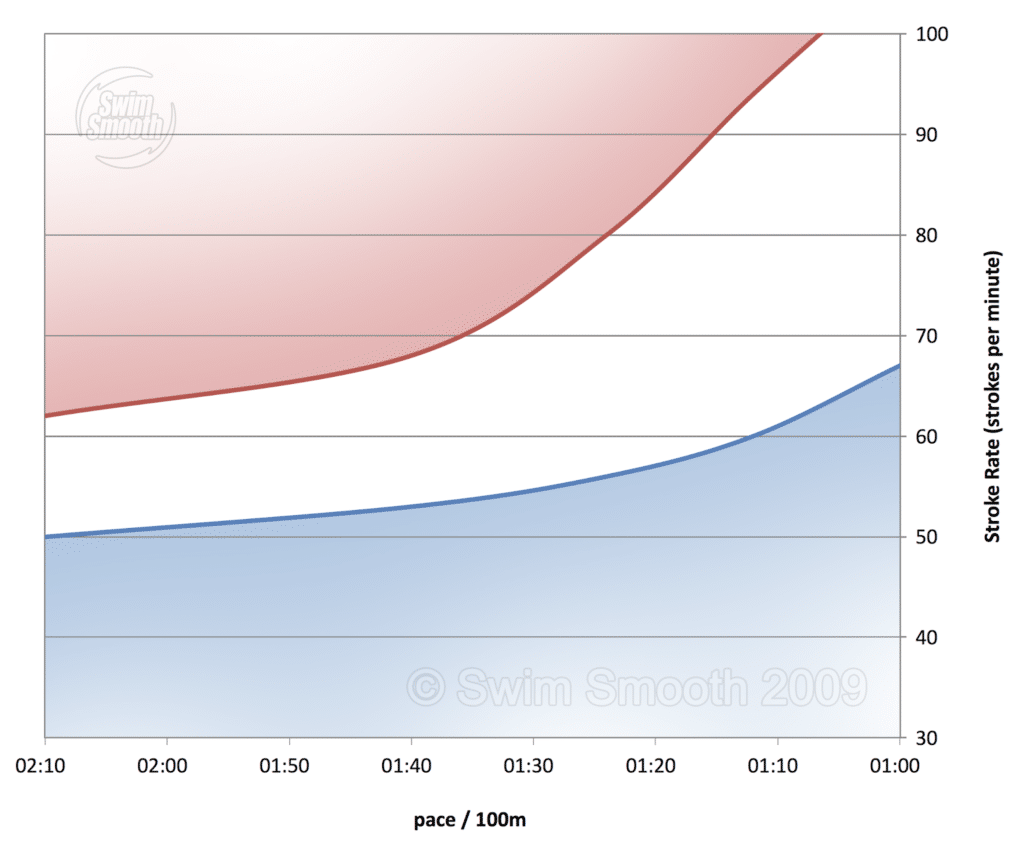
According to Swim Smooth, there is an ideal relationship between swim speed (time per 100 m) and swim stroke rate (strokes per minute). A swimming stroke that is too high (RED zone) hints at too short a stroke. On the other hand, a slow stroke rate typically indicates too much glide with each stroke and a tendency to create a hand position in the latter part of the stroke that causes one to slow.

My swim currently falls in the upper left portion of the BLUE region. Using my FINIS Tempo Trainer Pro, I am training to increase my stroke rate while paying close attention to the catch phase.

Graph showing the ideal stroke rate for various times for swimming 100 meters.
The ideal range for swim speed vs. stroke rate chart is in white between the blue (too low stroke rate) and red (too high stroke rate). Source: Swim Smooth

About the FINIS Tempo Trainer Pro

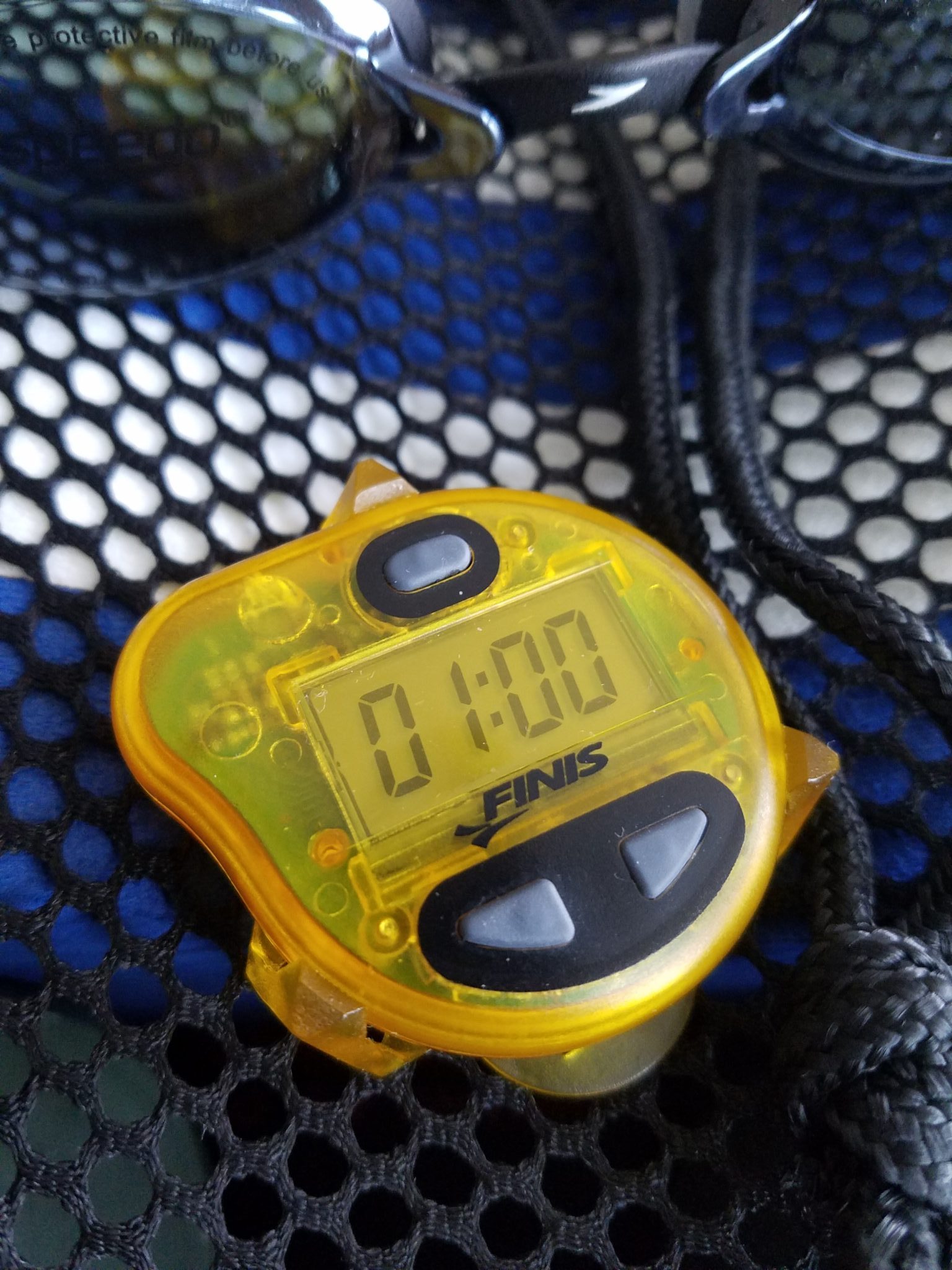
The FINIS Tempo Trainer Pro is a waterproof metronome. The choice of one of its three modes depends on the training plan. For example, one mode allow you to set a time per lap for use with interval training.

I set the device to transmit an audible tone for each of the strokes in the targeted pace. For example, I set the Trainer to beep every 1.0 second for a stroke rate of 60 strokes per minute.

The pace is adjustable in 1/100th of a second increments giving plenty of resolution for every situation.

The small, waterproof device easily secures beneath a swim cap and transmits a clearly heard, audible beep. It floats in water to help avoid it being lost in the pool or open water.

The Tempo Trainer Pro also comes with a clip for ‘dryland’ training. For example, it is used in bike (cadence) and run (foot turnover rate) training.

The FINIS Tempo Trainer Pro includes a replaceable battery. I have had the device for more than five years and replaced the battery one time by taking it to a local BatteriesPlus store.

My journey toward becoming a better swimmer continues by working to increase my stroke rate. With strength training and more structured time in the water, I am confident that I will be more competitive in the triathlon swim.

You can find the FINIS Tempo Trainer Pro at SwimOutlet.com

Check Backfor Reviews of Other Swim Tools

Meanwhile, You May Also Be Interested in These Posts

Optimal Stretching Pre and Post Workout

By Victoria Ward, Contributor

We’re all aware of how important stretching is before and after our workouts, so why is it that we decide to skip those crucial exercise steps? Well, besides being time consuming, a lot of people, myself included, think stretching is boring, and easy to skimp out on. That’s why it was only after a laundry list of injuries that I became consistent with my pre and post workout stretches. Nutrition is also very important when working out, you need to find the right balance, Sculpt Nation has some pre-workout powders that could be a great addition to your fitness goals.

But it was by stretching often that I learned how to do so effectively and make it enjoyable. Here, I’m going to lay out the exact stretching regimen I personally use, step by step, so you can try it yourself. Don’t be lazy like I was and wind of injuring yourself-some injuries never go away, like my elbow tendonitis (though I am still able to workout and wear the Best Elbow Brace for me to help support the elbow). So be proactive and put the work in.

Warming up

For those who have access, dynamic movements in a warmed pool, such as those in aquatic physical therapy, provide a fantastic way to warm up. The warm water promotes blood circulation and loosens the muscles while the aquatic medium allows stretching to be done without strain on the joints, tendons and ligaments. This is ideal for most athletes, especially with taxed or worn joints. It would be smart to perform aquatic physical therapy at least once or twice a week for general wellness and joint health. If you’re concerned about your joints, it may also be worth finding some supplement stacks that work. No one wants to be dealing with joint pain and taking supplements may relieve the pain.

Those of us without an in-gym pool will have to perform our dynamic stretching routine on ground. It burdens the joints somewhat more in this setting, but it can be relatively safe provided you move slowly and precisely through the movements. I suggest finding a whole-body dynamic stretching routine and performing it before every workout session.

It is usually recommended to perform each movement for 10-15 repetitions, though I sometimes perform as many as 20-30 if my muscles feel tight.

After dynamic stretches, I’ll get in some band work, which has worked great for improving my joint health. Taking a low-resistance band, I’ll mimic the exercises to be performed that day and hold the band in a static position for 30 seconds, or until I feel ‘loose’. Something that’s helped my wrist and elbow health, which nobody seems to be talking about, is using rubber bands. I put my fingers through a rubber band and then open them so the band stretches. I do this for perhaps 100 repetitions in each hand a couple of times a day and it’s made a huge difference in my elbow and wrist pain. With this being said, if these exercises are not making much difference to the pains being experienced, there are always options to find the best CBD topical cream or CBD oil, for example, to help relieve the symptoms of wrist pain. As this is said to be an anti-inflammatory product, this could be something worth considering, especially as your health should be the top priority.

Cooling down

After your workout, you may find your muscles much tighter than usual. To remedy this, we utilize what are known as static stretches. Unlike dynamic stretches, static stretches involve holding a certain position for some amount of time-usually 20-60 seconds. To make static stretches interesting, try pulling just a little bit farther each session. As an example, try touching your toes-if you can, then your hamstrings are pretty flexible. Now try working up to pressing your hands flat on the floor. Once you can do that then you’ve worked up some serious flexibility.

The last step is jumping into a cold bath before massaging out the muscles to break up any knots, fascia, and reduce swelling. Using a foam roller, tennis ball, your knuckle, or anything else you could think of would be a good idea. This stops muscles from getting tight and ultimately prevents many injuries. Following this you should make sure to get plenty of rest so your body can recover. Don’t make the same mistake I did-do your stretches and do them often.

Victoria Ward is a freelance writer with a profound interest in psychology, holistic health, and fitness. Her hobbies include tennis, cooking, writing, and yoga. When she’s not working, she can be found playing with her corgi, Milo.

You may also be interested in these posts

How Seniors Can Prepare for their First Triathlon

By Laurie Larson, Contributor

Triathletes of any age who are motivated and self-disciplined can safely and effectively train for a triathlon. Remember that a triathlon is not so much a sport for only the elite, but really it is a hobby that people work into their everyday lives, much like work, family, and routine duties.

According to the New York Times, there is a growing number of seniors involved with triathlons, and the Center for Disease and Control encourages older athletes to join in competitive sports. In fact, membership of USA Triathlon by older athletes has gone up by 230 percent since 2005!

Getting Started

So what age defines an “older” athlete? By most accounts, athletes over 50 are considered older, but that in no way means fitness and performance decrease as you age. To the contrary, you can perform well and continue to improve as an athlete every increasing year and decade of your life. If you are new to all three components of a triathlon, preliminary starter tips regardless of decade include:

  • If you are new to swimming, biking, and running, choose just one to work on at a time and utilize beginner training plans, building up slowly over time.
  • Look for local races and consider volunteering, where you can chat with people for knowledge and details about triathlons, as well as gain insider tips.
  • Join a triathlete training program where you can make some friends and be encouraged to be persistent with accomplishing small, manageable goals.

According to Ironman Coach Sally Drake, the limits you may experience with age include muscle loss, slower metabolism, loss in bone density, weaker immune system, and loss of joint range of motion. In order to account for such limitations, Drake says you must recognize the signs that you need to slow down or take more rest, especially if you feel pain.

See testimonials of triathletes over 50 and see Ironman training plans for triathletes who are 55+.

In terms of your 50s and then 60s and beyond, remembering specific guidelines and training recommendations per your decade will help you perform well and reduce the chance of injury. No matter how old you are, people are prone to injury and it can become more serious as people age. That’s why it’s so important to recover properly after any sporting event. We always see professionals getting sports recovery, but it’s also important for normal athletes to recover also. After running a triathlon, seniors need to make sure they receive some sort of athletic recovery treatment to keep themselves in good shape for their next sporting event. Seniors could always try and follow these tips to reduce their chance of injury too:

Training in Your 50s

According to 220 Triathlon, your joints begin to stiffen as your cartilage thins and the amount of lubricant surrounding your joints decreases. To combat this factor, choose to run on alternate days with interval sessions just once a week, in order to go easy on your joints and maximize performance. 220 Triathlon recommends a 2:1 training approach where you work hard for two weeks and rest for one week, and during that week of rest and recovery, engage in stretching, yoga, and massage. You want to reduce risks involved with overtraining and burning yourself out.

Training in Your 60s and Beyond

As you age, your muscle mass decreases. Remember that as you age, strength training is more and more critical, as by the time you turn 70, 24 percent of muscle mass is lost, where strength training increases these muscle building hormones. Restoration through sleep becomes more and more important, and napping can be very effective as well.

According to 220 Triathlon, better sleep and napping improve alertness, enhance performance, and reduce mistakes. On top of this, you can get extra alertness by consuming caffeine powder before a triathlon. If you’re well rested and have that extra boost, you’ll be able to perform to the best of your ability. Napping over 40 minutes increases release of the testosterone and growth hormone that helps repair and build muscle. It’s critical that your time of sleep is conducive of restoration, so be sure you can stay comfortable and avoid exacerbating your pain through sleeping on an improper sleeping structure. While your sleep is an important part of your rest and recovery, taking breaks is as well. Make sure you’re properly scheduling workouts and take two days of rest between your trainings.

If you don’t want to go out to do such exercises, you can hire an in-home care professional. The caretaker may assist you with the stretches, as well as your medication and other basic chores. Depending on your circumstances, there are several key types of aged care services to consider. These services include in-home care, respite or short-term care, and residential care (such as nursing homes or retirement villages). So, look for elderly care services that are appropriate for your needs and circumstances. You can learn more about such aged care services by visiting websites like careforfamily.com.au.

Consulting with Your Doctor

As with any matter concerning your health, it’s important that you consult with your doctor when making any major lifestyle changes. Once you decide to start training for a triathlon, it’s wise to visit with your doctor before, during, and after to be sure you are staying safe and healthy. Your doctor may be able to advise you on specific stretches, limits, and medications that could help you along the way. It’s always better to be safe than sorry, so keeping your doctor involved in the process is the best way to train. If you need any training tips, you can visit KCSS Online and sites alike, for workout advice as well as healthy lifestyle changes.

It turns out that age truly is just a number, provided that you account for changes in your body over time. Whether you are an aspiring athlete or someone who has been at this for a lifetime, with a proper training plan, diet, and persistence, the sky’s the limit!

Laurie Larson is a freelance writer based out of NC. She enjoys writing on health and lifestyle topics to help others live their best, healthiest, and happiest life!

You may also be interested in these posts

error

Enjoy this post? Please spread the word :)