Want to prevent fellow triathletes from becoming annoyed with you during a race? Avoid these mistakes commonly made during a pool swim.
From my experience with sprint triathlon, here are the top five mistakes, in no particular order, that occur doing a pool swim:
Reporting too aggressive or conservative pace/time
This mistake most often occurs during registration when you are asked to provide an estimate of the time that it will take to complete the swim. You definitely do not want to be swimming with triathletes who are significantly faster or slower than you.
If you are worried about the registration filling before you can time your swim, give your best estimate. Then, after later measuring the time, contact the race organizer to make any correction.
In many cases, you will also have opportunity on race day to make any correction. You will likely be asked to line up with those of similar pace (if the start is one at a time) or to join a group with those of similar speed (if swimmers start in a group, typically of five or six) .
Just don’t make the mistake on race day.
Starting too fast
With adrenaline rushing and the crowd roaring (even a small crowd can be deafening in an indoor pool), it is tempting to start swimming too fast too soon causing your heart rate to spike or breathing to become difficult. The next thing you know, you are swimming much slower than planned or even stopping to catch your breath. Better to start out at what you consider to be a bit slower that you think you should until you are in a rhythm. Once your breathing is at a normal race pace and you are ‘warmed up, give it your all.
Not drafting, if it is possible
Drafting is considered by many to be one of the keys to conserving energy during the swim while at the same time turning in a respectable (for you) time. The problem with drafting is that it can be difficult to practice unless you swim with a group.
To take advantage of drafting, swim with your hands just behind the feet of the person in front of you. (Avoid touching their feet which sends the message that you want to pass them.)
Not staying in your space
This is especially important when swimming in the same lane as one or more athletes and remaining in the same lane during the entire swim. Stay on your side (usually the right side) of the lane. You do not want to be the cause of a head-on crash.
Even if the swim involves a single length of each of several lanes in a Z-pattern, stay to the right as a matter of courtesy to faster swimmers. You will appreciate this if you are the faster swimmer.
Staying within your space during a pool swim will allow faster racers to pass.
Not allowing faster swimmers to pass when they let you know that they want to
Another courtesy to fellow racers is to allow faster swimmers to pass. Let them pass as soon as possible once they have signaled that they want to do so. Typically, faster swimmers will tap one of the feet of the swimmer that they wish to pass. If you can, move to the right side of the lane to allow them to pass. In races in which the entire length of swim involves multiple laps within a given lane, it is typical for the racer who is being passed to pause at the end of a length. Allow the faster swimmer or swimmers to pass you, and then resume your swim.
What is your experience?
Have you identified other mistakes or have experience with those I have listed? Leave your comments below.
By Liz Lawson – It’s been quite the year so far! I turned 54 last December and little did I know what the coming year would hold for me – training for and completing my first triathlon.
Even though I have lived in Raleigh, North Carolina for three years, I am still settling in. Working from home resulted in me sometimes feeling a little isolated. I was pretty down on everything.
Then, in September, a friend suggested to me that I think about training for a sprint triathlon. She had joined a local training group and completed her first sprint triathlon two years earlier. She said it was life-changing.
Deciding to Tri
I agreed to start training for a triathlon, mostly to not disappoint her, wondering what would happen. I joined a North Carolina-based group called Tri It For Life (TIFL), whose focus is on getting women to move, and began a 3-month program designed to prepare me for my first sprint triathlon. Our training was aimed at competing in the Ramblin’ Rose, a series of five sprint triathlons held for women in North Carolina.
I cannot say enough about how incredible this organization is. Tri It For Life is volunteer-driven. All the women who mentor the athletes have gone through the program. And, all of them continue with their triathlete ways.
After I paid for the training program, I literally broke into a cold sweat. I could barely swim!! I couldn’t even complete a 25-yard lap, and certainly not using a freestyle stroke. That forced me to do something I’d been putting off for years – learning to swim. I was terrified of drowning.
Getting Started in Training for My First Triathlon
I enrolled in swim classes at the Raleigh city pools. Although I was gasping for air most of the time, I was feeling a whole lot more confident. Then at the end of December, I had to have minor knee surgery. By mid-January, all I wanted to do was get back in the pool.
The TIFL training started in February. At the kick-off meeting, I started to realize this – the triathlon – was going to happen and I was terrified. I hadn’t been on a bike for 16 years and was still hobbling a bit because of my knee surgery. However, at least I could now swim the length of the pool without drowning.
I quickly learned that I was not alone. Our group was definitely a ‘mixed bag’ – some of the ladies were great runners, but wanted to train to swim; others were good swimmers but wanted to train to bike. Then there were those who deserved the greatest admiration, those who had almost never been in water, hadn’t been on a bike since they were 5 years old, and did not run.
There was no judgment and no competition. We all had the same goal….to do the Ramblin’ Rose triathlon!
Our training involved swimming two nights per week, biking on Sunday afternoon, and running/walking one evening. The intensity built each week.
Fast Progress in Training for My First Triathlon
Two months into the program, we were swimming between 500 and 700 yards twice a week.
The bike training started with learning about gears and how to use them. Then, we started training on a portion of the actual route with some gnarly hills – one, in particular, was most people’s nemesis. We started bike training two times per week.
The weeks of bike training leading up to the Rambin’ Rose prepared us for our first triathlon
We were also taught about transition, nutrition – every aspect of a triathlon. The TIFL mentors shared all their experiences with us.
In addition to the training that was part of the program, groups of us would get together for additional training – an ad-hoc Saturday meet up for a bike ride or an extra swim.
We all encouraged each other – even on the days when we were thinking “I can’t do this”. There was always someone to encourage us to take the extra step, do the extra lap, or get further up the hill before getting off to push.
There was no judgment and no competition. We all had the same goal….to do the Ramblin’ Rose triathlon!
Liz Lawson
One month before the actual event, TIFL held a mock-triathlon. We put together all of our training on a Sunday morning – including transition – and did our first swim/bike/run. This event was designed so we’d know what the real day would be like – what a wonderful experience. We even got medals for finishing the mock! The first medal I’d ever had in my life. For anything.
Race Day – Completing My First Triathlon
On the day of Ramblin’ Rose, we had fun. Yes, it was daunting to go from a training group of 50 to a race including 700 athletes. but we got through the event and there was nothing like coming to the finish line and seeing a big group of the mentors (now volunteering at the event) cheering us through and presenting our medal.
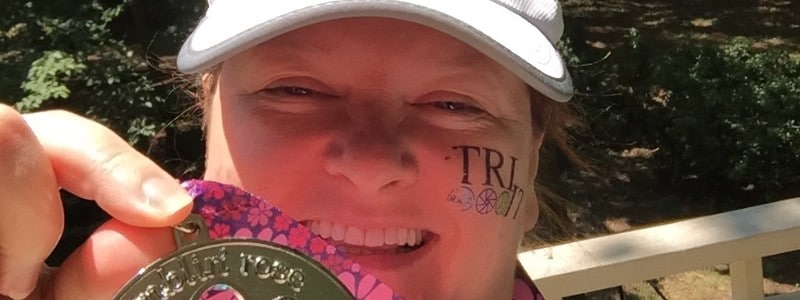
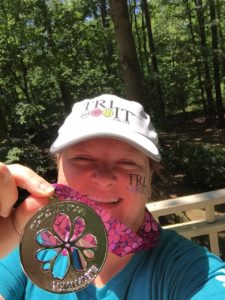
Liz Lawson celebrates completing her first triathlon
Continuing to Train
Once the event was over, I was so upset that my training time with Tri It For Life was coming to an end. But as a result of our experience, most of us had ‘drunk the kool-aid’ and kept going! I did another triathlon a month after Ramblin’ Rose.
Last weekend I did my first open water swim. I can do 1000+ yards in the pool, though I am still working on the non-stop bit :-). I’ve also signed up for the Tour de Femme bike ride and hoping to do at least two other sprint triathlons over the next year.
I’ve had a session with a running coach to learn how to do it properly. I have some problem with my Achilles tendon which is keeping me back from running, but this doesn’t have to stop everything else.
We meet up and bike each week. Some of the girls I train with will likely complete 6 or more events by the end of the year. Participating in the IronKiwi was a blast – and a blessing as it kept me focused on continuing to train.
Once the event was over, I was so upset that my training time with Tri It For Life was coming to an end.
Liz Lawson
As I am writing this, I am on vacation for two weeks, but can’t wait to get back and get started again. I’ve learned so much. It’s changed my life and I just want to keep going.
Stories like this are what make triathlon such a rewarding adventure—no matter when you begin.
Want to take the next step? Choose your path below.
Whether you’re just getting started or looking to improve, here are your next steps:
New to Triathlon?
Start with a step-by-step guide to triathlon after 50 designed specifically for older athletes.
Still have questions? Leave a comment—we’d love to hear from you.
What Was Your Experience Training For and Competing in Your First Triathlon?
Let us know in the Comments below your experience with your first triathlon and what you learned through it.
Comments: We’d love to hear about your experience. Join the conversation below. All comments are reviewed before they appear.
Reply notifications: Click the bell icon above Post Comment to be notified when someone replies to your comment.
Follow the discussion: Click Subscribe above the comment box and enter your email address to receive notifications whenever a new comment is added—even if you don’t leave a comment. After subscribing, check your email and click Confirm to activate notifications.
This post was originally published on July 5, 2016. It was updated with new formatting on January 13, 2021.
Terri Seidel’s triathlon story is about training for her first triathlon and, in doing so, pushing herself beyond her ‘comfort zone’. Her story is also about honoring a son by doing something he had thoroughly enjoyed.
It was during the TriZou Triathlon that I learned about the Josh Seidel Memorial Foundation. Following the triathlon, Terri and I made contact through friends of her son, Josh. We had both competed in the TriZou Sprint Triathlon, Terri as part of a relay and I as an individual.
Terri’s story was originally published on July 2, 2016. More than five years later, I still think of her courage in participating in the same triathlon her son had done years earlier.
As you read her story, I hope you will find encouragement to take part in triathlon even if you are not sure you can.
Terri’s story below is based on what I heard about her experience leading up to and participating in her first triathlon.
Deciding to Tri
“If I am going to do this triathlon, I need to commit to training”. Those were my words as I sat and discussed with my husband the thought of me participating in the 2016 TriZou Triathlon, my first triathlon.
My husband had participated in TriZou the year before. For me, participating in a triathlon was something I wanted to accomplish.
But, Why TriZou Triathlon?
The TriZou Triathlon and DuZou Duathlon are held every May at the University of Missouri in Columbia, also known as Mizzou. In recent years, it had attracted about 600 participants. It’s one of the largest triathlons in the Midwest. My husband, all three of our children, as well as countless brothers, brother-in-laws, nieces, and nephews, have all graduated from Mizzou.
My son Josh participated annually at the TriZou. It was one of his favorite events.
In 2013, Josh’s life was tragically taken in an industrial accident at the business he owned. After his death, a group of his high school and college friends established the Josh Seidel Memorial (JSM) Foundation, a foundation created to carry on Josh’s legacy by awarding scholarships and helping schools and other organizations.
The foundation created a tagline that summarizes what it’s all about.
LIVE LIKE JOSH: Work Hard – Play Hard – Help Others.
That is how Josh lived. He worked very hard. As an entrepreneur, he co-founded a successful manufacturing business in St. Louis. In spite of the long, 60-hour weeks that all new businesses need to thrive, Josh would also play hard. And, TriZou was an example of that. He would train for this event and participate with a goal of improving his time each year.
TriZou becomes ‘SlyZou’
In 2014, a group of Josh’s friends from Mizzou decided they were going to carry on his tradition by participating in the TriZou in honor of him. Those participating unofficially renamed the TriZou to SlyZou recognizing Josh’s nickname, Sly. From here forward, we referred to this event as the SlyZou.
That year, we had seven participate in the event. There were also 21 spectators. It was really heartwarming to see his friends continue his legacy and participate in an event that meant so very much to Josh.
In 2015, participants connected with the JSM Foundation soared to 15 with 18 supporters cheering them on. Josh’s dad, Mike, participated in the DuZou, which consisted of a one-mile run, seven-mile bike, and one-mile run.
At age 59, Mike finished and actually won a medal in the Clydesdale class (above 220 pounds) for his age group. However, in his words, the race almost killed him.
The missing ingredient was he hadn’t committed to training to the level I knew I needed for me to take part in this race. He had trained briefly, running to attempt to pick up his endurance. However, he had only registered about 20 miles total on the bike before the event. My thought was that if you are riding 7 miles the day of the race, a collective 20 miles is hardly considered “training”.
Choosing the Relay for TriZou 2016
So as my husband and I discussed participating in the 2016 Triathlon, I told him I would do it. I wanted to do it, but knew training was the key to success.
With less than six months to train while balancing other commitments, I could not see training for the complete triathlon.
Given the timing, that I look like a baby calf taking his first steps when I run, and that my biking skills are not great, we decided to make this a family event. I along with my two daughters would participate as a relay team this year. (See Reason #11 of 15 Reasons for Those 50 and Older to Do Triathlons.)
My daughters agreed that I would swim the 400 meters, my youngest daughter Lindsay (33) would bike the 14 miles, and my oldest daughter Katie (36) would run the 5k leg of the race. At 60 years old and generally in good shape but certainly not being a fitness buff, I did not see tackling a triathlon by myself as a smart move. At least given the time I had before the event.
Training for the Three Legs of a Triathlon Takes Time
Triathlons are something you prepare for over time. You enter a series of 5k runs to prepare and get comfortable with the run distance. On top of this, you train by biking longer distances on weekend mornings so a 14-mile race is achievable. Finally, you swim a lot at the local pool.
That is one of the beautiful things about TriZou. You can participate at many levels, so the barrier of entry for those who have not participated in this type of event goes away.
In addition to the Sprint TriZou race (400 m swim, 14 mile bike, 5 km run), they offer relay teams (same distances as sprint), super sprints (100m swim, 7 mile bike, 1 mile run), and a duathlon called DuZou (no swimming; 1 mile run, 7 mile bike, followed by a second 1 mile run). There are also divisions for those with extra pounds like my husband, called Clydesdale for men and Athena for the women.
Training for My First Triathlon
I joined our local YMCA about 4 months before the SlyZou. It was winter in St. Louis and I was going to have to get into a pool and log some serious miles if I wanted to complete this event.
Nervously, I entered the 25 meter pool at the Y for the first time, and barely made it from one end to the other. I’ve been swimming my entire life. We have spent countless weekends at the lake. However, I learned that the type of swimming I had done with these was not like that of a triathlon.
I quickly realized that floating on a noodle and swimming back to the boat for another cocktail is NOT swimming training.
Terri Seidel
Nevertheless, twenty five meters later I was at the other end of the pool, out of breath and overwhelmed. That I had to swim the equivalent of 16 laps of this pool, without stopping, to complete my leg of the race was more than intimidating.
Applying job skills to training
I’m a regional Vice President for a large company that owns and operates Ambulatory Surgery Centers across the country. In our daily business operations, we tackle new goals and accomplish new tasks every day.
I assist my employees and help them accomplish these goals, but it always boils back down to the same basic strategy I was going to need to accomplish this SlyZou event:
Prepare.
Get the tools and processes in place that you need to succeed.
Address the issue with confidence that you can achieve it.
Then execute the work.
I knew I needed to prepare myself physically for this event in the same way.
Getting a Swim Coach
The first step was to inquire about a swimming instructor at the Y. I felt I could improve a lot, but if I didn’t know where to focus, chances were slim that I actually would improve.
Stacy, my personal trainer for the next 4 months, was a gift from heaven. First, she analyzed my stroke.
I have often wondered what she really thought when she saw me swim a lap on the first day. Anyway, she quickly identified my strong and weak points and what I needed to work on to finish this race.
We started off slow. I committed to 3 days per week of training, We met at the pool where we worked on a particular area that would improve my swimming skills.
Sometimes, we worked on my stroke. Other times it was my breathing or my kick. Whatever it happened to be that day or week or month, Stacy would work with me, improving my skills. I also made sure I had the right swimsuit for training.
Building Endurance
My endurance started to improve. I still could not swim the entire 400 m without stopping, but I was getting stronger, and she would time me on my laps. She would discover that I hit a threshold, early in my swimming. I could be a couple of laps into my training, and I would slow down.
Stacy used her knowledge to help me learn things I would have never discovered on my own. Her suggestions helped tremendously.
Training for Actual Race Conditions for My First Triathlon
We also worked on the actual race day condition. Stacy knew this was going to be a very emotional event for me since, unlike many of the other participants, I was swimming for a cause.
Besides, she also recognized I had never participated in a race of any kind before so helped me plan the day of the race. For example, we discussed when to stretch, when to warm up outside the pool, and what to expect during the swim. These extras were a great help, especially since I had never been in a race in my 60 years of life.
Stacy also recruited other swimmer friends at the Y who were there for a normal workout. She would have them swim in front of me so that I got used to people swimming by me. Through this, I learned how to adjust my breathing for a very disturbed pool condition such as when you have 100 people in the water stirring it up lap by lap.
Before I knew it, we reached the last day of my training. ‘Ready or not, here I come.’
I felt ready. I was confident that I could swim my portion of the race.
Race Day
Since the race started very early in the morning, we traveled to Columbia the night before and got a hotel room. The rest of my relay team, our girls, and their families were also there.
There were 25 racers on “Team SlyZou” and equally as many supporters cheering them on. There were many husbands and wives who participated, a few other relay teams in our group, and a few DuZou participants.
Me? Nervous!
I was nervous, as expected, mainly because I really didn’t know what to expect. Even though my husband and I lived in Columbia for two years when he finished school, I had never been in the pool complex at Mizzou. It had only been built a few years earlier so was not part of Mizzou when we were there.
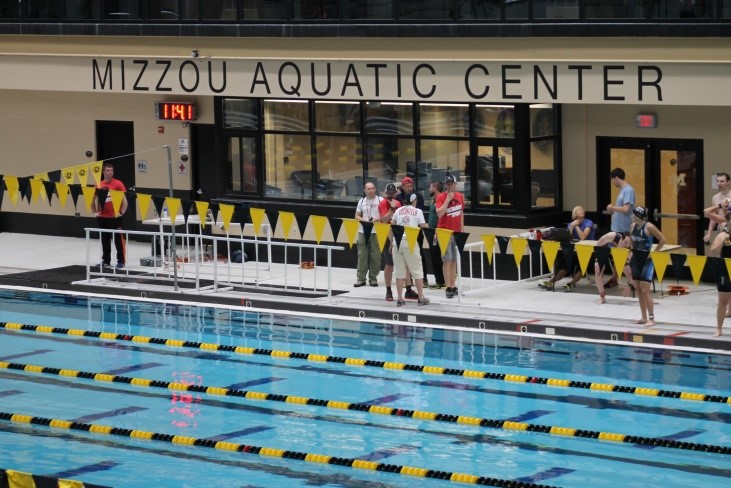
To say I was overwhelmed when I walked into the pool area was an understatement. First, the complex is amazing. On top of this, over 500 swimmers had packed into it. There I was, staring at a beautiful eight-lane, 50 meter pool, one of the finest pools in the Midwest.
There was also a lot going on. The race organizer was making announcements on the Public Address system. Big screen TV’s on the wall were displaying times. People all around me were talking and laughing while going through their pre-race routines. Meanwhile, there I was, standing mesmerized and scared to death of what I had signed up for.
Mizzou Aquatic Center at the University of Missouri at Columbia, venue for the swim leg of the TriZou Triathlon.
The relay teams swam after all full TriZou participants, so I was very near the end of the line of people to jump in the pool. About two hours after the “Elite” participants had started, I jumped into the pool. About that time, the thought occurred to me that the “Elite “racers were finished with the entire event, the entire TriZou, and I was just getting started.
It’s Time to Swim
We lined up in order of the time which we expected to complete the swim. This was done to prevent faster swimmers from running into a slower swimmer in front of them. As we crept forward toward the time when I would cross the timing mat and jump into the pool, I had to keep telling myself ‘Stay calm. You can do this. It’s no different than the YMCA.’
It was no different except for the fact that I had about 50 supporters, including grandkids, my husband, friends who had driven 100 miles to see this happen, in the stands. Even my mom was there. She had driven up to watch – and support – me. Sure, it was no different than the YMCA. Right!
As I jumped into the pool, all I could hear were grandkids yelling “Go Mimi. We love you.” That difference from the YMCA training was one I thoroughly enjoyed.
Some of Terri Seidel’s supporters – her grandkids Brooks, Tommy, Grace, Samantha, Graham – ready to cheer on ‘Mimi’.
I finished my first 50 meters and actually felt pretty good. The pool was not cold. I never experienced another swimmer tapping my feet to pass. My breathing was just like in training with the chop of the pool. I was sure I could do this.
After about 200 meters, I started to get tired. Since we had trained for this, I worked the plan and switched to the back stroke for a lap to recover somewhat. I could see that I was keeping pace. While I didn’t know my time, I was not passing anyone and they weren’t passing me. I assumed I was keeping my pace.
While I was counting laps – 8, now only 7, now 6, – somehow, when I got to my last 50 meter lap. I thought I still had three laps to go. We were swimming a zig-zag pattern, down the pool under the ropes, and back up the next lane, so when I saw the pool edge, I said: “I’m on my last lap. I thought I had 150 m to go”.
The Final Length
As I made my final turn, I could hear those who had come to see us cheering me on. It was at that point that I knew I would make it.
In no time, I found myself at the ladder at the end of my 400 meters; I was an emotional mess. After all, I was swimming this for my son Josh. I am certain he helped me finish.
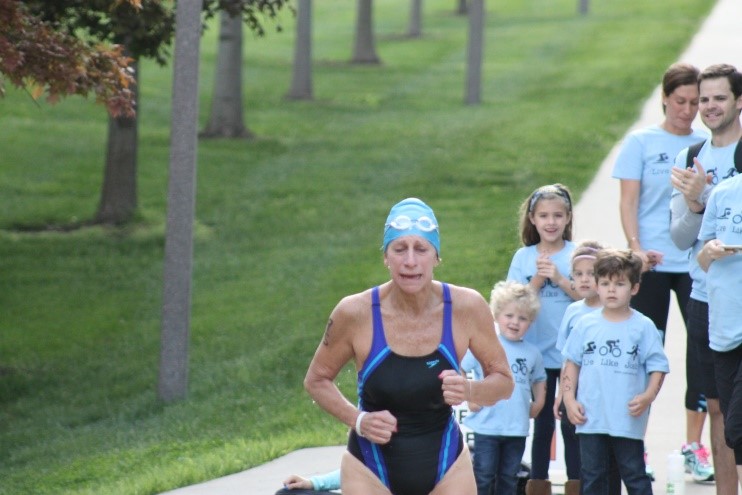
I climbed out of the pool, and now had about a 150 yard run to the transition point. Here, I would pass my ankle bracelet for timing (the timing chip) to my daughter. As I came out of the Natatorium, all I could see and hear were cheers from the supporters standing outside the doorway.
Reflecting After the Swim in My First Triathlon
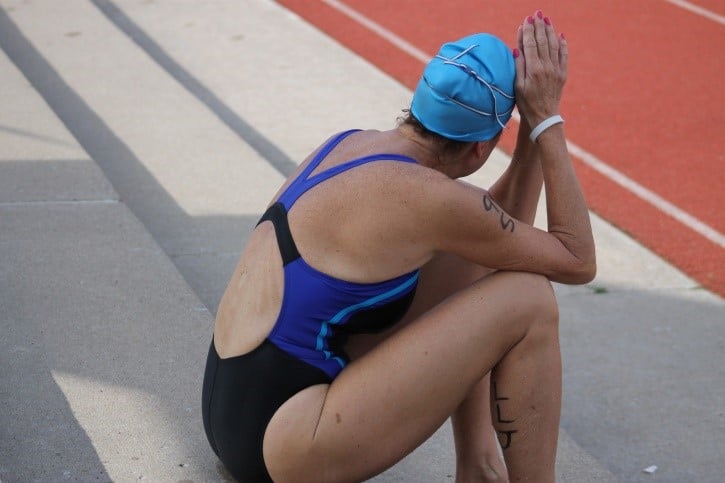
I had accomplished the goal I had set six months earlier. The swim portion of the race my son loved so much was over. After passing off the timing chip to my daughter, I sat at the steps around the transition area and cried.
Terri Seidel reflecting on the swimming accomplishment after completing the 400 meter swim in TriZou 2016.
While I completed only one leg of a triathlon, it was a major accomplishment for me.
I had been challenged physically before with work-related “team building” events. I ran a half marathon as a work event; remember earlier I told you I can’t run well. I hiked the Grand Canyon Rim To Rim in one day, starting at 3am and climbing out the top at 5pm, as a team building exercise. The National Parks Department won’t even let you do that if you tell them your intentions.
Set your goals, it’s a challenge. I’m normally one of the oldest if not the oldest in our group when doing these events – so to me they are a big accomplishment. Finishing this 400m in honor of our son tops all of those challenges – by far.
My daughters finished their individual legs of the relay as expected with decent times, and we were all happy to finish the event.
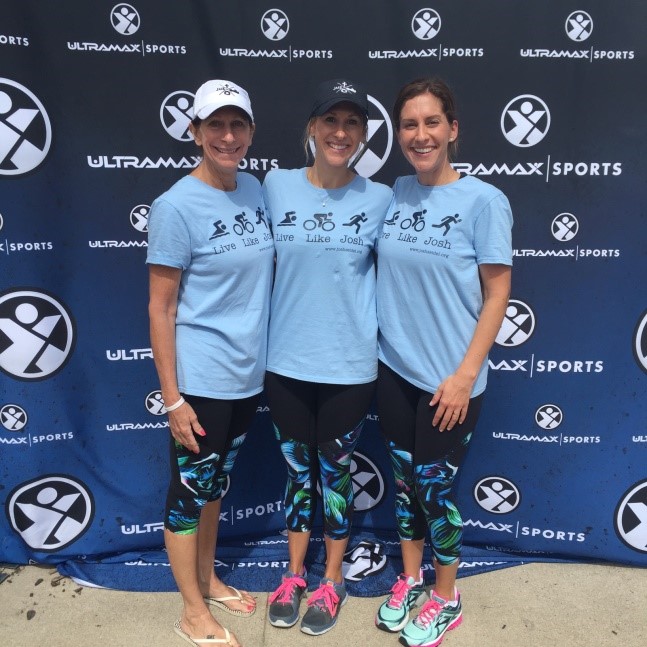
Team Boy (the nickname they gave to Josh) – Terri Seidel, Lindsay Bosworth, Katie Eisel
What I Learned From Training and Competing in My First Triathlon
Through this experience, Terri said that she had learned some lessons for other first-timers:
– Establish challenging yet obtainable goals, especially if over age 50.
If you want to finish a triathlon, maybe start out with a sprint, or a relay, or a DuZou, and work your way up to the main event. If you jump immediately into a triathlon, you may during training find it unobtainable and quit. You are better off accomplishing a smaller task toward the ultimate goal, than quitting and never getting to the ultimate goal.
– Train, Train, Train.
Eat right, train as many days per week as needed, and get your body ready for the physical challenge you are about to put it through. This type of event challenges your body – so get it as prepared as possible to minimize the risks of a heart attack or stroke, or some other physical event like torn muscles or joint injury.
– Have a reason or goal for the event.
In this case, I signed up and did this event in honor of my son Josh. Have a reason – a personal accomplishment, to show your spouse you care about your health (and theirs), to push your body and mind to be in better condition. Whatever it is, have a reason for participating.
On The Way Home After My First Triathlon
I will be 61 when the next SlyZou comes around. I turned to my husband on the drive back to St. Louis after this event, and with tears in my eyes, said “After I finished, I said to our son, OK Josh, mission accomplished – I did your race”.
Will I race again next year? Only time will tell.
Good luck to all those who read this and decide that they want to train for and participate in their first triathlon. My advice – if you do commit to the race, start your training now.
About JoshSeidel.org
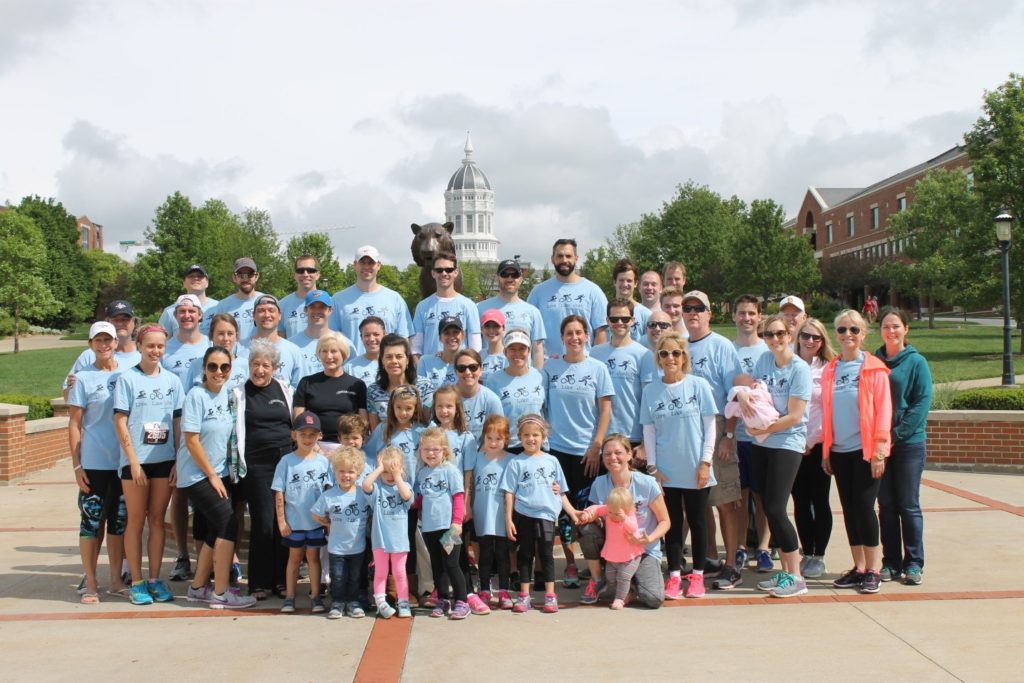
Team SlyZou 2016
Our Motto: LIVE LIKE JOSH – Work Hard / Play Hard / Help Others
The Josh Seidel Memorial Foundation is an organization created to continue the Legacy of Josh Seidel, whose life was tragically cut short in an industrial accident. The goal of this foundation is to honor the memory of Josh Seidel by assisting and inspiring young people to participate in programs or attend schools that build science, engineering and technical skills, encourage entrepreneurism and foster the connection of people for the greater good of our community. Through fundraising efforts, scholarships and financial assistance are given to students and schools. We rely heavily on fundraisiers to allow us to support students and schools. The foundation is a tax exempt 501 c 3 organization. For additional information, visit www.joshseidel.org.
Share Comments About Your First Triathlon Below
What has been the most memorable triathlon in which you have participated? Is there someone special in whose honor you have raced?
The SafeSwimmer Float and other brands of swim buoys provide visibility and more for triathletes training for open water swims. Check out the video review of the product below.
You can find information for getting a swim buoy at the end of this post.
About half of the triathlons in which I have participated have involved open water swimming. Even if most of your training is in a pool, eventually you will need to practice in open water.
In this post, I am going to share with you my initial experience with the ‘Safe Swimmers Float’ or ‘Float’, for short. In 2025, when I updated this post, many alternatives replaced this brand.
I first noticed the Float when I noticed swimmers dragging this orange floaty as they swam past our house. That I so easily noticed them was testimony to the visibility provided to the swimmer by the bright orange color.
This additional visibility is especially important for lakes where people use boats for fishing, skiing, wake boarding, and leisure cruising, and where the captains possess varying boating skills and levels of focus.
One inflates the Float quickly with a few strong breaths. Then, swimmers clip it to a belt around their waist.
The belt is adjustable to fit waist sizes up to 38 inches. An extender belt is available for larger waist sizes.
This particular model also has a place to store a water bottle for long swims. According to the manufacturer, swim coaches recommend consuming between 150 and 350 ml or 5 to 12 fluid ounces of water every 15 minutes during a swim to avoid dehydration.
The manufacturer claims you can also store personal items such as wallets and car keys in the same area as the bottle. I have not tried this and would, at a minimum, place these items inside a zippered bag to avoid them becoming wet.
Make sure that the Float is sitting on top of the water before you release it. The first time that I let the Float hang from my belt while I was standing in shallow water, the water bottle fell out of the Float into the lake.
Once out into the open water, you will not notice that you are towing the Float.
In addition to providing visibility for the swimmer, the Float will support the swimmer in the event of panic, a cramp, or anything else that causes one to stop.
No matter how much assistance the Float provides, it is still wise to never swim alone or at least never go out alone. My wife often followed me in our pontoon.
Disclaimer: Please note that SeniorTriathletes.com is a participant in the Amazon Services LLC Associates Program, an affiliate advertising program designed to provide a means for sites to earn advertising fees by advertising and linking to amazon.com. Amazon, the Amazon logo, AmazonSupply, and the AmazonSupply logo are trademarks of Amazon.com, Inc. or its affiliates. As an affiliate, I will receive a small commission for any purchases of this product that you make through Amazon.
Post Your Questions and Comments Below
Comments: We’d love to hear about your experience. Join the conversation below. All comments are reviewed before they appear.
Reply notifications: Click the bell icon above Post Comment to be notified when someone replies to your comment.
Follow the discussion: Click Subscribe above the comment box and enter your email address to receive notifications whenever a new comment is added—even if you don’t leave a comment. After subscribing, check your email and click Confirm to activate notifications.







Comments: We’d love to hear about your experience. Join the conversation below. All comments are reviewed before they appear.
Reply notifications: Click the bell icon above Post Comment to be notified when someone replies to your comment.
Follow the discussion: Click Subscribe above the comment box and enter your email address to receive notifications whenever a new comment is added—even if you don’t leave a comment. After subscribing, check your email and click Confirm to activate notifications.