‘Gotta Tri’ – Triathlon in The Villages, Florida
The Villages, Florida, located between Orlando and Ocala in central Florida, is a 55+ community like no other in the USA. To say that residents and visitors of every age and ability are required to stay active is no stretch. 

Thanks to The Villages Triathlon Club, triathlon is one of the sports growing here.

The Villages Triathlon Club Builds on an Active Lifestyle

If I were to pick one word to describe The Villages, I would choose ‘active’.

As just one example, consider that from 5 to 9 PM, 365 days per year, each of the three Town Squares has live music with residents and their guests filling the dance floors. 

To prepare for the evening, one needs to take afternoon dance lessons.  That is, unless you are golfing on one of the more than 50 courses, biking, doing water aerobics, playing pickleball at one of the roughly 150 courts, swimming in one of the 102 pools, or involved in any of the other hundred or so activities.

Triathlon-friendly ‘Biker Shuffle’ with Scooter The DJ at Spanish Springs Square in The Villages, Florida .

My Introduction to The Villages Triathlon Club

Reading the sports section of the daily newspaper of The Villages, The Daily Sun, has become a ritual when visiting the area. Articles in the paper often highlight accomplishments of active seniors. These stories never fail to encourage, inspire, and even amaze.

One article that especially grabbed my attention was that of a resident who had restarted swimming after quadruple bypass surgery.

Wanting to learn more about the story behind the story, I contacted the article’s author.  He eventually introduced me to Donna Maguire, founder and president of The Villages Triathlon Club.
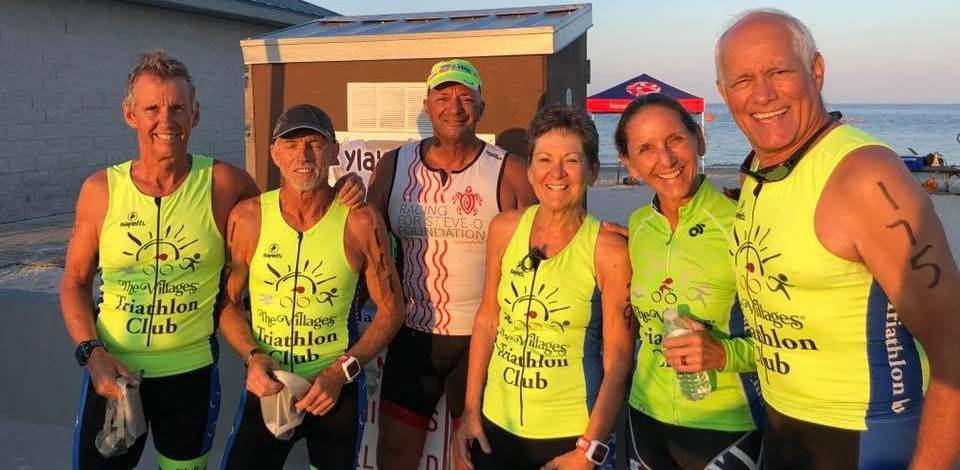
members of The Villages Triathlon Club preparing for the swim
Members of The Villages Triathlon Club often race together at sprint to Ironman distance events.

Beginnings of The Villages Triathlon Club

Donna Maguire started The Villages Triathlon Club in April, 2015 after venturing back into the triathlon world following her and her husband’s move to The Villages. While in central Florida, she learned about nearby Clermont, the so-called ‘Triathlon Capital of the World’.

While The Villages had groups for almost every activity and interest imaginable, there were no running or triathlon clubs. However, that changed through a ‘chance’ encounter between Donna and another ‘Villager’, Pat Johnson.

“One day, I met Pat while we were both playing pickleball. She told me that she had just signed up for her first triathlon at age 70. Pat had no idea what she was in for,” said Donna with a smile.

“She had less than three weeks to prepare for the race. So, I took her under my wing and shared my limited experience and some of my equipment.   Helping her helped me. And with that, the idea that would lead to the triathlon club was born.”

Donna started sharing her vision with other triathletes.

“Many of them encouraged me to start a triathlon club. All I wanted to do was find people to train and play with. Did I ever!

“We now have both a triathlon club and a running club”.

The Villages Triathlon Club Today

The Villages Triathlon Club’s mission is “to provide, for all levels of athletic ability, a network of information, support services, training, racing, and social activities in a friendly and supportive environment”.

Membership is open to residents who are currently participating in triathlons or have completed races in the past and have a desire to get involved again. Also welcomed are first-timers who want to learn about and prepare for a multi-sport challenge.

She and many of the club’s members have become ambassadors for triathlon throughout The Villages and beyond. Members often attend triathlons as a club, complete with t-shirts, warm-ups, triathlon suits, and other apparel bearing the club logo which was designed by Donna.

Donna’s support for triathlon even shows in her e-mail signature which includes the words ‘Gotta Tri’.

Many of these athletes also emphasize recovery. You can explore these insights further in our post on recovery strategies for triathletes over 50.

Sharing Triathlon Information Among Club Members

Both the triathlon and running clubs have Facebook pages to foster communication and support among members. “We encourage all club members and meeting attendees to try to do a triathlon.”

“I’m not an expert and although I share my experience, I also want to be sure that members have a variety of levels of expertise and experience on which to draw.”

Monthly educational meetings are another way the club promotes triathlon for its members and anyone interested in competing in the sport. These meetings are a time for sharing “tons of information”. Many include guest speakers to discuss topics related to training, rest and recovery, nutrition, and racing.

Triathlon Training Events

The Villages Triathlon Club also regularly organizes training events for its members.

The club has group runs on Sunday mornings. During the week, members regularly get together for 60+ mile bike rides at one of the local trails.
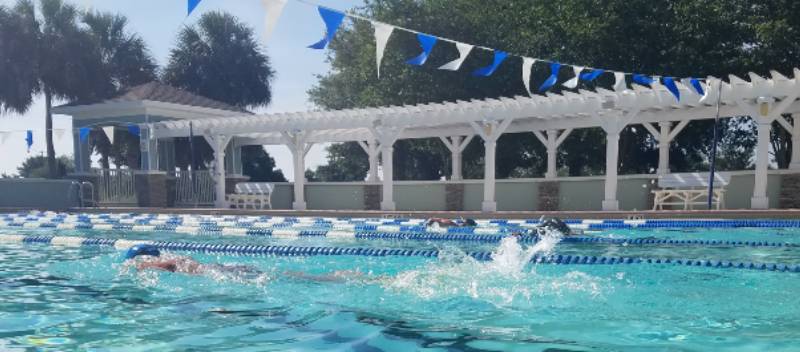
The Villages Triathlon Club holds groups swims two mornings per week
The Villages Triathlon Club holds group swims two times per week in one of The Villages’ sports pools..

The club also has standing Tuesday and Thursday morning reservations at one of The Villages’ sports pools. During this time, swimmers of all levels, from beginner to experienced, meet to build their swim fitness and improve their triathlon-specific swim technique.

For example, the group works on swimming close together and drafting, to become accustomed with the contact that often occurs during the triathlon swim.

Club members have also met for group swims and practice triathlons at nearby Lake Minneola and Lake Weir. One of these events included a triathlon swim lesson from a professional triathlete.

The Villages Running Club also hosts group runs on Tuesday’s and Thursday’s morning that leave Lake Sumter Square at 6:30 AM during the summer months.

Before COVID-19 shutdowns, the club reserved Lake Sumter Square (one of the three Town Squares mentioned earlier) on Friday mornings for a free Boot Camp. 

Attendees would gather at 7 AM for a 4-mile run that included interval training. Then at 8 AM, the Boot Camp session was led by one of the club’s members. Finally, a yoga class was held at 9 AM for the most ambitious members. A priceless start of the day.

Why Do A Triathlon?

Why should someone in or approaching retirement age participate in triathlon?

According to The Villages Triathlon Club members, there are many benefits from training in the three different sports. There are health benefits from being stronger, more fit, and, for some, losing weight.

Training in swimming, biking, and running helps avoid overuse injuries by working different parts of the body. It also prevents boredom, which can lead to inconsistency.

There are also social benefits; meeting new people, developing friends with whom you can share successes and struggles as well as learn, or go golfing.

For Donna and many other club members, triathlon has also helped build confidence and mental strength.

Not learning to swim until later in my adult life, Donna had always had a fear and discomfort in the swim portion.

“Little by little I’ve started to overcome that fear, something I never thought I’d be able to do.  I keep reminding myself – ‘Just breathe’.

“We all have something that is scary and out of our comfort area. We can take the easy route and just avoid that situation or tackle it and feel confident.”
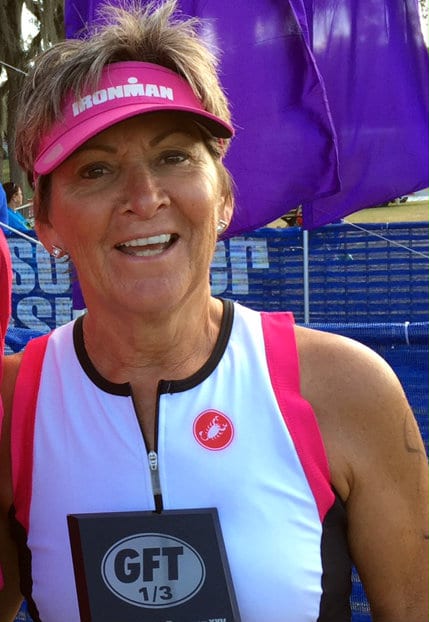
Donna Maguire, founder of The Villages Triathlon Club for senior triathletes
Senior triathlete, Donna Maguire celebrating her age group win at the 2015 Great Floridian GFT 1/3 Ironman Triathlon

Have Questions for The Villages Triathlon Club Members?

The Villages Triathlon Club highlights the value of the encouragement and camaraderie that comes from being part of a group that shares common goals and interests. For example, Donna has gone from ‘considering quitting triathlon’ to a 2x Ironman finisher during her time with The Villages Triathlon Club.

Feel free to post questions and comments for Donna and The Villages Triathlon Club members in the Comments section below.

Comments: We’d love to hear about your experience. Join the conversation below. All comments are reviewed before they appear.

Reply notifications: Click the bell icon above Post Comment to be notified when someone replies to your comment.

Follow the discussion: Click Subscribe above the comment box and enter your email address to receive notifications whenever a new comment is added—even if you don’t leave a comment. After subscribing, check your email and click Confirm to activate notifications.

This post was originally published on March 25, 2016. I updated it after Joy’s and my visit to The Villages during April 2021 and again in April 2026. In September 2021, we became residents of The Villages, where I am currently am a member of The Villages Triathlon Club.
Ask Our Coaches: Triathlon Training With Health Conditions After 50

Reader Request

We received the following request for guidance for triathlon training from Shelley, one of our readers.

“How to develop a training base that can accommodate increasing training times and distances to accommodate health conditions. How to make adjustments.”

Many athletes over 50 start training without a clear picture of how their health conditions will affect progress. The goal is not perfection—it’s building safely, consistently, and with flexibility.

If you’re new to triathlon after 50, this guide on how to start triathlon after 50 will help you take the first step.

Coach Jenn Reinhart’s Advice on Triathlon Training With Health Conditions

Hi! Shelley,
Terry forwarded your question about training for a Triathlon.

It would be good to know what type of health conditions you are specifically referring to prior to answering your question. Without that knowledge, I will provide you with my answer toward maintaining good health especially as we age.

For a sprint triathlon (typically 750 m swim, 20 km bike, 5 km run)—especially with health considerations—the key is to build a base that increases total training load without triggering setbacks. You’re managing three disciplines plus cumulative fatigue, so structure and restraint matter more than ambition.

1. Establish a triathlon-specific baseline

Instead of thinking per workout, think weekly structure across all three sports.

A sustainable starting point might look like:

  • Swim: 1–2×/week (10–20 min continuous or intervals)
  • Bike: 2×/week (15–30 min)
  • Run: 2×/week (10–20 min, or run/walk)
  • Total weekly time: ~90–150 minutes

This is your global load baseline—more important than any single session.

2. Progress total load, not just individual workouts

Triathlon adds a hidden stressor: stacking disciplines.

Instead of aggressively increasing each sport:

  • Increase total weekly time by ~5–10%
  • Rotate which discipline gets slightly longer each week

Example progression:

  • Week 1: baseline
  • Week 2: +10 min bike
  • Week 3: +5 min run
  • Week 4: deload (reduce all by ~20%)

This avoids overload from simultaneous increases.

Helpful next step: Since sleep strongly affects recovery and training consistency, you may also find this article on sleep for recovery and performance after 50 useful.

3. Use “discipline prioritization” blocks

You don’t need to improve everything at once.

Rotate focus every 2–4 weeks:

  • Block 1: emphasize bike (longer rides)
  • Block 2: emphasize run (slightly longer runs)
  • Block 3: emphasize swim technique/endurance

The other two disciplines stay maintenance-level.

4. Manage intensity tightly

For base development (especially with health conditions):

  • ~80–90% of training = easy aerobic effort
  • Avoid frequent high-intensity sessions early

A simple rule:

Coach’s Rule: You should finish most sessions feeling undertrained, not exhausted.

5. Introduce “brick” sessions gradually

Bricks = bike → run back-to-back (critical for triathlon)

Start very small:

  • 20 min bike + 5 min easy run

Progress slowly:

  • Add 2–5 minutes to the run portion over weeks

Adjustment rule: If bricks cause excessive fatigue, scale back immediately—they’re deceptively taxing.

6. Use flexible session scaling

Instead of rigid workouts, define ranges:

  • Swim: 15–25 min
  • Bike: 20–40 min
  • Run: 10–25 min

Then adjust daily based on how you feel:

  • Good day → upper range
  • Off day → lower range
  • Bad day → rest or very light

This is critical for managing unpredictable symptoms.

7. Split sessions when needed

If fatigue is a limiter:

  • Bike 30 min → split into 2 × 15 min
  • Run 20 min → run/walk intervals

You still build capacity without overwhelming your system.

Build discipline-specific durability

Each sport stresses the body differently:

Swim

  • Low impact → safest to increase frequency
  • Focus on technique first (efficiency reduces fatigue)

Bike

  • Best for building aerobic volume with lower injury risk
  • Can build longer durations earlier than running

Run

  • Highest injury/fatigue cost
  • Progress slowest (often the limiter)

9. Clear adjustment framework

Use this weekly decision model:

Progress if:

  • No symptom flare
  • Recovery within 24 hours
  • Stable energy

Hold if:

  • Lingering fatigue
  • Mild symptom increase

Reduce if:

  • Sleep disruption
  • Elevated resting fatigue
  • Pain or flare-ups

Reset if:

  • Significant crash → return to last stable week

Helpful next step: For a broader look at how older athletes manage fatigue, soreness, and training load, see Recovery After 50: What Every Triathlete Must Know.

10. Example beginner week (adaptive)

  • Monday: Rest or light swim (15 min)
  • Tuesday: Bike (25 min easy)
  • Wednesday: Run (15 min easy or run/walk)
  • Thursday: Swim – focus on short intervals
  • Friday: Rest or swim (technique)
  • Saturday: Bike (30 min) + short run (5 min brick)
  • Sunday: Easy run or bike (optional 15–20 min)

Adjust volume within ranges based on how you feel.

Progression target (over time)

You’re aiming to gradually tolerate:

  • Swim: 750–1000 m continuous
  • Bike: 45–60 min comfortable
  • Run: 30 min continuous (or run/walk equivalent)

No rush—timeline depends on your condition, not the race calendar.

Key mindset shift

You’re not just training for a race—you’re building a resilient system.

Progress = consistency without setbacks.

The help of a coach would go a long way to help ensure that you create a safe training plan. With the TriDot Training platform, an athlete can have the AI build a custom plan to the individual athlete.

Age, sex, years of experience are all factored into the plan. The number of workouts in each discipline can be selected, days of the week, intensity, and key metrics of heart rate, pace and power.

I would be happy to answer any questions you have.

Jenn Reinhart

512-762-7759

Jennifer@reinharts.org

Jenn.reinhart@tridot.com

TriDot Master Certified Coach

USAT Level II Certified Coach

IROMAN U Certified Coach

Happiness is Moving Forward!

Sign for Coaching thru TriDot or RunDot

https://app.tridot.com/onboard/sign-up/jenniferreinhart

https://app.rundot.com/onboard/sign-up/jenniferreinhart

Want to take the next step? Choose your path below.

Whether you’re just getting started or looking to improve, here are your next steps:

New to Triathlon?

Start with a step-by-step guide to triathlon after 50 designed specifically for older athletes.

Start Here →

Already Training?

Learn how to train smarter, recover better, and improve performance after 50.

Improve Performance →

Join the Conversation

Share your comments, questions, and experience below. You may also submit your question(s) through the website here.

Comments: We’d love to hear about your experience. Join the conversation below. All comments are reviewed before they appear.

Reply notifications: Click the bell icon above Post Comment to be notified when someone replies to your comment.

Follow the discussion: Click Subscribe above the comment box and enter your email address to receive notifications whenever a new comment is added—even if you don’t leave a comment. After subscribing, check your email and click Confirm to activate notifications.

Medical Disclaimer

The content on SeniorTriathletes.com is for informational and educational purposes only and is not intended as medical advice, diagnosis, or treatment. Always consult with your physician or a qualified healthcare provider before beginning or modifying any exercise, training, nutrition, or recovery program—especially if you have existing health conditions or concerns.

Participation in triathlon training and related activities involves inherent risks. By using this information, you acknowledge and accept full responsibility for your health and well-being. The author and contributors are not liable for any injuries or health issues that may result from the use of this content.

Ask Our Coaches: Six Months To An Olympic Triathlon

Question

We received the following question about the time required to train for an Olympic distance triathlon. For those of you not yet conversant in the distances of the various triathlon types, the Olympic distance triathlon comprises a 1.5 km swim, 40 km bike, and 10 km run.

Here is our senior triathletes question:

“Is six months sufficient time for a 72 year-old male to train for an Olympic Triathlon?

I’m generally fit, but have been going to the gym less frequently in the past 6 months than I did prior to that time. At the gym I exercise for strength and cardio (running on the treadmill and cycling).

Coach Tony Washington’s Reply

David,

Terry passed along the question you sent through the SeniorTriathletes.com website.

Congrats on being 72 years young and taking charge of your health and fitness. Life changing stuff.

I’d love to hear more specifically about your current regimen but I’ll make some little assumptions in general. Since you are cycling and running, you are ready to roll. If any of these sessions are already over 30 mins, even better. How’s your swimming? I highly recommend TriDot Pool School. I can help with video analysis too.

Where are you located? While 50% of the athletes I coach are local, I travel the country for work and often meet up with my remote folks for one on one sessions.

I love that you do strength work. Building a strong frame is critical to sustain the training load. Your strength and core are the foundation of keeping you moving forward in an Olympic triathlon. It’ll keep you injury free and flexible too.

TriDot is an amazing program personalized to you and your goal race. We’ll evaluate your fitness changes every month and reset your training zones. I’ve been using it as an athlete for over a decade and coaching using it for 6 years.

Keep the questions coming,

Tony Washington

Senior International Captain/Grandpa

Founder and Head Coach – Team No Coasting

IRONMAN U Certified

Certified TriDot Coach

Certified TriDot Pool School Lane Lead

https://app.tridot.com/onboard/sign-up/tonywashington

Join the Conversation

Share your comments, questions, and experience below. You may also submit your question(s) through the website here.

Comments: We’d love to hear about your experience. Join the conversation below. All comments are reviewed before they appear.

Reply notifications: Click the bell icon above Post Comment to be notified when someone replies to your comment.

Follow the discussion: Click Subscribe above the comment box and enter your email address to receive notifications whenever a new comment is added—even if you don’t leave a comment. After subscribing, check your email and click Confirm to activate notifications.

Medical Disclaimer

This content is for educational purposes only and does not constitute medical advice. I am not a physician. Always consult your healthcare provider before making training or treatment decisions. You assume full responsibility for your participation in any exercise program.

Ironman Kona After Open-Heart Surgery: A 66-Year-Old’s Comeback

by Darrell Myrick

The Breakdown

It’s June 3rd, a little over three months until the 2022 Ironman World Championship in Kona, triathlon’s most prestigious race. I’m halfway up Glendora Mountain Road on my road bike, and my legs are failing me. My heart rate is well above the ceiling my cardiologist set, and I can’t push another turn of the pedals. I put a foot down and collapse onto my handlebars, sweating and gasping for air.

Glendora Mountain is one of Southern California’s iconic climbs — eight miles of 4–8% grade. For years, it was a route I treated as a warmup before long days in the San Gabriel Mountains.

But on this day, I can’t finish it.

Earlier that week I had also struggled through a two-mile run and cut short a swim. A quiet panic begins to build as I picture the Kona race on the horizon.

This isn’t who I’ve been. I had open-heart mitral valve repair surgery at the end of January. I’ve followed the rehab plan, taken the medications, and rebuilt carefully under my cardiologist’s supervision. By now, I thought I’d be climbing strong again.

Hunched over my bike, I’m forced to confront a difficult question: how do I reconcile my identity as an endurance athlete with a body that feels fragile and unpredictable?

The Backstory

I qualified for Kona in June 2021 at Ironman Coeur d’Alene. The race was later postponed due to the pandemic, delaying what had felt like a rare opportunity.

For years I had known I had a faulty mitral valve. It became impossible to ignore when I collapsed at Ironman Santa Rosa after going into A-Fib. Doctors diagnosed a moderately leaking valve but initially recommended monitoring since I was still performing well.

Three months after qualifying for Kona, I failed on the run at the Arizona Half Ironman when my heart rate spiraled out of control. That moment made the situation clear. I could no longer dismiss what was happening.

Surgery became unavoidable.

Shortly before my scheduled surgery date, I contracted COVID, which forced a postponement. By the time I underwent open-heart mitral valve repair at the end of January, my condition had worsened. Complications followed — recurring A-Fib episodes and heart rates in the 150s — leading to a 13-day hospital stay. Recovery would require patience, medical supervision, and a reset of expectations.

By February, Kona in October still felt distant enough to aim toward. I committed to rehabilitation cautiously, understanding that progress would need to be gradual and closely monitored.

Related post: I Found ‘Athlete’ In The Words ‘Heart Health’ – David Conover’s Story

Identity, Aging, and Doubt

Returning to training wasn’t only about racing. It was about returning to the discipline of what I call “The Ironman Lifestyle.” This approach to life has shaped much of my adult life. Endurance sport has required structure — sleep, nutrition, balance — and it has helped stabilize both my physical and mental health.

Progress, however, came slowly.

Another bout of COVID delayed consistent training until June. By then, I was twenty pounds heavier, detrained, and easily winded. Even walking pushed my heart rate into the 100s.

For the first time, I wondered whether my 66-year-old body would respond the way it once had. I had always trusted that steady work would produce improvement. Now, after weeks of effort, the gains were minimal.

The psychological strain weighed heavily. Physical activity had long been my safeguard against depression. Without measurable progress, doubts crept in.

Thankfully, I wasn’t alone. My family and triathlon friends believed in me when I struggled to believe in myself. Their steady encouragement kept me moving forward, even when results lagged behind effort.

Resetting the Goal

While still in the hospital, I had established three goals:

  1. Regain full mobility and daily function.
  2. Complete an Ironman.
  3. Perform competitively in an Ironman again.

By mid-summer, I had achieved the first goal. It became clear that chasing peak competitiveness this season was unrealistic. I shifted my focus to finishing Kona.

That adjustment brought relief. Instead of comparing myself to previous performances, I focused on building enough endurance to complete the race safely and within the allotted time.

In August, progress finally began to show. I lost weight, extended workouts, and recovered more consistently. With the help of training partners, I completed a 100-mile ride, an 18-mile run, and multiple 2.5-mile swims. They weren’t fast — but they were sufficient.

Consistent recovery after exercise is a key strategy for staying active with age. You can explore these insights further in our post on recovery strategies for triathletes over 50.

Race Week in Kona

I arrived in Kona six days before the race, joined by my wife and eight friends who made the trip to support me. Their presence felt like a reminder of how fortunate I was simply to stand on the starting line.

On race morning, I found a quiet place before my wave start and reflected on what had brought me there: being alive, having a supportive family, and being healthy enough to attempt one of the most demanding endurance events in the world.

When the horn sounded, the day began.

Race day at the 2022 Ironman Championship in Kona, Hawaii began with a relaxed swim in the Pacific Ocean.

The Bike: Managing the Effort

The swim was steady and uneventful. On the bike, I deliberately held back — riding about five miles per hour below the pace I would have targeted in previous years. Conservation was critical.

Around mile 100, climbing toward the scenic overlook on the Queen K Highway out of Waikoloa, fatigue caught up with me. A headwind and rising heat drained my legs. My nutrition stopped digesting properly, and nausea set in.

The final miles were about preservation. Speed no longer mattered. Forward progress did.

The Run: One Mile at a Time

In transition, I sat briefly and asked the only question that mattered: Did I have enough left to finish within the cutoff?

I realized I could think just as clearly while walking. So I stood up and began moving.

The first couple miles were slow — mostly walking. Anyone tracking online could see I was close to the time limit.

A few miles in, teammates met me on the course and told me the pace I needed to maintain. I settled into a controlled walk/jog rhythm, carefully monitoring effort to avoid pushing beyond safe limits.

At mile 18, I recognized something encouraging: I was slightly ahead of schedule. I could finish even with steading walking.

Relief replaced anxiety. The task became simple — keep moving.

🎧 Related Podcast: The Ironman Lifestyle – The Courage to Keep Moving Forward

Hear Darrell Myrick discuss this journey in more depth on The PhD Journey Unplugged Podcast Episode 52 .

The Finish Line

Turning onto Ali’i Drive, I heard the unmistakable voice of the longtime Ironman announcer Mike Reilly welcoming finishers with his iconic “You Are An Ironman” call.

I don’t remember much of the final stretch. I moved in what felt like a slow shuffle up the finisher’s ramp.

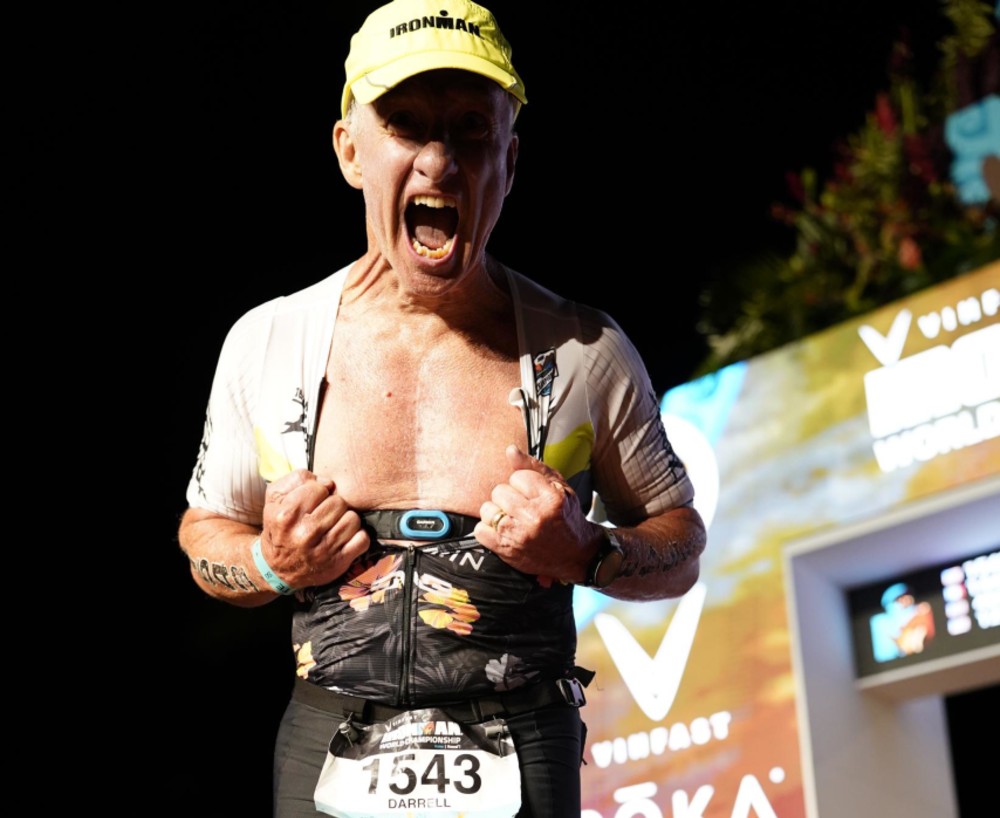
At the line, I unzipped my tri suit and revealed for the photographers the scar from my open-heart surgery — not for attention, but as a quiet acknowledgment of what the previous nine months had required.

Then I collapsed.

Friends volunteering at the finish line guided me to the medical tent. After IV fluids, monitoring, and a brief visit to a trash can to relieve my unsettled stomach, I stabilized. One doctor, smiling after hearing the story, suggested I might not have been the brightest participant that day. He may not have been entirely wrong.

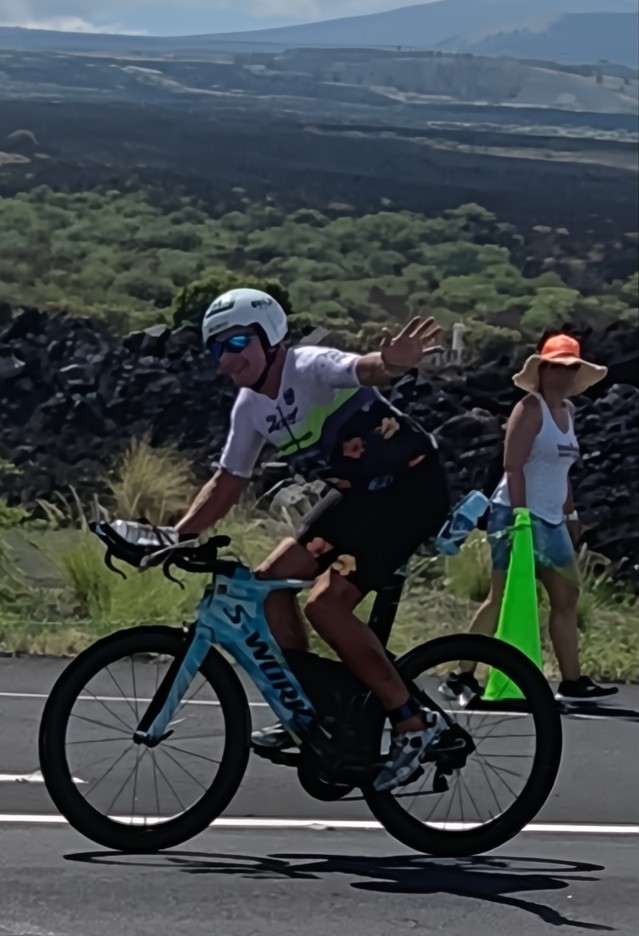
Darrell Myrick’s support team for the 2022 Ironman Championship included his wife Roxann, who captured this picture on the race course.

What the Journey Taught Me

Endurance sport often mirrors life. Both demand focus, patience, and adaptation. Neither unfolds as a steady line of personal bests.

Recovery required accepting realistic expectations rather than chasing earlier versions of myself. The challenge was not recreating the past, but discovering what remained possible.

The months between surgery and Kona were frustrating, humbling, and at times frightening. But they were also clarifying. Progress did not arrive on my preferred timeline, and success looked different than it once had.

Like life, Ironman rewards steady forward motion — however modest — especially when circumstances force you to redefine the goal.

Nine months after open-heart surgery, finishing in Kona was not about proving anything. It was about gratitude, resilience, and the quiet satisfaction of continuing when stopping would have been easier.

Have Questions or Comments for Darrell?

Join the conversation by sharing your questions and comments below.

Comments: We’d love to hear about your experience. Join the conversation below. All comments are reviewed before they appear.

Reply notifications: Click the bell icon above Post Comment to be notified when someone replies to your comment.

Follow the discussion: Click Subscribe above the comment box and enter your email address to receive notifications whenever a new comment is added—even if you don’t leave a comment. After subscribing, check your email and click Confirm to activate notifications.