When we asked SeniorTriathletes readers about their nutrition concerns, protein after 50 was one of the topics they most wanted us to explore. The questions weren’t surprising: How much do we really need? Does timing matter? And are protein powders, amino acids and other supplements worth considering?
Protein has become one of the most talked-about nutrients in healthy aging. Older adults are told to eat more of it. Athletes are told to consume it immediately after exercise. Supplements promise to overcome the body’s declining ability to use protein as we age.
There is good science behind some of this advice. But there is also more certainty in many protein recommendations than the research—especially research involving older endurance athletes—can support.
That’s an important distinction for triathletes over 50.
We aren’t sedentary older adults. We regularly ask our muscles to swim, bike, run and, ideally, perform resistance training. At the same time, we aren’t simply younger athletes with a few more birthdays behind us. Aging affects muscle mass, strength, recovery and the way muscle responds to both exercise and nutrition.
So how much protein do we really need? Does it have to be spread evenly throughout the day? Is there a post-workout “window”? What if you practice intermittent fasting? And do whey, leucine, HMB or creatine add anything?
The research provides useful answers—but not always the ones suggested by the headlines.
Start With What We Don’t Know
The Recommended Dietary Allowance (RDA) for protein for adults is 0.8 grams per kilogram of body weight per day. That number is intended to meet the basic needs of most healthy adults. It was not developed as an optimal intake for someone training for triathlon in their 60s, 70s, or beyond.
Researchers commonly recommend higher intakes for healthy older adults and for athletes. But when we ask the more specific question—How much protein does an endurance athlete after 50 actually need?—the evidence becomes surprisingly thin. It becomes thinner still when we look for research involving athletes in their late 60s, 70s and beyond.
A 2025 review found only 12 studies connecting protein intake with body composition or performance in master athletes. Seven involved endurance athletes. Even more revealing, participants classified as “master athletes” ranged from 26 to 75 years old. Protein intakes ranged from about 1.0 to 1.9 g/kg/day. The researchers concluded that the available studies were too few and too heterogeneous to establish protein recommendations specifically for aging athletes.
That doesn’t mean we know nothing. It means we should distinguish between what has been demonstrated in older endurance athletes and what has been reasonably extrapolated from research involving younger athletes or less-active older adults.
WHAT THE RESEARCH SHOWS: How Much Protein?
Modern studies of endurance athletes suggest protein needs can be considerably higher than the 0.8 g/kg adult RDA. In one metabolic study, endurance-trained men completing a 20-kilometer run had an estimated average requirement of about 1.65 g/kg/day, with an upper recommended intake of about 1.83 g/kg/day. A later study involving both male and female endurance athletes estimated approximately 1.60–1.61 g/kg/day.
The catch: These were endurance athletes, but not specifically athletes in their 60s and 70s.
What this means for you: An intake well above the RDA is reasonable for a regularly training endurance athlete, but science has not established that 1.6—or 1.8—g/kg/day is the optimal amount for a healthy 70-year-old triathlete.
A Practical Protein Target
Given the evidence we do have, approximately 1.2–1.6 g/kg/day is a reasonable working range for many older endurance athletes, with the upper end becoming more relevant during heavier training, resistance training, calorie restriction or periods when maintaining muscle is particularly important.
That is a range, not a threshold.
For a 175-pound athlete—about 79 kilograms—it translates to approximately:
- 1.2 g/kg = 95 grams/day
- 1.4 g/kg = 111 grams/day
- 1.6 g/kg = 126 grams/day
Some athletes may appropriately consume more. But the evidence does not support the idea that continually increasing protein automatically produces additional muscle, strength or performance benefits.
And protein should not displace the carbohydrate and total energy needed to support endurance training.
Does Aging Make Us “Protein Resistant”?
You’ve probably encountered some version of this claim:
After 50 or 60, your body can no longer use protein efficiently.
That greatly oversimplifies a real phenomenon called anabolic resistance.
Anabolic resistance means that older muscle can have a smaller muscle-protein-synthesis response to a given amount of dietary protein or exercise than younger muscle. It does not mean older adults cannot digest protein or build muscle.
More importantly, age isn’t the only factor.
Physical inactivity, metabolic health, body composition and training status also affect how muscle responds.
That distinction matters enormously when applying studies of sedentary older adults to master athletes.
WHAT THE RESEARCH SHOWS: Age—or Inactivity?
In one experiment, older men reduced their daily activity to fewer than 1,500 steps for two weeks. One leg performed low-load resistance training three times per week while the other did not. Lean mass declined in the inactive leg but increased in the trained leg, and the trained muscle had a substantially greater protein-synthesis response to feeding.
In another study, lifelong endurance athletes averaging about 69 years old had resting and resistance-exercise-induced muscle protein synthesis similar to healthy untrained older men. Their controlled protein intake was about 1.3 g/kg/day. Importantly, the study did not establish that 1.3 g/kg was optimal; it demonstrated that muscle at this age remained responsive to exercise.
What this means for you: Aging matters, but so does what you ask your muscles to do. Staying active—and particularly including resistance training—may be at least as important as trying to solve anabolic resistance by simply eating more protein.
This may be one of the most important lessons from the protein research:
Give aging muscle a reason to use the protein.
Swimming, cycling and running provide valuable training stimuli, but they are not substitutes for resistance training when the objective is preserving strength and muscle.
How Much Protein at a Meal?
Another commonly repeated recommendation is that older adults need approximately 0.4 g/kg of protein per meal.
This number has a reasonable scientific basis.
Research examining the acute muscle-protein-synthesis response to different protein doses estimated that younger adults reached a maximal MPS response around 0.24 g/kg per meal, while older adults required closer to 0.4 g/kg. That does not mean protein consumed beyond this amount is wasted or provides no additional whole-body benefit.
For our 175-pound athlete, 0.4 g/kg is approximately 32 grams of protein.
That makes 25–40 grams of high-quality protein at a meal a useful practical reference for many older athletes.
But “useful reference” is different from “required dose.”
Most of these studies measure the acute response of muscle protein synthesis over a few hours. They do not demonstrate that eating precisely 0.4 g/kg at every meal produces more muscle, greater strength or better triathlon performance years later.
Does Protein Need to Be Evenly Distributed?
This is where an interesting physiological idea became a fairly rigid nutrition rule.
Because muscle protein synthesis responds to protein at each meal, researchers proposed that spreading protein evenly through the day might provide repeated opportunities to stimulate muscle growth and repair.
An influential study found approximately 25% greater 24-hour muscle protein synthesis when protein was distributed relatively evenly across breakfast, lunch and dinner rather than heavily concentrated at dinner.
There was just one problem when applying this to SeniorTriathletes readers:
The participants averaged about 37 years old.
Research in older adults has been less convincing.
WHAT THE RESEARCH SHOWS: Total Protein vs. Perfect Distribution
In a randomized trial of older adults, researchers compared higher and lower total protein intakes and even versus uneven distribution across meals. Higher total protein improved whole-body protein balance and muscle protein synthesis. In that study, even distribution did not produce an additional advantage.
Another eight-week randomized trial similarly found that protein-distribution pattern did not affect anabolic response, lean body mass, strength or physical function in older adults.
A large 2025 analysis of 814 community-dwelling adults averaging 69 found that breakfast was typically the lowest-protein meal and dinner the highest. Those consuming more total protein more often reached meaningful protein amounts at individual meals, but distribution patterns themselves were similar across intake groups.
What this means for you: Avoid routinely protein-poor meals—especially breakfast if yours contains very little protein—but don’t become preoccupied with making breakfast, lunch and dinner mathematically equal.
The evidence isn’t entirely one-sided. Another study found that evenly distributing protein across meals improved whole-body protein balance, primarily by reducing protein breakdown, even though muscle protein synthesis did not increase. This is another reason to distinguish short-term physiological effects from evidence that a particular eating pattern produces more muscle or greater strength over time.
If you consume 110 grams of protein daily as 10 grams at breakfast, 25 at lunch and 75 at dinner, shifting some protein toward breakfast makes physiological sense.
If you’re already consuming 30, 35 and 45 grams, there is little evidence that changing those numbers to 37, 37 and 36 will produce a meaningful advantage.
Total daily protein appears more important than perfect distribution.
What If You Practice Intermittent Fasting?
Time-restricted eating complicates the usual advice to eat protein three or four times per day.
A common 16:8 pattern restricts food intake to an eight-hour period, sometimes with only two substantial meals.
Can an older athlete still get enough protein?
Yes—but those meals have to do more work.
If our 175-pound athlete targets 1.4 g/kg/day, that is about 111 grams of protein. Divided between two meals, that’s roughly 55 grams per meal.
Protein above the amount needed to maximally stimulate muscle protein synthesis at one moment isn’t simply “wasted.” Protein serves many functions throughout the body, and digestion and absorption continue for hours.
In a recent 24-hour study of adults averaging 61, consuming 1.5 g/kg/day across only two meals produced better whole-body protein balance than either 0.8 or 1.1 g/kg/day, even though each meal contained considerably more than the often-cited 0.4 g/kg protein target.
The larger concern may be whether restricting the eating window makes it difficult to consume enough total protein and enough total energy to support training and recovery.
There is also insufficient evidence to justify intermittent fasting for a healthy older endurance athlete primarily on claims of improved “hormone health.” Time-restricted eating may be useful for some people for controlling energy intake, body weight or metabolic health, but that is a different objective.
For an older endurance athlete whose priorities are preserving muscle, recovering from training and maintaining performance, the relevant question is simpler:
Can you consistently consume enough protein and enough total energy within your chosen eating window?
Do You Need Protein Immediately After Exercise?
For decades, athletes were warned about a narrow post-exercise “anabolic window.”
Finish your workout. Get protein into your body within 30—or perhaps 60—minutes. Miss the window and you’ve missed an opportunity.
The underlying physiology was legitimate. Exercise makes muscle responsive to amino acids, and consuming protein around exercise supports repair and remodeling.
The stopwatch was the questionable part.
A 2025 meta-analysis restricted its analysis to studies that directly compared protein consumed before versus after exercise for at least four weeks. It found no meaningful difference in lean-mass adaptation based on whether protein came before or after training.
Exercise appears to create a broad period of increased sensitivity, not a tiny window that suddenly closes.
WHAT THE RESEARCH SHOWS: More Isn’t Automatically Better
Researchers tested this question directly in eight master triathletes averaging 52 years old after a muscle-damaging downhill run. During eight hours of recovery, the athletes consumed either 0.3 or 0.6 g/kg of protein on three occasions.
Doubling the protein dose did not significantly improve overall recovery or subsequent cycling performance, although the higher dose produced some potentially meaningful improvements in perceived fatigue and loss of muscle force.
What this means for you: Protein after a demanding workout is sensible. Twice as much is not necessarily twice as useful.
There are circumstances when post-workout nutrition deserves greater urgency.
If you trained after an overnight fast, getting protein afterward makes more sense than deliberately extending the fast several more hours.
If you have another demanding workout later that day, rapid recovery becomes more important—and for an endurance athlete, carbohydrate replacement matters along with protein.
But if you ate a protein-containing meal a few hours before training and another normal meal is coming afterward, you probably don’t need to carry a protein shake to the pool deck so you can drink it before you’ve dried off.
Whole Food or Protein Powder?
A food-first approach still makes sense.
Eggs, dairy products, fish, poultry, lean meats, soy, beans, lentils and other protein-rich foods provide protein along with vitamins, minerals, fats, carbohydrates and other nutrients.
But “food first” shouldn’t become “supplements never.”
Whey protein is highly digestible, rich in essential amino acids and leucine, and convenient. If an athlete struggles to reach an appropriate protein intake through meals—or wants to increase protein without adding a large amount of food—a protein powder can solve a legitimate problem.
The important question isn’t “Is protein powder good or bad?“
It is “What problem is protein powder solving?“
If you’re already meeting your protein needs comfortably through food, adding another shake simply because whey rapidly stimulates muscle protein synthesis has not been shown to guarantee additional long-term benefit.
What About Plant Protein?
Animal proteins generally provide a high concentration of essential amino acids and are highly digestible. Some individual plant proteins contain less leucine or lower amounts of one or more essential amino acids.
That doesn’t mean an older athlete needs animal protein.
A varied plant-based diet can provide sufficient protein. Athletes relying heavily on plant sources simply have more reason to pay attention to total quantity, variety and protein quality, rather than assuming that equal gram amounts of every protein source produce identical physiological responses.
This is another place where adequate total intake can reduce the importance of micromanaging individual foods.
BCAAs, Leucine and Essential Amino Acids
You’ve probably seen supplements containing branched-chain amino acids, or BCAAs, promoted for muscle growth and recovery. The three BCAAs—leucine, isoleucine and valine—are part of a larger group of nine essential amino acids (EAAs) that our bodies cannot make and must obtain from food.
Leucine is particularly important because it helps signal muscle protein synthesis. But signaling muscle to build protein isn’t enough. The other essential amino acids are also needed to provide the building materials.
That’s why taking BCAAs alone isn’t equivalent to consuming a complete protein.
Recommendations have changed as the research has evolved. In 2007, the International Society of Sports Nutrition (ISSN) recommended BCAAs before and after exercise—and during prolonged endurance exercise—based on the evidence available at the time. By its 2017 protein position stand, the emphasis had shifted toward high-quality protein providing sufficient leucine along with all the essential amino acids. Research since then has further questioned whether supplementing with the three BCAAs alone provides meaningful benefits. A 2026 systematic review focused on endurance athletes found no consistent improvement in endurance performance, fatigue or recovery.
Recent systematic reviews suggest BCAA supplements may modestly reduce muscle soreness after exercise. But they have not consistently improved strength, endurance, body composition or recovery of muscle performance.
For an older endurance athlete already consuming enough high-quality protein, there is little evidence that adding a BCAA supplement provides an additional benefit. If protein intake is inadequate, consuming complete protein—or all the essential amino acids—makes more physiological sense than supplementing only the three BCAAs.
Leucine can help flip the switch for muscle protein synthesis, but your body still needs all the building materials.
HMB: Promising Theory, Less-Impressive Results
HMB—beta-hydroxy-beta-methylbutyrate—is a metabolite of leucine promoted for preserving muscle, particularly in older adults.
The idea is biologically plausible, and some earlier studies were promising, particularly in frail, inactive or nutritionally compromised people.
But more recent evidence makes routine supplementation difficult to justify for healthy athletes who can resistance train.
A 2026 meta-analysis included 13 randomized trials and 561 adults age 50 and older. Adding HMB to resistance training produced no significant additional improvement in muscle mass, muscle strength or fat mass. The authors concluded that HMB could not be recommended routinely for people capable of structured exercise.
That’s a useful example of science progressing from a plausible mechanism and promising early results to a more restrained conclusion as evidence accumulates.
Creatine Is Different
Creatine frequently appears in the same conversations as protein supplements, but it should be treated separately because creatine isn’t protein. It helps increase phosphocreatine availability in muscle, supporting rapid ATP regeneration during high-intensity muscular work.
More importantly, creatine has accumulated a substantial research base when combined with resistance training.
WHAT THE RESEARCH SHOWS: Creatine vs. HMB
A 2026 analysis of 11 randomized trials involving adults age 60 and older found that adding creatine to resistance training produced a small additional improvement in muscle strength. The certainty of evidence was moderate. Additional effects on muscle mass and physical function remained uncertain.
In contrast, the 2026 HMB meta-analysis found no significant additional improvement in muscle mass or strength when HMB was added to resistance training.
What this means for you: Among supplements marketed for aging muscle, creatine has a stronger case as an adjunct to resistance training. But the important word is adjunct. It does not replace resistance training or adequate protein.
Creatine can also raise blood creatinine, which is commonly used to estimate kidney function. Anyone taking creatine should tell their healthcare provider, particularly when kidney function is being evaluated. People with kidney disease or other relevant medical conditions should discuss supplementation with the clinician managing their condition.
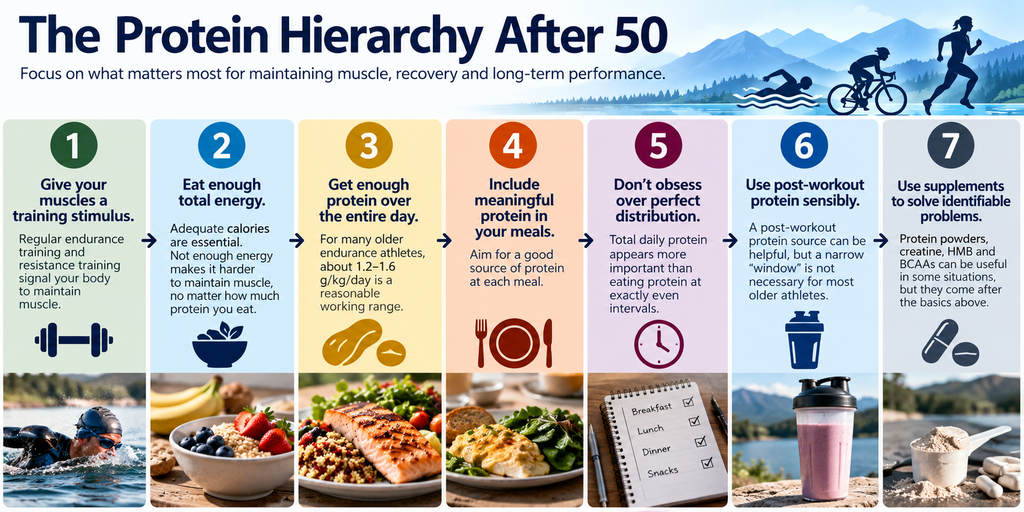
The Protein Hierarchy After 50
After reviewing the research, I think the priorities for an older endurance athlete are much clearer than the individual numbers sometimes make them appear.
1. Give your muscles a training stimulus.
Continue your endurance training, but include resistance training. Protein cannot substitute for a stimulus telling muscle to maintain strength and mass.
2. Eat enough total energy.
Chronic under-fueling makes it harder to recover, train and preserve muscle regardless of protein intake.
3. Get enough protein over the entire day.
For many regularly training older endurance athletes, approximately 1.2–1.6 g/kg/day is a reasonable working range. Treat it as a range rather than a magic threshold.
4. Include meaningful protein in your meals.
Around 0.4 g/kg at a meal is a useful reference for older adults, but don’t turn it into a requirement that must be hit exactly at every meal.
5. Don’t obsess over perfect distribution.
Fix obviously protein-poor meals before worrying about whether every meal contains precisely the same number of grams.
6. Use post-workout protein sensibly.
If you’ve eaten protein within a few hours before training, eat your next normal protein-rich meal afterward. Give recovery nutrition greater priority after fasted, long or particularly demanding workouts or when another training session is coming soon.
7. Use supplements to solve identifiable problems.
Protein powder can make an appropriate daily intake easier. Leucine or essential amino acids may help when protein intake is limited. Current evidence gives HMB a weak case for routine use by healthy exercising older adults. Creatine has better evidence as an adjunct to resistance training.
Don’t Let Precision Exceed the Evidence
Perhaps the most surprising lesson from this research is how quickly certainty decreases as protein advice becomes more precise.
We have strong evidence that resistance training matters.
There is good evidence that regularly training older adults need more protein than the adult RDA is designed to provide.
We have good physiological evidence that older muscle benefits from meaningful amounts of high-quality protein.
But ask exactly how many grams a 72-year-old triathlete should eat every day, exactly how many grams must be consumed at breakfast, precisely how evenly protein must be distributed, or how many minutes after a workout it must be consumed—and the evidence becomes much less certain.
That’s not a failure of science. It’s a reason to use the science appropriately.
The research isn’t finished. Several of the researchers whose work is discussed here specifically call for more studies involving older trained athletes—including research comparing different protein intakes and examining athletes in their 60s, 70s and 80s.
For now, the evidence gives older endurance athletes good reason to be diligent about consuming enough protein to help maintain muscle and support recovery, but not enough evidence to insist that everyone needs the same precise amount or timing strategy.
The objective isn’t to optimize every gram of protein.
It is to create an eating and training pattern you can sustain that gives your body enough energy, enough protein and—most importantly—enough reason to maintain the muscle you’ll want for the years of training, racing and living still ahead.
We will continue to follow this research and update our recommendations as better evidence involving older endurance athletes becomes available.
Coach’s Rule
Get the fundamentals right before optimizing the details: train your muscles, eat enough, meet your daily protein needs—and then decide whether timing or supplements solve a real problem.
Selected References
- Franzke B, Maierhofer R, Putz P. Protein Intake, Physical Performance and Body Composition in Master Athletes—A Short Scoping Review. Nutrients. 2025.
- Moore DR. Protein Requirements for Master Athletes: Just Older Versions of Their Younger Selves? Sports Medicine. 2021.
- Kato H, et al. Protein Requirements Are Elevated in Endurance Athletes after Exercise as Determined by the Indicator Amino Acid Oxidation Method. PLOS ONE. 2016.
- Doering TM, et al. The Effect of Higher Than Recommended Protein Feedings Post-Exercise on Recovery Following Downhill Running in Masters Triathletes. International Journal of Sport Nutrition and Exercise Metabolism.
- Casuso RA, et al. Does Protein Ingestion Timing Affect Exercise-Induced Adaptations? A Systematic Review with Meta-Analysis. Nutrients. 2025.
- Wang G, et al. Efficacy of HMB Supplementation as an Adjunct to Resistance Training in Older Adults: A Comprehensive Meta-analysis. Age and Ageing. 2026.
- Yao L, et al. Effects of Resistance Training Combined with Creatine Supplementation on Muscle Strength, Physical Function, and Muscle Mass in Older Adults: A Systematic Review and Three-Level Meta-analysis. 2026.
Have a Protein Question for Our Coaches?
Still have a question about protein, recovery, meal timing, or supplements as an older triathlete? Send it to Ask Our Coaches using the button below. Your question may become the basis for a future SeniorTriathletes article.
Submit Your Question
What Has Worked for You?
How do you approach protein as an older endurance athlete? Have you changed how much you eat, when you eat it, or whether you use protein powders or other supplements? What seems to have helped with maintaining muscle, training, or recovery? Share your experience in the comments below.
Medical Disclaimer
Protein needs can differ with kidney disease, other medical conditions, medications, energy restriction, and other factors. Discuss significant dietary or supplement changes with an appropriate healthcare professional.
The content on SeniorTriathletes.com is for informational and educational purposes only and is not intended as medical advice, diagnosis, or treatment. Always consult with your physician or a qualified healthcare provider before beginning or modifying any exercise, training, nutrition, or recovery program—especially if you have existing health conditions or concerns.
Participation in triathlon training and related activities involves inherent risks. By using this information, you acknowledge and accept full responsibility for your health and well-being. The author and contributors are not liable for any injuries or health issues that may result from the use of this content.









Comments: We’d love to hear about your experience. Join the conversation below. All comments are reviewed before they appear.
Reply notifications: Click the bell icon above Post Comment to be notified when someone replies to your comment.
Follow the discussion: Click Subscribe above the comment box and enter your email address to receive notifications whenever a new comment is added—even if you don’t leave a comment. After subscribing, check your email and click Confirm to activate notifications.