How Seniors Can Prepare for their First Triathlon
By Laurie Larson, Contributor

Triathletes of any age who are motivated and self-disciplined can safely and effectively train for a triathlon. Remember that a triathlon is not so much a sport for only the elite, but really it is a hobby that people work into their everyday lives, much like work, family, and routine duties.

According to the New York Times, there is a growing number of seniors involved with triathlons, and the Center for Disease and Control encourages older athletes to join in competitive sports. In fact, membership of USA Triathlon by older athletes has gone up by 230 percent since 2005!

Getting Started

So what age defines an “older” athlete? By most accounts, athletes over 50 are considered older, but that in no way means fitness and performance decrease as you age. To the contrary, you can perform well and continue to improve as an athlete every increasing year and decade of your life. If you are new to all three components of a triathlon, preliminary starter tips regardless of decade include:

  • If you are new to swimming, biking, and running, choose just one to work on at a time and utilize beginner training plans, building up slowly over time.
  • Look for local races and consider volunteering, where you can chat with people for knowledge and details about triathlons, as well as gain insider tips.
  • Join a triathlete training program where you can make some friends and be encouraged to be persistent with accomplishing small, manageable goals.

According to Ironman Coach Sally Drake, the limits you may experience with age include muscle loss, slower metabolism, loss in bone density, weaker immune system, and loss of joint range of motion. In order to account for such limitations, Drake says you must recognize the signs that you need to slow down or take more rest, especially if you feel pain.

See testimonials of triathletes over 50 and see Ironman training plans for triathletes who are 55+.

In terms of your 50s and then 60s and beyond, remembering specific guidelines and training recommendations per your decade will help you perform well and reduce the chance of injury. No matter how old you are, people are prone to injury and it can become more serious as people age. That’s why it’s so important to recover properly after any sporting event. We always see professionals getting sports recovery, but it’s also important for normal athletes to recover also. After running a triathlon, seniors need to make sure they receive some sort of athletic recovery treatment to keep themselves in good shape for their next sporting event. Seniors could always try and follow these tips to reduce their chance of injury too:

Training in Your 50s

According to 220 Triathlon, your joints begin to stiffen as your cartilage thins and the amount of lubricant surrounding your joints decreases. To combat this factor, choose to run on alternate days with interval sessions just once a week, in order to go easy on your joints and maximize performance. 220 Triathlon recommends a 2:1 training approach where you work hard for two weeks and rest for one week, and during that week of rest and recovery, engage in stretching, yoga, and massage. You want to reduce risks involved with overtraining and burning yourself out.

Training in Your 60s and Beyond

As you age, your muscle mass decreases. Remember that as you age, strength training is more and more critical, as by the time you turn 70, 24 percent of muscle mass is lost, where strength training increases these muscle building hormones. Restoration through sleep becomes more and more important, and napping can be very effective as well.

According to 220 Triathlon, better sleep and napping improve alertness, enhance performance, and reduce mistakes. On top of this, you can get extra alertness by consuming caffeine powder before a triathlon. If you’re well rested and have that extra boost, you’ll be able to perform to the best of your ability. Napping over 40 minutes increases release of the testosterone and growth hormone that helps repair and build muscle. It’s critical that your time of sleep is conducive of restoration, so be sure you can stay comfortable and avoid exacerbating your pain through sleeping on an improper sleeping structure. While your sleep is an important part of your rest and recovery, taking breaks is as well. Make sure you’re properly scheduling workouts and take two days of rest between your trainings.

If you don’t want to go out to do such exercises, you can hire an in-home care professional. The caretaker may assist you with the stretches, as well as your medication and other basic chores. Depending on your circumstances, there are several key types of aged care services to consider. These services include in-home care, respite or short-term care, and residential care (such as nursing homes or retirement villages). So, look for elderly care services that are appropriate for your needs and circumstances. You can learn more about such aged care services by visiting websites like careforfamily.com.au.

Consulting with Your Doctor

As with any matter concerning your health, it’s important that you consult with your doctor when making any major lifestyle changes. Once you decide to start training for a triathlon, it’s wise to visit with your doctor before, during, and after to be sure you are staying safe and healthy. Your doctor may be able to advise you on specific stretches, limits, and medications that could help you along the way. It’s always better to be safe than sorry, so keeping your doctor involved in the process is the best way to train. If you need any training tips, you can visit KCSS Online and sites alike, for workout advice as well as healthy lifestyle changes.

It turns out that age truly is just a number, provided that you account for changes in your body over time. Whether you are an aspiring athlete or someone who has been at this for a lifetime, with a proper training plan, diet, and persistence, the sky’s the limit!

Laurie Larson is a freelance writer based out of NC. She enjoys writing on health and lifestyle topics to help others live their best, healthiest, and happiest life!
You may also be interested in these posts

Making Fitness a Lifestyle – Jeanne Minder’s Story

From her earliest memories of growing up in South St. Paul, Minnesota, Jeanne Minder has been active. Her love for moving, whether through biking, running, swimming, walking, skiing, or you-name-it, has led to impressive accomplishments in triathlon.

Following is Jeanne’s triathlon story and information about triathlon training for seniors that she shared with Joy and me over coffee.


Accomplishments On and Off the Course

I was first introduced to Jeanne through an article in an online newspaper covering the northern suburbs of St. Paul, Minnesota. However, when Joy and I met with Jeanne over coffee and tea at the Caribou Coffee in Arden Hills, Minnesota, we learned a whole lot more about her.

A sampling of her accomplishments tells part of the story:

  • Over 400 triathlons including three at the Ironman World Championship in Kailua-Kona, Hawaii
  • Minnesota Senior Sports Hall of Fame inductee
  • Gold medalist in triathlon at the 2015 National Senior Games
  • Mother of an active son and daughter
  • Leader of the County Cycles Triathlon Club for 24 years
  • Personal trainer for 28 years, including 23 years with the New Brighton Community Center
  • University of Minnesota graduate
  • High school track & field and cross country skiing coach
  • And, an on-going participant in endurance events involving running, skiing, and biking.

But that’s not all. In talking with Jeanne, we were able to see her personal side – her passion for endurance sports and her love for helping people, especially seniors, “make fitness a lifestyle”.

“Anybody who does triathlon or any sport is doing good. As a personal trainer, I try to get people to work out three times per week and make it a lifestyle.” Jeanne Minder


Getting Started in Triathlon

Jeanne did her first triathlon, the Turtleman Triathlon in Shoreview, Minnesota, in 1982.

“I had been training with local athletes Mary Lou Schmidt and Roy Carlsted and they encouraged me to do a triathlon.”

Like so many of us, she caught the ‘triathlon bug’ after completing her first. There was no turning back.


A Mother’s Example

But the seed for her triathlon excursion started years earlier. Jeanne credits much of her love for being active to her mother. Growing up in South St. Paul, Minnesota, Jeanne’s mother taught her and her three sisters how to manage without a second car.

“We walked or biked everywhere that we needed to go.”

During the summer, they made the daily bike ride to the pool where they spent their afternoons. Swimming, biking, and running were a natural part of her lifestyle as a child.

“When we were at home, my mom would tell us to ‘Go outside and play’. So we would go outside, ride bike, swim or play kick the can in the summer, and go tobogganing in the winter. We were literally outside whenever possible.”

Even though she did not participate in organized sports in high school, the foundation for future activities had been built.


Triathlon and More

Since 1982, Jeanne has done over 400 triathlons. These have included six Ironman distance races of which three have been at the Ironman World Championship in Kailua-Kona, Hawaii. Qualifying for Ironman Championships in Hawaii meant that she won her age group at qualifying Ironman triathlons in Lake Placid, New York; Cape Cod, Massachusetts; and Hilton Head, South Carolina.

Along the way, she has amassed a large number of interesting stories. The first one which she shared during our conversation was from the Ironman Cape Cod.

“Cape Cod was tough with 40 miles per hour winds in every direction. Oh, yes, and they forgot to tell us until the next day during the awards ceremony about the sharks that had been around the swim course.”

She has also completed 26 marathons. These have included the iconic Boston Marathon, the Twin Cities Marathon in Minneapolis-St. Paul, and Grandma’s Marathon in Duluth, Minnesota.

On top of this, she has finished countless long distance bike rides across her home state of Minnesota (TRAM, Bike Across Minnesota, MS150), the Birkebeiner cross-country ski race, and bike rides across long stretches of the USA and Canada.

And then, there was her 2015 first-place finish in women’s triathlon at the National Senior Games.

Jeanne-Minder-awards

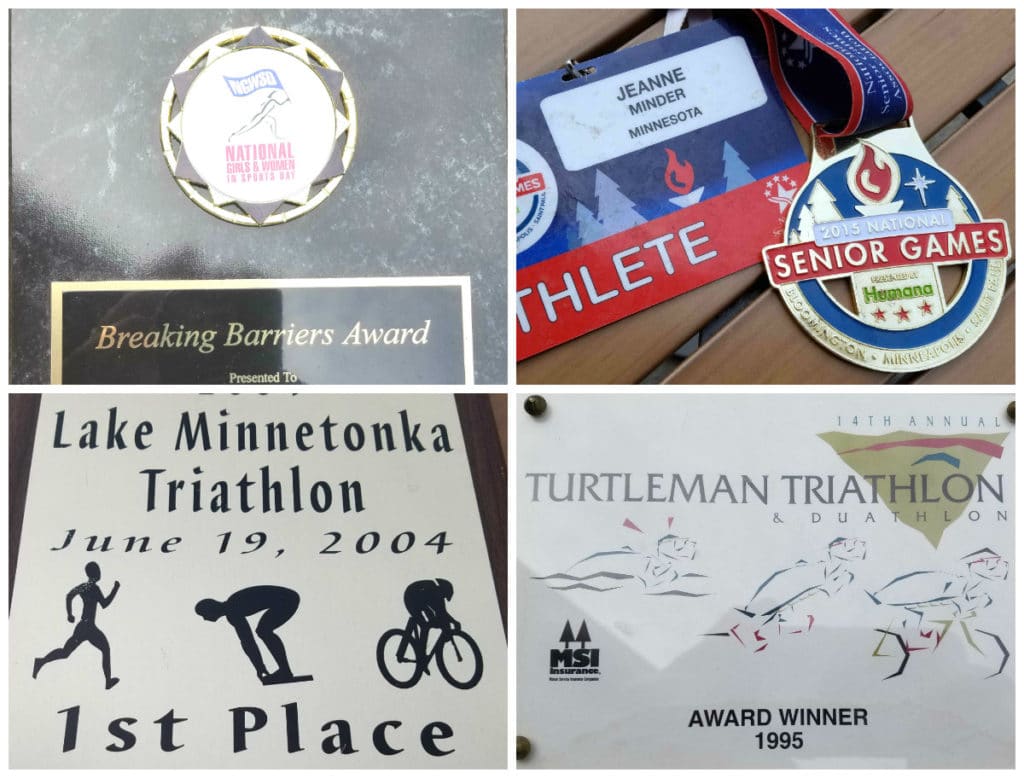
A sampling of Jeanne Minder’s awards and recognition. Clockwise from the upper left: 2018 ‘Breaking Barriers Award’ (upper left), finisher medal from the 2015 National Senior Games (upper right), the award from the 1995 Turtleman Triathlon (lower right), and the award from the 2004 Lake Minnetonka Triathlon.


Minnesota Senior Sports Hall of Fame

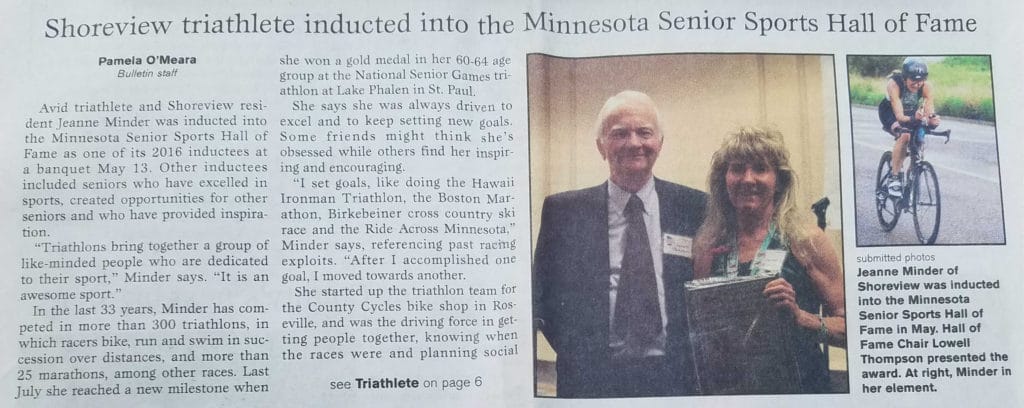
Despite this fantastic list of accomplishments, Jeanne told us that she was surprised to receive a call from a representative of the Minnesota Senior Sports Hall of Fame one day in early 2016. The caller informed Jeanne that her accomplishments had been noticed and that she had been nominated to the Hall of Fame.

“When the caller told me that I had been nominated for the Senior Sports Hall of Fame, I asked ‘For what?’. ‘For triathlon’ was his answer.”

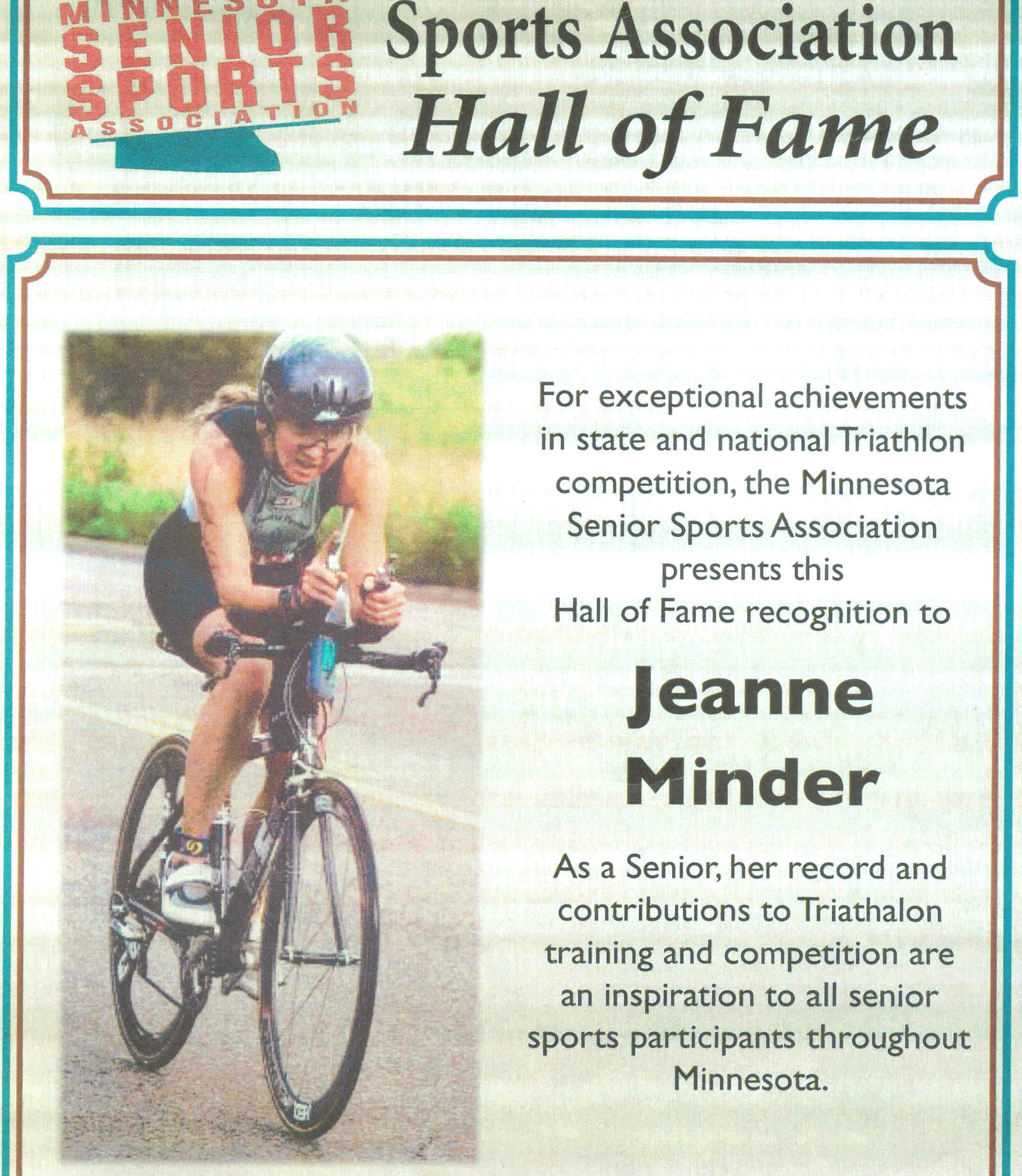
On May 13, 2016, Jeanne received the award recognizing her accomplishments in a ceremony at Jimmy’s Food & Drink in Vadnais Heights, Minnesota.

Jeanne-Minder-Hall-of-Fame-article

Jeanne Minder was inducted to the Minnesota Senior Sports Hall of Fame on May 13, 2016.


The Minnesota Senior Sports Hall of Fame is sponsored by the Minnesota Senior Sports Association. According to their website, the Association is “dedicated to encouraging and supporting men and women from Minnesota in their pursuit of competitive athletics.”


Triathlon Training for Seniors

There are several approaches to training for a triathlon. These include self-training (developing a training plan on your own), training as part of a triathlon club, and training under either a virtual or live coach.

While I have used self-training based on research and reading from a select group of books and websites, I have never been sure that this is the best approach or that it has helped me to be the most competitive.

28 years ago, Jeanne decided to become a personal trainer. She had to compare ACE and NASM certifications and train rigorously to get her qualification, but she says she wouldn’t change it for the world. Because of that 28 year experience, and the fact she is an accomplished triathlete, I decided to get her thoughts.

Frankly, I expected that she would recommend hiring a trainer or triathlon coach. However, this has not been her approach nor one she recommended. In fact, I left feeling hopeful since she has followed a self-training approach with 2-3 group workouts per week.


Group Training Options

“There are plenty of options for group training. Most running stores offer group runs. Masters swimming clubs (such as U.S. Master Swimming) provide group swim training. And many bike shops put together group rides.”

“Or, you can do what I did this morning. When I got to the community center pool at 6 o’clock, there were already eight people in the pool. I asked them if they wanted to do a workout, which they did. So we ended up swimming 3,000 meters using a workout that I quickly put together.”

“As you get to know people in each of these, you will inevitably find those interested in triathlon. You can put together triathlon specific sessions such as brick (e.g. bike followed by a run) workouts with these new found friends.”

“For example, we would bring our bikes to White Bear Beach (in White Bear Lake, Minnesota). After a swim (in White Bear Lake), we would bike from the beach to Somerset, Wisconsin; eat lunch; and return home, having biked roughly 70 miles round trip.”

While triathlon is an individual sport, triathlon training provides plenty of opportunity for being social.

There can be no question that one factor in Jeanne’s success is her love for being with people. She told us repeatedly of the thrills that have come from meeting and spending time with people, whether training together or camping at a multi-day biking event.

“Triathlon has allowed me to meet some really neat people.” Jeanne Minder


It’s Not About the Competition

If we are truthful, we all want to be competitive and even win some races, or at least finish in first place in our age group once in a while.

However, most seniors who do triathlon or are active with other sports – Jeanne Minder included – mostly want to see others share in the benefits of being active. Not just as validation for their sports activities but because they (we) have seen the benefits of it.

“Anybody who does a triathlon or any sport is doing good. As a personal trainer, I try to get people to work out three times per week and make it a lifestyle.


Let’s Not Forget the Volunteers and Race Directors

On several occasions, Jeanne stopped to point out the importance of volunteers and race directors to triathlon.

“Triathlons wouldn’t even be around were it not for the volunteers. And, as for the race directors, most people do not realize the amount of work that goes into a triathlon. There is not only the race but the work to organize the volunteers and all of the pre-race and post-race activities.”

Jeanne singled out Randy Fulton for his support of triathlon:

“For a while, Randy was running every triathlon around here (Minneapolis-St. Paul area). He was really great for promoting the sport and giving us great races to do. He was a great person.”

By the way, next time you are at a triathlon, thank the volunteers.


What’ Next?

Jeanne loves being with people. She has high energy and loves to be active.

She also loves her dogs.

“Today, my inspiration for running comes from my three Golden Retrievers. Goldens are runners. They love to run.”

“After coming home from a hard day, these guys give me a look that tells me ‘You need to take me for a run’. How can I say ‘No’?”


Questions?

Please send any questions or comments through the comment box below or by emailing seniortriathletes@gmail.com.


You may also be interested in these posts

Product Review: Nose Clip for Triathlon Swim Training

Does water in your nose during swimming lead to sneezing or a running nose after your swim? How about congestion?  If you share any of these symptoms, you will also find my experience with a nose clip useful for your triathlon swim training.


I Love Swimming Except For Water In My Nose

I am comfortable when swimming, whether in a pool or the open water.

My breathing during both pool and open water swimming is comfortable and relaxed.  I exhale through my mouth and nose while my face is in the water.  This keeps me from taking in much water during the swim.  But, there is always some water that gets into my mouth and nose.

The pool water that gets into my nose will invariably result in a runny nose and sometimes sneezing over the next few hours.

When I swim in lake water, even the slightest amount of water in my nose will leave me with a plugged nose, making sleeping the next night difficult.  I blame it on an allergy to the algae in the lake water.

While a nasal decongestant will help reduce the congestion, I avoid using one until it is necessary.

In the past, I had tried a nose clip that I dug out of my wife’s gym bag.  However, it was more hassle than help since it slipped off my nose after a short time in the water.


Rethinking the Nose Clip for Triathlon Swim Training

Recently, I came across an article about Olympic swimmer and gold medalist Missy Franklin.  The article showed her wearing a nose clip.

This got me thinking.

Since I live near a lake, open water swim training is very accessible.  I decided that I wanted to solve the problem.

I took to the internet to review various nose clips.  For every positive review, there was an equally negative one.  In most cases, the reviewers with negative comments wrote of the clip falling off their nose.  Several even lost their clip during its first use.  No brand seemed to be immune from this.

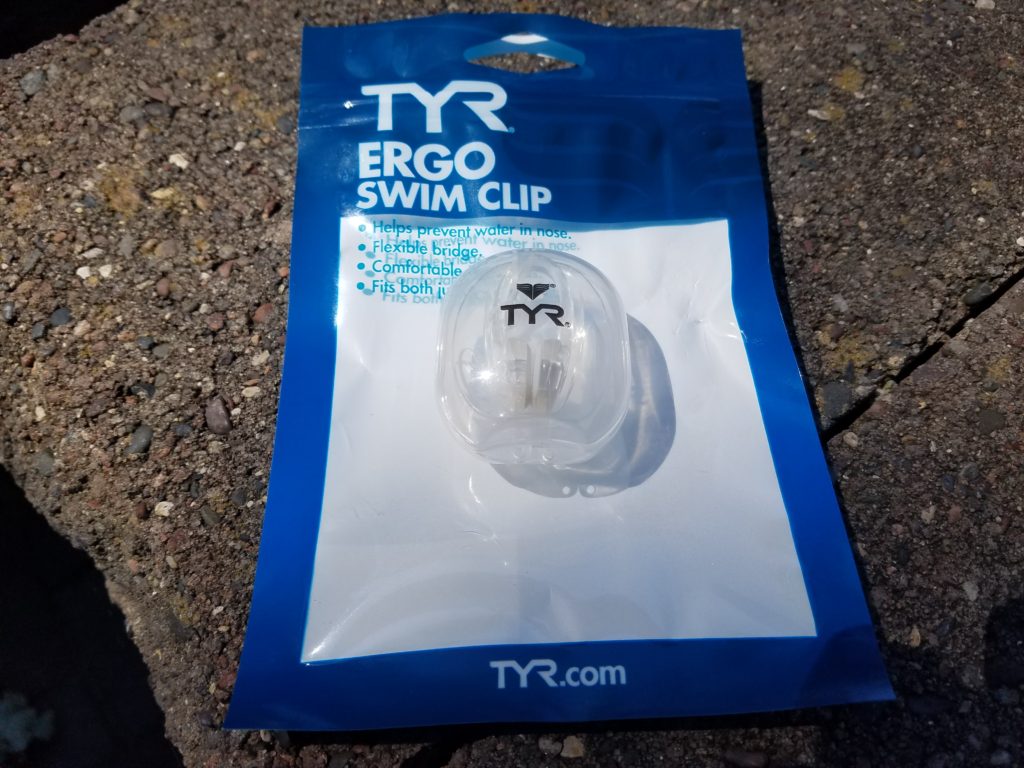
In the end, I went to local sporting goods stores, finally finding a clip at a local REI.  I purchased the last unit of the only model they had in stock, the TYR Ergo Swim Clip.

You can also purchase the TYR Ergo Nose Clip at SwimOutlet.com.

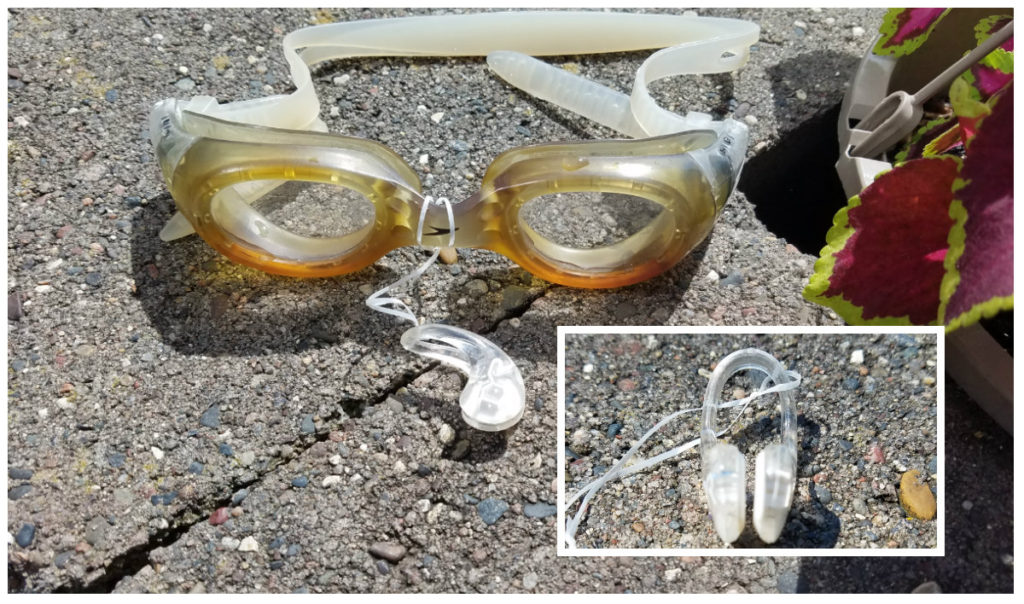
Tyr Ergo nose clip for triathlon swim training

My experience with the TYR Ergo Swim Clip has been positive, especially with the clip attached to my swim goggles.


Protecting My Investment

The nose clip is inexpensive (around $5) so it would not be terrible if I lost it in the lake.

However, losing it would mean that I would be back to square one, getting water in my nose.  Also, I preferred to not be running around shopping for another if I were to lose this one.  Remember, my experience with nose clips was that they fell off.

I decided to find a way to keep from losing the clip in the lake.  The first attempt was to use some good quality dental floss to secure the clip around my neck (like a necklace).  This was similar to the design of the clip that I had borrowed from my wife, except that hers used a rubber strap.

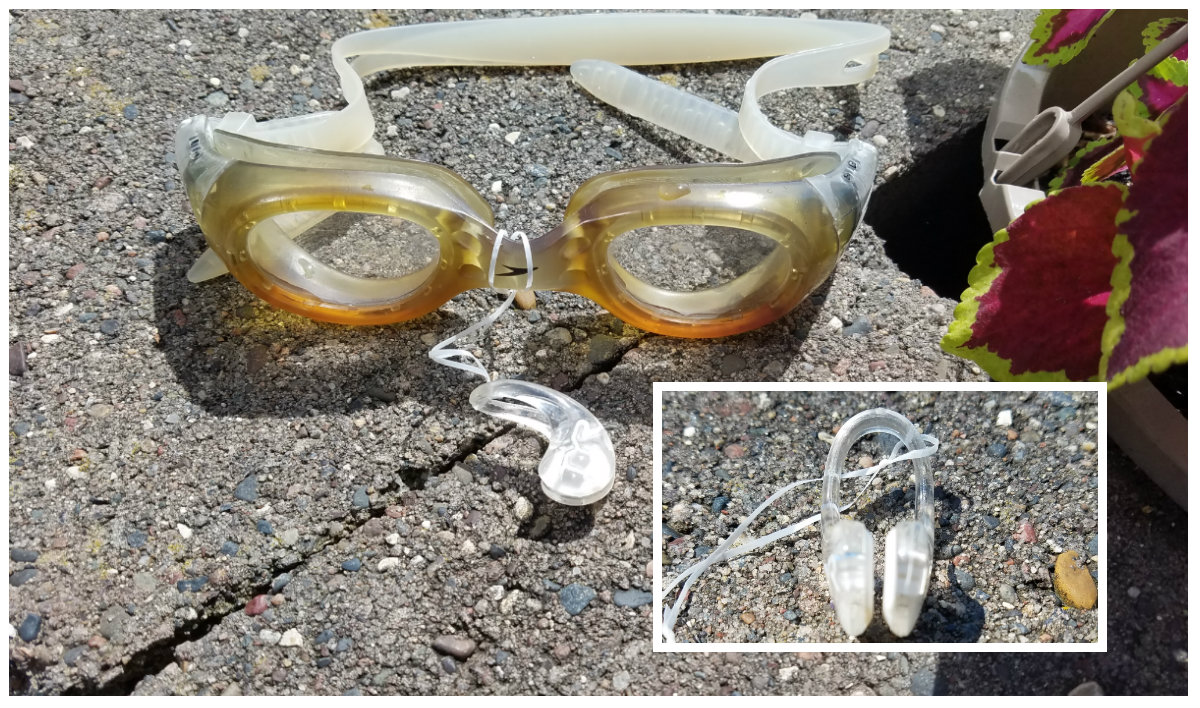
I secured the floss to the clip using a loose knot around the bridge of the clip.  The knot was smaller than the ends of the clip so that it would not come off.  For reference, see the inset in the picture in this article for which the caption begins with “Here is what worked for me“.


First Open Water Swim

In my first open water swim of one mile, the clip came loose two times, the first time after swimming more than a half mile.  Since the process of coming off my nose was relatively slow, I could stop and reattach the clip before it came completely off.


Pool Swim

The second time, I used the clip in the LA Fitness swimming pool.  Again, I found that the floss holding the clip around my neck would catch on my face, occasionally tugging on the clip.  I was certain that this is the reason the clip started to come off my nose.

While in the pool, I also found that the nose clip did not sink to the bottom of the pool when dropped in the water.  Instead, it floated somewhat below the surface of the water.  Still, I was not giving up on securing it.


Second Open Water Swim

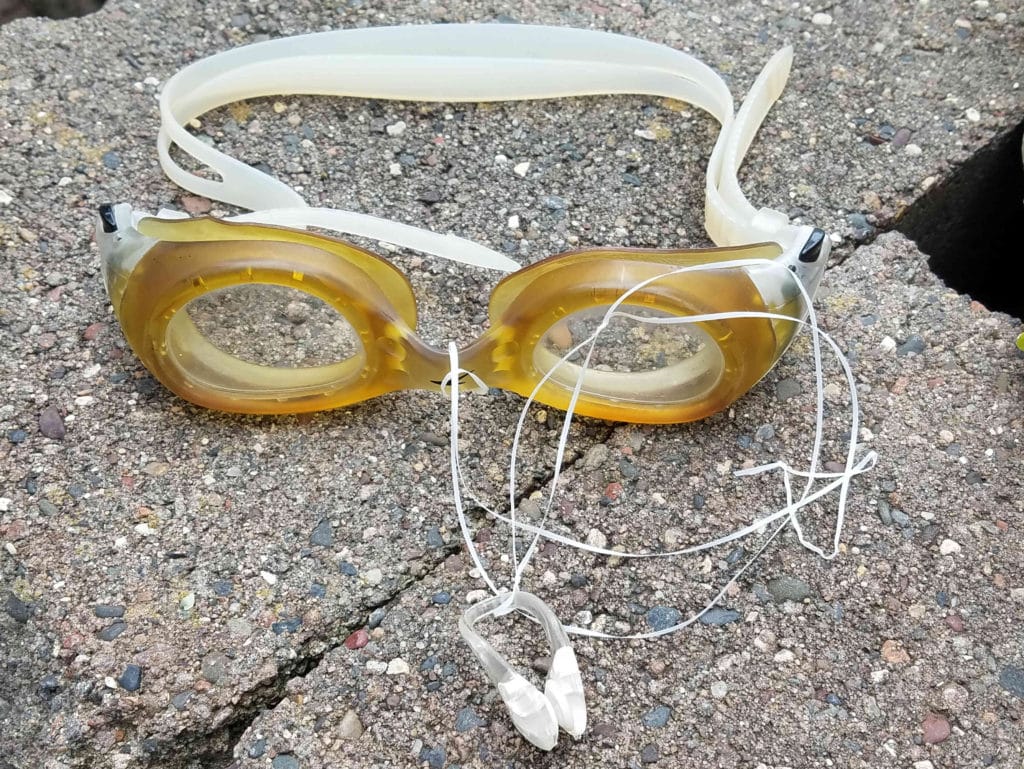
The next time, during an open water swim in a nearby lake, I attached the floss holding the clip to my goggles (see picture below).  The floss was still the original length; throughout the swim, I could feel the floss dancing around my face, occasionally catching momentarily on my skin and tugging on the clip.

Tyr-Ergo-nose-clip-attached-to-goggles-with-long-connection

Swim goggles with TYR Ergo Nose Clip connected by dental floss. In this case, the floss is longer than needed which caused it to catch on my face during the swim.

However, over the course of a mile, the nose plug came loose, but not completely off, only once.  Progress!


Third Time’s a Charm

Before the next lake swim, I reduced the length of the floss holding the clip to the bridge of my goggles so it was not brushing against or catching on my face.

Tyr Ergo nose clip for triathlon swim training

Here is what has worked for me for triathlon swim training. Swim goggles with Tyr Ergo Nose Clip connected by floss. The floss is secured to the nose clip by a knot that prevents the floss from passing over either of the two larger ends of the clip.


The result was exactly as I hoped.  The clip stayed on my nose throughout a one mile lake swim.  And, more importantly, there was no runny nose or congestion.

Not Used in Racing—Yet

I have not worn the nose clip in a triathlon.   However, I know I would have benefited from it in races involving open water swims, especially those in which the algae-filled water led to post-race nasal congestion.

An Inexpensive Aid for Triathlon Swim Training

If you have problems with water getting in your nose during swimming, the swim clip may be the solution.  You can avoid losing it—or worrying about losing it—in the pool, lake, river, or ocean by clipping it to your goggles using a short piece of floss or string.


You May Also Be Interested in These Posts

5 Common Mistakes in the Pool Swim of a Triathlon

Want to prevent fellow triathletes from becoming annoyed with you during a race? Avoid these mistakes commonly made during a pool swim.

From my experience with sprint triathlon, here are the top five mistakes, in no particular order, that occur doing a pool swim:

  • Reporting too aggressive or conservative pace/time

This mistake most often occurs during registration when you are asked to provide an estimate of the time that it will take to complete the swim.   You definitely do not want to be swimming with triathletes who are significantly faster or slower than you.

If you are worried about the registration filling before you can time your swim, give your best estimate.  Then, after later measuring the time, contact the race organizer to make any correction.

In many cases, you will also have opportunity on race day to make any correction.  You will likely be asked to line up with those of similar pace (if the start is one at a time) or to join a group with those of similar speed (if swimmers start in a group, typically of five or six) .

Just don’t make the mistake on race day.


  • Starting too fast

With adrenaline rushing and the crowd roaring (even a small crowd can be deafening in an indoor pool), it is tempting to start swimming too fast too soon causing your heart rate to spike or breathing to become difficult.  The next thing you know, you are swimming much slower than planned or even stopping to catch your breath.  Better to start out at what you consider to be a bit slower that you think you should until you are in a rhythm.  Once your breathing is at a normal race pace and you are ‘warmed up, give it your all.


  • Not drafting, if it is possible

Drafting is considered by many to be one of the keys to conserving energy during the swim while at the same time turning in a respectable (for you) time.  The problem with drafting is that it can be difficult to practice unless you swim with a group.

To take advantage of drafting, swim with your hands just behind the feet of the person in front of you.  (Avoid touching their feet which sends the message that you want to pass them.)


  • Not staying in your space

This is especially important when swimming in the same lane as one or more athletes and remaining in the same lane during the entire swim.  Stay on your side (usually the right side) of the lane.  You do not want to be the cause of a head-on crash.

Even if the swim involves a single length of each of several lanes in a Z-pattern, stay to the right as a matter of courtesy to faster swimmers.  You will appreciate this if you are the faster swimmer.

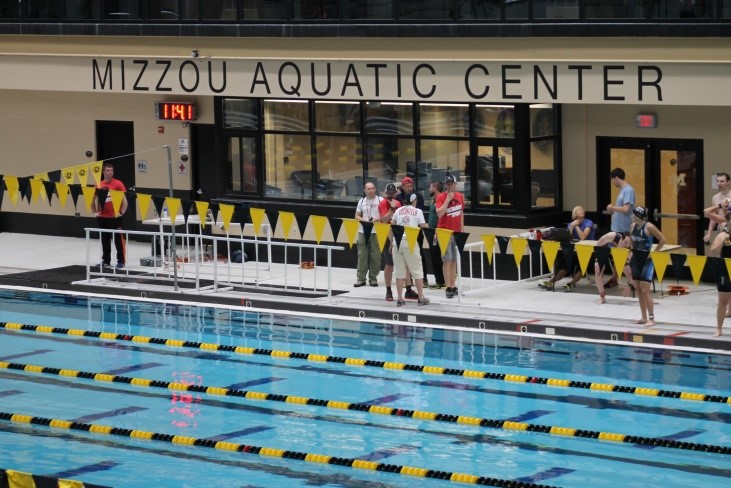
pool swim

Staying within your space during a pool swim will allow faster racers to pass.

  • Not allowing faster swimmers to pass when they let you know that they want to

Another courtesy to fellow racers is to allow faster swimmers to pass.  Let them pass as soon as possible once they have signaled that they want to do so.  Typically, faster swimmers will tap one of the feet of the swimmer that they wish to pass.  If you can, move to the right side of the lane to allow them to pass.  In races in which the entire length of swim involves multiple laps within a given lane, it is typical for the racer who is being passed to pause at the end of a length.  Allow the faster swimmer or swimmers to pass you, and then resume your swim.


What is your experience?

Have you identified other mistakes or have experience with those I have listed? Leave your comments below.


You may also be interested in these posts

error

Enjoy this post? Please spread the word :)